

In the high-stakes arena of Software as a Service (SaaS), standing still is the equivalent of moving backward. For a mid-sized firm like PulseByte, which specializes in AI-driven dashboards for the retail sector, strategic clarity is not just a luxury—it is a survival requirement. Navigating the treacherous waters of market competition requires more than a simple list of attributes; it demands a sophisticated professional AI-powered SWOT and TOWS analysis tool that can bridge the gap between abstract observation and concrete action. Visual Paradigm has answered this call with an application that is as intellectually rigorous as it is aesthetically pleasing.
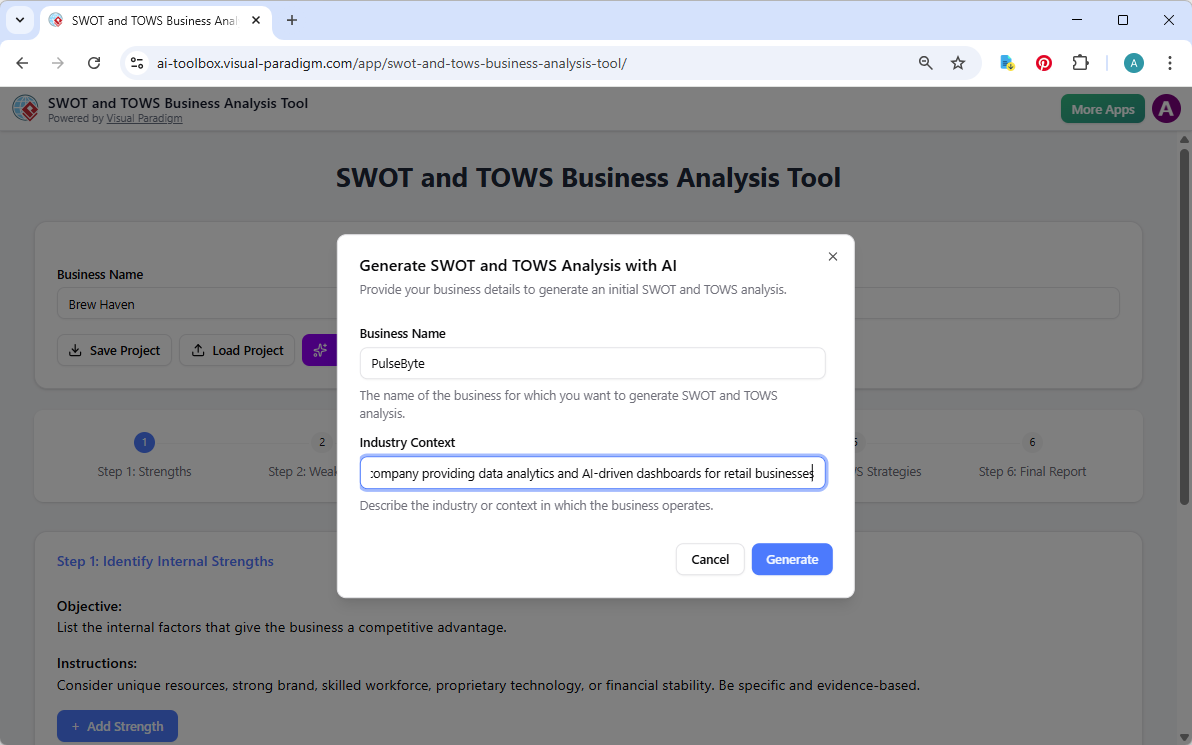
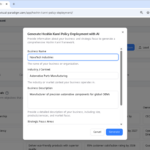
The journey begins with a deceptively simple interface that masks a powerful generative engine. Upon launching the tool, the user is greeted with a sleek modal requesting the fundamental essence of their enterprise. In our deep dive, we observe the user defining PulseByte’s identity: a “Small-to-medium SaaS company providing data analytics and AI-driven dashboards for retail businesses.” This initial contextualization is the spark that ignites the AI’s analytical furnace, allowing it to move beyond generic business platitudes and into the nuanced reality of the retail tech sector.
Strategic Foundations: Identifying the Internal Pulse
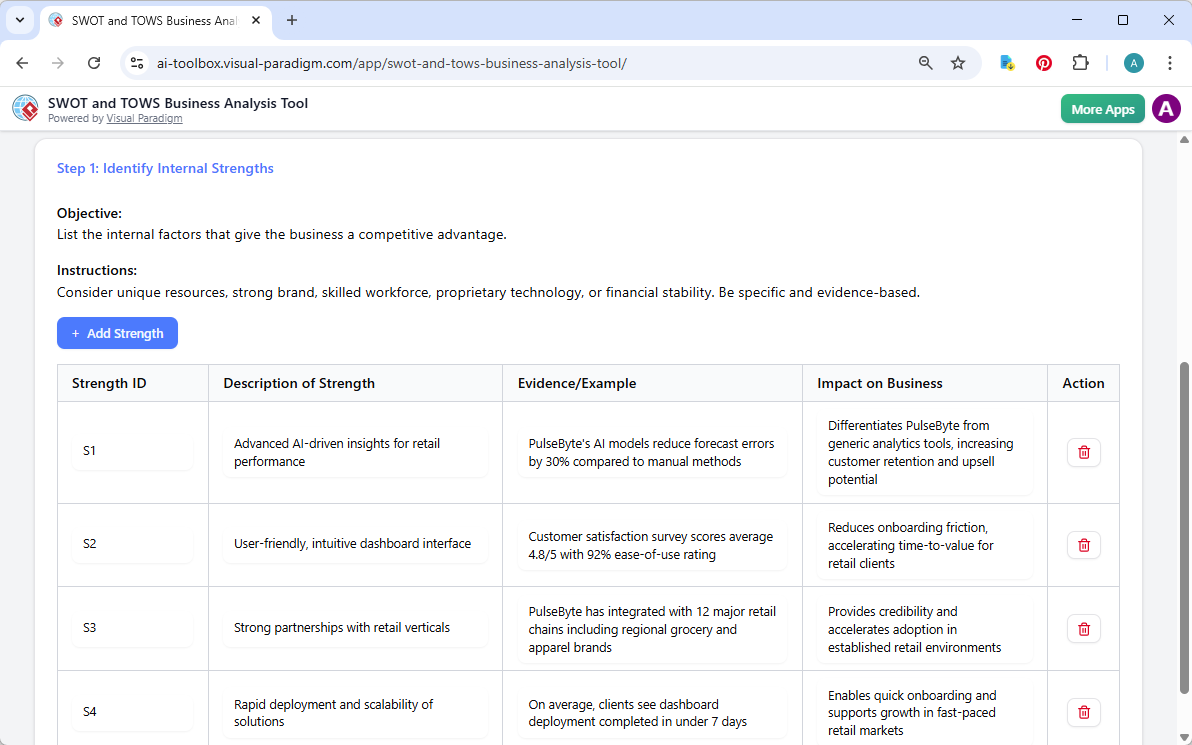
A robust strategy is built from the inside out. The first critical phase of the 6-step workflow involves a meticulous inventory of internal attributes. For PulseByte, the easy-to-use SWOT maker identifies key strengths such as “Advanced AI-driven insights” and a “User-friendly, intuitive dashboard interface.” What elevates this tool above a mere digital notepad is the requirement for evidence. It is one thing to claim strength; it is quite another to document that “AI models reduce forecast errors by 30%,” providing the empirical weight necessary for serious executive review.
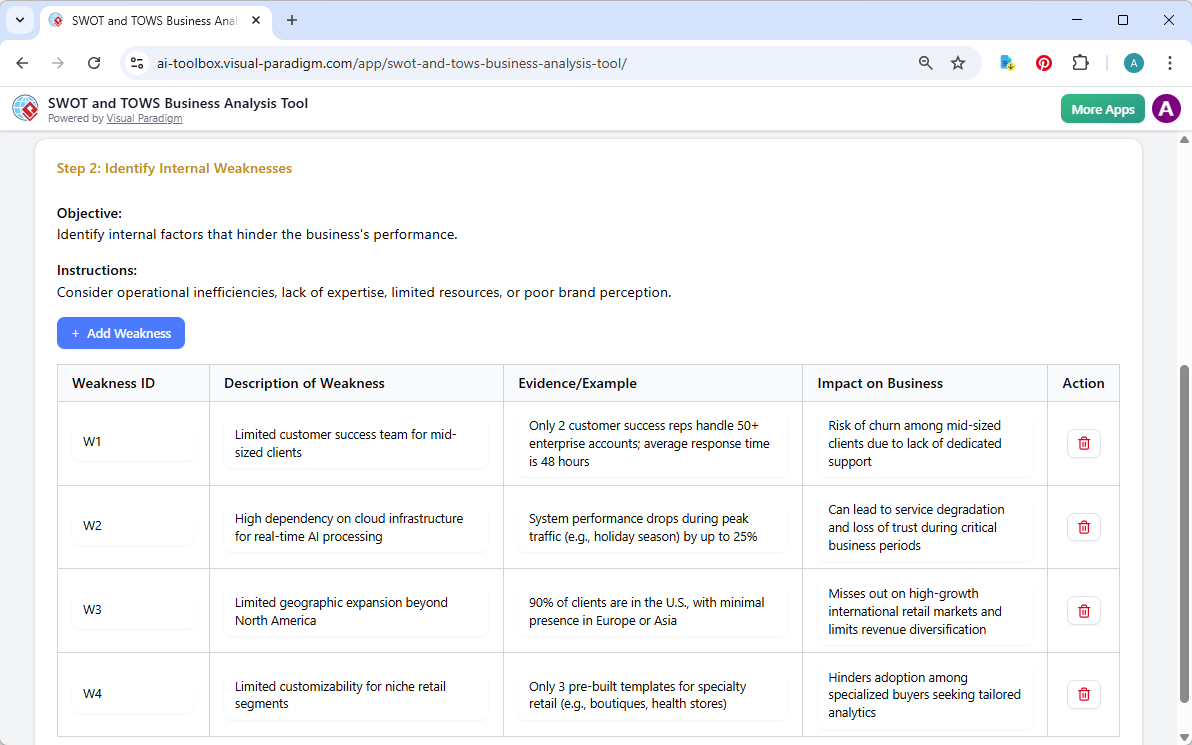
However, true professional maturity involves an unblinking look into the mirror of organizational limitations. The transition to Step 2—Identifying Internal Weaknesses—is handled with a refined, structured elegance. The AI perceptively suggests that PulseByte may suffer from a “Limited customer success team” or a “High dependency on cloud infrastructure.” These are not merely critiques; they are data points with defined impacts, such as the risk of churn among mid-sized clients. The tool’s interactive dynamic tables allow managers to edit these suggestions in real-time, ensuring the final analysis is perfectly aligned with the ground truth of the company’s operations.
Quick Summary: Why Professionals Prefer This Tool
-
Intelligent Generation: AI provides a comprehensive first draft of SWOT factors tailored to specific industry contexts.
-
Actionable Methodology: Seamlessly transitions from SWOT identification to TOWS strategy formulation.
-
Data Sovereignty: Saves all strategic insights locally as .json files, ensuring business secrets stay off the public cloud.
-
Structured Workflow: A guided 6-step process that eliminates “blank page syndrome” for busy managers.
-
Presentation Ready: Generates polished, consolidated reports suitable for immediate stakeholder distribution.
The External Horizon: Opportunities and Threats
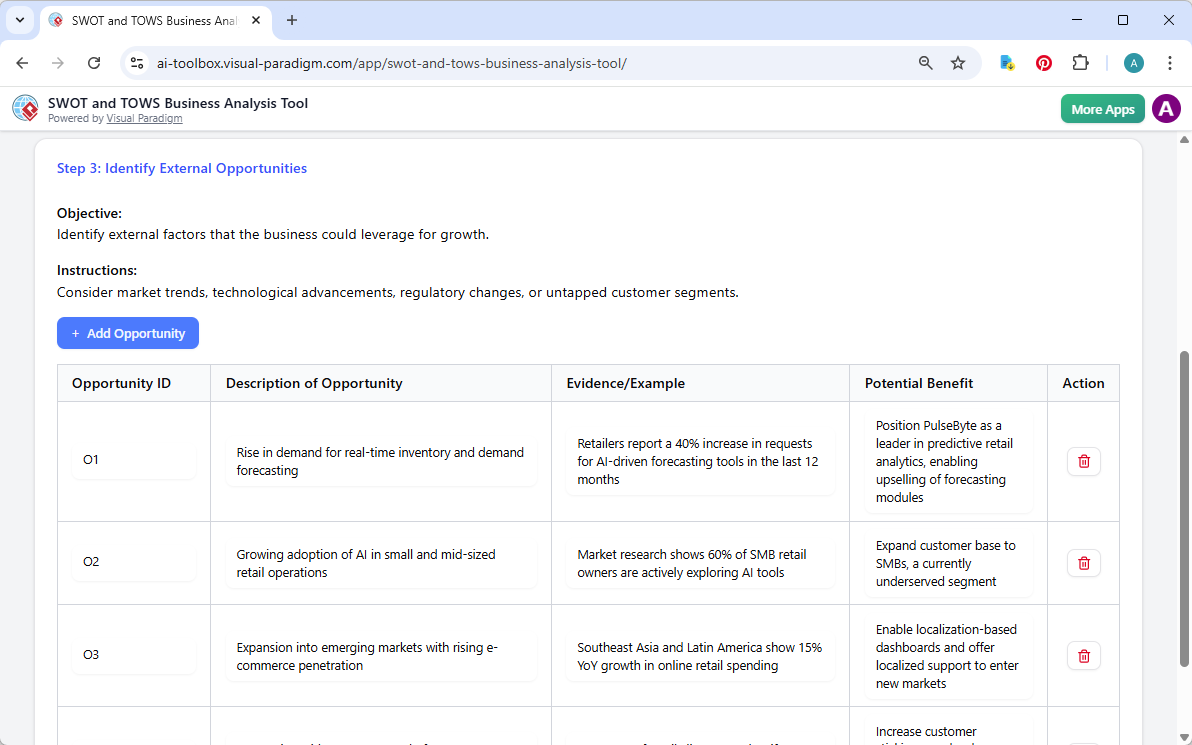
No business exists in a vacuum, and the third step of this online AI-powered SWOT and TOWS tool turns its gaze outward. For PulseByte, the external environment is ripe with potential, such as the “Growing adoption of AI in small and mid-sized retail operations.” The tool prompts the user to consider potential benefits, like expanding the customer base to underserved SMB segments. It’s almost as if the software has its own subscription to the latest market research journals, providing a sophisticated rhythmic flow to the brainstorming process.
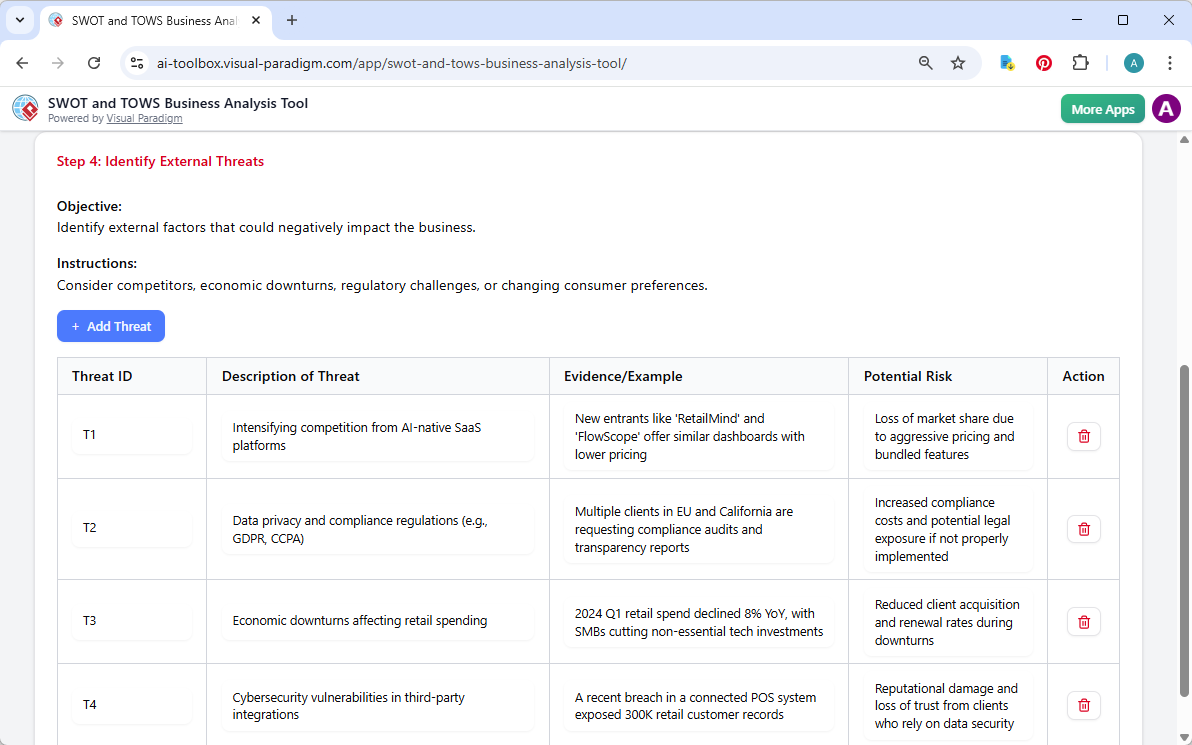
But the horizon also harbors storms. The fourth step addresses external threats with the gravity they deserve. The tool identifies intensifying competition from “AI-native SaaS platforms” and the ever-present specter of data privacy regulations like GDPR and CCPA. By documenting these threats alongside specific evidence—such as a recent 8% decline in retail spend—PulseByte’s leadership can move from a state of vague anxiety to one of prepared vigilance. The professional SWOT analysis software ensures that no threat is left unquantified.
The TOWS Matrix: Where Insight Becomes Impact
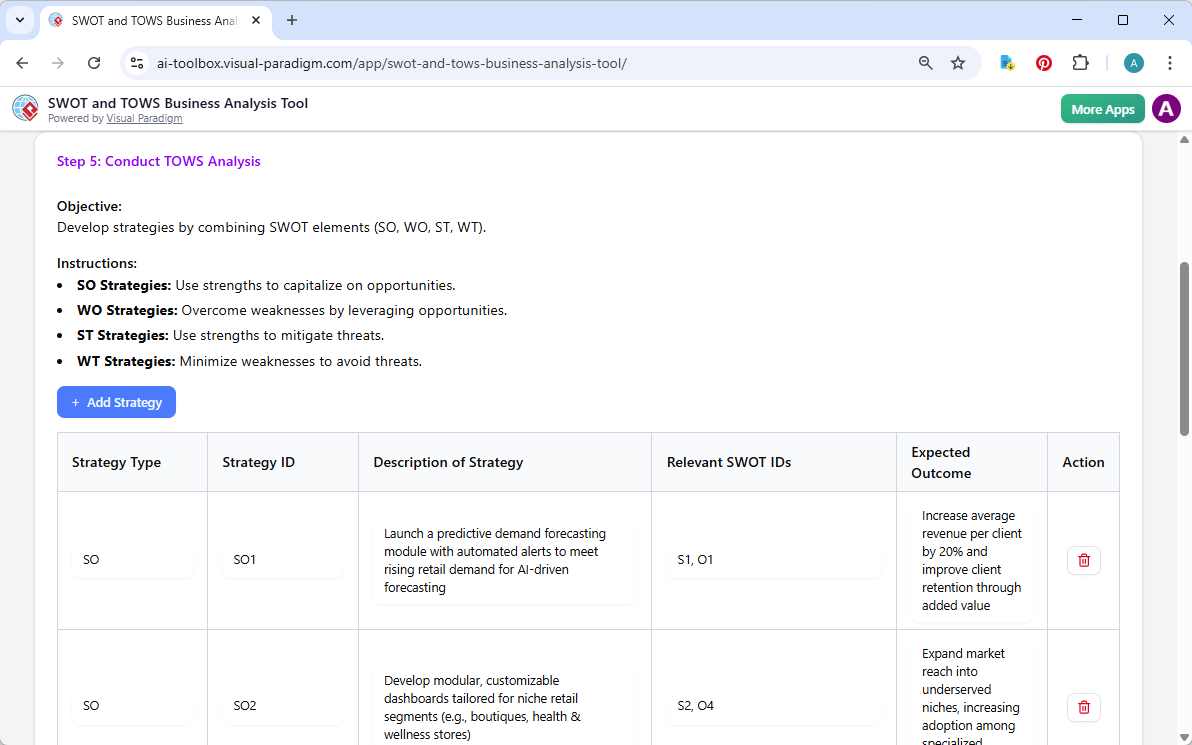
The true “magic” of this application—though we prefer to call it “sophisticated algorithmic logic”—occurs in the TOWS Matrix phase. While many tools stop at SWOT, Visual Paradigm’s solution pushes forward into the TOWS framework, matching internal factors with external realities. This is where the best TOWS matrix app earns its keep. It combines PulseByte’s strength (S1: AI-driven insights) with an opportunity (O1: Rise in demand for forecasting) to propose a “Predictive demand forecasting module” (Strategy SO1). It is a masterclass in turning “what is” into “what could be.”
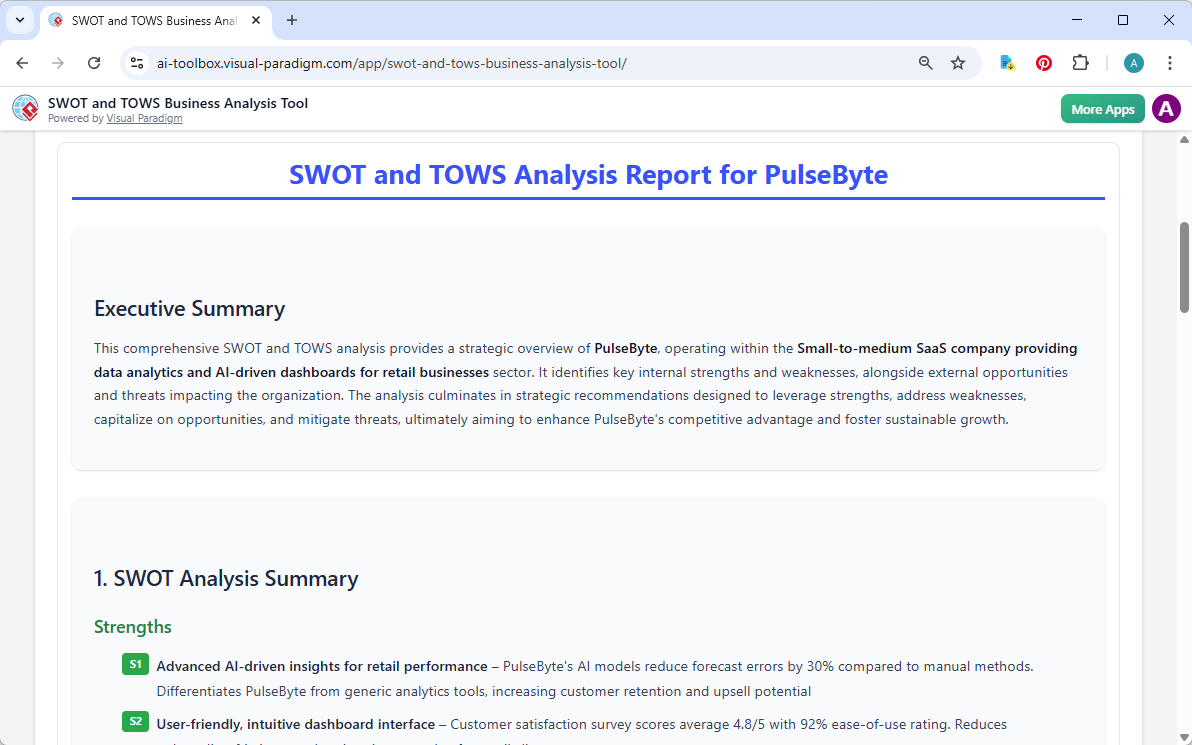
Finally, the culmination of this analytical odyssey is the Consolidated Final Report. It gathers every factor, every piece of evidence, and every formulated strategy into a single, high-fidelity document. The report features an Executive Summary that synthesizes the entire strategic posture of PulseByte, ready to be printed or saved as a PDF for the next board meeting. It is a satisfying conclusion to a process that, while complex in its implications, is delightfully simple in its execution.
Conclusion: Crafting the Future of Your Enterprise
Strategic planning should not be a chore that is relegated to dusty binders or neglected spreadsheets. By utilizing a professional AI-powered SWOT and TOWS analysis tool, organizations can transform their planning sessions from speculative guesses into data-driven roadmaps. PulseByte’s journey through the Visual Paradigm interface demonstrates that with the right guidance, a business can identify its competitive advantages, shore up its defenses, and seize market opportunities with surgical precision. Whether you are a seasoned consultant or a budding entrepreneur, the ability to generate a robust strategic report in minutes—while maintaining total data privacy—is a competitive advantage in its own right.
Ready to redefine your business trajectory? Don’t let your strategy remain an afterthought. Experience the future of business analysis today.
Experience the power of Visual Paradigm’s SWOT and TOWS tool:
Learn more about the methodology: https://ai.visual-paradigm.com/tool/swot-tows-business-analysis/
Try the tool now: https://ai-toolbox.visual-paradigm.com/app/swot-and-tows-business-analysis-tool/
Related Links
Strategic analysis is the systematic process of evaluating an organization’s macro-environment and internal capabilities to facilitate data-driven business decisions. Visual Paradigm offers a comprehensive suite of tools for this purpose, including SWOT, PESTLE, and Porter’s Five Forces, allowing teams to align organizational goals with actionable insights. Recent advancements have integrated AI-powered automation into these frameworks, enabling architects and planners to generate 360-degree environmental scans and complex scenario models instantly from simple descriptions.
-
Comprehensive Suite of Strategic Analysis Tools: A central resource detailing integrated tools for PEST, SWOT, and Porter’s Five Forces analysis to support structured organizational planning.
-
Strategic Analysis Tool for Business Planning: An online platform designed to improve informed decision-making through various strategic modeling frameworks.
-
SWOT Analysis: A Definitive Guide to AI-Powered Strategic Planning: Discusses how AI transforms static SWOT lists into dynamic action plans by pairing strengths with opportunities and weaknesses with threats.
-
PESTLE Analysis: A Definitive Guide to AI-Powered 360° Environmental Scanning: Explains using AI to achieve a comprehensive view of political, economic, social, technological, legal, and environmental factors.
-
How to Use Radar Charts for Competitive Analysis: A practical tutorial on comparing competitor performance across multi-dimensional metrics to identify market positioning.
-
Strategy Map Tool – Visualize Your Organization’s Strategic Goals: Details how to create strategy maps that align organizational objectives with key performance indicators and strategic initiatives.
-
AI-Powered Scenario Analysis for Strategic Business Planning: Explores the use of AI to model future outcomes and evaluate potential risks in business strategy development.
-
AI Benchmarking Tool for Strategic Growth: Demonstrates how to leverage AI-driven benchmarking data to inform and drive long-term business growth strategies.
Related posts:
 Sustainable Agriculture Strategic Planning with the Professional AI-Powered PESTLE Analysis Tool
 Creating a Strategic Roadmap in Minutes: Hoshin Kanri for Automotive Manufacturers
 Modeling the Lifecycle of a Library Book with UML State Diagrams: A Practical Case Study
 From Text to Structure: Accelerating System Design with Visual Paradigm’s AI-Powered DFD & ERD Generator