


Enterprise Architecture (EA) often feels abstract to stakeholders outside the technical domain. One of the most effective ways to bridge this gap is through a Business Capability Map. This document serves as a foundational guide for architects and strategists looking to draft their first capability map. It focuses on creating a stable structure that aligns organizational strategy with operational execution.
Building a capability model requires discipline, clear communication, and a deep understanding of how the business creates value. This guide walks through the process step-by-step, avoiding vendor-specific tools to ensure the methodology remains applicable regardless of your technology stack. We will explore the hierarchy, the validation process, and how to use the map for long-term strategic decisions.
Understanding the Core Concept 🧠
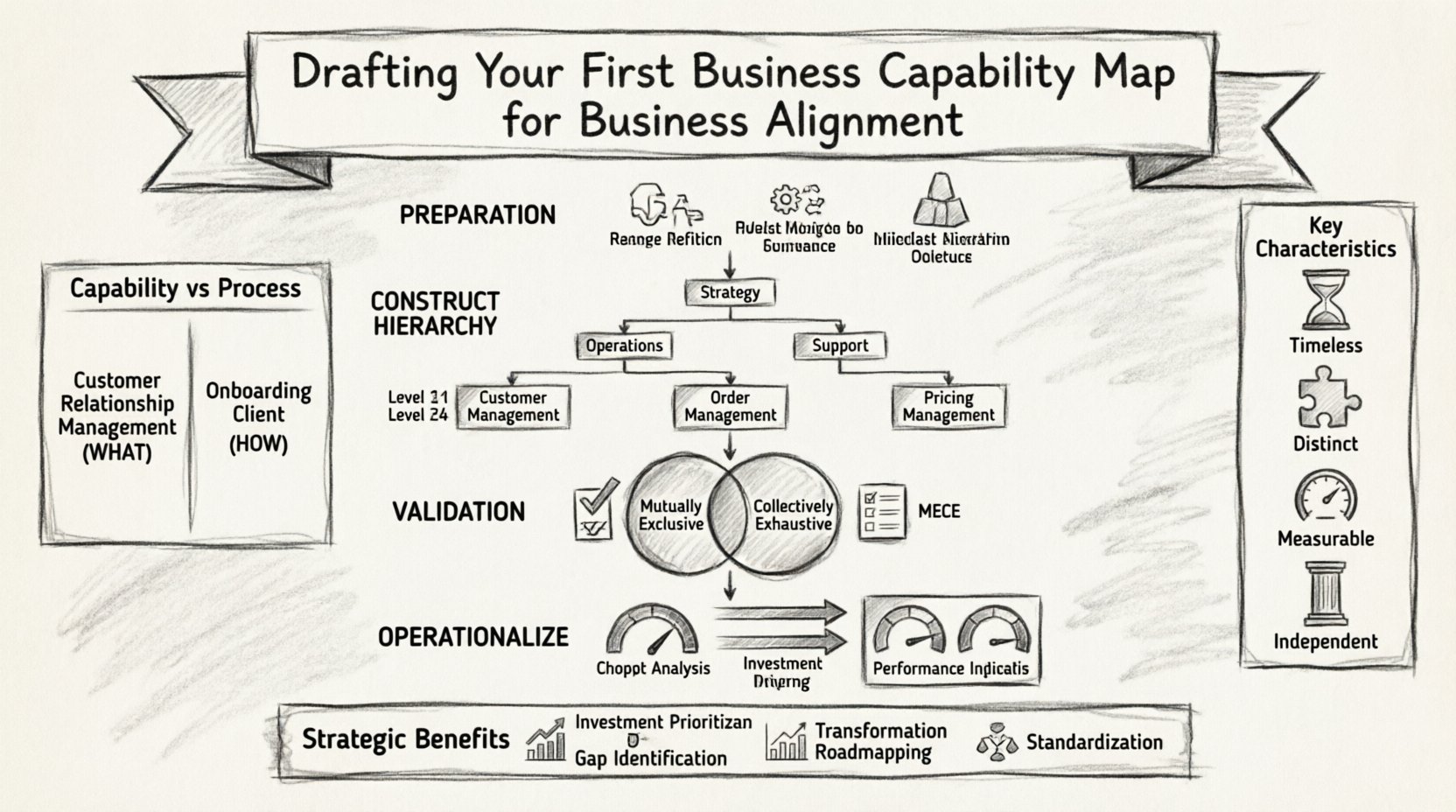
A business capability is what an organization needs to be able to do to achieve its goals. It is distinct from a process, which is how the work is done. A process describes the flow of activities, while a capability describes the ability to perform a function. For example, “Customer Relationship Management” is a capability. “Onboarding a New Client” is a process that falls under that capability.
Why distinguish between the two? Capabilities are stable. Processes change frequently due to efficiency improvements or regulatory updates. Capabilities change less often. Mapping capabilities allows leaders to see the organization’s structure independent of its current software or organizational chart.
Key Characteristics of a Capability
Timeless: It exists regardless of who is performing it or what tools are used.
Distinct: It is not duplicated across other areas of the map.
Measurable: You can assess the performance level of the capability.
Independent: It does not rely on another capability to exist.
When you draft your first map, you are creating a taxonomy of the business. This taxonomy becomes the backbone for portfolio management, investment decisions, and transformation planning.
Why Business Alignment Matters 🎯
Without alignment, IT investments often drift away from business needs. This leads to redundancy, wasted budget, and missed opportunities. A capability map provides a neutral language for IT and Business leaders to discuss strategy.
The Strategic Benefits
Clear Investment Prioritization: You can identify which capabilities drive revenue and which are cost centers.
Gap Identification: You can see where the organization lacks the ability to execute its strategy.
Transformation Roadmapping: You can sequence change initiatives based on capability dependencies.
Standardization: You can identify duplicate capabilities across different business units.
When the map is accurate, it acts as a single source of truth. It prevents the “shadow IT” phenomenon where departments buy their own solutions without oversight, as the map highlights which capabilities are already covered by existing investments.
Phase 1: Preparation and Scope Definition 🛠️
Before drawing a single box, you must define the boundaries of the exercise. A capability map for the entire enterprise is a massive undertaking. A map for a specific division is more manageable for a first attempt.
1. Define the Scope
Decide the granularity of the map. Will it cover the whole organization or just the Operations department? For a first draft, start with a domain such as “Finance” or “Supply Chain”. This limits the complexity and allows you to refine the methodology before scaling.
Enterprise Level: High-level view (Level 1 and 2).
Business Unit Level: Detailed view (Level 2 and 3).
Functional Level: Very detailed view (Level 3 and 4).
2. Identify Stakeholders
Capability mapping is a collaborative effort. You cannot do it alone in a vacuum. You need input from Subject Matter Experts (SMEs) and leadership.
Sponsor: An executive who champions the initiative and resolves conflicts.
Domain Owners: Leaders responsible for specific areas (e.g., Head of Sales).
Process Owners: Individuals who know the day-to-day work.
Architects: The team building the model.
3. Establish Governance
Who approves the names of the capabilities? Who decides when a new capability is added? You need a governance model from the start. Without it, the map becomes a collection of opinions rather than a structured standard.
Role | Responsibility |
|---|---|
Architecture Board | Approves high-level changes and standards |
Domain Owner | Validates capability definitions within their area |
EA Team | Maintains the model and ensures consistency |
Phase 2: Constructing the Hierarchy 🔨
The structure of a capability map follows a hierarchical tree. It typically starts with broad business functions and drills down into specific abilities. This structure ensures that no capability is left orphaned.
1. Top-Down Approach
Start with the business strategy. What are the primary goals? These goals often translate directly into Level 1 capabilities. For example, a goal to “Expand Market Share” implies capabilities related to “Marketing” and “Sales”.
Level 1: Major Business Domains (e.g., Strategy, Operations, Support).
Level 2: Core Business Functions (e.g., Product Development, Order Management).
Level 3: Specific Capabilities (e.g., Pricing Management, Customer Support).
Level 4: Sub-Capabilities (Optional, for high granularity).
2. Naming Conventions
Consistency is key. Use noun phrases, not verb phrases. “Pricing Management” is better than “Manage Pricing”. This reinforces the stability of the capability.
Standard: [Domain] – [Function] – [Capability]
Format: Capitalize words for readability.
Uniqueness: Ensure no two capabilities have the same name.
3. Drafting the Content
Gather the domain owners and workshop the list. Do not try to guess the capabilities. Ask them: “What do you need to do to run your business?”
Example Scenario:
Domain: Customer Management
Function: Acquisition
Capability: Lead Generation
Capability: Lead Qualification
Capability: Contract Signing
Repeat this process for all major domains. Ensure that the list is mutually exclusive. If “Lead Generation” and “Marketing” overlap, define the boundary clearly.
Phase 3: Validation and Refinement ✅
A draft map is rarely perfect. Validation is the process of checking the map against reality. This step ensures the model reflects the actual business structure and strategy.
1. The MECE Principle
Ensure the capabilities are Mutually Exclusive and Collectively Exhaustive (MECE). This means no capability should overlap with another, and all necessary capabilities should be included.
Mutually Exclusive: If a capability is in “Sales”, it should not be in “Marketing”.
Collectively Exhaustive: All business activities should map back to a capability.
2. Stress Testing
Ask stakeholders to map their current projects to the capabilities. If a project does not fit into any box, you have found a gap. This indicates a missing capability in the map.
3. Refinement Loop
Update the map based on the feedback. You may need to split a broad capability into two or merge two similar ones. This iterative process is normal. Do not rush to finalize the map before validation.
Validation Check | Pass Criteria | Action if Failed |
|---|---|---|
Clarity | Can a non-expert understand the definition? | Refine the definition text |
Completeness | Do all projects have a home? | Add missing capabilities |
Consistency | Are naming conventions uniform? | Standardize naming |
Phase 4: Operationalizing the Map 🚀
Once the map is validated, it must be used. A map that sits on a shelf provides no value. The goal is to integrate the map into decision-making processes.
1. Gap Analysis
Use the map to identify where the organization is weak. You can rate capabilities on maturity levels (e.g., Ad-hoc, Defined, Managed, Optimized).
High Maturity: Invest in optimization and automation.
Medium Maturity: Invest in standardization and improvement.
Low Maturity: Consider outsourcing or acquisition.
2. Investment Alignment
Link budget requests to capabilities. When a department asks for funding, they should specify which capability the investment supports. This prevents spending on “nice-to-have” features that do not align with strategy.
3. Performance Monitoring
Define metrics for each capability. For “Order Fulfillment”, a metric might be “Order Cycle Time”. For “Customer Support”, it might be “First Contact Resolution”.
This transforms the map from a static diagram into a dynamic management tool. It allows leadership to see which capabilities are delivering value and which are dragging down performance.
Common Pitfalls to Avoid ⚠️
Even experienced architects make mistakes when drafting capability maps. Being aware of these common traps can save time and effort.
1. Confusing Capability with Process
The most common error is listing activities instead of abilities. “Process Customer Order” is a process. “Order Management” is a capability. Keep the focus on the ability.
2. Over-Granularity
Creating a map with 500 capabilities is too detailed to be useful. Aim for a high-level view first. You can drill down later if needed. A cluttered map is ignored.
3. Ignoring the Business
Building the map in isolation leads to rejection. If business leaders do not own the definitions, they will not use the map. Involve them in every step.
4. Lack of Maintenance
Businesses evolve. Capabilities change. If the map is not updated, it becomes obsolete. Schedule regular reviews to keep the model current.
Maintaining Long-Term Value 🔁
The work does not end at the first draft. A capability map is a living asset. It requires ongoing stewardship to remain relevant in a changing market.
1. Version Control
Keep track of changes to the map. Document why changes were made. This history helps explain shifts in strategy over time.
2. Integration with Other Models
Link the capability map to other architectural artifacts. Connect capabilities to applications, data, and infrastructure. This creates a full picture of the enterprise.
Application Portfolio: Which apps support which capabilities?
Process Model: Which processes execute which capabilities?
Organization Chart: Which teams own which capabilities?
3. Cultural Adoption
Encourage the use of capability language in meetings and reports. When everyone speaks the same language, communication improves. This cultural shift is often more important than the map itself.
Conclusion on Execution
Drafting a capability map is a significant undertaking that yields high returns for those who persist. It provides clarity in complex environments and aligns technology with business goals. By following the steps outlined in this guide, you can create a robust model that supports strategic decision-making.
Remember that the map is a tool, not a destination. Its value lies in the conversations it enables and the decisions it informs. Start small, validate rigorously, and maintain the model with discipline. With these practices, your enterprise architecture will provide a solid foundation for growth and adaptation.
Next Steps for Your Team
Review: Read this guide with your architecture team.
Plan: Schedule the kickoff meeting with domain owners.
Execute: Begin the Level 1 and Level 2 drafting session.
Iterate: Plan regular review cycles for the model.
By committing to this process, you ensure that your organization remains agile and aligned with its strategic vision.