

Enterprise architecture serves as the blueprint for organizational transformation. It connects the abstract vision of leadership with the concrete reality of technology and business operations. Within this discipline, the ArchiMate modeling language provides a standardized way to represent these connections. While the Business, Application, and Technology layers describe what an organization does and how it does it, the Motivation layer explains why. Understanding this layer is critical for ensuring that every architectural decision aligns with the core purpose of the enterprise.
This guide explores the process of identifying strategic drivers using ArchiMate motivation elements. It provides a structured approach for architects to capture intent, assess impact, and validate alignment without relying on specific tooling or proprietary methodologies. By focusing on the fundamental relationships between goals, drivers, and stakeholders, organizations can build a more resilient and purpose-driven architecture.
🧭 The Motivation Layer: Why Architecture Matters
Architecture without motivation is merely a map without a destination. It describes the state of systems but fails to explain the forces pushing for change or the value sought by the organization. The Motivation layer sits above the other layers in the ArchiMate framework, acting as the context for all other elements.
When identifying strategic drivers, architects must look beyond functional requirements. They must examine the underlying pressures and aspirations. These drivers are not static; they evolve with market conditions, regulatory changes, and internal shifts. Capturing them accurately requires a disciplined approach to modeling and analysis.
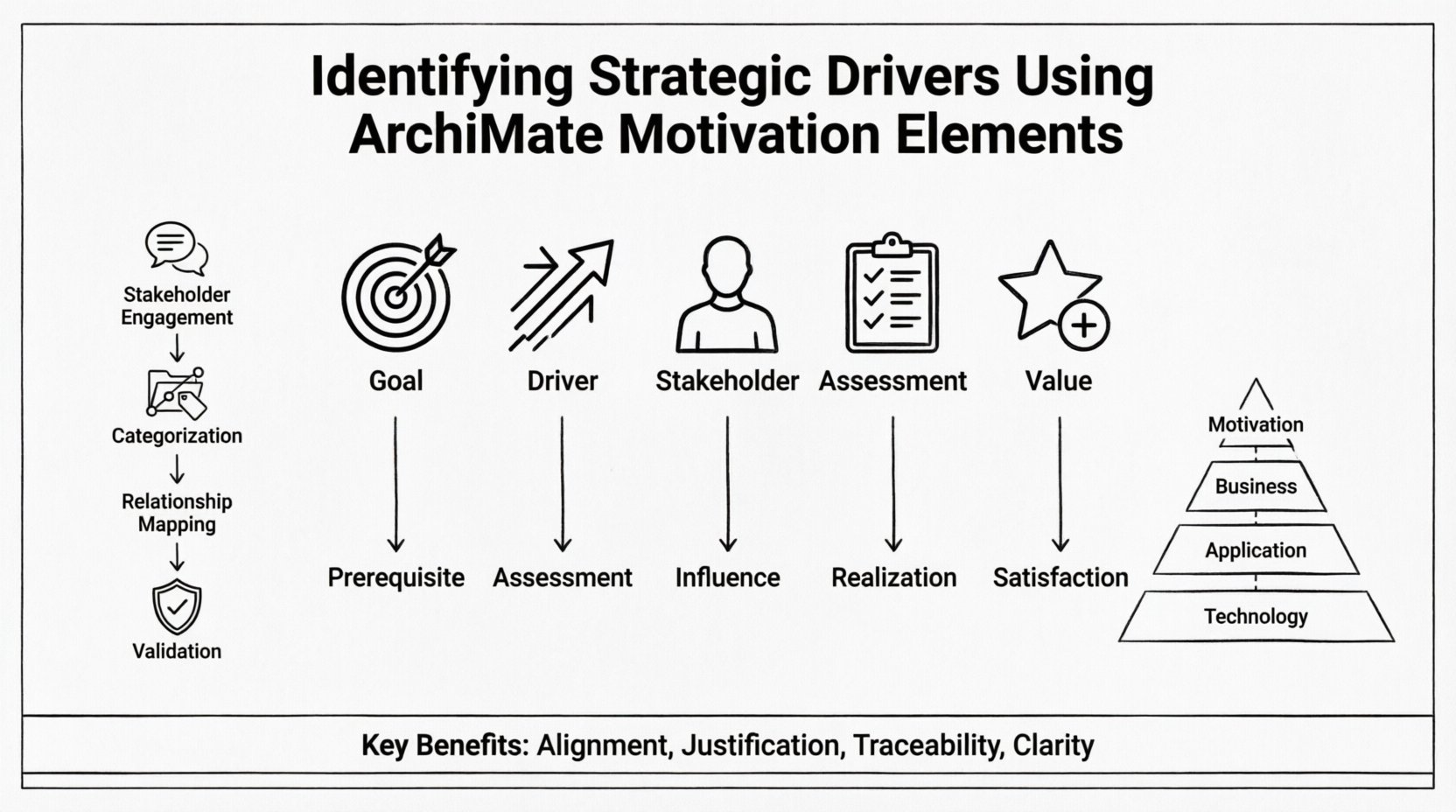
Key benefits of utilizing the Motivation layer include:
- Alignment: Ensures that business initiatives support high-level goals.
- Justification: Provides a rationale for investment in specific capabilities.
- Traceability: Links technical implementations back to business value.
- Clarity: Reduces ambiguity regarding the purpose of projects.
🔍 Core Motivation Elements Explained
To effectively identify strategic drivers, one must understand the specific building blocks available within the ArchiMate standard. Each element serves a distinct purpose in the modeling process. Misusing these elements can lead to confusion and a fragmented architecture model.
Below is a detailed breakdown of the primary elements relevant to strategic driver identification.
1. Goal
A Goal represents a desired outcome that an actor or group of actors wishes to achieve. It defines the direction of the enterprise. Goals are typically measurable and time-bound, though in early architecture phases, they may be qualitative.
- Function: Sets the target state.
- Example: “Achieve 99.9% system availability” or “Reduce carbon footprint by 20%.”
2. Driver
A Driver is a force that pushes or pulls the organization toward change. Unlike a Goal, a Driver does not necessarily represent a desired state but rather a condition that necessitates action. Drivers can be internal or external.
- Function: Explains the origin of the need for change.
- Example: “New regulatory compliance requirements” or “Competitor price reduction.”
3. Stakeholder
A Stakeholder is an entity with a concern or interest in the enterprise. Identifying stakeholders is crucial because drivers and goals often stem from specific groups within or outside the organization.
- Function: Assigns ownership and interest to architectural elements.
- Example: “Board of Directors,” “Regulatory Body,” or “End Users.”
4. Assessment
An Assessment describes the evaluation of a situation. It is often used to judge whether a specific driver or goal is being met or if a certain action is required.
- Function: Provides the criteria for decision-making.
- Example: “Market analysis indicates demand shift” or “Security audit reveals vulnerability.”
5. Value
Value is a special type of assessment that is judged as positive. It represents the benefit received by the organization or its stakeholders.
- Function: Quantifies or qualifies the benefit.
- Example: “Increased customer satisfaction” or “Reduced operational costs.”
Understanding the distinction between these elements is the first step in accurate modeling. A Driver explains the pressure; a Goal defines the solution target; an Assessment measures the success.
📊 Mapping Relationships Between Elements
Individual elements are powerful, but their true value lies in the relationships that connect them. ArchiMate defines specific association types that describe how motivation elements interact. These relationships form the logic of the strategy.
The following table outlines the primary relationships used in strategic driver modeling.
| Relationship Type | Description | Example |
|---|---|---|
| Prerequisite | Indicates that one element must be satisfied before another can be achieved. | Goal A is a prerequisite for Goal B. |
| Assessment | Indicates that an element is evaluated against another. | Driver X is assessed by Assessment Y. |
| Influence | Indicates that one element affects the likelihood of another being achieved. | Driver Z influences the success of Goal W. |
| Realization | Indicates that one element implements or realizes another. | Business Process realizes a Goal. |
| Satisfaction | Indicates that a capability satisfies a need. | Application satisfies a Stakeholder need. |
Understanding Prerequisites
The Prerequisite relationship is vital for sequencing strategy. It helps architects determine the order of operations. If Goal A is a prerequisite for Goal B, then resources must be allocated to Goal A first. This prevents the organization from attempting to solve downstream problems without addressing upstream constraints.
Understanding Influence
Influence relationships capture the probabilistic nature of strategy. A Driver might influence a Goal positively or negatively. For example, a budget cut (Driver) might negatively influence the ability to hire staff (Goal). Mapping these influences allows for risk assessment and contingency planning.
🛠️ Process for Identifying Strategic Drivers
Identifying strategic drivers is not a one-time event; it is a continuous process of discovery and validation. The following steps outline a robust methodology for capturing these elements within an architecture model.
Step 1: Stakeholder Engagement
Begin by identifying who matters. Engage with senior leadership, business unit heads, and external regulators. Ask open-ended questions about their concerns and aspirations. The goal is to uncover the raw material for drivers and goals.
- What keeps you awake at night?
- What are the top three priorities for the next fiscal year?
- What external forces are impacting your operations?
Step 2: Categorization and Classification
Once data is gathered, classify the information. Distinguish between a Driver (the pressure) and a Goal (the target). Ensure that Stakeholders are clearly linked to the elements they care about. This step requires critical thinking to avoid conflating symptoms with causes.
Step 3: Relationship Mapping
Connect the elements. Use the Prerequisite and Influence relationships to build a chain of logic. Verify that the model tells a coherent story. If a Goal has no Drivers, it may be arbitrary. If a Driver has no Goals, it may be an ignored risk.
Step 4: Validation and Review
Present the model to the stakeholders. Does the model reflect their understanding of the business? Are the relationships logical? Use the Assessment element to validate whether current capabilities meet the identified drivers.
⚠️ Common Pitfalls in Motivation Modeling
Even experienced architects can stumble when working with the Motivation layer. The abstract nature of this layer invites ambiguity. Recognizing common pitfalls can save time and improve model quality.
- Over-complication: Creating too many layers of abstraction. Keep the model as simple as possible while remaining accurate.
- Missing Stakeholders: Focusing only on technology and business processes while ignoring the people involved. A goal without a stakeholder owner is often ignored.
- Confusing Drivers and Goals: Treating a market trend as a goal. A trend is a Driver; the response to the trend is the Goal.
- Static Modeling: Creating a model and never updating it. Drivers change. Goals shift. The model must be a living document.
- Lack of Traceability: Failing to link motivation elements to the Business, Application, or Technology layers. Without this link, the strategy remains theoretical.
🔗 Integrating Motivation with Other Layers
The Motivation layer does not exist in isolation. Its power comes from its ability to drive the other layers of the ArchiMate framework. Strategic drivers must ultimately result in changes to business processes, applications, or infrastructure.
Linking to Business Architecture
Business capabilities and processes are the primary targets of strategic drivers. A Driver regarding “Efficiency” should influence a Business Process to reduce steps. A Goal regarding “Growth” might require new Business Capabilities. The Realization relationship connects these elements.
Linking to Application Architecture
Applications enable business capabilities. When a strategic driver necessitates a new capability, it creates a demand for specific applications. The Satisfaction relationship shows how an Application supports a Business Function which realizes a Goal.
Linking to Technology Architecture
Technology provides the foundation. If a Goal requires high availability, the Technology layer must support redundancy. The Motivation layer ensures that the infrastructure investment is justified by a business need rather than a technical preference.
When integrating these layers, ensure the flow is logical: Motivation drives Business, Business drives Application, Application drives Technology. Breaking this flow leads to “technology for technology’s sake”.
📈 Measuring Success and Continuous Improvement
Once the model is established, it becomes a tool for measurement. The Assessment element allows architects to track progress against the strategic drivers defined in the Motivation layer.
Key Performance Indicators (KPIs)
Define KPIs that map directly to the Goals and Drivers. If the Goal is “Improve Customer Experience,” the KPI might be “Net Promoter Score.” If the Driver is “Regulatory Compliance,” the KPI might be “Number of Audit Findings.”
Regular Reviews
Schedule periodic reviews of the motivation model. Ask:
- Are the Drivers still valid?
- Have the Stakeholders changed?
- Are the Goals still achievable?
This ensures the architecture remains relevant. An outdated motivation model can lead to decisions that solve yesterday’s problems while ignoring today’s realities.
💡 Best Practices for Architects
To maintain high quality in your motivation modeling, adhere to the following best practices. These guidelines help maintain consistency and clarity across the enterprise architecture.
- Use Consistent Terminology: Ensure that “Driver” means the same thing across all models. Avoid synonyms that create confusion.
- Limit Scope: Do not model every minor detail. Focus on the strategic drivers that impact the entire enterprise. Tactical details belong in lower-level models.
- Document Assumptions: If a relationship is based on an assumption, document it. This helps future reviewers understand the context of the model.
- Visual Clarity: Use colors or shapes to differentiate between internal and external Drivers. This aids in quick visual analysis.
- Collaborate: Do not work in a vacuum. Involve business stakeholders in the modeling process. Their input validates the authenticity of the drivers.
🚀 Conclusion on Strategic Alignment
Identifying strategic drivers using ArchiMate motivation elements is a discipline that requires precision and foresight. It bridges the gap between abstract strategy and concrete execution. By clearly defining Goals, Drivers, and Stakeholders, and by mapping the relationships between them, organizations can ensure that their architecture serves a clear purpose.
The process is iterative. As the environment changes, the model must evolve. The Motivation layer provides the context necessary to make informed decisions about where to invest and what to retire. It transforms architecture from a documentation exercise into a strategic asset.
Success in this area is measured not by the complexity of the model, but by the clarity it brings to the organization’s direction. When the “why” is clear, the “how” becomes manageable. Architects who master the Motivation layer enable their organizations to navigate change with confidence and purpose.
Start by auditing your current drivers. Verify their relevance. Update your models. The value of the architecture lies in its ability to reflect the truth of the business, and the Motivation layer is the most truthful representation of that reality.