
In today’s fast-paced digital landscape, business leaders frequently encounter the term Enterprise Architecture (EA). It often sounds technical, complex, and intimidating. Yet, ignoring it can lead to fragmented systems, wasted budget, and stalled innovation. This guide breaks down the concept without the confusion. We will explore how EA acts as a blueprint for your organization, aligning technology with business goals.
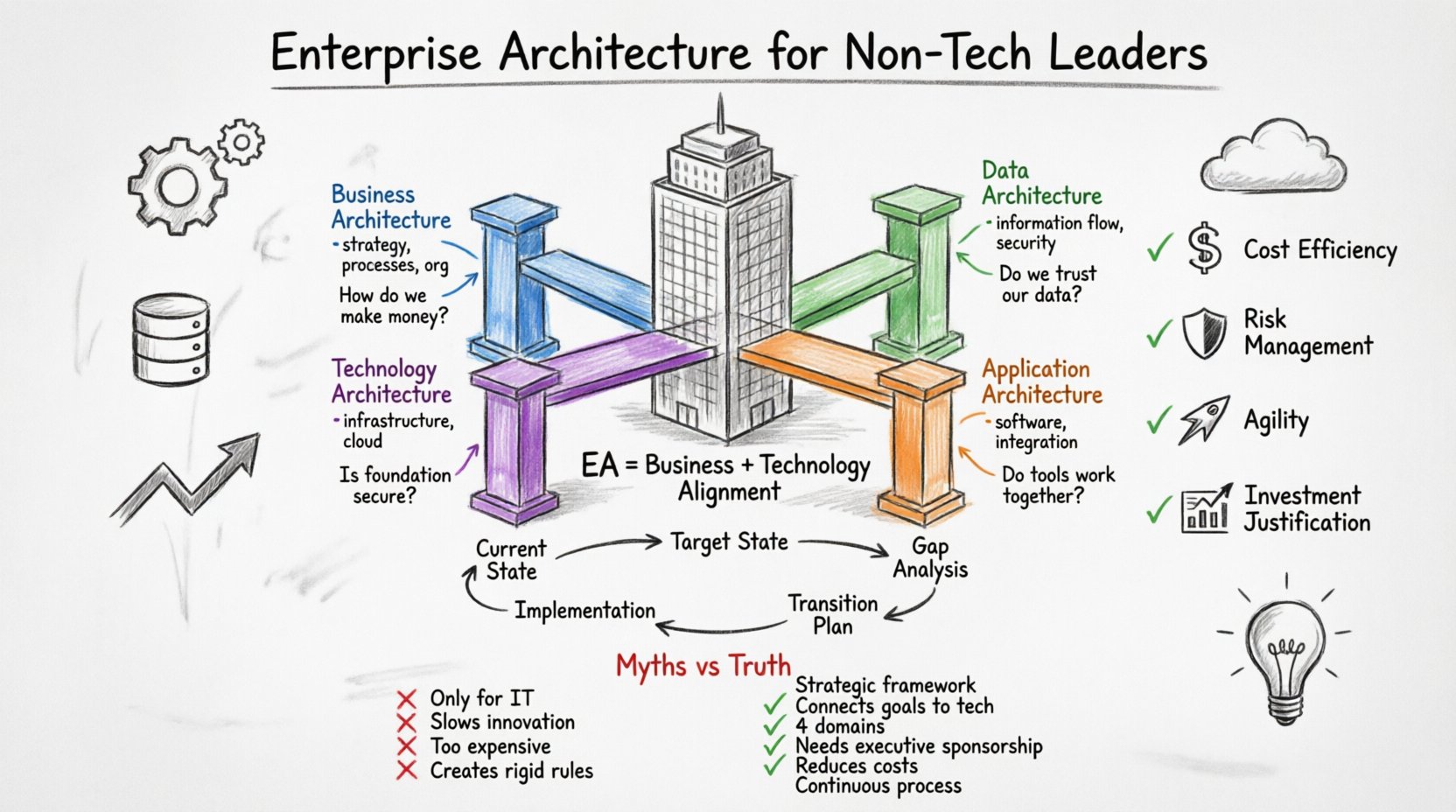
What is Enterprise Architecture? 🤔
At its core, Enterprise Architecture is a strategic practice. It involves defining the structure and behavior of an organization. Think of it as the architectural plans for a skyscraper. Before construction begins, architects draw detailed blueprints showing how the foundation, electrical systems, and plumbing connect. Without these plans, the building might stand, but it could be inefficient, unsafe, or impossible to expand later.
Similarly, EA maps out how your business functions. It connects your strategy to your execution. It ensures that every software purchase, process change, or data initiative supports the overall mission of the company. It is not just about IT; it is about the entire business ecosystem.
Why Leaders Must Understand EA 💼
Many executives view technology as a cost center. However, with a solid architectural view, technology becomes a strategic asset. Here is why this knowledge matters for non-technical leaders:
- Cost Efficiency: EA identifies redundant tools. If two departments buy different software to solve the same problem, EA highlights the waste.
- Risk Management: It maps dependencies. You will know which systems support critical revenue streams and which are vulnerable.
- Agility: When the market changes, an architect understands how to pivot the infrastructure quickly without breaking existing operations.
- Investment Justification: It helps prioritize spending. You can allocate budget to projects that drive the most value.
The Four Pillars of Enterprise Architecture 🏛️
To understand EA, you need to look at the four main domains. These domains interact to create a cohesive whole. Visualizing them helps leaders grasp the scope of the work.
| Domain | Focus Area | Leadership Question |
|---|---|---|
| Business Architecture | Strategy, Processes, Organization | How do we make money and operate? |
| Data Architecture | Information Flow, Quality, Security | Do we trust our numbers and data? |
| Application Architecture | Software Systems, Integration | Do our tools work together? |
| Technology Architecture | Infrastructure, Hardware, Networks | Is our foundation stable and secure? |
1. Business Architecture 📈
This is the starting point. It defines the business strategy, governance, organization, and key business processes. If the business strategy shifts from retail to e-commerce, the architecture must reflect that. Leaders must ensure that the technology roadmap matches this business vision.
2. Data Architecture 📊
Data is the lifeblood of modern organizations. This domain defines how data is stored, integrated, and managed. A common issue is data silos. For instance, if the sales team uses one database and marketing uses another, customer insights are lost. EA ensures data flows seamlessly across the enterprise.
3. Application Architecture 🖥️
This covers the software applications needed to support the business. It maps out how these applications interact. Do the customer relationship tools talk to the billing system? If they do not, manual workarounds are required. EA seeks to automate these connections to reduce errors and improve speed.
4. Technology Architecture ⚙️
This is the underlying infrastructure. It includes servers, cloud platforms, networks, and security protocols. Leaders need to know if the current infrastructure can handle future growth. Scaling a system built on outdated technology is often more expensive than building new.
The EA Process: How It Works 🔄
Enterprise Architecture is not a one-time project. It is a continuous cycle. It involves planning, designing, implementing, and monitoring. Here is a breakdown of the typical lifecycle:
- Current State Assessment: Analyze what exists now. Document systems, processes, and gaps.
- Target State Definition: Define where the organization wants to be in 3 to 5 years.
- Gap Analysis: Identify the differences between the current and target states.
- Transition Planning: Create a roadmap to bridge the gap. This includes prioritizing initiatives.
- Implementation: Execute the projects defined in the roadmap.
- Governance: Ensure new projects align with the architecture standards.
Common Misconceptions ❌
There are several myths surrounding EA that can hinder its adoption. Leaders should be aware of these to avoid pitfalls.
- Myth 1: It is only for IT. False. EA is a business capability. IT supports it, but the strategy comes from the business.
- Myth 2: It slows down innovation. False. Good architecture enables speed by removing technical debt and redundancy. Bad architecture slows things down.
- Myth 3: It is too expensive. While it requires investment, the cost of poor architecture is often much higher in the long run due to maintenance and integration failures.
- Myth 4: It creates rigid rules. Modern EA is agile. It provides guardrails, not handcuffs. It allows teams to move fast within defined boundaries.
Aligning Strategy and Execution 🎯
The primary value of EA lies in alignment. When strategy and execution are misaligned, companies fail to deliver value. For example, a strategy to “be the fastest in the market” might fail if the IT infrastructure requires three days to provision a new server. EA bridges this gap.
Leaders should ask specific questions during strategic planning:
- Do we have the data capabilities to support this new product?
- Is our current technology stack capable of scaling to meet projected demand?
- Are we duplicating efforts across different business units?
- What are the security implications of this new initiative?
The Role of the Business Sponsor 🤝
For EA to succeed, it needs strong sponsorship from the executive team. The Chief Information Officer (CIO) or Chief Technology Officer (CTO) may lead the technical side, but the business leaders must own the outcome. This is often the responsibility of a Chief Business Architect or a similar role that bridges the gap.
Without executive buy-in, architecture initiatives stall. Leaders must champion the discipline of planning. They must insist that new projects adhere to the architectural standards. This ensures consistency and longevity.
Measuring Success and Value 📏
How do you know if Enterprise Architecture is working? You cannot rely on vague feelings. You need metrics. Here are some key performance indicators (KPIs) to track:
- System Utilization: Are we using the tools we pay for?
- Time to Market: Is the time to deploy new features decreasing?
- Integration Costs: Are the costs of connecting systems going down?
- Technical Debt: Is the amount of legacy code being reduced?
- Compliance: Are we meeting regulatory requirements without costly fixes?
Tracking these metrics provides evidence of value. It justifies the budget required for architectural improvements.
Common Challenges and Risks ⚠️
Implementing EA is not without difficulty. Leaders should anticipate these challenges:
- Resistance to Change: Teams may prefer their own tools and methods. Communication is key.
- Complexity: Large organizations have complex histories. Simplifying this takes time.
- Lack of Skills: Finding people who understand both business and technology is difficult.
- Scope Creep: EA can become too theoretical. It must remain practical and actionable.
Future Proofing Your Organization 🔮
The technology landscape changes rapidly. Artificial intelligence, cloud computing, and the Internet of Things are reshaping industries. Enterprise Architecture provides the stability needed to navigate these changes.
By maintaining a clear view of your capabilities, you can adopt new technologies without disrupting core operations. You can integrate new tools into the existing ecosystem rather than replacing everything. This ensures resilience.
Practical Steps for Leaders 🚀
How can you start engaging with Enterprise Architecture today? You do not need to become an architect yourself. You need to foster an environment where architecture thrives.
- Ask Questions: In project meetings, ask about alignment with the broader strategy.
- Review Roadmaps: Ensure technology roadmaps are visible to business leaders.
- Invest in Talent: Support the hiring of skilled architects who understand business.
- Standardize: Encourage the use of common platforms and standards across departments.
- Monitor: Regularly review the health of the IT landscape against business goals.
Building a Culture of Architecture 🌱
Ultimately, Enterprise Architecture is about culture. It is about valuing planning as much as execution. It is about understanding that building the right thing is more important than building the thing right.
When leaders prioritize EA, they create a foundation for sustainable growth. They reduce waste. They increase speed. They improve security. They create a business that is ready for whatever the future holds.
Key Takeaways for Decision Makers 📝
- Enterprise Architecture is a strategic framework, not just an IT function.
- It connects business goals with technology capabilities.
- There are four main domains: Business, Data, Application, and Technology.
- Success requires executive sponsorship and clear metrics.
- It reduces costs, manages risk, and enables agility.
- It is a continuous process, not a one-time project.
Understanding these concepts empowers leaders to make better decisions. It moves the conversation from “how much does this cost?” to “what value does this create?”. By embracing the principles of Enterprise Architecture, organizations can navigate complexity with confidence.