
Entering the field of Enterprise Architecture (EA) can feel like stepping into a vast, intricate maze. You are tasked with connecting the dots between business strategy and technology execution. This role is not merely about drawing diagrams or managing servers; it is about designing the blueprint for how an organization operates, adapts, and grows. For new architects, understanding the core principles and methodologies is essential to avoid common pitfalls and deliver tangible value.
This guide provides a comprehensive breakdown of Enterprise Architecture. We will move from foundational definitions to practical steps you can take immediately. Whether you are transitioning from IT operations, software development, or consulting, this resource covers the landscape of modern architecture without relying on specific tools or vendors.
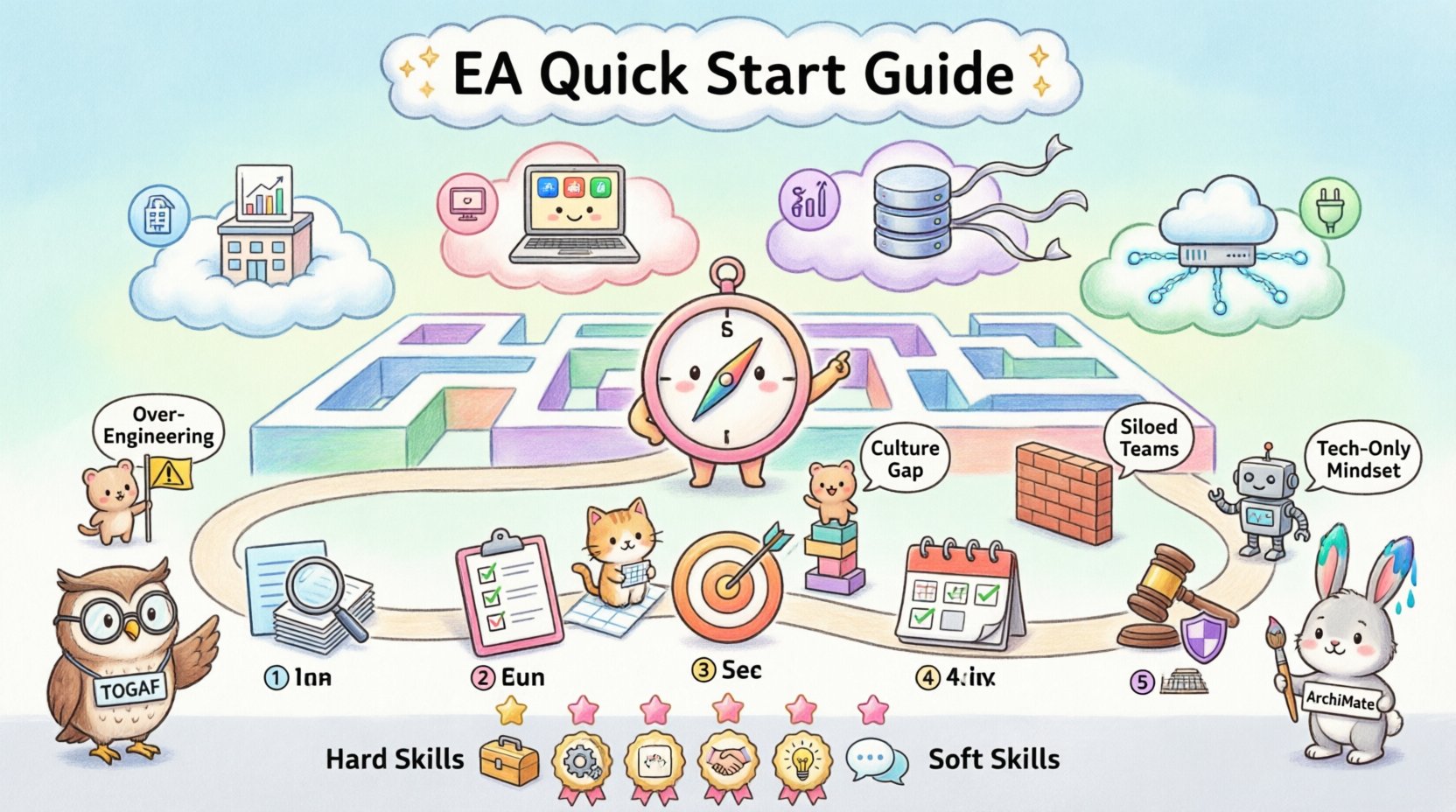
🧭 What is Enterprise Architecture?
Enterprise Architecture is a discipline that provides a strategic view of the organization. It aligns business goals with IT capabilities to ensure that technology investments support the mission of the company. Think of it as urban planning for a digital city. You do not just build roads (infrastructure); you ensure they connect to schools (business units), hospitals (operations), and commercial zones (revenue streams).
Key characteristics of EA include:
- Holistic View: It looks at the entire organization, not just isolated departments.
- Long-term Focus: It plans for the future, anticipating changes in market conditions and technology.
- Standardization: It establishes common languages and standards to reduce complexity.
- Alignment: It ensures that every technical decision contributes to business objectives.
Without EA, organizations often suffer from silos, redundant systems, and high maintenance costs. Architecture brings order to chaos, creating a structure that is both stable and adaptable.
🏛️ The Four Core Domains of Architecture
To understand how EA functions, you must understand its four primary domains. These domains act as lenses through which you analyze the organization. Most frameworks structure their models around these pillars.
| Domain | Focus Area | Key Questions | Primary Outputs |
|---|---|---|---|
| Business Architecture 🏢 | Strategy, Governance, Organization, Processes | What are our goals? How do we operate? | Process Maps, Capability Models |
| Data Architecture 📊 | Information Assets, Data Flows, Governance | Where is our data? How is it secured? | Data Models, Integration Maps |
| Application Architecture 💻 | Software Systems, Interactions, Lifecycle | What apps do we run? How do they talk? | Application Portfolios, Interface Specs |
| Technology Architecture 🔌 | Hardware, Networks, Cloud, Infrastructure | What supports the apps? Where is it hosted? | Infrastructure Diagrams, Standards |
These domains are not isolated. A change in Business Architecture often triggers a change in Application Architecture, which then impacts Technology Architecture. The role of the architect is to manage these dependencies effectively.
🛠️ A Step-by-Step Quick Start for New Architects
If you are new to the discipline, jumping straight into complex modeling can be overwhelming. Instead, follow a structured approach to build your knowledge and deliver value incrementally. This methodology mirrors established practices used by industry leaders.
Step 1: Understand the Business Context 📝
Before drawing a single line, you must understand the business. You cannot design a solution if you do not know the problem.
- Review Strategic Plans: Read the annual reports, mission statements, and strategic roadmaps of the organization.
- Interview Stakeholders: Talk to C-level executives, department heads, and operational managers. Ask them about their pain points.
- Identify Drivers: Determine what is driving change. Is it regulatory compliance, cost reduction, or customer experience?
Step 2: Assess the Current State (As-Is) 📉
You need a baseline to measure progress against. This involves cataloging what currently exists.
- Inventory Assets: List the applications, servers, and data stores currently in use.
- Map Processes: Document how work actually gets done, not just how it is supposed to be done.
- Identify Gaps: Where are the inefficiencies? Where is data stuck in silos? Where is technical debt accumulating?
Step 3: Define the Target State (To-Be) 🎯
Once you know where you are, define where you need to go. This is the vision of the future state.
- Set Principles: Establish rules that guide decision-making (e.g., “Cloud First” or “Buy Before Build”).
- Design Capabilities: Define the new capabilities required to support the business strategy.
- Create Roadmaps: Outline the transition from the current state to the target state over time.
Step 4: Develop Implementation Plans 📅
Architecture is useless without execution. You must translate the vision into actionable projects.
- Prioritize Initiatives: Not everything can happen at once. Rank projects by value and risk.
- Allocate Resources: Ensure you have the budget and personnel to execute the plan.
- Manage Dependencies: Coordinate with project managers to ensure technical requirements are met.
Step 5: Establish Governance 🏛️
Governance ensures that the architecture is adhered to over time. It prevents drift and maintains standards.
- Architecture Review Boards: Set up committees to review significant changes before they are implemented.
- Compliance Checks: Ensure solutions meet the established principles and standards.
- Feedback Loops: Create mechanisms to learn from implementation and update the architecture.
🧠 Key Frameworks and Methodologies
While you do not need to adopt a specific software tool, adopting a structured framework is highly recommended. Frameworks provide a common language and a proven set of practices.
TOGAF (The Open Group Architecture Framework)
This is one of the most widely used frameworks. It focuses heavily on the Architecture Development Method (ADM). It is a cycle that guides you through the steps mentioned above repeatedly.
- Phase A: Architecture Vision
- Phase B: Business Architecture
- Phase C: Information Systems Architectures (Data and Application)
- Phase D: Technology Architecture
- Phase E: Opportunities and Solutions
- Phase F: Migration Planning
- Phase G: Implementation Governance
- Phase H: Architecture Change Management
Zachman Framework
This framework is organized as a matrix. It looks at the organization from the perspective of different stakeholders (Who, What, Where, When, Why, How) and different levels of detail (Planner, Owner, Designer, Builder, Subcontractor, Functioning System).
ArchiMate
Often used alongside TOGAF, ArchiMate provides a modeling language to describe, analyze, and visualize the architecture. It helps in creating clear diagrams that communicate complex relationships.
🤝 Stakeholder Management and Communication
A significant portion of an architect’s time is spent communicating. You must translate technical concepts into business value for non-technical leaders.
- Know Your Audience: A CIO cares about cost and risk. A CEO cares about revenue and market position. Tailor your message accordingly.
- Visuals Matter: Use diagrams to simplify complexity. A well-drawn map is worth a thousand words of text.
- Listen Actively: Architecture is a collaborative effort. Listen to the concerns of developers, operations, and business users.
- Build Trust: Deliver on your promises. If you say a standard will save costs, prove it with data.
⚠️ Common Pitfalls to Avoid
New architects often make mistakes that stem from inexperience or misunderstanding the scope of the role. Be aware of these common traps.
1. Over-Engineering 🏗️
Creating a perfect architecture that takes years to implement is rarely successful. Aim for “good enough” to solve the immediate problem while keeping the door open for future changes. Perfection is the enemy of progress.
2. Ignoring Culture 🧠
Technology is easy; people are hard. If you design a system that requires a massive cultural shift without preparing the organization, adoption will fail. Change management is a critical part of architecture.
3. Staying in the Silo 🚧
Do not design in isolation. If you do not talk to the teams building the solution, your architecture will remain theoretical. Engage with the implementers early.
4. Focusing Only on Technology 💾
Enterprise Architecture is not just IT. It is business architecture first. If the business strategy changes, the IT architecture must change with it. Do not let technology drive the business.
📈 Measuring Success and KPIs
How do you know if your Enterprise Architecture is working? You need metrics that demonstrate value. Avoid vanity metrics like “number of diagrams created.” Focus on outcomes.
- IT Cost Reduction: Are we spending less on maintenance due to standardization?
- Time to Market: Are new features being delivered faster because of reusable components?
- System Availability: Is the infrastructure more stable and resilient?
- Compliance: Are we meeting regulatory requirements more efficiently?
- Decision Speed: Are leaders making technology decisions faster because the context is clear?
🚀 Skills Required for the Role
Becoming a successful Enterprise Architect requires a blend of hard and soft skills. You are a hybrid professional who bridges gaps.
Hard Skills
- System Design: Understanding how systems integrate and interact.
- Modeling: Ability to create clear visual representations.
- Data Management: Knowledge of data governance and integrity.
- Security: Understanding of risk management and compliance.
Soft Skills
- Communication: Ability to explain complex topics simply.
- Negotiation: Balancing competing interests between departments.
- Leadership: Influencing others without direct authority.
- Adaptability: Willingness to pivot as the business environment changes.
🌱 Continuous Learning and Growth
The field of architecture is never static. New technologies emerge, and business models evolve. A committed architect must be a lifelong learner.
- Stay Curious: Read industry publications and attend conferences.
- Network: Join communities of practice to share knowledge with peers.
- Get Certified: Consider certifications to validate your knowledge, though experience often outweighs credentials.
- Mentor Others: Teaching reinforces your own understanding and builds a stronger team.
🔍 Summary of Best Practices
To wrap up, here is a checklist of best practices to keep in mind as you navigate your career in Enterprise Architecture.
- Start Small: Don’t try to map the entire enterprise on day one. Pick a domain or a project.
- Focus on Value: Always tie your work back to business outcomes.
- Keep it Simple: Complexity is the enemy of adoption. Simplify where possible.
- Document Clearly: If it isn’t documented, it doesn’t exist. Keep your documentation up to date.
- Be Pragmatic: Balance ideal theory with practical reality.
Enterprise Architecture is a journey of continuous improvement. It requires patience, vision, and a deep understanding of the organization you serve. By following these steps and maintaining a focus on alignment, you can build a robust architecture that stands the test of time.
Your role is to be the compass that guides the ship. You do not steer every turn, but you ensure the ship stays on course toward its destination. With the right mindset and tools, you can navigate the complexities of modern business and technology successfully.
Begin your journey today. Map your first process, interview your first stakeholder, and start building the bridge between strategy and execution.