


Entity Relationship Diagrams (ERDs) serve as the blueprint for database architecture. They define how data is structured, stored, and connected within an application. For senior backend developers, the ability to design a robust schema is a fundamental skill. However, experience can sometimes breed complacency. Even seasoned engineers fall into traps that compromise data integrity, system performance, and long-term maintainability.
This guide examines the frequent pitfalls encountered during the ERD design phase. We will explore specific technical errors, their consequences, and the strategies to avoid them. The focus remains on foundational principles rather than specific tools or platforms.
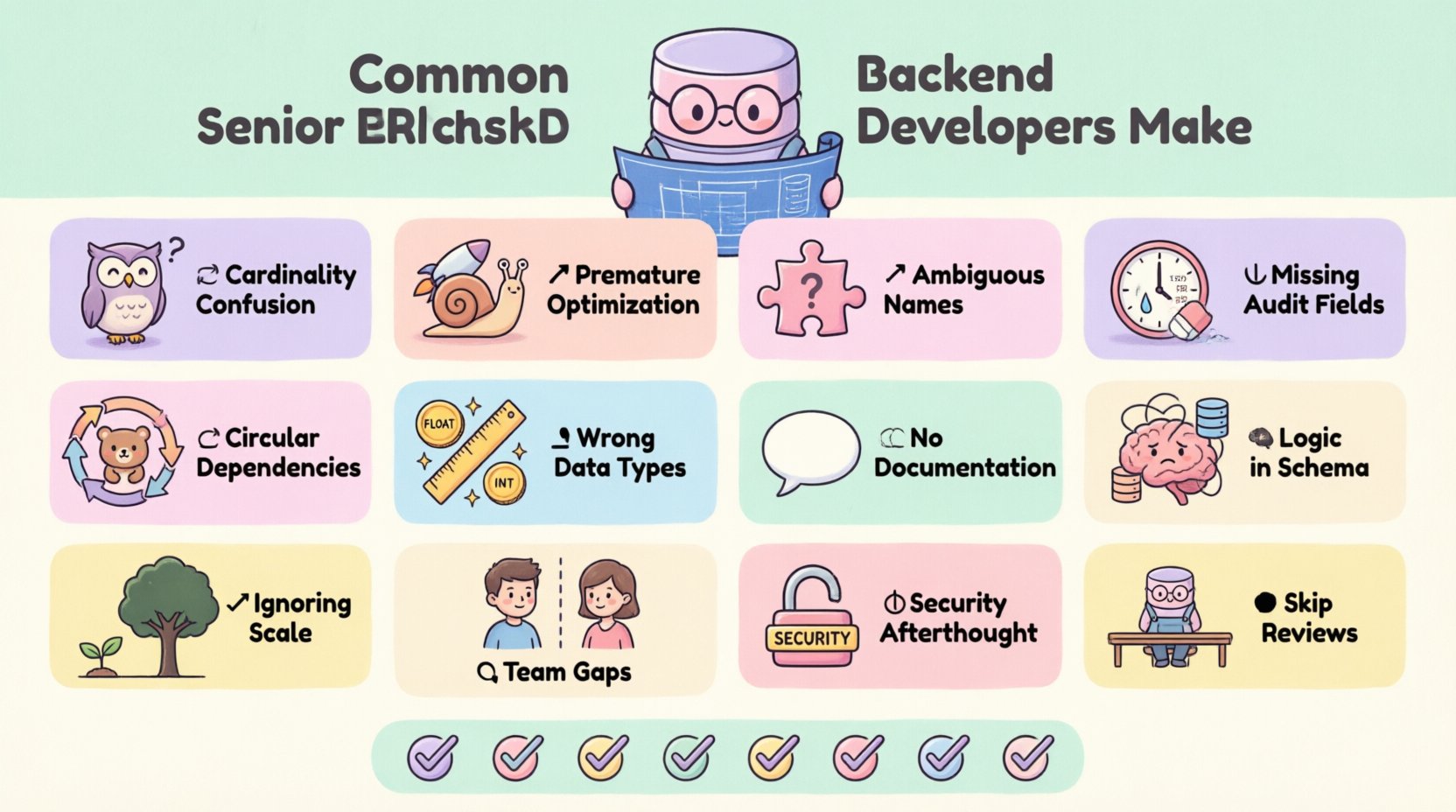
1. Misinterpreting Cardinality Constraints 🔄
Cardinality defines the numerical relationship between entities. Incorrectly mapping these relationships is perhaps the most common source of data anomalies. Senior developers often rush this step, assuming relationships are obvious without explicit validation.
One-to-One Confusion
Assuming a one-to-one relationship where a one-to-many exists can lead to data loss. For example, if a User entity is linked to a Profile entity as one-to-one, but the business logic allows multiple profiles over time, the schema forces a deletion of old data.
- Impact: Historical data becomes inaccessible.
- Fix: Review the lifecycle of the data. Does an entity persist or replace another?
Many-to-Many Oversights
Directly linking two tables with multiple foreign keys without an intermediate join table creates redundancy. A many-to-many relationship requires an associative entity.
- Impact: Data duplication and update anomalies.
- Fix: Introduce a junction table to resolve the relationship.
2. Premature Optimization for Performance 🚀
It is tempting to normalize data to the absolute limit (Third Normal Form) to reduce storage. Conversely, some developers denormalize too early to speed up reads. Both extremes can cause issues.
Over-Normalization
Creating too many tables for trivial details increases the number of joins required to fetch data. This slows down query execution, especially under load.
- Scenario: Storing an address in a separate table when it is only needed once per user record.
- Consequence: Complex queries that are hard to maintain and optimize.
Under-Normalization
Duplicating data across tables to avoid joins creates a high risk of inconsistency. If a user changes their name, you must update it in every table where it is stored.
- Scenario: Embedding product names directly into order records.
- Consequence: Data integrity issues if product details change later.
3. Ambiguous Naming Conventions 📝
Clear naming is the backbone of documentation and communication. When table or column names are vague, the ERD becomes a puzzle for future developers. Senior developers should enforce strict standards.
- Table Names: Use plural nouns (e.g.,
usersinstead ofuser). - Foreign Keys: Name them consistently (e.g.,
user_idinstead ofuidorfk_user). - Boolean Fields: Prefix with
is_orhas_(e.g.,is_active).
Ambiguity leads to errors where developers query the wrong column or assume a relationship exists when it does not.
4. Neglecting Soft Deletes and Audit Fields ⏳
Hard deletes remove data permanently. In many systems, this is not desirable. A senior design should account for soft deletes (marking a record as inactive rather than removing it).
Missing Timestamps
Every table should record when a row was created and last modified. Without created_at and updated_at columns, debugging data history becomes nearly impossible.
Ignoring Soft Delete Flags
Without a flag like deleted_at, removing a record affects all historical reports that rely on it. This breaks audit trails and compliance requirements.
5. Circular Dependencies and Self-Referencing 🔁
Complex hierarchies often lead to circular foreign keys. For instance, if Table A references Table B, and Table B references Table A, it creates a cycle.
- Problem: This can prevent database initialization or cause infinite loops during recursive queries.
- Self-Referencing: A table referencing itself (e.g.,
employeesreferencingmanager_idwithin the same table) requires careful constraint management.
When designing these structures, ensure that at least one entity can exist independently without the other.
6. Data Types and Precision Errors 📏
Choosing the wrong data type is a subtle but critical mistake. It affects storage size, performance, and calculation accuracy.
Float vs. Decimal
Using floating-point numbers for currency is a classic error. Floating-point arithmetic introduces rounding errors that are unacceptable in financial contexts.
- Recommendation: Use fixed-point decimal types for money.
String Length Limits
Setting a column to VARCHAR(255) by default may seem safe, but it wastes space if the actual data is shorter. Conversely, VARCHAR(50) might be too short for modern usernames or addresses.
- Recommendation: Analyze actual data requirements before setting limits.
7. Lack of Documentation and Comments 📄
An ERD is a living document. Without comments explaining business rules, the diagram loses value over time. Senior developers should document constraints that are not obvious.
- Business Rules: Explain why a relationship is optional.
- Constraints: Document unique constraints and check constraints.
- Evolution: Note why a specific design decision was made for future reference.
8. Mixing Domain Logic with Schema Design 🧠
Database schemas should store data, not logic. Embedding business rules directly into the database layer (e.g., via triggers or stored procedures) makes the system hard to migrate or scale.
- Bad Practice: Enforcing validation logic in the database.
- Good Practice: Keep the schema simple and move logic to the application layer.
This separation ensures that the database remains stable even if the application code changes.
9. Ignoring Scalability and Partitioning 📈
Designs that work for small datasets often fail at scale. A senior developer must anticipate growth.
- Indexing: Plan indexes for columns used in search and join operations.
- Partitioning: Consider how tables will be split if they grow to billions of rows.
- Sharding: Understand which keys will be used to shard data across multiple servers.
Comparison: Common Pitfalls vs. Best Practices
| Area | Common Mistake ❌ | Best Practice ✅ |
|---|---|---|
| Relationships | Assuming 1:1 without proof | Validate cardinality with business requirements |
| Performance | Over-normalizing for storage | Balance normalization with query needs |
| Names | Short, ambiguous aliases | Descriptive, consistent naming standards |
| History | Hard deletes only | Implement soft deletes and audit logs |
| Money | Using Float/Double | Use Decimal/Fixed-point types |
| Logic | Triggers for validation | Application-level validation |
| Growth | No indexing strategy | Plan indexes and partitioning early |
10. Communication Gaps with Frontend Teams 🤝
The schema is not built in a vacuum. It must serve the API contracts that frontend applications consume. A mismatch between the ERD and the API response structure causes friction.
- Naming Conflicts: Database columns often use snake_case, while APIs use camelCase. Ensure a clear mapping strategy.
- Data Exposure: Do not expose internal IDs (like
user_id) in public APIs unless necessary. Use opaque identifiers if security is a concern. - Versioning: Plan for schema migrations. Changes to the ERD should not break existing clients.
11. Security Considerations 🔒
Security is often an afterthought in ERD design. Sensitive data requires specific handling.
PII and Encryption
Personally Identifiable Information (PII) must be identified in the schema. Fields containing emails, phone numbers, or addresses should be flagged for encryption or hashing.
Access Control
While the database handles row-level security, the schema should support it. Design tables that allow for tenant isolation or role-based access control if multi-tenancy is required.
12. The Human Element: Review and Collaboration 👥
Even the best designers miss things. Peer review is essential. A fresh pair of eyes can spot a circular dependency or a naming conflict that the original author overlooked.
- Design Reviews: Schedule sessions where the ERD is walked through line by line.
- Stakeholder Feedback: Ensure domain experts verify the data model matches real-world processes.
- Documentation: Keep the diagram up to date with the codebase.
Summary of Key Takeaways 📌
- Validate Cardinality: Never assume relationships. Verify them against business rules.
- Balance Normalization: Optimize for both storage and query performance.
- Standardize Naming: Use clear, consistent conventions across the schema.
- Plan for History: Implement soft deletes and audit timestamps.
- Choose Types Carefully: Use decimals for money and appropriate lengths for strings.
- Separate Logic: Keep the database for data, not business rules.
- Document Everything: Explain the “why” behind design decisions.
- Consider Scale: Design with indexing and partitioning in mind from day one.
- Collaborate: Involve frontend and stakeholders in the design process.
Designing an Entity Relationship Diagram is a critical task that sets the foundation for the entire application. By avoiding these common mistakes, senior backend developers can ensure their systems are robust, maintainable, and ready for growth. The goal is not just to store data, but to structure it in a way that supports the business indefinitely.