


Entering the landscape of Enterprise Architecture (EA) as a Solution Architect is a significant career milestone. It requires more than just technical proficiency; it demands a strategic mindset, the ability to navigate complex organizational structures, and a disciplined approach to planning. Many projects fail not because of bad code, but because of poor alignment between business needs and technical execution. Preparation is the bedrock of success in this domain.
This guide serves as a practical roadmap. It outlines the critical actions required before you begin building solutions that support your organization’s long-term goals. By following this checklist, you ensure that your architectural decisions are grounded in reality, supported by stakeholders, and aligned with the broader enterprise strategy.
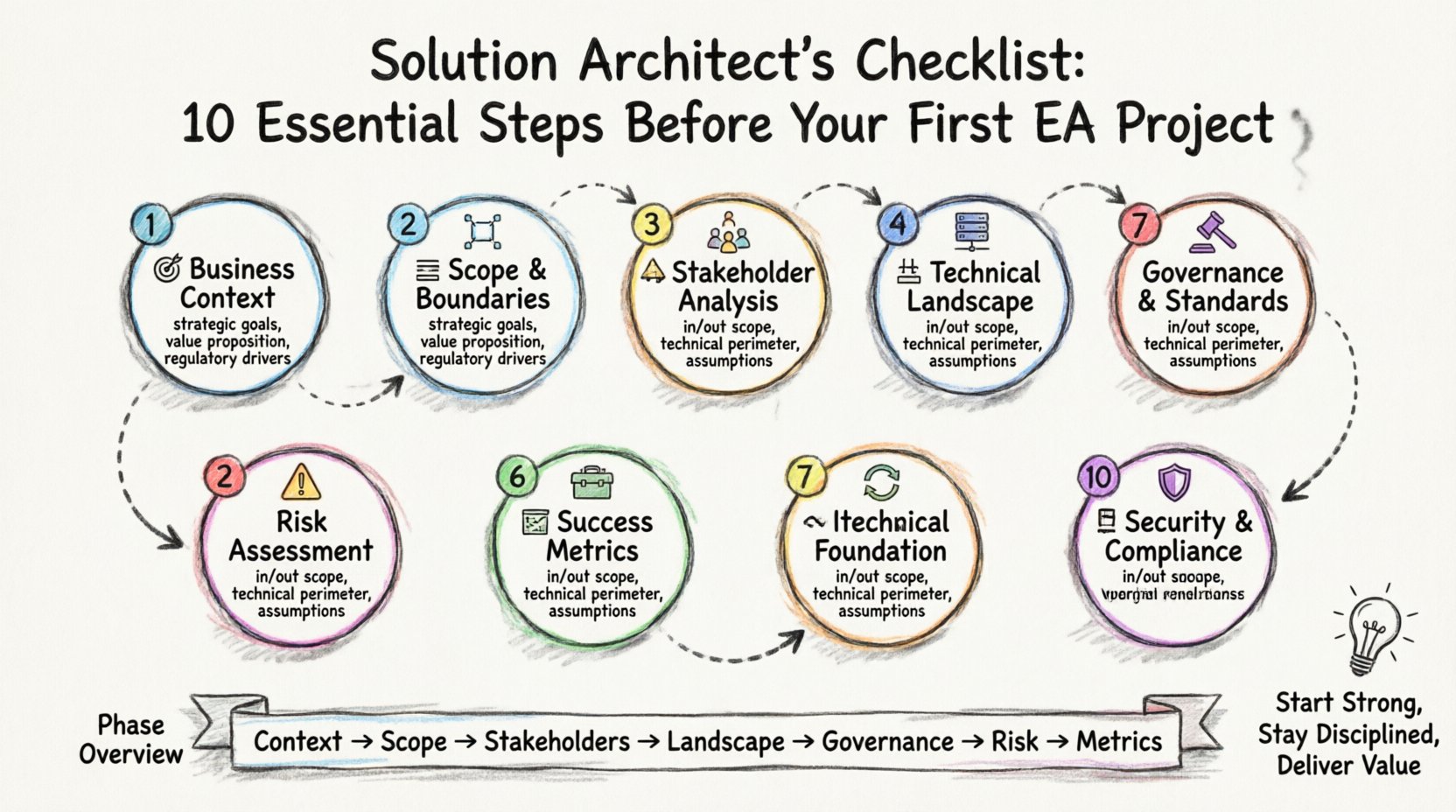
🎯 1. Clarify the Business Context and Strategic Goals
Before drawing a single diagram or selecting a technology stack, you must understand the “why” behind the project. Enterprise Architecture exists to bridge the gap between business strategy and IT execution. If you do not grasp the strategic drivers, your solution will likely become obsolete quickly or fail to deliver value.
- Identify the Primary Business Driver: Is this project driven by regulatory compliance, cost reduction, market expansion, or digital transformation? Understanding the root cause helps prioritize requirements.
- Align with Organizational Strategy: Review the current corporate strategy documents. Does your project support the three-year roadmap? If the organization is focusing on agility, your architecture must prioritize speed and modularity.
- Define Value Proposition: Articulate clearly what the business gets out of this. Is it revenue generation, risk mitigation, or operational efficiency? Quantify this where possible.
- Understand the Regulatory Environment: Are there specific laws, data privacy rules, or industry standards that dictate how the solution must be built?
Without this clarity, you risk building a solution that works technically but fails commercially. Take time to interview business leaders and review strategic plans. Do not assume you know the goals; verify them.
📏 2. Define Scope and Boundaries Explicitly
Scope creep is the most common enemy of architecture projects. A clear definition of what is included and, crucially, what is excluded, protects the team and the timeline. Ambiguity in scope leads to misaligned expectations and budget overruns.
- Establish In-Scope Systems: List the specific applications, databases, and infrastructure components that will be directly affected by the solution.
- Identify Out-of-Scope Items: Document what this project will not touch. This prevents stakeholders from assuming features or integrations will be delivered without additional effort.
- Set Technical Boundaries: Define the limits of the architecture. Are you integrating with legacy systems? Is cloud migration part of this phase or a future phase? Be specific about the technical perimeter.
- Document Assumptions: Every project runs on assumptions. Write them down. If an assumption proves false, the project plan may need adjustment. Examples include data availability, third-party API stability, or user adoption rates.
Creating a scope document is not just bureaucracy; it is a contract of understanding. It ensures that when the project is delivered, everyone agrees on what was promised.
🤝 3. Conduct a Comprehensive Stakeholder Analysis
Architecture is a social discipline as much as a technical one. You cannot succeed in a vacuum. Identifying who holds power, who holds influence, and who will be affected by the change is vital for gaining buy-in and managing resistance.
- Map Key Stakeholders: Create a list of all individuals and groups impacted by the solution. This includes executives, IT operations, development teams, and end-users.
- Analyze Influence and Interest: Categorize stakeholders based on their level of power and their interest in the project. High power/High interest stakeholders require close management and engagement.
- Identify Champions and Detractors: Find those who will support the initiative and those who might block it. Engage champions early to advocate for the solution and address detractors to understand their concerns.
- Define Communication Channels: Determine how and when you will communicate progress. Some stakeholders need high-level summaries, while others need deep technical details.
Ignoring stakeholders often leads to a solution that is technically sound but politically impossible to implement. Invest time in building relationships and understanding the human dynamics of your organization.
🏛️ 4. Assess the Current Technical Landscape
You cannot design a future state without a clear picture of the present. A thorough assessment of the existing environment reveals technical debt, integration complexities, and capacity constraints that will influence your architectural decisions.
- Inventory Existing Assets: Catalog the applications, data stores, and networks currently in use. Know what you have before you build what you need.
- Evaluate Integration Points: Map how systems communicate today. Are there hard-coded dependencies? Are interfaces well-documented? Legacy integration patterns often dictate the constraints of the new solution.
- Assess Technical Debt: Identify areas where shortcuts were taken in the past. Addressing this debt during the new project is often more cost-effective than deferring it.
- Review Capacity and Performance: Analyze current performance baselines. If the existing infrastructure is at 90% capacity, your new solution may require immediate scaling plans.
This assessment prevents the common pitfall of designing a solution that cannot run on the current infrastructure or that breaks existing critical workflows.
⚖️ 5. Establish Governance and Standards
Enterprise Architecture relies on standards to ensure consistency and maintainability. Without governance, every project might take a different approach, leading to a fragmented and fragile IT environment. You must define the rules of the road early.
- Define Architectural Principles: Set the guiding rules for the project. Examples include “cloud-first,” “data ownership by business unit,” or “open standards preferred.”
- Set Review Gates: Determine at which stages of the project architecture reviews will occur. This ensures compliance with standards before significant resources are spent.
- Identify Decision Rights: Clarify who has the authority to make final decisions on technology selection and architectural patterns. This avoids bottlenecks and confusion.
- Standardize Documentation: Agree on the formats and templates for architecture diagrams and documentation. Consistency aids knowledge transfer and maintenance.
Governance is not about restriction; it is about enabling sustainable growth. It ensures that the solution remains manageable and adaptable over time.
⚠️ 6. Perform a Risk Assessment
Every architectural decision carries risk. Identifying these risks early allows you to develop mitigation strategies rather than reacting to failures after they occur. A proactive risk management approach is a hallmark of a senior architect.
- Identify Technical Risks: Consider technology maturity, vendor stability, and skill gaps within the team. Is the technology unproven? Are there enough experts available?
- Identify Business Risks: What happens if the project is delayed? What is the impact on revenue or customer satisfaction? Quantify the potential loss.
- Identify Operational Risks: How will the solution impact daily operations during implementation? Consider downtime requirements and migration complexities.
- Develop Mitigation Plans: For every high-priority risk, define a contingency plan. If the primary vendor fails, is there an alternative? If the migration fails, how do we revert?
Documenting risks does not mean you expect failure; it means you are prepared. This transparency builds trust with leadership and project sponsors.
📊 7. Define Success Metrics and Deliverables
How will you know the project is successful? Vague goals like “improve performance” are insufficient. You need measurable outcomes to validate the architecture and the project delivery.
- Establish Key Performance Indicators (KPIs): Define specific metrics related to business outcomes, such as transaction processing time or cost savings.
- Define Key Quality Indicators (KQIs): Measure technical health, such as system availability, security compliance rates, or code coverage.
- Specify Deliverables: List exactly what will be handed over. This includes architecture diagrams, data models, API specifications, and operational runbooks.
- Set Acceptance Criteria: Define the conditions that must be met for the solution to be considered complete and ready for production.
Clear metrics allow for objective evaluation. They shift the conversation from opinion-based feedback to data-driven decision-making.
📋 Phase-by-Phase Checklist Overview
The following table summarizes the critical phases and actions required to ensure a robust start to your Enterprise Architecture project.
| Phase | Key Action | Desired Outcome |
|---|---|---|
| Context | Review Strategic Plans | Clear business alignment |
| Scope | Document Boundaries | Agreed project limits |
| Stakeholders | Map Influence Matrix | Stakeholder buy-in |
| Landscape | Assess Current State | Inventory of assets |
| Governance | Set Review Gates | Compliance framework |
| Risk | Identify Mitigation | Risk register |
| Metrics | Define KPIs | Measurable success |
🛠️ 8. Prepare the Technical Foundation
Once the strategic and governance aspects are settled, attention turns to the practical setup required to execute the architecture. This involves preparing the environment where the design work and implementation will happen.
- Set Up Design Environments: Ensure you have access to sandbox environments that mimic production. Do not design on a live system.
- Configure Modeling Tools: Select appropriate tools for creating diagrams and documentation. Ensure the team is trained on these tools to maintain consistency.
- Establish Version Control: Treat architecture documents like code. Use version control systems to track changes, enable collaboration, and maintain history.
- Prepare Data Models: Begin drafting high-level data schemas. Data is the most persistent asset; its structure should be defined early to guide application development.
Having the right environment ready prevents workflow interruptions. It allows the team to focus on design and logic rather than fighting with infrastructure.
🔄 9. Plan for Iteration and Evolution
Architecture is not a one-time event. It is an iterative process that evolves as the business and technology landscape change. Rigid plans often break under pressure. Building flexibility into your approach is essential.
- Adopt Agile Principles: Even in large architecture projects, incorporate iterative cycles. Review designs regularly and adjust based on feedback.
- Design for Change: Build components that are decoupled and modular. This makes it easier to swap out technologies or update features without rebuilding the entire system.
- Schedule Regular Reviews: Plan for periodic architecture reviews. These sessions allow the team to assess if the current path is still valid or if a pivot is necessary.
- Document Lessons Learned: Create a mechanism to capture what worked and what did not during the project. This knowledge becomes an asset for future initiatives.
An evolutionary approach ensures the architecture remains relevant. It acknowledges that the future is uncertain and plans accordingly.
🔐 10. Prioritize Security and Compliance from the Start
Security cannot be an afterthought. It must be woven into the fabric of the architecture from the very first line of design. A secure architecture reduces the cost of remediation and protects the organization’s reputation.
- Apply Security by Design: Integrate security controls into the architecture patterns, not as an add-on layer.
- Define Data Classification: Categorize data based on sensitivity. This dictates how data is stored, encrypted, and transmitted.
- Plan for Identity Management: Determine how users and systems will authenticate and authorize access. Ensure single sign-on and role-based access controls are considered.
- Review Compliance Requirements: Ensure the design meets all necessary regulatory standards regarding data residency, retention, and privacy.
Security is a shared responsibility. As the Solution Architect, you set the baseline that developers and operations teams must adhere to.
🚀 Final Considerations for Execution
Completing this checklist does not guarantee success, but it significantly increases the probability of a smooth and valuable project delivery. The journey from concept to implementation is complex, and preparation is the only way to navigate it with confidence.
Remember that your role extends beyond technical design. You are a translator between business needs and technical capabilities. You are a guide for your team and a partner to your stakeholders. The steps outlined above provide the structure needed to perform these roles effectively.
As you move forward, maintain a focus on clarity, communication, and continuous improvement. Keep your documentation updated, your stakeholders informed, and your architecture adaptable. These habits will serve you well throughout your career in Enterprise Architecture.
Start strong, stay disciplined, and deliver value that endures.
Related posts:
 The Beginner’s Guide to Enterprise Architecture: A Definitive Overview
 Enterprise Architecture Explained: A Step-by-Step Quick Start for New Architects
 Business, Data, and Technology: Breaking Down the Core Components of Enterprise Architecture
 Domain Architecture vs. Solution Architecture: Key Differences and When to Use Each