


Enterprise architecture relies heavily on precise modeling to ensure that complex organizational systems remain coherent and adaptable. Within the ArchiMate framework, the distinction between how elements connect structurally and how they depend on one another functionally is often a source of confusion. Understanding these nuances is critical for creating models that accurately reflect business reality without introducing unnecessary complexity or ambiguity.
This guide provides a detailed examination of structural and dependency relationships. It covers the definitions, usage scenarios, and implications of these connections across the different layers of the architecture. By mastering these concepts, architects can build models that support effective impact analysis and change management.
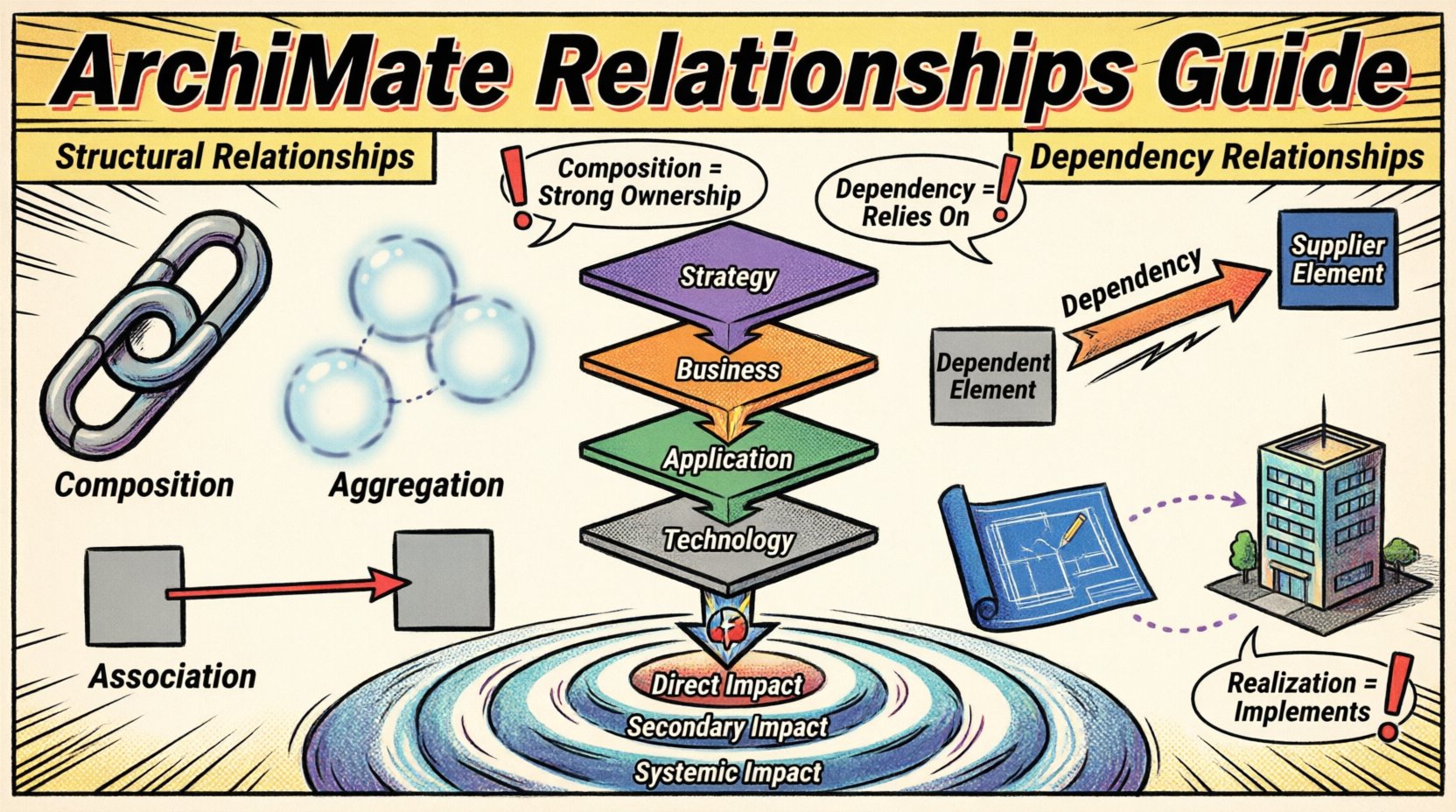
🧩 Understanding the Architectural Layers
Before diving into relationships, it is necessary to establish the context in which they exist. ArchiMate organizes architecture into three primary layers:
- Strategy Layer: Deals with mission, goals, and principles.
- Business Layer: Covers business processes, functions, and roles.
- Application Layer: Focuses on software services and applications.
- Technology Layer: Encompasses hardware, network, and system software.
There is also a Physical Layer, which represents the infrastructure hardware. Relationships define the interactions between these layers. While some relationships stay within a layer (horizontal), others cross layers (vertical). The distinction between structural and dependency relationships is vital when connecting elements across these boundaries.
🔗 Structural Relationships Deep Dive
Structural relationships describe the composition or aggregation of elements. They answer the question: “What is this thing made of?” or “How do these parts form a whole?” These relationships imply a strong binding where the existence of the whole often dictates the existence of the parts, or vice versa, depending on the specific type.
Composition
Composition is the strongest form of structural relationship. It indicates that the whole owns the parts. If the whole is destroyed, the parts are destroyed. In enterprise architecture, this is useful for defining:
- A Business Process composed of Business Functions.
- A Business Process composed of Business Objects.
- An Application Component composed of Application Services.
When modeling a process, composition implies that the process cannot exist without the functions that constitute it. This is a lifecycle dependency as well as a structural one. The ownership is exclusive; a part belongs to only one whole in a strict composition.
Aggregation
Aggregation is a weaker form of structural relationship. It indicates that the whole contains the parts, but the parts can exist independently. If the whole is removed, the parts may still persist. This is often used for:
- A Business Object structure that groups multiple data elements.
- Organizational Units grouping multiple Roles.
The key distinction here is independence. In an aggregation, the lifecycle of the part is not strictly tied to the lifecycle of the whole. This allows for flexibility in the model, reflecting real-world scenarios where resources are shared across different organizational units.
Association
Association is the most generic structural relationship. It simply indicates a connection without implying ownership or lifecycle dependency. It is used when elements are related but do not form a whole-part structure. Examples include:
- A Role interacting with a Business Process.
- An Application Function interacting with a Business Object.
Associations are neutral. They describe that a link exists, but they do not dictate that one element is built from the other. This is crucial for mapping interactions that are purely informational or procedural without structural binding.
🔄 Dependency and Flow Relationships
Dependency relationships describe how one element relies on another to function. Unlike structural relationships, which ask “what is it made of?”, dependency relationships ask “what does it need?”. These relationships are fundamental for impact analysis, as changes to a dependency source can ripple through the model.
Dependency
The Dependency relationship is the standard way to express reliance. It is often used when one element uses the services or data provided by another. In ArchiMate, this relationship is directional. It flows from the dependent element to the supplier element.
- Business Dependency: A Business Process depends on a Business Function.
- Application Dependency: An Application Service depends on an Application Function.
- Technology Dependency: An Application Component depends on a Hardware Node.
It is important to note that dependency does not imply control. It implies usage. If the supplier is unavailable, the dependent element cannot function correctly, but the dependent element does not control the supplier.
Realization
Realization is a specific type of dependency relationship where one element implements the specification of another. It is commonly used to link abstract concepts to concrete implementations. For example:
- A Business Service is realized by a Business Process.
- An Application Interface is realized by an Application Component.
- A Capability is realized by an Organization Unit.
Realization bridges the gap between “what is required” and “what is delivered.” It is the primary mechanism for tracing requirements down to implementations. Without realization, the model lacks the thread of traceability that connects high-level goals to low-level technical details.
⚖️ Comparison of Relationship Types
To clarify the differences, consider the following comparison of key relationship types. This table highlights the nature of the connection, the directionality, and the typical usage scenarios.
| Relationship Type | Nature of Connection | Direction | Typical Usage |
|---|---|---|---|
| Composition | Part-of, strong ownership | Whole to Part | |
| Aggregation | Part-of, weak ownership | Whole to Part | |
| Association | Generic link | Either way | |
| Dependency | Relies on | Dependent to Supplier | |
| Realization | Implements | Realized to Realizer | |
| Access | Read/Write | Active Element to Passive Element |
🌐 Cross-Layer Dynamics
One of the most powerful aspects of ArchiMate is the ability to connect layers. Cross-layer relationships allow architects to trace how a business goal influences a technology configuration. Understanding structural and dependency relationships across layers is essential for this traceability.
Serving
The Serving relationship is a cross-layer dependency. It indicates that a layer provides a service to another layer. Typically, a lower layer serves a higher layer. For instance, the Application layer serves the Business layer, and the Technology layer serves the Application layer.
- Business to Application: A Business Service is served by an Application Function.
- Application to Technology: An Application Component is served by a Technology Node.
This relationship emphasizes the service-oriented nature of the architecture. It highlights that the primary purpose of the lower layer is to enable the capabilities of the upper layer.
Assignment
Assignment links an active element (like a Role or Application Function) to a passive element (like a Business Object or Application Component). It describes who or what is responsible for an action or holds a data structure.
- A Role is assigned to a Business Process.
- An Application Function is assigned to an Application Component.
While Assignment is a form of association, it carries specific semantic weight regarding responsibility and ownership of execution or data.
Access
Access is distinct from Assignment. It describes the flow of information. An active element accesses a passive element. This is crucial for data flow modeling.
- A Business Process accesses a Business Object.
- An Application Function accesses a Data Object.
Distinguishing Access from Assignment prevents confusion between “who does the work” and “what data is used.” This clarity is vital when analyzing data governance and access control policies.
🛠️ Modeling Best Practices
Creating a robust ArchiMate model requires adhering to specific conventions. The following practices help maintain model integrity and clarity.
- Consistency in Terminology: Ensure that element names are consistent across layers. A “Customer” in the Business layer should map logically to a “Customer” entity in the Application layer.
- Avoid Redundancy: Do not mix relationships that convey the same meaning. For example, do not use both Association and Dependency for the same pair of elements if one is sufficient.
- Layer Alignment: Keep relationships aligned with the logical flow of the architecture. Business processes should not directly depend on Technology nodes without passing through Application layers.
- Traceability Chains: Ensure that every goal in the Strategy layer has a realization path down to the Technology layer. Broken chains indicate gaps in the architecture.
- Directionality: Always verify the direction of the arrow. Dependency flows from dependent to supplier. Realization flows from realized to realizer.
⚠️ Common Pitfalls to Avoid
Even experienced architects can introduce errors into a model. Being aware of common mistakes helps in maintaining quality.
- Over-Modeling: Trying to model every possible connection leads to a cluttered diagram. Focus on the relationships that impact decision-making.
- Mixing Control and Dependency: Do not use Dependency to represent control flow. Dependency is about reliance, not execution sequence.
- Ignoring Lifecycle: Composition implies a lifecycle link. If the parts can outlive the whole, use Aggregation instead of Composition.
- Circular Dependencies: Avoid cycles where Element A depends on B, and B depends on A. This creates logical paradoxes that complicate impact analysis.
- Unclear Cross-Layer Links: Ensure that cross-layer links are meaningful. A direct link from a Business Goal to a Hardware Node often skips necessary abstraction layers.
📊 Impact Analysis and Traceability
The primary value of defining these relationships lies in impact analysis. When a change occurs in one part of the architecture, the relationships define the scope of the ripple effect.
Upstream and Downstream Analysis
Using dependency relationships, architects can trace changes upstream to see what is affected by the change, or downstream to see what supports the change. For example, if a specific Technology Node is deprecated:
- Identify all Application Components dependent on it.
- Identify all Business Processes that use those Components.
- Identify all Business Goals that rely on those Processes.
This chain of dependencies allows for a comprehensive view of the risk associated with the change. It moves the conversation from technical specifics to business impact.
Traceability
Traceability is the ability to follow the lineage of a requirement. In ArchiMate, Realization relationships are the backbone of traceability. They link the Motivation layer to the Implementation layer.
- Requirement to Implementation: A Business Requirement is realized by a Business Process, which is served by an Application Service, which is realized by a Software Module.
- Goal to Service: A Strategic Goal is achieved by a Business Service.
Without clear relationships, traceability becomes manual and error-prone. Automated tools can leverage these defined links to generate reports on coverage and compliance.
🔍 Conclusion on Relationship Selection
Selecting the correct relationship in ArchiMate is not merely a technical exercise; it is a modeling decision that reflects the business reality. Structural relationships define the makeup of the organization, while dependency relationships define the flow of value and reliance.
By carefully distinguishing between Composition, Aggregation, Association, Dependency, and Realization, architects create models that are both accurate and useful. These models serve as the foundation for strategic planning, transformation initiatives, and operational stability. The effort invested in clarifying these connections pays dividends in reduced ambiguity and improved communication across the enterprise.
When building the next architecture model, prioritize clarity over complexity. Use the relationships that best fit the actual interactions within the organization. This disciplined approach ensures that the architecture remains a living document that guides decision-making rather than a static diagram that gathers dust.