
💡 Key Takeaways
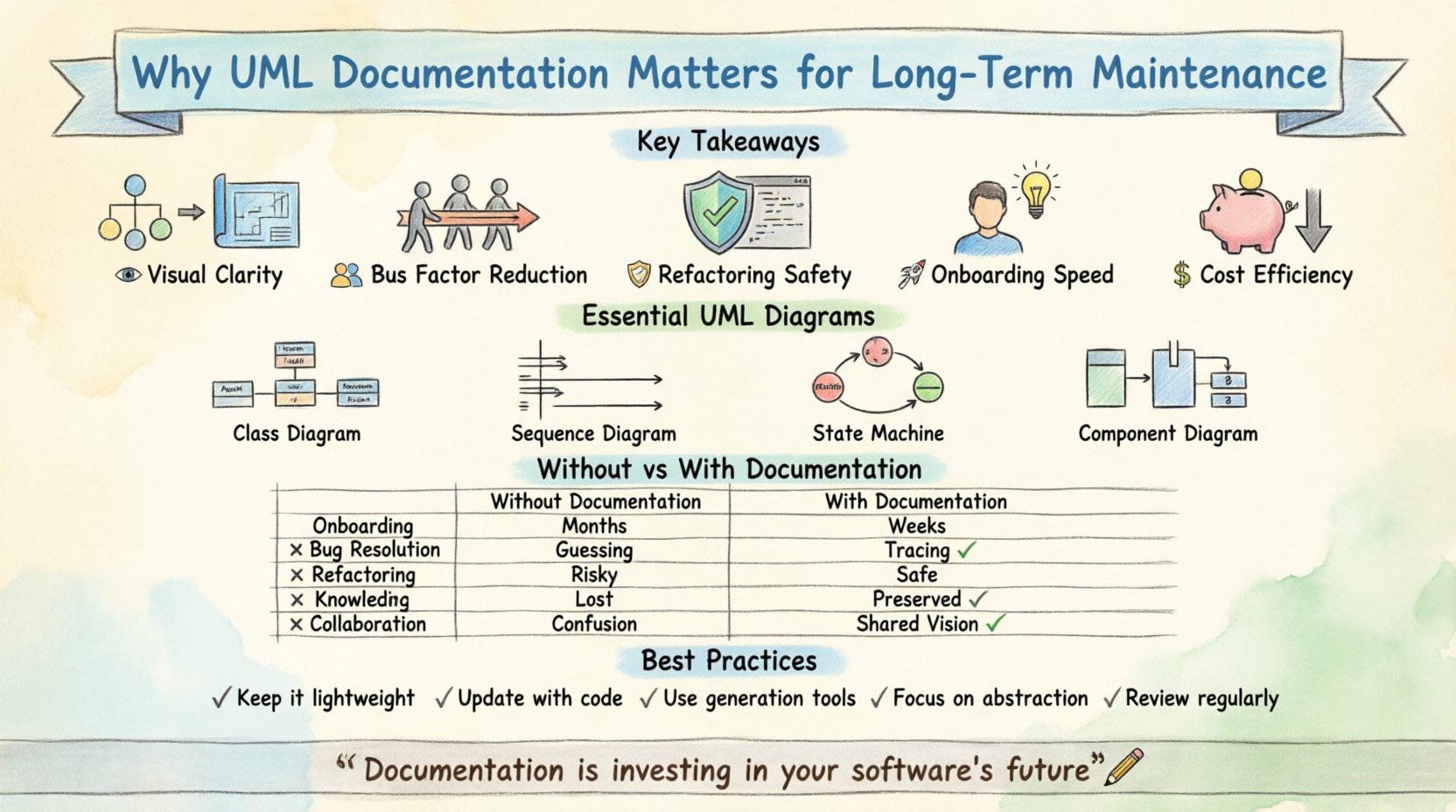
- Visual Clarity: UML diagrams transform abstract logic into visual blueprints, reducing ambiguity during code reviews.
- Bus Factor Reduction: Comprehensive documentation ensures knowledge transfer when key team members leave the project.
- Refactoring Safety: Accurate models allow developers to predict side effects before changing core architecture.
- Onboarding Speed: New engineers understand system flow faster when sequence and class diagrams exist.
- Cost Efficiency: Investing in diagrams early reduces the high cost of fixing structural errors in production.
In the realm of software engineering, code is often viewed as the primary artifact. However, code is merely the implementation of a design. When a system grows over years, the code itself becomes a labyrinth of dependencies and legacy patterns. This is where Unified Modeling Language (UML) documentation transitions from a theoretical exercise to a critical asset for maintenance. Without a clear map of the system’s structure and behavior, even the most skilled engineer struggles to navigate the complexity. This article explores why documentation, specifically visual modeling, is the backbone of sustainable software.
The Lifecycle of Software and Knowledge Decay ⏳
Software is rarely static. It evolves to meet changing business requirements, fix bugs, and adapt to new technologies. This evolution creates a phenomenon known as knowledge decay. When a project starts, the original architects and developers understand the logic intimately. Over time, team members rotate, leave, or shift focus. The mental model of the system fades, but the code remains. This gap creates a high risk of introducing regressions.
Documentation acts as the persistent memory of the project. Unlike human memory, which is fallible and subject to change, written and visual records remain stable. UML diagrams serve as a language that bridges the gap between technical implementation and business logic. They allow stakeholders to understand the system without needing to read every line of code. For maintenance teams, this is invaluable. It answers the question: “Why was this built this way?” before they even touch a file.
UML as a Communication Tool 🗣️
Communication is the single most important skill in software development. Misunderstandings lead to bugs, delays, and technical debt. UML provides a standardized set of visual notations that are universally understood by technical teams. It removes the ambiguity of natural language descriptions. Consider the difference between a paragraph describing a user login process and a Sequence Diagram showing the interaction between the interface, the controller, the service layer, and the database.
The diagram conveys timing, state, and failure conditions instantly. It highlights bottlenecks and potential points of failure that text might obscure. In a maintenance context, this clarity is essential. When a bug report comes in, a developer can trace the flow of data through the diagrams to isolate the issue. This reduces the time spent guessing and increases the time spent solving.
Maintenance Challenges Without Documentation 📉
When documentation is absent, maintenance becomes a process of reverse engineering. Developers must trace execution paths through code to understand the original intent. This is not only time-consuming but also prone to error. Code is often written with assumptions that are not immediately obvious. Without a diagram, these assumptions remain hidden.
Consider the Bus Factor. If only one person understands a specific module, the project is at risk. If that person leaves, knowledge is lost. Documentation mitigates this risk. It ensures that the logic is accessible to anyone on the team. Furthermore, without diagrams, refactoring is dangerous. Changing a class structure can have ripple effects throughout the system. If the relationships between classes are not documented, developers may break dependencies they did not know existed.
Another challenge is Technical Debt. Undocumented systems often accumulate “spaghetti code” where logic is scattered and intertwined. Over time, the cost to modify the system outweighs the cost to rewrite it. Documentation helps identify areas of high complexity that need attention. It allows teams to prioritize refactoring efforts based on structural risks rather than just code volume.
The Benefits of UML Documentation 📊
Investing time in creating and maintaining UML diagrams yields significant returns during the maintenance phase. The benefits extend beyond simple understanding; they impact efficiency, quality, and team dynamics.
| Aspect | Without Documentation | With UML Documentation |
|---|---|---|
| Onboarding | Months to understand core flows | Weeks with visual aids |
| Bug Resolution | Guessing and trial-and-error | Tracing logic through diagrams |
| Refactoring | High risk of breaking dependencies | Safe changes with clear impact analysis |
| Knowledge Retention | Lost when staff leaves | Preserved in artifacts |
| Team Collaboration | Misinterpretations of requirements | Shared visual understanding |
Types of UML Diagrams for Maintenance 📝
Not all diagrams are equally useful for maintenance. Different aspects of the system require different views. Selecting the right diagram type ensures that the documentation is relevant.
1. Class Diagrams
These describe the static structure of the system. They show classes, attributes, methods, and relationships (inheritance, association, aggregation). For maintenance, class diagrams are critical for understanding how data flows between objects. When a new feature is added, a developer can check the class diagram to see if a new method should be added to an existing class or if a new class is required.
2. Sequence Diagrams
These illustrate how objects interact over time. They are essential for understanding the flow of a specific use case. If a feature is broken, a sequence diagram helps pinpoint exactly which object failed to respond or sent incorrect data. It captures the dynamic behavior that code alone might not reveal clearly.
3. State Machine Diagrams
For systems with complex logic states, such as order processing or workflow engines, state diagrams are vital. They show the various states an object can be in and the events that trigger transitions. Maintenance often involves adding new states or modifying transition rules. Without this documentation, changing a state logic can lead to inconsistent system behavior.
4. Component Diagrams
These show the high-level architecture, grouping classes into components and libraries. They help maintenance teams understand the boundaries of the system. When integrating with third-party services or new modules, component diagrams clarify where the system ends and external dependencies begin.
Best Practices for Sustainable Documentation 📌
Creating diagrams is not enough; they must be maintained. Documentation that becomes outdated is worse than no documentation, as it misleads the team. Here are strategies to keep UML artifacts useful.
- Keep it Lightweight: Do not document every single method. Focus on the architecture and critical flows. Over-documentation leads to maintenance fatigue.
- Integrate with Workflow: Update diagrams when code changes. Treat diagram updates as part of the definition of done for a task.
- Use Generation Tools: Where possible, generate diagrams from code to ensure synchronization. While manual updates are still needed for high-level logic, this reduces the gap between code and model.
- Focus on Abstraction: Maintenance teams need to understand the what and why, not just the how. Diagrams should abstract away implementation details that clutter the view.
- Review Regularly: Schedule periodic reviews of the documentation to ensure it matches the current state of the system.
The Cost of Inaction 💸
Skipping documentation is often seen as a way to save time. In reality, it is a false economy. The time saved in the initial development phase is quickly lost in the maintenance phase. Every hour spent deciphering undocumented code is an hour not spent adding value. The cost of fixing a bug in production is exponentially higher than fixing it during the design phase.
Furthermore, the loss of institutional knowledge affects morale. Engineers feel frustrated when they cannot understand the system. They feel like they are constantly putting out fires rather than building new features. Good documentation empowers the team. It gives them confidence to make changes and the security to know that the system will not collapse.
Conclusion: Building for the Future 🏗️
Long-term maintenance is not about keeping the lights on; it is about ensuring the system remains adaptable. UML documentation provides the structure needed to adapt without breaking. It transforms the codebase from a black box into a transparent system. By prioritizing clear visual models, teams reduce risk, improve collaboration, and extend the lifespan of their software.
The decision to document is a decision to invest in the future. It signals a commitment to quality and sustainability. In an industry where technology changes rapidly, the ability to maintain and evolve a system is the true measure of success. Documentation is the foundation of that ability.