
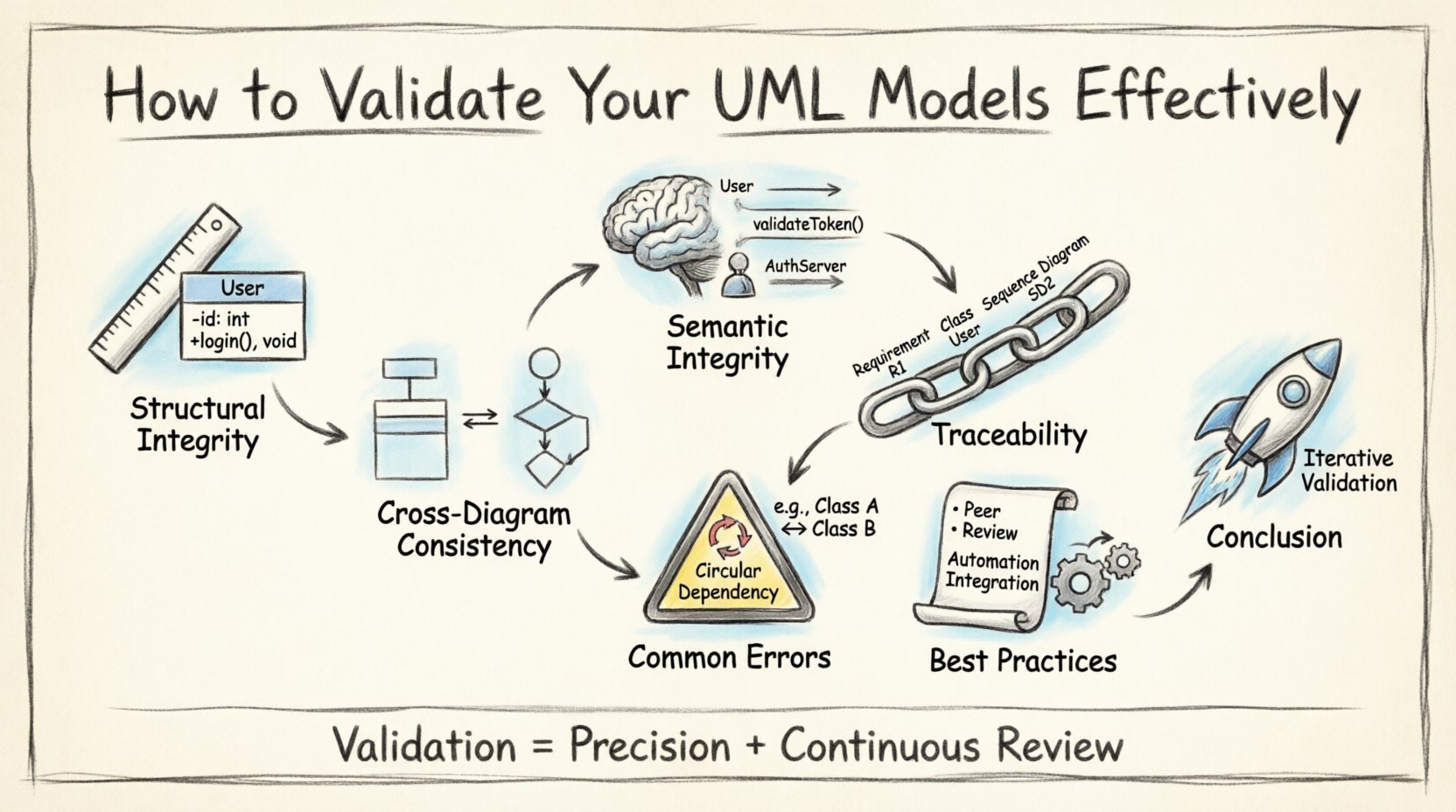
In the realm of software architecture, a model is more than a drawing; it is a contract between the design intent and the implementation reality. Unified Modeling Language (UML) provides a standardized notation to capture this intent. However, the mere existence of a diagram does not guarantee its correctness. Validation is the critical process that ensures your models are accurate, consistent, and ready for the next phase of development. Without rigorous validation, technical debt accumulates silently, leading to implementation errors and costly refactoring later in the lifecycle. 🛠️
💡 Key Takeaways
Structural Integrity: Ensure every diagram adheres to UML syntax rules and grammar before assessing meaning.
Consistency Checks: Verify that relationships in sequence diagrams match the state transitions in state machine diagrams.
Traceability: Maintain a clear link between requirements and model elements to ensure nothing is overlooked.
Automated Verification: Leverage validation engines to catch syntax errors and logical contradictions early.
Iterative Review: Validation is a continuous activity, not a one-time gate before code generation.
🔍 Why Validation Matters in Model-Driven Design
UML serves as the blueprint for complex systems. When developers interpret a flawed blueprint, the resulting structure is compromised. Validation acts as the quality assurance mechanism for these blueprints. It distinguishes between a diagram that looks correct visually and one that is logically sound. A model might render perfectly but contain impossible state transitions or circular dependencies that render the system unbuildable.
Effective validation reduces ambiguity. It forces the architect to resolve contradictions before they become embedded in the codebase. This process saves time during the coding phase, as the design team can resolve logical gaps while the context is still fresh. Furthermore, it facilitates communication. When stakeholders review a validated model, they can focus on business logic rather than questioning the structural validity of the diagram itself. ✅
1. Ensuring Syntactic Correctness
The first layer of validation is syntactic. This involves checking whether the model adheres to the formal grammar of UML. Every element has specific rules regarding how it can be connected to others. For instance, a Generalization relationship can only exist between two classifiers, not between a class and an interface in certain contexts without proper implementation. 📝
Syntactic validation tools typically scan the model for:
Undefined References: Links pointing to elements that do not exist within the repository.
Invalid Multiplicities: Association ends where the cardinality constraints are mathematically impossible.
Orphaned Elements: Diagrams containing elements that are not connected to the rest of the system structure.
Reserved Keyword Usage: Ensuring standard terms are not misused as identifiers.
Without this foundation, semantic analysis is futile. A diagram with broken syntax cannot be parsed correctly by downstream tools, preventing code generation or simulation. It is the digital equivalent of a blueprint with missing dimensions or undefined materials.
2. Checking Semantic Integrity
Once the syntax is sound, the focus shifts to semantics. This layer asks: Does the model accurately represent the intended behavior and logic of the system? A diagram may be grammatically perfect but semantically void. For example, a sequence diagram might show a method call, but if the target class does not possess that method, the behavior is invalid. 🧠
Key areas for semantic validation include:
Logic Flow: Do the interactions make sense in a real-world scenario? Are there deadlocks or infinite loops implied by the interaction flow?
State Constraints: In state machine diagrams, does every state have a valid exit path? Are all triggers covered?
Data Types: Do parameters in operation signatures match the data types defined in the class attributes?
Business Rules: Do the constraints and preconditions reflect actual business requirements?
This phase often requires human review. Automated engines struggle with context-specific logic. Architects must walk through the critical paths of the system to verify that the model reflects the domain reality accurately.
3. Cross-Diagram Consistency
UML is a multi-view language. A single system is represented through various diagrams: class, sequence, state, component, and deployment. A common pitfall is inconsistency between these views. The class diagram defines the structure, while the sequence diagram defines the behavior. These two must align perfectly. 🔄
Consistency validation checks the following:
View Pair | Validation Focus | Common Error |
|---|---|---|
Class & Sequence | Operation Signatures | Sequence calls a method not defined in Class Diagram |
Class & State Machine | Attributes & Triggers | State transition triggers an attribute that does not exist |
Component & Deployment | Interface Provision | Component requires an interface not provided by Deployment Node |
Use Case & Class | Actor Responsibilities | Actor performs an action not supported by any Class |
When inconsistencies arise, they usually indicate a gap in the design. The model needs to be updated to reflect the true scope of the system. Maintaining consistency across views is an ongoing discipline, requiring regular synchronization as the design evolves.
4. Establishing Traceability
A validated model must trace back to the source of truth: the requirements. If a feature is not modeled, it will not be built. If a model element does not map to a requirement, it may be unnecessary complexity. Traceability links ensure that the design remains aligned with business goals. 📊
To validate traceability:
Requirement Coverage: Verify that every requirement ID has at least one corresponding element in the model (e.g., a class, use case, or state).
Forward Traceability: Ensure that every design element can be traced forward to a test case or implementation artifact.
Impact Analysis: Understand which requirements are affected if a specific model element is changed. This helps in assessing the risk of refactoring.
Traceability matrices are often used to document these links. During validation, these matrices should be audited to ensure no links are broken or orphaned. This practice prevents scope creep and ensures that the model remains a faithful representation of the project scope.
5. Identifying Common Modeling Errors
Certain patterns of error recur frequently in UML modeling. Recognizing these patterns accelerates the validation process. ⚠️
Circular Dependencies: Class A depends on Class B, which depends on Class C, which depends on Class A. This creates a compilation error in code and a logical paradox in design.
Over-Abstraction: Creating generic classes that are too broad to be instantiated or used effectively. This leads to a model that is hard to understand and harder to implement.
Missing Navigation: In class diagrams, associations should clearly indicate navigability. If a class needs to know about another, the arrow must point in the correct direction.
Redundant Inheritance: Using inheritance where composition would be more appropriate. This creates tight coupling and makes the system rigid.
6. Best Practices for Validation Workflows
Validation is not a single event but a continuous workflow. Integrating validation into the daily design process ensures that issues are caught early. 🔎
Regular Audits: Schedule periodic reviews of the model repository. As the system grows, old models may drift from the current reality. Regular audits keep the documentation current.
Peer Reviews: Have another architect review the model. A fresh pair of eyes can spot inconsistencies that the original author misses. This is often more effective than automated tools for semantic checks.
Incremental Validation: Do not wait for the entire system to be modeled before validating. Validate each module or subsystem as it is completed. This reduces the cognitive load of finding errors in a massive model.
Tool Support: Utilize modeling environments that offer built-in validation engines. These tools can automatically check for syntax errors and basic consistency issues, allowing human reviewers to focus on logic and architecture.
7. Conclusion
Validating UML models is a disciplined practice that bridges the gap between abstract design and concrete implementation. It requires a blend of automated checks for syntax and human insight for semantics. By focusing on structural integrity, cross-diagram consistency, and traceability, architects can ensure that their models serve as reliable foundations for software development. This diligence pays dividends in the form of reduced rework, clearer communication, and higher quality systems. 🚀
The process of validation is not about perfectionism; it is about precision. Every checked box and verified link contributes to a system that is robust and maintainable. Treat the model as a living document that requires the same care as the code it describes.