
Enterprise Architecture (EA) sits at the intersection of business strategy and technology execution. It is the discipline that ensures an organization’s IT landscape aligns with its long-term goals. For many, the path into this field seems daunting, filled with complex diagrams and abstract concepts. However, with the right guidance and a structured approach, anyone can build a solid foundation.
This guide addresses common questions about the field, offering a clear roadmap for professionals looking to transition into EA roles. We will explore definitions, frameworks, skills, and the day-to-day realities of the profession without relying on marketing hype.
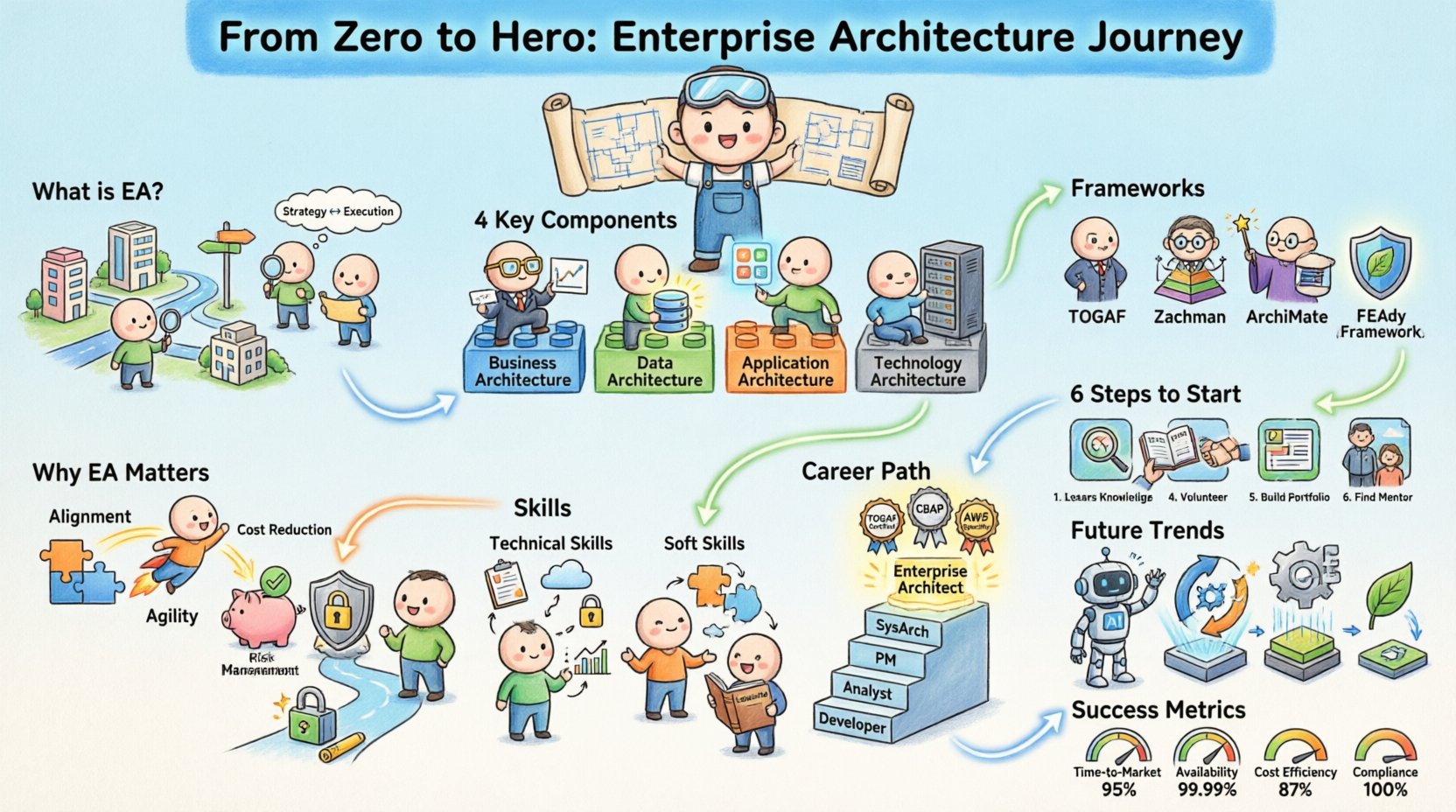
🤔 What Exactly is Enterprise Architecture?
At its core, Enterprise Architecture is a blueprint. It describes the current state of an organization’s infrastructure, applications, and data, and defines the target state required to meet business objectives. It is not just about drawing boxes and lines; it is about understanding how different parts of the organization interact.
Think of it as urban planning for a city. You cannot build a new highway without considering traffic flow, zoning laws, and environmental impact. Similarly, EA ensures that new software or processes do not create bottlenecks or security risks.
Key Components of EA
- Business Architecture: Defines the strategy, governance, organization, and key business processes.
- Data Architecture: Describes how data is stored, organized, and managed across the enterprise.
- Application Architecture: Provides a blueprint for individual applications and their interactions.
- Technology Architecture: Describes the hardware and software infrastructure required to support the applications.
💼 Why Do Organizations Need Enterprise Architecture?
Organizations often face fragmentation. Different departments buy different tools that do not talk to each other. This leads to data silos, redundant costs, and security vulnerabilities. EA solves this by providing a holistic view.
Here are the primary reasons companies invest in this discipline:
- Alignment: Ensures technology investments support actual business needs, not just IT preferences.
- Agility: Allows the organization to respond quickly to market changes by understanding dependencies.
- Cost Reduction: Identifies redundant systems and processes that can be consolidated.
- Risk Management: Helps identify security gaps and compliance issues before they become critical failures.
📚 Understanding EA Frameworks
Frameworks provide a standardized approach to organizing architectural work. They are not software tools but rather structured methodologies. Below is a comparison of widely used frameworks to understand their focus areas.
| Framework | Primary Focus | Best Used For |
|---|---|---|
| TOGAF | Comprehensive process for developing architecture | Large enterprises needing a standardized lifecycle |
| Zachman | Ontological classification of artifacts | Ensuring all perspectives are covered |
| ArchiMate | Modeling language for architecture | Visualizing relationships between layers |
| FEAF | Federal enterprise architecture | Government and public sector entities |
Choosing the right framework depends on the organization’s size and complexity. Many practitioners adapt these models rather than following them rigidly.
🛠️ What Skills Are Required to Succeed?
Becoming an Enterprise Architect requires a blend of hard technical skills and soft interpersonal abilities. You must be able to translate business requirements into technical specifications and vice versa.
Technical Competencies
- System Modeling: Ability to create diagrams that represent complex systems clearly.
- Cloud Knowledge: Understanding of cloud computing models (IaaS, PaaS, SaaS) and migration strategies.
- Security Principles: Knowledge of identity management, encryption, and compliance standards.
- Data Management: Familiarity with data governance, warehousing, and analytics.
Soft Skills That Matter
- Communication: Explaining technical debt to non-technical stakeholders requires clarity and patience.
- Leadership: Influencing decision-makers without always having direct authority.
- Problem Solving: Breaking down large, vague problems into manageable components.
- Curiosity: Staying updated on emerging trends and understanding their potential impact.
📈 How to Build a Career in Enterprise Architecture
There is no single degree that qualifies you for this role. Most architects transition from other IT or business roles. The path is often non-linear.
Common Entry Points
- System Architect: Moving from designing specific systems to designing the overall ecosystem.
- Business Analyst: Leveraging understanding of business processes to inform technical decisions.
- Project Manager: Using experience in delivery to understand the lifecycle of solutions.
- Software Developer: Gaining deep technical knowledge before expanding to the broader picture.
Certifications to Consider
Certifications validate your knowledge but do not replace experience. They show commitment to the field.
- TOGAF Certification: Widely recognized for the architecture development method.
- Certified Enterprise Architect: Focuses on the broader scope of organizational alignment.
- Cloud Certifications: Vendor-neutral or specific cloud provider credentials to prove infrastructure knowledge.
❓ Common Challenges in the Field
Even with the best plans, resistance is common. Here are questions professionals often ask about the hurdles they face.
Q: How do I handle resistance to change?
Change management is a critical part of the job. Stakeholders often prefer the status quo because it feels safe. To overcome this:
- Show Value: Demonstrate how the change reduces cost or risk.
- Involve Stakeholders: Get buy-in early by including them in the planning process.
- Start Small: Pilot programs prove success before full-scale rollout.
Q: Is the role too abstract?
Some architects struggle with being too theoretical. The key is to remain grounded.
- Stay Connected: Regularly review code, logs, or dashboards to understand the reality of the systems.
- Focus on Outcomes: Measure success by business metrics, not just diagram completeness.
- Iterate: Treat architecture as a living document that evolves with the business.
Q: How do I keep up with technology?
The technology landscape shifts rapidly. Trying to learn everything is impossible.
- Focus on Fundamentals: Concepts like data flow and security remain constant.
- Read Industry Reports: Follow analyst firms for trend analysis.
- Network: Learn from peers about what is working in their organizations.
🚀 Steps to Get Started Today
If you are ready to begin this journey, here is a practical checklist to guide your initial efforts.
- 1. Assess Your Current Knowledge: Identify gaps between your current role and the EA skill set.
- 2. Learn a Modeling Language: Start with basic diagramming tools and notation standards.
- 3. Study a Framework: Read the core documentation of a major framework like TOGAF.
- 4. Volunteer for Projects: Ask to participate in architectural reviews or planning sessions.
- 5. Build a Portfolio: Document case studies where you improved alignment or efficiency.
- 6. Find a Mentor: Connect with an experienced architect for guidance and feedback.
🔮 The Future of Enterprise Architecture
The role is evolving. As organizations become more digital, the boundary between business and IT blurs. EA is becoming more about innovation and less about documentation.
Emerging Trends
- AI Integration: Using artificial intelligence to analyze architecture data for optimization.
- Continuous Architecture: Moving from periodic planning to real-time adaptation.
- Platform Engineering: Shifting focus to internal developer platforms and product thinking.
- Sustainability: Considering the carbon footprint of technology infrastructure in planning.
📊 Measuring Success in Enterprise Architecture
How do you know if the architecture is working? Metrics are essential to prove value.
- Time to Market: Does the architecture enable faster delivery of features?
- System Availability: Is the infrastructure stable and reliable?
- Cost Efficiency: Are we reducing technical debt and infrastructure spend?
- Compliance Rate: Are we meeting regulatory requirements consistently?
💡 Final Thoughts on the Journey
Entering the world of Enterprise Architecture is a commitment to continuous learning. It requires patience, as results may not be immediate. However, the impact of effective architecture is profound. It creates stability in chaos and clarity in complexity.
By focusing on the fundamentals, building relationships, and understanding the business, you can navigate this path successfully. The goal is not just to design systems, but to design a future that is resilient and adaptable.
Remember, there is no single “right” way to do EA. Every organization is unique. The best architects are those who adapt their methods to fit their specific context while maintaining core principles of alignment and efficiency.