
In the complex landscape of modern enterprise architecture, maintaining consistency and alignment across business and IT strategies is a persistent challenge. Governance serves as the backbone for ensuring that architectural decisions support organizational goals without drifting into fragmentation or technical debt. ArchiMate provides a standardized modeling language that facilitates this alignment. By leveraging its structured approach, organizations can define clear rules, validate models, and enforce policies effectively.
This guide explores the mechanisms of enforcing governance using ArchiMate standards. It details the structural layers, the dynamic relationships, and the practical steps required to embed governance into the architecture lifecycle. We focus on the framework itself, avoiding specific tool implementations to remain neutral and universally applicable.
📋 The Role of Governance in Enterprise Architecture
Architecture governance is not merely about control; it is about enabling informed decision-making. Without a standardized language, communication between stakeholders becomes prone to misinterpretation. Governance ensures that every model created reflects the current state of the enterprise and aligns with future targets.
- Consistency: Ensures that terminology and modeling conventions remain uniform across different domains.
- Compliance: Verifies that architectural designs adhere to regulatory and internal policy requirements.
- Alignment: Connects business strategy directly to IT capabilities through traceable relationships.
- Quality: Establishes criteria for what constitutes a valid and usable architectural model.
When governance is embedded into the modeling process, it reduces the risk of costly rework and ensures that investments deliver the intended value. ArchiMate supports this by offering a multi-layered view that separates concerns while maintaining connectivity.
🧩 Understanding the ArchiMate Language
ArchiMate is an open and independent standard for enterprise architecture. It provides a structured way to describe, analyze, and visualize the relationship between business, information, application, and technology layers. This structure is vital for governance because it allows architects to categorize and manage artifacts based on their domain.
Core Components of the Framework
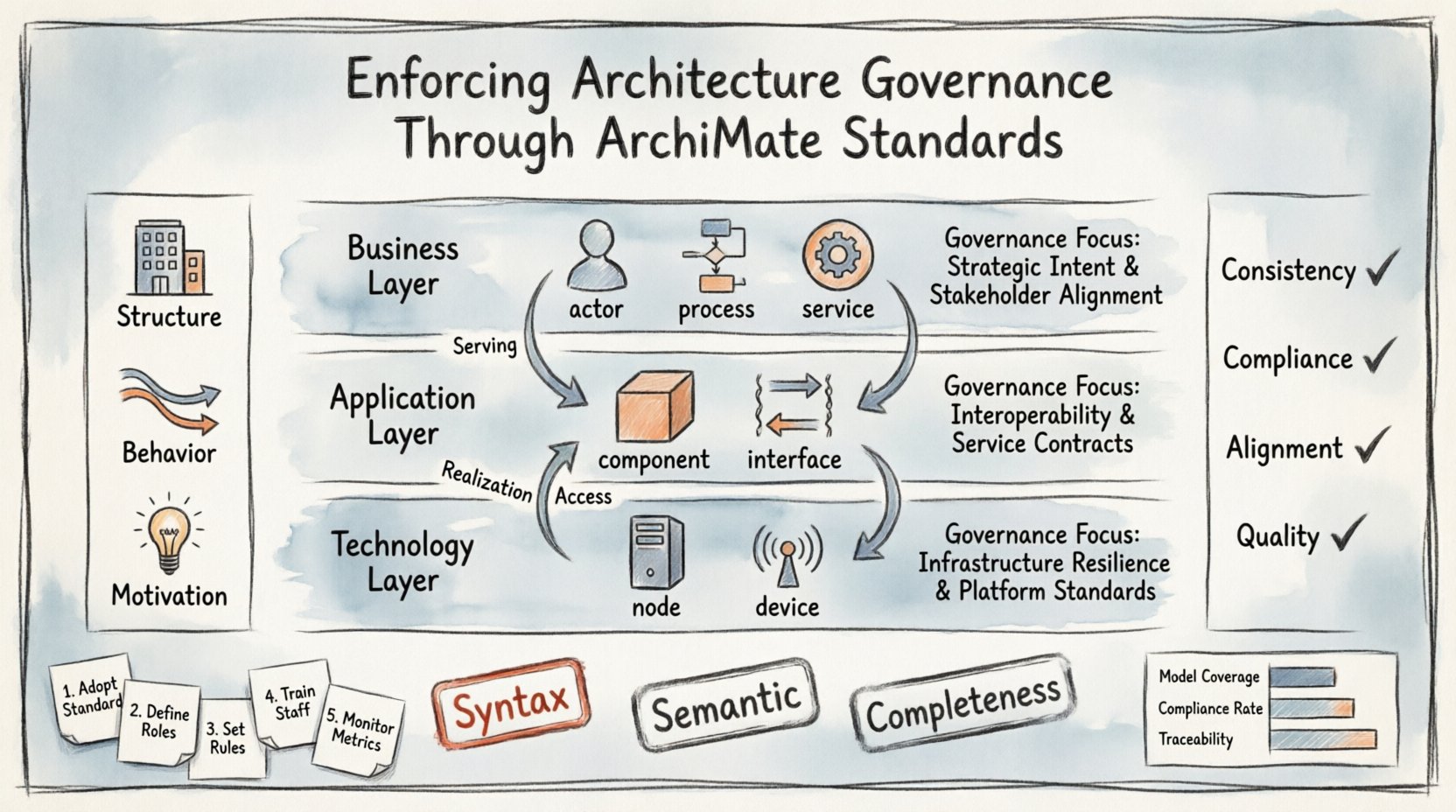
To enforce governance, one must first understand the building blocks. The framework consists of three primary dimensions: structure, behavior, and motivation.
- Structure: Represents the static elements of the enterprise, such as business actors, applications, and infrastructure.
- Behavior: Describes the dynamic aspects, including processes, functions, and services.
- Motivation: Captures the reasons behind architectural decisions, including goals, principles, and requirements.
Governance becomes more robust when it addresses all three dimensions. A decision might be structurally sound but fail to meet a strategic goal. Conversely, a strong goal might be ignored if the structural impact is not modeled.
🏗️ The Three Core Layers and Governance Touchpoints
The stratification of ArchiMate into distinct layers allows for targeted governance. Each layer has specific artifacts and relationships that require validation. By mapping governance rules to these layers, organizations can ensure that changes are propagated correctly.
| Layer | Key Artifacts | Governance Focus |
|---|---|---|
| Business Layer | Business Actor, Process, Service | Strategic alignment, Regulatory compliance |
| Application Layer | Application Component, Application Interface | Functional coverage, Integration standards |
| Technology Layer | Node, Device, Infrastructure | Security, Performance, Reliability |
Business Layer Governance
The business layer defines the core value proposition of the organization. Governance here ensures that business processes are optimized and that services align with customer needs. Key activities include validating that every process has a defined owner and that every service maps to a business goal.
Application Layer Governance
This layer bridges business needs with technical solutions. Governance rules here focus on data integrity, interface standardization, and reuse of components. Architects must verify that no application layer element exists without a corresponding business function.
Technology Layer Governance
The technology layer supports the applications. Governance ensures that infrastructure choices meet security policies and performance requirements. It also mandates that hardware and software versions are tracked and that dependencies are documented.
🔄 Dynamic Modeling for Governance Flow
Static models show what exists, but dynamic models show how things work. Governance must account for the flow of information and control. ArchiMate allows for the modeling of relationships between elements across layers, which is critical for impact analysis.
- Serving Relationships: Define which applications serve business functions. Governance checks ensure that critical functions are not dependent on single points of failure.
- Access Relationships: Show how users interact with applications. Governance validates that access rights are documented and compliant with security policies.
- Realization Relationships: Indicate how a goal is achieved. Governance ensures that every strategic objective has a realized architectural path.
By modeling these flows, governance teams can simulate changes. If a technology node is removed, the model reveals which applications and business processes are affected. This proactive approach prevents downtime and operational disruption.
🛡️ Establishing Compliance and Validation Rules
Effective governance requires explicit rules. These rules define the constraints that models must satisfy before they are approved. Using ArchiMate, rules can be defined at the meta-model level, ensuring that the language itself enforces standards.
Defining Principles
Principles are high-level guidelines that inform decision-making. In the context of ArchiMate, principles are modeled within the Motivation Layer. Examples include:
- Standardization: All systems must use approved interfaces.
- Security: All data flows must be encrypted.
- Scalability: Infrastructure must support a 50% growth in load.
When creating a model, architects must reference these principles. Governance checks verify that no design contradicts an established principle.
Validation Mechanisms
Validation can be manual or automated. Regardless of the method, the criteria must be clear.
- Syntax Validation: Ensures that the model follows the correct syntax of the ArchiMate specification.
- Semantic Validation: Ensures that the relationships make logical sense (e.g., a Business Actor cannot directly realize a Technology Node).
- Completeness Validation: Ensures that all necessary stakeholders and functions are modeled.
📊 Measuring Governance Effectiveness
To improve governance, metrics are essential. Organizations need to know if their governance framework is working. ArchiMate models provide the data needed to calculate these metrics.
- Model Coverage: What percentage of the enterprise is currently modeled?
- Change Frequency: How often are models updated to reflect reality?
- Compliance Rate: What percentage of projects pass governance checks without remediation?
- Traceability: How many links exist between business goals and technical components?
Tracking these metrics over time reveals trends. A drop in traceability might indicate a breakdown in communication between business and IT. A high compliance rate suggests that governance is integrated into daily work rather than acting as a bottleneck.
🚧 Common Implementation Hurdles
Implementing ArchiMate governance is not without challenges. Organizations often face resistance or confusion during the initial phases. Recognizing these hurdles allows for better mitigation strategies.
Complexity Overload
Attempting to model everything at once leads to paralysis. It is better to start with critical domains. Focus on the high-value processes and systems first. Gradually expand the scope as the framework gains maturity.
Lack of Training
ArchiMate has a steep learning curve. Without proper training, architects may misuse the notation, leading to inaccurate models. Governance becomes ineffective if the underlying models are flawed. Regular workshops and certification programs are recommended.
Tool Dependency
Organizations sometimes focus too heavily on the software used to create models rather than the standards themselves. The language is independent of the tool. Emphasize the standard over the platform to ensure long-term viability.
📈 Sustaining the Governance Model
Governance is a continuous process, not a one-time project. It requires ongoing maintenance and adaptation. As the enterprise evolves, the ArchiMate models must evolve with it.
- Regular Reviews: Schedule periodic audits of the architecture repository to ensure accuracy.
- Feedback Loops: Allow stakeholders to report discrepancies between the model and reality.
- Version Control: Maintain a history of model changes to track the evolution of the enterprise.
By embedding these practices, organizations create a living architecture. The models become a reliable source of truth rather than static documents that gather dust.
🌐 The Future of Architecture Governance
The landscape of enterprise architecture is shifting towards greater agility and automation. Governance frameworks must adapt to support these changes. ArchiMate is evolving to accommodate new paradigms such as cloud computing and microservices.
- Automation: Tools will increasingly validate models automatically against governance rules.
- Integration: Architecture models will integrate more tightly with DevOps pipelines.
- Visualization: Better dashboards will make governance metrics visible to non-technical stakeholders.
Staying current with these developments ensures that the governance framework remains relevant. The goal is to enable speed without sacrificing control.
🎯 Summary of Key Actions
To successfully enforce governance using ArchiMate standards, organizations should take the following steps:
- Adopt the Standard: Commit to the ArchiMate language as the primary modeling notation.
- Define Roles: Clearly assign responsibility for model creation and review.
- Set Rules: Establish clear validation criteria for each layer.
- Train Staff: Invest in education to ensure correct usage of the framework.
- Monitor Metrics: Track the health and coverage of the architecture.
- Iterate: Continuously improve the governance process based on feedback.
By following this structured approach, enterprises can build a resilient architecture that supports strategic objectives. Governance becomes an enabler of value, not an obstacle to progress.
🔗 Conclusion
Enforcing architecture governance through ArchiMate standards requires discipline, clarity, and ongoing commitment. It transforms the architecture practice from a documentation exercise into a strategic asset. By leveraging the layers, relationships, and motivation constructs of the framework, organizations can maintain alignment between business and IT.
The path forward involves continuous improvement and adaptation. As technology changes, the governance model must remain flexible. With the right standards in place, enterprises can navigate complexity with confidence and clarity.