
Enterprise architecture frameworks provide the structure needed to align business strategy with technology. Among these frameworks, ArchiMate offers a robust standard for visualizing and analyzing complex business landscapes. One critical aspect of modern enterprise architecture is understanding how customers interact with an organization. This interaction is often referred to as the customer journey. Mapping these journeys within the Business Layer of ArchiMate allows organizations to visualize touchpoints, identify value streams, and ensure alignment between customer needs and internal capabilities. This guide explores the methodology for charting these journeys effectively using standard modeling techniques.
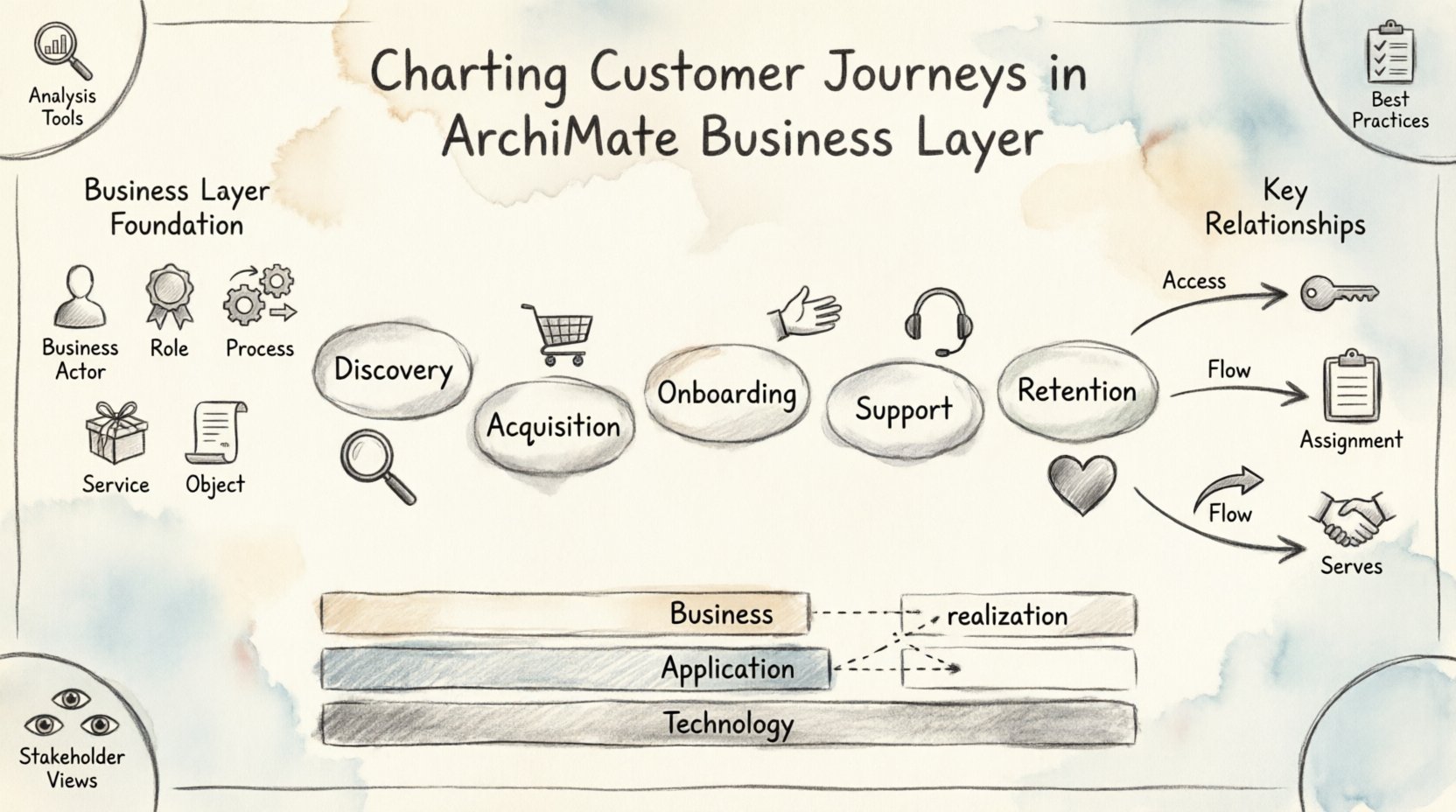
Understanding the Business Layer Foundation 🏗️
The Business Layer serves as the primary interface for describing the business structure, processes, and interactions. It focuses on the organization itself, independent of specific software or technology implementations. When modeling customer journeys, this layer acts as the canvas upon which the narrative of value delivery is painted.
Key components within this layer include:
- Business Actors: Entities capable of performing activities, such as customers, partners, or external agencies.
- Business Roles: Functions that can be played by actors, such as a Customer Support Agent or Account Manager.
- Business Processes: Structured sequences of activities that produce specific results.
- Business Services: Units of functionality provided by the business to stakeholders.
- Business Objects: Logical representations of data managed by the business, such as an Order or Invoice.
By grounding the customer journey in these elements, architects ensure that the model remains stable even as underlying technologies change. This abstraction is vital for maintaining a long-term view of organizational capability.
Identifying Journey Actors and Roles 👥
The first step in charting a journey is identifying who is involved. In a customer journey context, the primary actor is the customer. However, the journey often involves internal roles that facilitate the experience.
External vs. Internal Actors
Distinguishing between external and internal participants helps clarify responsibility and value exchange. Use the following criteria to categorize actors:
- Primary Actors: The customer or client initiating the interaction. Their goal is to achieve a need or solve a problem.
- Supporting Actors: Internal or external entities that assist the primary actor. This includes sales teams, logistics partners, or billing departments.
- Regulatory Actors: Bodies that enforce rules, such as compliance officers or government agencies.
For example, in a digital banking journey, the Account Holder is the primary actor. The Verification System might be modeled as a business role played by the Security Officer. Clearly defining these roles prevents ambiguity during analysis.
Mapping Processes and Services 🔄
Once actors are defined, the flow of activities must be structured. Customer journeys are essentially sequences of business processes triggered by customer actions. These processes are supported by services that deliver value.
Defining the Value Stream
A value stream represents the end-to-end flow of activities that create value for the customer. In ArchiMate, this is often modeled as a series of business processes linked by flow relationships. Consider the following stages:
- Discovery: The customer learns about the service.
- Acquisition: The customer engages in the transaction or sign-up.
- Onboarding: The customer begins using the service.
- Support: Ongoing assistance and maintenance.
- Retention: Renewal or continued engagement.
Service Provisioning
Every stage in the journey requires specific business services. These services are the interface between the process and the customer. For instance, a Product Recommendation Service might be invoked during the discovery phase. A Payment Processing Service is essential during acquisition.
It is important to distinguish between the provisioned service (what the business offers) and the required service (what the customer needs). Modeling both sides of this interaction ensures that the business is not just delivering features, but solving problems.
Establishing Relationships and Interactions 🤝
Relationships define how the elements of the journey connect. In ArchiMate, specific association types are used to describe these links. Understanding these relationships is crucial for accurate modeling.
Key Relationship Types
| Relationship Type | Description | Use Case in Journey |
|---|---|---|
| Access | One element makes another available. | A customer accesses a self-service portal. |
| Assignment | An actor is assigned to a role or process. | A support agent is assigned to a complaint ticket. |
| Flow | Data or objects move between elements. | An order flows from the shopping cart to fulfillment. |
| Serves | A process serves a service. | The Order Processing process serves the Order Fulfillment service. |
Using these relationships correctly ensures that the model reflects reality. For example, a Flow relationship indicates the movement of an object, such as a Customer Request. An Access relationship indicates that an actor has the capability to use a service.
Dynamic Behavior
While the Business Layer is often viewed statically, journeys are dynamic. To capture the sequence of events, modelers should focus on the triggering of processes. A customer action (e.g., clicking a button) triggers a business process (e.g., Update Profile). This causality is best represented through flow relationships between business objects and processes.
Connecting to Application and Technology Layers 🔗
The Business Layer does not exist in isolation. It relies on Application and Technology layers to function. Mapping the journey requires understanding how business services are realized by applications and supported by infrastructure.
Realization Relationships
A business service is typically realized by an application service. This connection is critical for impact analysis. If a technology component fails, how does it affect the customer journey? The realization relationship links the business intent to the technical implementation.
Consider this chain:
- Business Service: Online Checkout
- Application Service: Payment Gateway API
- Application Component: Transaction Processor
- Technology Node: Cloud Server Cluster
By maintaining these links, architects can trace a customer complaint back to a specific server configuration or software module. This traceability is essential for root cause analysis.
Analysis and Optimization 🔍
Once the model is constructed, the true value lies in analysis. The diagram is not an end product but a tool for insight. Several analytical approaches can be applied to the customer journey model.
Gap Analysis
Compare the current state model with the target state. Are there missing processes? Is there a service that exists but is not utilized? Gaps often appear where a customer needs a service that the business does not currently offer.
Efficiency Metrics
Identify bottlenecks in the process flow. Are there unnecessary steps? Can a service be automated? For instance, if a Manual Verification process is required, examine if an Automated Verification service can replace it.
Value Stream Mapping
Map the value added at each stage. Some steps add value to the customer, while others are necessary but non-value-adding. The goal is to maximize value-added steps and minimize waste. This aligns the architecture with lean principles.
Best Practices for Modeling 📝
To ensure the model remains useful over time, adhere to specific modeling standards. Consistency is key when multiple architects work on the same enterprise.
- Define Granularity: Decide the level of detail. Too much detail creates clutter; too little obscures critical paths. For customer journeys, focus on the high-level interactions rather than every sub-step.
- Use Consistent Naming: Ensure terms are consistent across the repository. Customer should always refer to the same concept, not sometimes User or Client.
- Version Control: Treat the architecture model like code. Changes to the journey should be tracked, reviewed, and approved.
- Separate Concerns: Do not mix business logic with technical implementation details. Keep the Business Layer focused on what the business does, not how it is built.
Common Challenges and Solutions ⚠️
Modeling complex journeys often presents difficulties. Recognizing these challenges early can save significant time and effort.
Challenge 1: Over-Complexity
Problem: The model becomes too detailed to read.
Solution: Use delegation. Create sub-diagrams for specific segments of the journey. Keep the high-level view focused on the end-to-end flow.
Challenge 2: Ambiguous Roles
Problem: It is unclear who performs which activity.
Solution: Explicitly assign roles to processes. Ensure every process has a clear owner within the organizational structure.
Challenge 3: Static vs. Dynamic
Problem: The model looks static but the journey is dynamic.
Solution: Use sequence diagrams or flow relationships to indicate time and order. Clearly mark triggers and outcomes.
Integration with Stakeholder Management 🤝
A customer journey model is not just for architects. It is a communication tool for stakeholders. Different groups need different views of the same data.
- Business Leaders: Focus on value streams and service levels. They need to see where the money is made.
- IT Managers: Focus on services and applications. They need to see where the systems are needed.
- Customer Experience Teams: Focus on touchpoints and pain points. They need to see the emotional and functional journey.
By tailoring views, the model serves as a single source of truth for the entire organization. This shared understanding reduces friction between departments.
Conclusion and Next Steps 🚀
Charting customer journeys in the ArchiMate Business Layer provides a structured approach to understanding organizational capability. By focusing on actors, processes, and services, architects can create models that are both strategic and actionable. The key is to maintain clarity, ensure consistency, and link business activities to technical realization.
As you begin your modeling efforts, remember that the goal is not to create a perfect diagram but to facilitate better decision-making. Start with the core value stream, define the key actors, and map the essential services. From there, the model can grow and evolve alongside the business.
Continuous improvement is part of the process. Regularly review the journey models to ensure they reflect current operations. Update them when processes change or new services are introduced. This discipline ensures that the architecture remains relevant and valuable.
Ultimately, the integration of customer journey mapping into enterprise architecture leads to more responsive and customer-centric organizations. It bridges the gap between high-level strategy and daily operations, ensuring that every technical decision supports the customer experience.