
When two technology organizations combine, the integration of their systems is often the most complex challenge they face. It is not merely a matter of merging codebases or consolidating infrastructure. The true friction point lies in the alignment of technical teams regarding system boundaries. Without a shared understanding of how components interact, how data flows, and where responsibilities end, the merger can lead to technical debt, downtime, and cultural friction. 🛑
This guide explores how to navigate the architectural complexities of mergers using a structured approach. By adopting a visual language that transcends individual team dialects, organizations can reduce ambiguity and foster collaboration. The focus here is on the practical application of layered modeling to define and agree upon boundaries before any code changes occur. 🧭
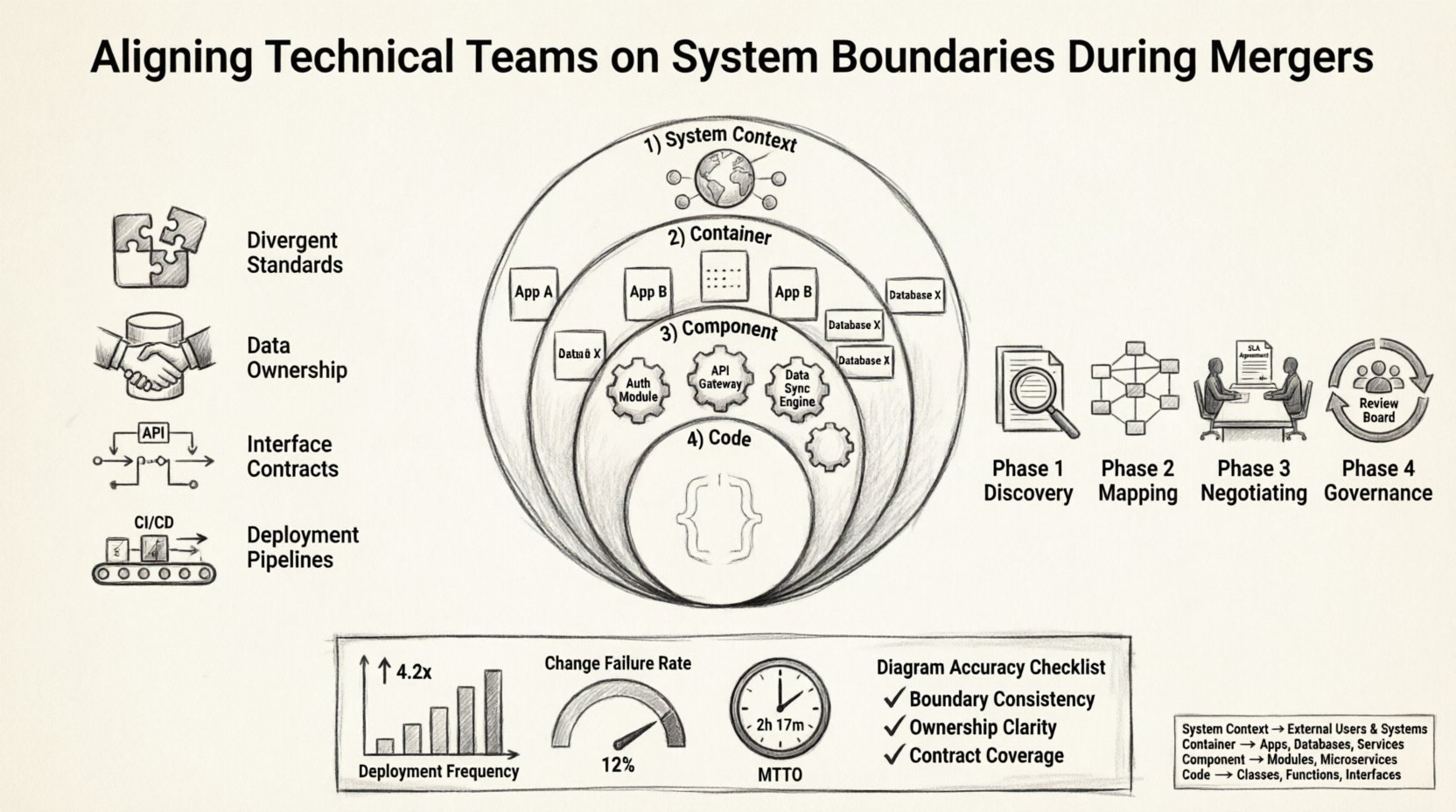
🧩 The Challenge of Merging Architectures
Merger scenarios introduce a unique set of architectural risks. Teams accustomed to specific design patterns, deployment strategies, and naming conventions must suddenly coexist. This environment often results in what is known as “architectural drift,” where the combined system becomes less maintainable than the sum of its parts. Understanding the root causes of this friction is the first step toward resolution.
- Divergent Standards: One team may prioritize microservices, while another relies on monolithic structures. Aligning these philosophies requires careful negotiation.
- Data Ownership: Disputes often arise over which team owns specific data entities. Without clear boundaries, data integrity suffers.
- Interface Contracts: APIs and protocols may differ significantly. Merging these without version control leads to breakages.
- Deployment Pipelines: Continuous integration workflows must be reconciled to ensure releases do not conflict.
These issues are not just technical; they are organizational. Teams often protect their boundaries as a form of autonomy. Breaking down these silos requires a neutral framework that allows both parties to visualize their contributions and dependencies clearly. 📉
🌉 Introducing the C4 Model as a Bridge
To resolve boundary disputes, a common language is essential. The C4 model provides a structured way to describe software architecture at different levels of abstraction. It moves from high-level context down to code details. During a merger, this model serves as a Rosetta Stone, allowing engineers from different backgrounds to discuss the same system without confusion. 🗝️
The model consists of four distinct layers. Each layer offers a specific perspective on the system boundaries. By mapping both organizations’ architectures across these layers, stakeholders can identify overlaps, gaps, and conflicts before they become production issues.
Level 1: System Context Diagrams 🌍
The context diagram shows the system in question and the people and systems that interact with it. In a merger, this layer answers the question: “Who is this system talking to?”
- Scope Definition: Define the external entities. Are there third-party vendors, internal business units, or customer-facing applications?
- Integration Points: Identify where the new entity connects to the existing ecosystem. This is often where data synchronization issues begin.
- Trust Boundaries: Visualize where security boundaries lie. Does traffic pass through a firewall or a public network?
When merging, create a unified context diagram. Place both organizations’ systems within the same view. This reveals immediate integration points that require attention. For example, if System A sends data to System B, but System B is now owned by the other organization, a new contract must be established. 🤝
Level 2: Container Diagrams 📦
Containers represent the high-level building blocks of the system, such as web applications, mobile apps, databases, or microservices. This layer answers: “What runs where?”
- Technology Stack: Identify the languages and frameworks used. Java vs. Node.js, for instance, may require different deployment strategies.
- Physical Placement: Are containers on-premise or in the cloud? Do they share the same region?
- Communication Protocols: How do containers talk? HTTP, gRPC, message queues, or shared databases?
During a merger, container boundaries often blur. Teams may assume they own a specific service, only to find another team is consuming its data. A container diagram clarifies ownership. It highlights which team is responsible for the health, scaling, and security of a specific container. This reduces ambiguity in incident management. 🚨
Level 3: Component Diagrams ⚙️
Components break down containers into internal parts. This layer answers: “How does this container work internally?”
- Logic Separation: Separate the user interface from the business logic.
- Subsystems: Identify internal modules that handle specific tasks, such as authentication or billing.
- Data Flow: Trace how data moves within the container.
This level is critical for understanding technical debt. If one organization has tightly coupled components and the other has loosely coupled ones, merging them requires a refactoring strategy. The component diagram exposes these structural differences. It allows architects to plan the migration path without disrupting the external interface. 🛠️
Level 4: Code Level 📜
While less common for high-level alignment, the code level details classes and functions. In a merger context, this is rarely used for boundary definition unless there is a specific concern about code reuse or licensing. However, understanding the granularity of the code helps in estimating the effort required for integration. 💻
📋 Step-by-Step Alignment Process
Aligning teams is a process, not a one-time event. It requires a structured approach to discovery, mapping, negotiation, and governance. The following phases provide a roadmap for technical leadership to follow during the integration period.
Phase 1: Discovery and Inventory 📂
The first step is to catalog what exists. This involves gathering documentation from both organizations. If documentation is sparse, teams must reconstruct it based on current observations. This phase is about honesty and transparency. Do not hide legacy systems or deprecated APIs.
- Asset Audit: List all active services, databases, and third-party integrations.
- Team Mapping: Identify which teams own which systems. Ensure there is no overlap in ownership claims.
- Dependency Graph: Create a high-level map of dependencies between systems. This helps identify single points of failure.
Phase 2: Mapping Interdependencies 🕸️
Once the inventory is complete, map the relationships. Use the C4 model to draw the connections. This visual representation makes dependencies obvious. It is easier to see a tangled web of connections on a diagram than in a spreadsheet.
| Dependency Type | Risk Level | Alignment Action |
|---|---|---|
| Shared Database | High | Define strict access policies and ownership. |
| API Call | Medium | Standardize versioning and error handling. |
| File Transfer | Medium | Establish secure protocols and encryption. |
| Manual Process | High | Automate and document the workflow. |
High-risk dependencies require immediate attention. Shared databases, in particular, are a common source of contention. One team may want to change the schema, while the other relies on the current structure. Mapping this early allows for a coordinated release plan. 🗓️
Phase 3: Negotiating Boundaries 🤝
With dependencies mapped, the teams must negotiate boundaries. This involves defining who is responsible for what. It is not enough to say “Team A owns the API.” They must also agree on the SLA, the monitoring requirements, and the incident response process.
- Service Level Agreements: Define uptime and latency expectations.
- Change Management: Agree on how changes are proposed and approved.
- Cost Allocation: Clarify who pays for infrastructure costs associated with the boundary.
This phase often requires executive support. Technical teams may struggle to agree on ownership due to competing priorities. A neutral party, such as a Chief Architect or Integration Manager, can facilitate these discussions. The goal is to create a contract that both sides respect. 📜
Phase 4: Governance and Evolution 🔄
Boundaries are not static. As the business grows, the architecture must evolve. Establish a governance model to manage future changes. This includes a review board for significant architectural decisions and a mechanism for updating diagrams when the system changes.
- Architecture Review Board: A group of senior engineers who approve boundary changes.
- Diagram Maintenance: Ensure diagrams are updated within a set timeframe after changes.
- Communication Channels: Maintain open lines of communication between teams to prevent silos from reforming.
🚧 Common Pitfalls in Merger Architecture
Even with a solid plan, organizations can stumble. Being aware of common pitfalls helps avoid them. The following list highlights frequent mistakes made during the integration of technical teams.
- Ignoring Legacy Systems: Trying to replace old systems immediately can disrupt business operations. Integrate them first, then plan for retirement.
- Over-Optimizing: Trying to make the new architecture perfect before it is stable can slow down progress. Focus on functionality first.
- Assuming Compatibility: Do not assume that two systems can talk to each other just because they use the same protocol. Check the implementation details.
- Centralizing Too Soon: Do not move all decisions to a central team immediately. Maintain local autonomy where possible to speed up delivery.
📖 Establishing a Shared Glossary
Language is a barrier. One team might call a “User,” another might call a “Customer.” One might refer to “Deployment,” another to “Release.” These semantic differences lead to confusion in documentation and communication. Creating a shared glossary ensures everyone speaks the same language. 🗣️
This glossary should cover:
- Entity Names: Define what specific terms mean in the combined organization.
- Process Terms: Standardize terms for workflows like “CI/CD” or “Incident Management”.
- Boundary Definitions: Clearly define what constitutes a boundary between teams.
📉 Managing Technical Debt Post-Merger
Merger integration often exacerbates technical debt. The pressure to deliver quickly can lead to shortcuts. To prevent this, allocate time for refactoring. Do not treat technical debt as an afterthought. It must be part of the integration budget.
Identify debt categories:
- Security Debt: Inconsistent security practices across teams.
- Performance Debt: Inefficient queries or slow APIs.
- Documentation Debt: Missing or outdated diagrams.
Assign owners to each category. Track progress using metrics. This ensures that debt is addressed systematically rather than ad-hoc. 📊
📊 Metrics for Alignment Success
How do you know if alignment is working? Use metrics to measure the health of the integration. These metrics should focus on stability, velocity, and collaboration.
- Deployment Frequency: Are teams able to release changes without blocking each other?
- Change Failure Rate: How often do deployments cause incidents?
- Mean Time to Recovery: How quickly can teams resolve issues caused by boundary conflicts?
- Diagram Accuracy: How often do diagrams need to be updated due to discrepancies?
Review these metrics regularly. If deployment frequency drops, it may indicate that boundary negotiations are too slow. If failure rates rise, it may indicate that contracts are not being respected. 📈
🔮 Future-Proofing the Combined Architecture
The goal of alignment is not just to fix current issues but to build a resilient system for the future. As the organization grows, the architecture must support scaling. This means designing boundaries that are flexible enough to accommodate new teams and services.
- Modularity: Ensure services are loosely coupled.
- Interoperability: Use standard protocols that allow new technologies to integrate easily.
- Observability: Implement logging and monitoring that spans all boundaries.
By focusing on these principles, the organization can adapt to market changes without constant architectural rework. The C4 model remains relevant because it allows the architecture to be described at any level of detail, making it adaptable to future needs. 🚀
🤝 Conclusion on Team Alignment
Aligning technical teams on system boundaries during a merger is a significant undertaking. It requires patience, communication, and a shared vision. The C4 model provides the structure needed to make these conversations productive. By focusing on context, containers, and components, teams can define clear responsibilities and reduce friction.
The process is iterative. Boundaries will shift as the business evolves. The key is to maintain a culture of transparency and continuous improvement. When teams trust each other and understand the architecture, the merger becomes an opportunity for innovation rather than a source of instability. 🌟
Start with the diagrams. Map the dependencies. Negotiate the contracts. Monitor the metrics. And always keep the human element in mind. Technical systems are built by people, and the success of the merger depends on how well those people collaborate. 🏁
🛠️ Additional Resources for Implementation
To support the implementation of this alignment strategy, consider the following practical steps:
- Workshops: Host joint workshops where teams draw their own diagrams side-by-side.
- Documentation Repositories: Create a central location for all architectural diagrams and glossaries.
- Training: Provide training on the C4 model to ensure all engineers understand the notation.
- Feedback Loops: Establish regular feedback sessions to discuss boundary issues as they arise.
These steps reinforce the commitment to alignment. They ensure that the architectural vision is not just a document, but a living practice within the organization. 📚
🎯 Final Thoughts on Boundary Management
System boundaries are not walls; they are interfaces. They define where one responsibility ends and another begins. In a merger, these interfaces become critical. They determine the flow of value and the speed of delivery. By treating boundaries with the care they deserve, organizations can turn a complex merger into a streamlined integration. 🌉
Remember that the goal is not to eliminate boundaries, but to make them clear. Ambiguity is the enemy of efficiency. Clarity is the friend of productivity. Use the tools available to you, engage your teams, and build a foundation that supports long-term growth. The journey is challenging, but the result is a more robust and capable engineering organization. 💪
As you move forward, keep the focus on collaboration. Technical alignment is a team sport. It requires input from developers, architects, operations, and management. When everyone pulls in the same direction, the system succeeds. When boundaries are respected and understood, the organization thrives. 🏆