
The landscape of database architecture is shifting beneath the feet of data engineers and system architects. For decades, the Entity Relationship Diagram (ERD) has served as the blueprint for data structures, defining how information flows, connects, and persists within complex systems. Traditionally, crafting these diagrams required meticulous manual effort, deep domain knowledge, and a willingness to endure tedious iterations. Today, the integration of artificial intelligence into modeling workflows is introducing a new paradigm. This evolution is not merely about speed; it is about fundamentally changing how logical data models are conceived, validated, and maintained.
Artificial intelligence is moving beyond simple automation to become an active participant in the design process. By leveraging natural language processing and pattern recognition, these advanced systems interpret business requirements and translate them into structural schemas with remarkable accuracy. This guide explores the mechanics of this transition, the tangible benefits for development teams, and the strategic considerations necessary for adopting these technologies without compromising data integrity.
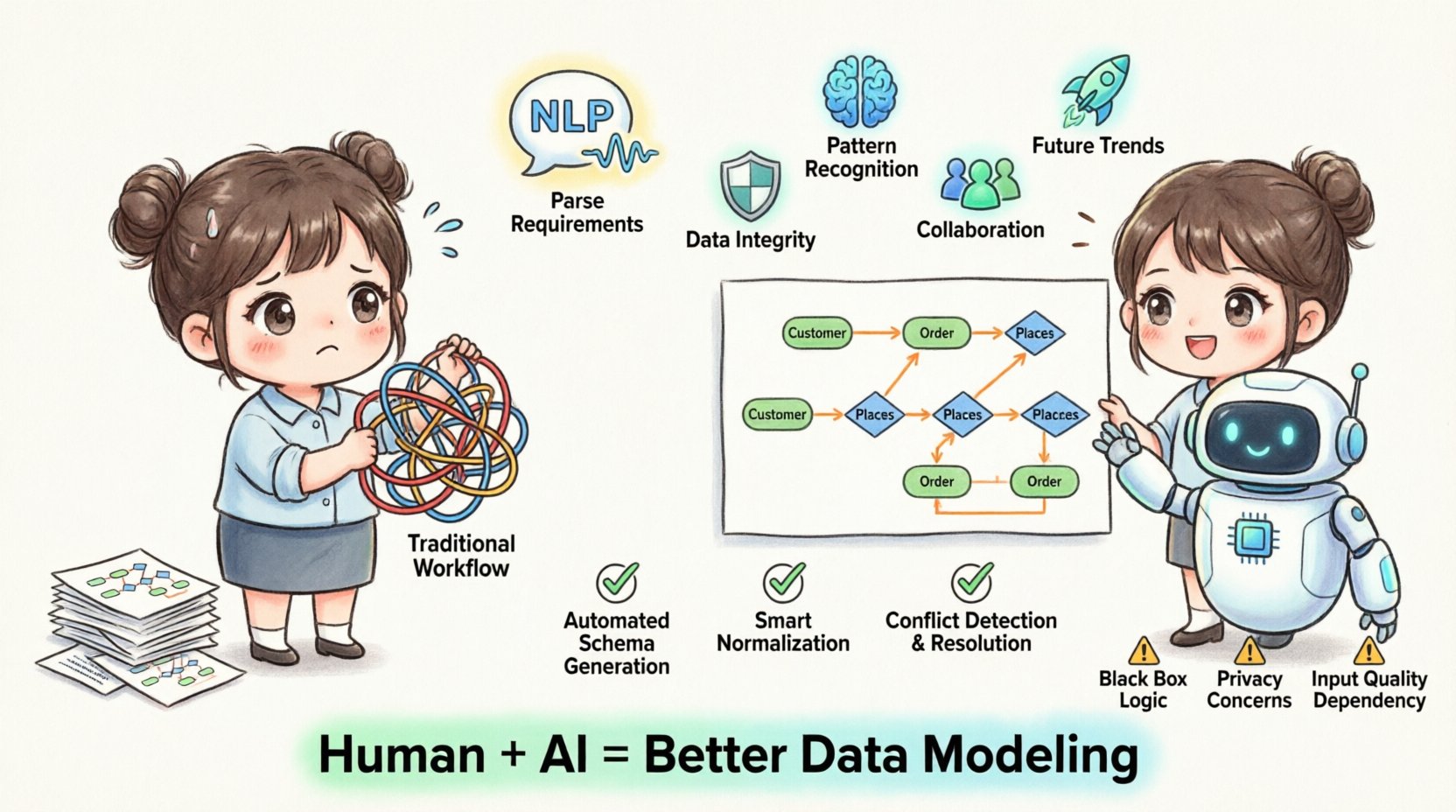
📐 The Traditional ERD Workflow and Its Limitations
Before examining the future, it is essential to understand the baseline. The creation of an Entity Relationship Diagram has historically been a linear, labor-intensive process. Architects would gather requirements, identify entities, define relationships, and normalize the data structure. While effective, this approach carries inherent risks and inefficiencies that become more pronounced as systems scale.
- High Cognitive Load: Designing complex schemas requires holding vast amounts of relational logic in memory. This increases the likelihood of oversight.
- Version Control Fragmentation: Diagram files often become isolated artifacts, disconnected from the actual source code or database definitions.
- Manual Normalization Errors: Ensuring Third Normal Form (3NF) or Boyce-Codd Normal Form (BCNF) requires constant vigilance against redundancy and anomalies.
- Collaboration Bottlenecks: Multiple stakeholders often need to review the same diagram, leading to feedback loops that stall development.
- Static Documentation: Once drawn, ERDs frequently become outdated as the underlying application logic evolves.
These challenges create a gap between the intended design and the implemented reality. The gap widens further when business requirements change rapidly, a common scenario in modern agile environments.
🧠 The Mechanics of AI-Driven Modeling
AI-driven ERD tools do not simply draw lines between boxes. They operate on a foundation of machine learning models trained on vast repositories of database patterns, industry standards, and architectural best practices. Understanding the underlying mechanics helps in evaluating the reliability of these tools.
1. Natural Language Processing (NLP) Interpretation
Modern systems can ingest unstructured text, such as product requirement documents or user stories, and extract key entities and attributes. The AI parses semantic meaning rather than just keywords. For instance, if a document mentions “customer orders,” the system identifies “Customer” and “Order” as likely entities and infers the relationship based on linguistic context.
2. Pattern Recognition and Generative Design
Once entities are identified, the AI applies learned patterns to suggest relationships. It recognizes common cardinalities, such as one-to-many or many-to-many, based on the semantic weight of the terms. This generative capability allows for the rapid creation of a draft schema that serves as a starting point for human refinement.
3. Contextual Understanding
Advanced models maintain context across the entire document or project. If a specific attribute is defined as a unique identifier in one section, the system remembers this constraint when generating foreign keys in another section. This consistency is difficult to maintain manually across large-scale projects.
⚙️ Key Capabilities Transforming Data Modeling
The integration of AI brings specific functional capabilities that address the pain points of traditional modeling. These features are designed to augment human intelligence rather than replace it.
- Automated Schema Generation: Convert textual specifications directly into database schema definitions (DDL) and visual diagrams simultaneously.
- Intelligent Refinement: The system suggests optimizations for indexing strategies based on the proposed query patterns.
- Conflict Detection: AI can flag potential naming conflicts or circular dependencies before they are committed to the database.
- Smart Normalization: Algorithms analyze the structure to recommend normalization steps that reduce redundancy without losing query performance.
- Legacy Migration Analysis: When integrating with existing systems, AI can map old schemas to new structures, identifying breaking changes.
📊 Comparing Traditional vs. AI-Assisted Workflows
To visualize the shift, consider the following comparison of how tasks are handled in a traditional environment versus an AI-integrated environment.
| Task | Traditional Workflow | AI-Assisted Workflow |
|---|---|---|
| Requirement Analysis | Manual extraction of entities from text | NLP extraction with confidence scoring |
| Relationship Mapping | Architect draws lines and defines cardinality | System suggests relationships based on semantics |
| Normalization | Review against 3NF rules manually | Algorithmic validation and optimization |
| Documentation Updates | Diagram must be redrawn after changes | Live sync with schema changes |
| Error Detection | Found during testing or code review | Proactive warnings during design phase |
This comparison highlights that the primary value lies in shifting effort from execution to validation. The AI handles the repetitive construction, allowing the human expert to focus on architectural strategy and business logic alignment.
🛡️ Enhancing Data Integrity and Consistency
Data integrity is the bedrock of reliable software. Inconsistent data leads to flawed analytics, failed transactions, and security vulnerabilities. AI tools introduce a layer of enforcement that is consistent and rule-based.
Referential Integrity Checks
One of the most common errors in ERD design is the creation of orphaned records due to incorrect foreign key constraints. AI systems automatically verify that every foreign key has a corresponding primary key defined in the referenced entity. They can also suggest composite keys where appropriate, ensuring that relationships remain robust.
Attribute Typing and Constraints
Choosing the correct data type is critical for performance and storage. AI models analyze the nature of the data described in the requirements. If a field is described as “date of birth,” the system ensures it is not modeled as a simple string but as a temporal type with appropriate validation rules.
Standardized Naming Conventions
Inconsistent naming conventions create confusion. “user_id”, “UserId”, and “UserID” might all refer to the same concept, complicating joins. AI tools enforce a global naming strategy, ensuring that all generated entities adhere to the project’s coding standards automatically.
🤝 Impact on Team Collaboration
The evolution of ERD tools also changes how teams collaborate. When diagrams are dynamic and generated from shared requirements, the barrier between business analysts, developers, and data architects lowers.
- Single Source of Truth: When the diagram is linked to the source requirements, stakeholders can verify the model against the original text.
- Real-Time Collaboration: Cloud-based modeling platforms allow multiple users to view and suggest changes without overwriting each other’s work.
- Reduced Ambiguity: Visual outputs generated by AI reduce the ambiguity of textual descriptions. A diagram is often clearer than a paragraph of text.
- Faster Onboarding: New team members can understand the system architecture faster by reviewing the AI-generated maps and relationship flows.
⚠️ Limitations and Ethical Considerations
Despite the advancements, AI-driven tools are not a silver bullet. Relying solely on automated systems without human oversight introduces specific risks that must be managed.
1. The Black Box Problem
AI models are often opaque. If the system suggests a specific relationship, the architect needs to understand why. Without explainability, it is difficult to trust the model’s decisions in critical systems.
2. Contextual Nuance
AI may struggle with highly specific business rules that are not common in general data patterns. For example, a unique regulatory compliance rule might be missed if it does not appear in the training data.
3. Data Privacy and Security
When using cloud-based AI modeling tools, the metadata being processed includes sensitive information about the system’s structure. It is vital to ensure that data governance policies are respected and that proprietary logic is not exposed to external models.
4. Dependency on Input Quality
The output of an AI model is only as good as the input. If the requirements document is vague or contradictory, the generated ERD will reflect those flaws. Human validation remains a necessary step.
🔮 Future Trends in Intelligent Data Modeling
Looking forward, the trajectory of AI in ERD creation points toward deeper integration with the development lifecycle. The following trends are likely to define the next generation of tools.
- Predictive Schema Evolution: Tools will analyze usage patterns to predict future scaling needs and proactively suggest partitioning or sharding strategies.
- Self-Healing Databases: Integrated systems will detect schema drift and suggest rollback or migration scripts automatically.
- Query-Aware Modeling: AI will optimize the ERD based on the specific queries the application runs, rather than just the business requirements.
- Multi-Model Support: As NoSQL and graph databases become more common, AI will assist in designing hybrid models that support relational, document, and graph structures simultaneously.
- Integration with DevOps: ERD changes will trigger CI/CD pipelines, ensuring that database migrations are tested and deployed alongside application code.
📋 Best Practices for Adoption
Organizations looking to adopt these technologies should follow a structured approach to ensure success. Integration should be gradual, focusing on augmenting existing processes rather than disrupting them.
Start with Pilot Projects
Do not migrate the entire enterprise architecture at once. Select a non-critical project to test the capabilities of the AI modeling tools. Measure the time saved and the quality of the output.
Maintain Human-in-the-Loop
Establish a governance policy that requires human sign-off on all schema changes. The AI provides the draft; the architect provides the judgment.
Focus on Data Governance
Ensure that the AI tool aligns with the organization’s data governance framework. Naming conventions, security classifications, and retention policies must be configured within the tool.
Train the Team
Provide training on how to interact with the AI. Team members should understand how to prompt the system effectively and how to interpret the suggestions it makes.
Monitor for Drift
Regularly audit the generated diagrams against the actual deployed database. This ensures that the AI remains aligned with the system’s reality over time.
🎯 Strategic Value for Modern Development
The shift toward AI-driven ERD creation represents a strategic advantage for organizations. By reducing the time spent on rote modeling tasks, teams can focus on innovation. The ability to rapidly prototype data structures allows for faster experimentation and iteration.
Furthermore, the consistency introduced by these tools reduces technical debt. Schemas that are generated with AI adherence to standards are easier to maintain and extend. This longevity is crucial in an era where data is the primary asset of most digital businesses.
As the technology matures, the distinction between the “designer” and the “builder” may blur. The line between conceptual modeling and physical implementation will become increasingly porous. This convergence promises a more agile and responsive software development lifecycle.
🌐 Conclusion
The evolution of Entity Relationship Diagrams through AI is a significant development in the field of data engineering. It moves the discipline from manual drafting to intelligent design. While challenges regarding trust, context, and governance remain, the potential benefits for efficiency, accuracy, and scalability are substantial.
For architects and developers, the path forward involves embracing these tools as powerful assistants. By combining human expertise with machine intelligence, teams can build robust data architectures that stand the test of time. The future of data modeling is not about replacing the human mind, but about empowering it with tools that understand the complexity of the modern data landscape.