Enterprise Architecture (EA) serves as the foundational blueprint for organizational IT strategy. It defines how technology assets align with business goals, ensuring scalability, security, and efficiency. Choosing the right methodology for designing this architecture is critical. The debate often centers on two dominant frameworks: Waterfall and Agile. Each approach offers distinct advantages and challenges depending on the organizational context, project complexity, and market volatility. This guide provides a deep dive into both methodologies, examining their application within enterprise architecture design.
Understanding the nuances of these approaches helps architects make informed decisions. A rigid plan may suit a stable environment, while a flexible strategy works better in dynamic markets. We will explore the structural differences, governance implications, and practical implementation details without focusing on specific software tools. The goal is to clarify how these methodologies shape the final architectural outcome.
Understanding Waterfall in Enterprise Architecture 📊
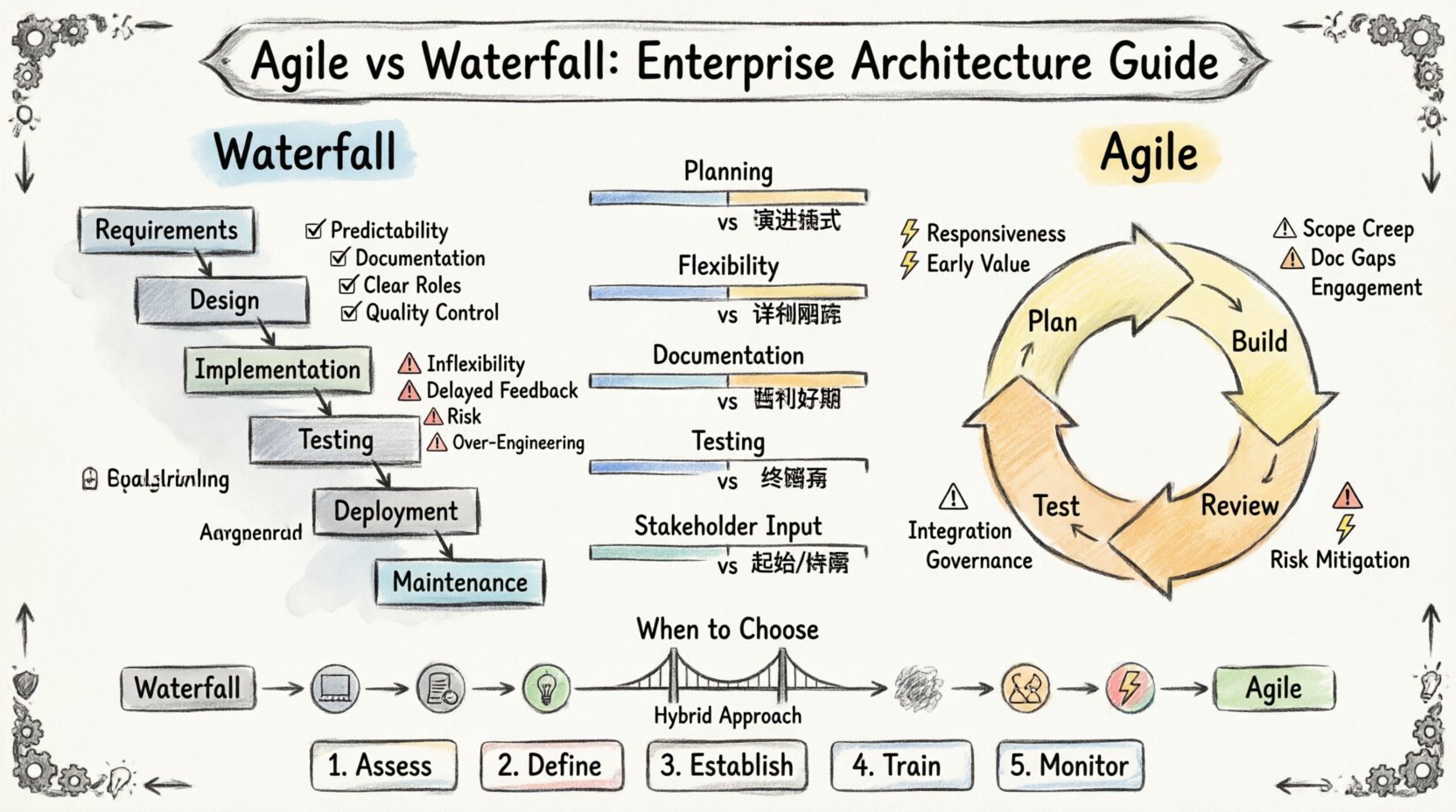
The Waterfall model represents a traditional, linear approach to project management and system design. In the context of Enterprise Architecture, it follows a sequential progression. Each phase must be completed before the next begins. This method relies heavily on upfront planning and detailed documentation.
Core Phases of Waterfall EA
- Requirements Gathering: Stakeholders define all needs at the start. There is little room for change later.
- System Design: Architects create comprehensive blueprints based on requirements.
- Implementation: Development teams build the solution according to the design specs.
- Testing: Rigorous validation occurs against the original requirements.
- Deployment: The final solution is released to the production environment.
- Maintenance: Ongoing support ensures stability post-launch.
This structure provides clear milestones. Management can track progress against a fixed timeline. However, the rigidity can be a drawback in fast-changing industries. If market conditions shift during the design phase, the architecture may become misaligned before deployment.
Advantages of Waterfall Architecture
- Predictability: Costs and timelines are easier to estimate early on.
- Documentation: Extensive records exist for compliance and knowledge transfer.
- Clear Roles: Responsibilities are well-defined for each team member.
- Quality Control: Testing happens at the end, ensuring the final product meets specs.
Disadvantages of Waterfall Architecture
- Inflexibility: Changes are expensive and difficult to implement mid-process.
- Delayed Feedback: Stakeholders see the final product only after a long cycle.
- Risk Accumulation: Technical issues often surface late in the timeline.
- Over-Engineering: Designing for every possible scenario can waste resources.
Understanding Agile in Enterprise Architecture 🔄
Agile methodology prioritizes flexibility, collaboration, and iterative progress. In Enterprise Architecture, this means designing systems in small increments. Feedback loops allow architects to adjust the direction based on real-world usage and changing business needs.
Core Principles of Agile EA
- Iterative Delivery: Value is delivered in small, functional chunks rather than one big release.
- Adaptability: Plans evolve as new information becomes available.
- Collaboration: Architects work closely with developers and business stakeholders.
- Continuous Improvement: Regular retrospectives refine the process and the product.
Agile architecture often focuses on building a Minimum Viable Architecture (MVA). This allows the organization to start realizing value quickly. As the system grows, the architecture evolves to support new capabilities. This approach reduces the risk of building something that is no longer relevant.
Advantages of Agile Architecture
- Responsiveness: Teams can pivot quickly when requirements change.
- Early Value: Functional components are available sooner.
- Stakeholder Engagement: Continuous feedback ensures alignment with business goals.
- Risk Mitigation: Issues are identified and resolved in early iterations.
Disadvantages of Agile Architecture
- Scope Creep: Lack of a fixed plan can lead to endless feature additions.
- Documentation Gaps: Focus on code over docs can hinder long-term maintenance.
- Integration Challenges: Frequent changes can complicate system integration.
- Governance Complexity: Maintaining standards across many small teams requires effort.
Head-to-Head Comparison: Agile vs. Waterfall 🥊
Visualizing the differences helps in making a strategic choice. The table below outlines key distinctions across critical dimensions relevant to Enterprise Architecture.
| Dimension | Waterfall Approach | Agile Approach |
|---|---|---|
| Planning | Comprehensive upfront planning. Detailed roadmaps. | High-level planning. Roadmaps evolve iteratively. |
| Flexibility | Low. Changes require formal change requests. | High. Changes are expected and welcomed. |
| Documentation | Extensive and formal. Created before building. | Just enough. Created alongside building. |
| Testing | Conducted after development is complete. | Continuous. Testing happens throughout. |
| Stakeholder Input | Primarily at the start and end. | Continuous feedback loops. |
| Risk Management | Identified early, but risks materialize late. | Identified and managed continuously. |
| Best For | Stable requirements, regulated industries. | Uncertain requirements, fast-paced markets. |
Deep Dive: Governance and Compliance 🛡️
Governance is a major consideration in Enterprise Architecture. It ensures that IT decisions align with organizational policies and regulatory requirements. Both methodologies handle governance differently.
Waterfall Governance
In a Waterfall environment, governance is typically gate-based. Reviews occur at the end of each phase. A Change Control Board (CCB) might approve major shifts. This structure ensures strict adherence to standards. It is particularly effective in highly regulated sectors like healthcare or finance where compliance is non-negotiable.
- Approval Workflow: Sequential sign-offs are mandatory.
- Standardization: Uniform processes apply to all projects.
- Audit Trail: Detailed records support compliance audits.
Agile Governance
Agile governance shifts from gatekeeping to enabling. The focus is on guardrails rather than walls. Automated checks and continuous integration pipelines enforce standards. Architects act as coaches, guiding teams rather than blocking progress. This requires a high level of trust and maturity within the organization.
- Automated Compliance: Tools enforce rules in the pipeline.
- Decentralized Decision Making: Teams make local decisions within boundaries.
- Transparency: Dashboards provide real-time visibility into progress.
Deep Dive: Risk Management and Technical Debt ⚠️
Every architectural decision carries risk. How these risks are managed defines the success of the project. Technical debt, the implied cost of additional rework caused by choosing an easy solution now instead of a better one, is a critical metric.
Risk Profiles
Waterfall concentrates risk. If the requirements were wrong, the entire project may fail. This is known as the “Big Bang” risk. However, if the plan is solid, the execution risk is lower. Agile distributes risk. Small failures in early iterations do not doom the entire initiative. This makes Agile safer for innovation but potentially more chaotic for maintenance.
Managing Technical Debt
- Waterfall: Debt is often identified late. Refactoring becomes a separate phase or is deferred, leading to significant rework later.
- Agile: Debt is addressed continuously. Teams allocate capacity in sprints to improve code quality. This prevents debt from compounding.
Architects must balance the need for stability with the need for speed. Ignoring debt leads to a fragile system. Ignoring speed leads to missed market opportunities. The choice of methodology influences how this balance is struck.
When to Choose Waterfall 📅
Waterfall is not obsolete. It remains the best fit for specific scenarios where stability and predictability are paramount.
- Fixed Scope Projects: When requirements are well-understood and unlikely to change.
- Regulatory Constraints: Industries requiring strict audit trails and approval gates.
- Hardware Integration: Projects involving physical infrastructure that cannot be easily updated.
- Large Budgets: When funding is tied to specific deliverables and milestones.
- Legacy Modernization: Sometimes, replacing a monolithic system requires a complete, planned shutdown and restart.
When to Choose Agile 🚀
Agile thrives in environments where change is the only constant. It is ideal for organizations that need to respond to customer feedback rapidly.
- Uncertain Requirements: When the end goal is clear, but the path is not.
- Customer-Centric Products: Where user feedback drives feature development.
- High Competition: Markets where speed to market is a competitive advantage.
- Innovation Initiatives: Projects where experimentation and failure are part of the learning process.
- Complex Ecosystems: Systems with many interdependent parts that need frequent updates.
Navigating Hybrid Approaches 🔄📊
Many enterprises find that a pure binary choice is insufficient. A hybrid model combines the planning rigor of Waterfall with the execution flexibility of Agile. This is often referred to as “Wagile” or a phased approach.
Hybrid Strategy Components
- Strategic Planning (Waterfall): High-level roadmaps and budget allocations are defined upfront.
- Execution (Agile): Implementation teams work in sprints to deliver value.
- Architecture Governance (Agile): Guardrails are set, but teams have autonomy on implementation details.
- Release Management (Waterfall): Major releases are coordinated and tested in a structured manner.
This approach allows organizations to maintain control over their investment while delivering value incrementally. It requires clear communication channels between strategic planners and execution teams. Governance bodies must be willing to trust the iterative process.
Implementation Steps for Enterprise Architects 🛠️
Transitioning between methodologies requires a structured plan. Architects should follow these steps to ensure a smooth adoption.
1. Assess Organizational Maturity
Before changing the methodology, evaluate the current culture. Does the team have the discipline to manage Agile? Do they have the documentation skills for Waterfall? The culture dictates the success of the process.
2. Define Architecture Principles
Regardless of the methodology, core principles must remain constant. These might include security by design, interoperability, or scalability. These principles guide decision-making in both Waterfall and Agile contexts.
3. Establish Feedback Mechanisms
Create channels for continuous feedback. In Waterfall, this means regular milestone reviews. In Agile, this means sprint reviews and retrospectives. The frequency depends on the chosen model.
4. Train Teams
Invest in training. Agile requires different skills than Waterfall. Teams need to learn how to estimate, prioritize, and communicate effectively in the new framework.
5. Monitor and Adapt
Continuously measure the effectiveness of the chosen approach. If metrics show delays or quality issues, adjust the process. Methodologies are tools, not dogmas.
Common Pitfalls to Avoid 🚫
Even with a solid plan, pitfalls can derail the architecture design process. Being aware of them helps in prevention.
- Agile without Architecture: Moving fast without a plan leads to a fragmented system. Ensure there is enough architectural guidance to maintain coherence.
- Waterfall without Flexibility: Sticking to the plan when the market changes leads to obsolescence. Allow for contingency buffers.
- Ignoring Stakeholders: Both models fail if end-users are not involved. Keep them engaged throughout the lifecycle.
- Over-Documentation: In Agile, spending too much time on docs slows delivery. Focus on value.
- Under-Planning: In Waterfall, skipping detailed requirements leads to rework. Invest time in the beginning.
Future Trends in Architecture Methodologies 📈
The landscape of Enterprise Architecture is evolving. New trends are emerging that blend traditional and modern practices.
DevOps and CI/CD
Continuous Integration and Continuous Deployment have become standard. This pushes architectures towards more modular designs. Microservices fit well with Agile, while monolithic structures suit Waterfall. The pipeline dictates the architecture.
Cloud-Native Design
Cloud environments offer elasticity. This favors iterative scaling. Waterfall planning for cloud capacity can be inefficient. Agile capacity planning allows for on-demand scaling.
Data-Driven Decision Making
Architects are increasingly using data to guide decisions. Analytics can show which architectural patterns perform best. This data informs whether to stick with the current approach or pivot.
Final Thoughts on Methodology Selection 💡
Selecting between Agile and Waterfall for Enterprise Architecture is not about finding the perfect solution. It is about finding the right fit for the current situation. Organizations must weigh the need for stability against the need for speed. They must consider their risk tolerance and their ability to adapt.
There is no single path that works for every project. Some parts of the architecture may benefit from a Waterfall approach, while others thrive in an Agile environment. The key is to remain aware of the trade-offs. Regularly review the methodology to ensure it still serves the business goals. Flexibility in the process is just as important as flexibility in the technology.
By understanding the strengths and weaknesses of each approach, architects can design systems that are robust, scalable, and aligned with business objectives. The choice shapes the future of the organization’s technology landscape.