


The landscape of data management has shifted dramatically over the past decade. As applications grew in scale and complexity, the rigid structures of the past began to show cracks. NoSQL databases emerged to handle massive datasets, high-velocity streams, and unstructured information that traditional relational models struggled to accommodate efficiently. This evolution has sparked a persistent debate among architects and developers: Will NoSQL eliminate the need for traditional Entity Relationship Diagrams (ERDs)? 🤔
To answer this, we must look beyond the hype and examine the fundamental purpose of data modeling. While NoSQL technologies have changed how we store data, the need to visualize relationships and structure information remains a core requirement for system stability. This guide explores the nuances of schema design, the role of ERDs in a polyglot persistence world, and where the industry is heading.
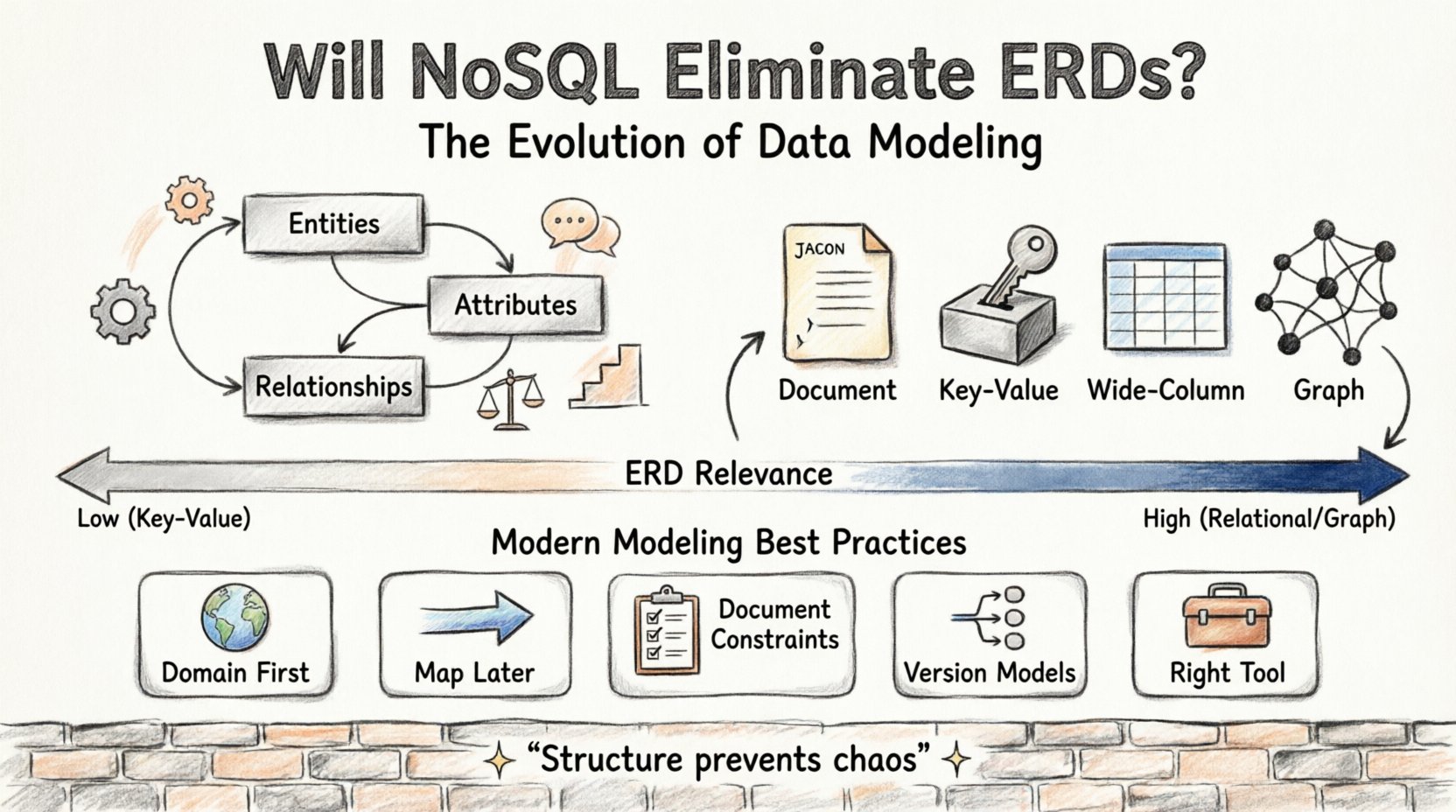
Understanding the Foundation: What is an ERD? 🏗️
An Entity Relationship Diagram is a visual representation of data structures and how they relate to one another. Developed in the early 1970s, it became the blueprint for relational database design. An ERD uses specific symbols to denote entities (tables), attributes (columns), and relationships (foreign keys).
The primary goals of an ERD include:
- Clarity: Providing a visual map for developers to understand data flow.
- Integrity: Ensuring data rules are enforced before the system goes live.
- Communication: Acting as a universal language between business stakeholders and engineering teams.
- Normalization: Organizing data to reduce redundancy and improve consistency.
In a relational context, these diagrams are not optional. They are the contract between the application and the storage engine. Without them, joins become impossible to plan, and transactional integrity is at risk.
The NoSQL Disruption: A New Paradigm 📉
NoSQL databases were not created to break rules for the sake of rebellion. They were born from necessity. As the web scaled, the need for horizontal scaling (adding more servers) became more critical than vertical scaling (adding more power to one server). Relational databases, which often struggle with horizontal scaling, gave way to alternatives.
There are several categories of NoSQL systems, each with different modeling requirements:
- Document Stores: Store data in JSON-like documents. Relationships are often embedded rather than linked via foreign keys.
- Key-Value Stores: Simple lookups based on unique identifiers. No complex relationships.
- Wide-Column Stores: Optimized for massive datasets across distributed systems. Schema is flexible and defined at read time.
- Graph Databases: Designed specifically for highly interconnected data. Nodes and edges replace tables and rows.
In many of these models, the concept of a rigid, pre-defined schema is relaxed. This flexibility led to the belief that traditional planning tools like ERDs were obsolete. Developers could start coding, push data, and fix the structure later. This approach is often called “Schema-on-Read”.
Why the “No ERD” Myth Persists 🚫📄
The idea that NoSQL does not require design stems from the initial ease of use. In a document-oriented store, you can insert a record without defining the columns beforehand. This speed is appealing for prototyping. However, as the application grows, this lack of structure creates technical debt.
Common misconceptions include:
- “It’s just JSON.” While the payload looks like JSON, the underlying storage engine still requires organization to query efficiently.
- “Relationships don’t matter.” Data is rarely isolated. A user has orders, orders have items, and items have categories. Ignoring these links leads to data duplication and inconsistency.
- “Schema evolution is automatic.” Changing the structure of data in a distributed system without planning can lead to downtime or data corruption during migration.
The Role of ERDs in Modern Architecture 🔄
While the strict 1-to-1 mapping of ERDs to SQL tables is fading, the concept of the ERD is evolving. It is no longer just about tables; it is about data connectivity. Even in NoSQL environments, understanding how data entities connect is vital for performance and maintainability.
Here is how the function of data modeling changes across different storage types:
| Database Type | Modeling Focus | ERD Relevance |
|---|---|---|
| Relational (SQL) | Normalization, Foreign Keys | High (Essential) |
| Document Store | Denormalization, Embedding | Medium (Conceptual) |
| Graph Database | Nodes, Edges, Traversal | High (Visualized Differently) |
| Key-Value Store | Identifier Lookup | Low (Minimal) |
| Wide-Column | Partition Keys, Clustering | Medium (Structural) |
As shown in the table, the relevance of diagramming shifts. For Graph databases, a visual diagram is actually more critical than for Key-Value stores. The terminology changes from “Tables” to “Nodes”, but the need to understand connections remains.
When ERDs Are Still Critical 🛡️
There are specific scenarios where skipping the design phase is a recipe for failure. Even with flexible NoSQL storage, certain constraints apply.
1. Data Integrity and Consistency
In financial systems or inventory management, data accuracy is non-negotiable. If you store a transaction in a document store without defining the schema, you risk inserting an invalid state. A diagram helps identify where referential integrity checks are needed, even if they are enforced in the application layer rather than the database layer.
2. Complex Query Patterns
Querying data becomes exponentially harder as the dataset grows. If you do not plan how you will retrieve data, you may end up performing full table scans or inefficient lookups. Understanding the read patterns helps determine the structure of the documents or columns.
3. Team Collaboration
Large teams cannot rely on verbal agreements about data structure. An ERD serves as documentation. When a new developer joins, they look at the diagram to understand the domain model. Without this, onboarding takes longer, and bugs increase.
4. Polyglot Persistence
Modern applications often use multiple database types simultaneously. You might use a relational store for user accounts, a document store for product catalogs, and a graph store for recommendation engines. An overall system architecture diagram is necessary to map how data flows between these different stores.
Modeling for NoSQL: Beyond the Traditional ERD 🧠
Adopting NoSQL requires a shift in mindset. The traditional normalization rules (1NF, 2NF, 3NF) are often inverted. Denormalization becomes a best practice to reduce the number of queries required. This is where the “diagram” changes shape.
Denormalization Patterns:
- Embedding: Storing related data inside a single document. Example: Storing an address inside a user profile.
- Referencing: Keeping a separate document and linking by ID. Example: A user ID in an order document.
- Aggregation: Pre-calculating data to avoid runtime math. Example: Storing the total cart price.
When designing these structures, architects often create a Logical Data Model rather than a strict physical ERD. This model focuses on the relationships and cardinality without committing to specific table definitions. It answers questions like:
- Is this a one-to-one or one-to-many relationship?
- Which side of the relationship is the “owner”?
- How frequently is this data read versus written?
Challenges in Diagramming NoSQL Systems ⚠️
Creating a diagram for a flexible schema presents unique challenges. Traditional tools expect fixed columns. NoSQL expects dynamic structures. This mismatch can cause friction in the design process.
1. Schema Evolution
Because NoSQL allows schema changes, teams often feel less pressure to plan ahead. However, changing a core data structure in a distributed system can be expensive. Migration scripts must be written carefully. A diagram helps track version changes over time.
2. Query-First Design
In NoSQL, you often design the data structure based on how you will query it, not just how you will store it. This is known as “Query-Driven Design”. A traditional ERD focuses on storage efficiency. A NoSQL model focuses on query efficiency. The diagram must reflect read paths, not just write paths.
3. Visual Complexity
Graph databases can result in incredibly dense diagrams. With thousands of nodes, a static image becomes unreadable. Automated visualization tools are needed to handle this scale, but the logical relationships must still be defined.
Future Trends in Data Modeling 🚀
The industry is moving towards a hybrid approach. We are not abandoning structure, but we are adapting it. Here is what the future likely holds.
- Schema Validation Layers: Many NoSQL engines now offer optional schema validation. This allows the flexibility of NoSQL with the safety of SQL. This brings the need for ERDs back into play, as you must define the rules you want to enforce.
- Data Mesh: This architectural trend decentralizes data ownership. Different teams own their data domains. ERDs become domain-specific contracts rather than global blueprints.
- AI-Assisted Modeling: Artificial intelligence tools are beginning to suggest schema designs based on query logs. These tools can generate ERD-like visualizations from actual usage patterns.
- Unified Query Engines: New engines allow querying across different database types (SQL and NoSQL) simultaneously. This requires a unified metadata layer, which essentially functions as a global ERD.
Best Practices for Modern Data Modeling 📝
If you are designing a system today, how should you approach documentation? Here are actionable guidelines.
1. Start with the Domain, Not the Database
Define the business entities first. What is a “Customer”? What is a “Product”? This is independent of whether you store them in SQL or NoSQL. Use an ERD to define these entities and their relationships abstractly.
2. Map to Storage Later
Once the domain model is clear, map it to the storage technology. Decide where to denormalize. Decide where to normalize. This separation of concerns keeps the design flexible.
3. Document Constraints Explicitly
Even if the database does not enforce constraints, document them. State clearly: “User ID must be unique” or “Order Date cannot be in the future”. This ensures the application layer enforces what the storage layer allows.
4. Version Your Models
Treat your data models like code. Keep them in version control. When you change a relationship, commit the change. This creates an audit trail of how the system evolved.
5. Use the Right Tool for the Job
Don’t force a SQL ERD tool to model a Graph database. Use tools that support the specific data type you are using. For documents, use schema definition files. For graphs, use node-link diagrams.
Comparing Approaches: A Side-by-Side Look 🔍
Understanding the trade-offs helps in making the right decision for your specific project. The table below contrasts the two approaches.
| Aspect | Traditional ERD (Relational) | Modern NoSQL Modeling |
|---|---|---|
| Structure | Fixed Schema | Flexible / Dynamic Schema |
| Relationships | Foreign Keys | Embeds or References |
| Design Focus | Normalization | Denormalization / Read Patterns |
| Change Cost | High (Migrations) | Medium (Application Logic) |
| Documentation | Diagram is Mandatory | Diagram is Highly Recommended |
This comparison highlights that the principle of modeling is constant, even if the implementation varies. You still need to know how data connects. You still need to know what data represents.
Addressing the Skeptics 🗣️
Sometimes, developers argue that diagrams slow down development. They prefer to code first and fix the data later. While this works for small scripts, it fails for enterprise systems.
Consider the cost of refactoring. In a relational database, adding a column requires a migration. In a NoSQL system, changing a document structure might require a full data rewrite across millions of records. The cost of fixing a bad model is always higher than the cost of planning one. Diagrams reduce the risk of these expensive fixes.
Final Thoughts on the Future 🌅
The question of whether NoSQL will eliminate ERDs is answered by looking at the purpose of the diagram. If the purpose is to define table columns, then NoSQL has indeed reduced the need for that specific type of diagram. However, if the purpose is to visualize data relationships, integrity, and flow, then the need for a diagram remains strong.
Technology evolves, but the complexity of data does not diminish. As systems become more distributed, the need for clear documentation increases. The ERD is not dying; it is transforming. It is becoming less about the physical storage and more about the logical domain.
Architects who ignore data modeling in a NoSQL environment risk creating systems that are fast to build but impossible to maintain. The future belongs to those who balance flexibility with structure. We will continue to draw diagrams, but they will look different, focus on different metrics, and adapt to different storage engines.
The choice is not between diagrams and NoSQL. The choice is between disciplined modeling and chaotic improvisation. In a world of infinite data, structure is the only thing that prevents chaos. 🧱✨
Related posts:
 Entity Relationship Diagram Architectures That Prevent Schema Drift in Scalable Systems
 Why Your Entity Relationship Diagrams Are Blocking Microservices Migration (And How to Fix It)
 The Hidden Complexity Gap: When Junior Engineers Misbuild Entity Relationship Diagrams
 Database Administrators’ Secret Checklist for Validating Entity Relationship Diagram Integrity