


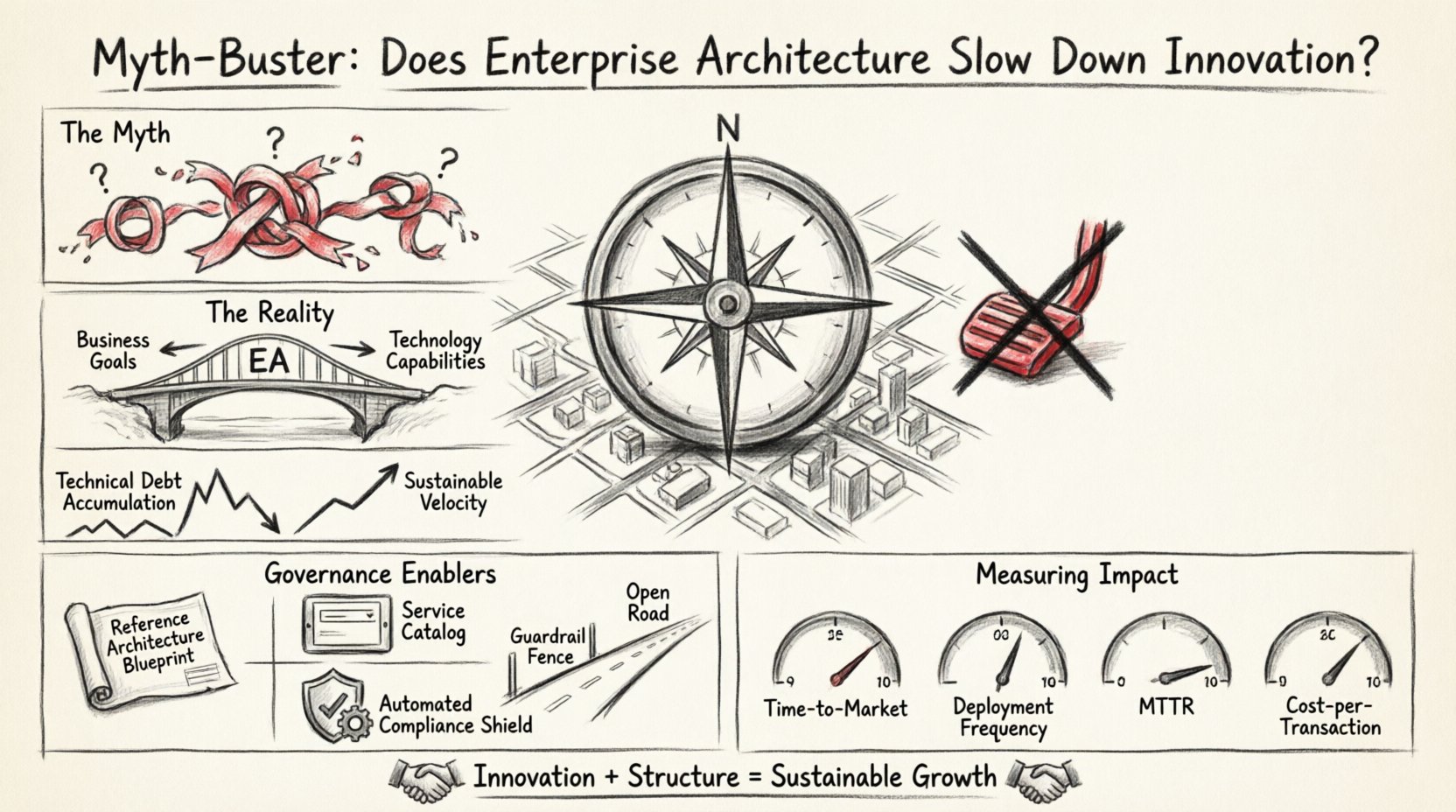
In the fast-paced landscape of digital transformation, a persistent question haunts many technology leaders: Does Enterprise Architecture (EA) slow down innovation? 🤔 The narrative often paints EA as a bureaucratic checkpoint, a gatekeeper that demands excessive documentation and approval before a single line of code is written. However, this perspective overlooks the strategic value that structured design brings to complex organizations. The reality is far more nuanced. When implemented correctly, EA acts not as a brake, but as a navigation system, ensuring that speed is directed toward meaningful business outcomes.
This guide explores the tension between agility and governance. We will dissect the myths surrounding architectural oversight, examine how modern practices align with rapid development cycles, and provide a framework for understanding the symbiotic relationship between stability and creativity. 🚀
1. The Origin of the Skepticism 🧐
Why do so many developers and product managers view Enterprise Architecture with suspicion? The roots of this friction often lie in historical context. Decades ago, EA was synonymous with rigid waterfall methodologies. Teams were required to define every interface, dependency, and data flow before implementation began. In an environment where requirements changed weekly, this approach felt like trying to drive a car by looking at the rearview mirror.
Several factors contribute to the negative perception today:
- Perceived Bureaucracy: The belief that architecture involves endless review boards and sign-off processes.
- Lack of Visibility: Developers often see the rules without understanding the strategic reasoning behind them.
- Focus on Control: When architecture is used primarily to enforce compliance rather than enable capability, resistance grows.
- Tooling Complexity: Excessive documentation tools can create friction in the daily workflow.
These pain points are valid, but they point to a failure in how EA is executed, not a flaw in the concept itself. Confusing governance with obstruction is a common error that stalls progress.
2. Understanding the True Purpose of Architecture 🧱
At its core, Enterprise Architecture is the discipline of aligning technology capabilities with business strategy. It is about understanding the context in which applications operate. Without this context, teams may build solutions that work in isolation but fail to integrate with the broader ecosystem.
Consider the analogy of urban planning. A city without zoning laws might see rapid construction, but the result could be chaos: no roads, no power grids, and incompatible building structures. Architecture provides the zoning laws. It defines where the roads go and how the infrastructure supports the buildings.
The primary objectives of effective EA include:
- Strategic Alignment: Ensuring technology investments support specific business goals.
- Interoperability: Enabling systems to communicate and share data seamlessly.
- Scalability: Designing systems that can grow without requiring complete overhauls.
- Risk Management: Identifying potential security or compliance issues before deployment.
When these objectives are met, innovation is not slowed; it is made sustainable.
3. The Friction vs. Flow Debate ⚖️
The debate often centers on the trade-off between control and speed. Traditional views suggest that adding a layer of review inevitably increases cycle time. However, modern architectural thinking shifts this dynamic.
In a low-governance environment, teams might move quickly initially. But as the number of services grows, the cost of integration rises exponentially. This is known as technical debt. Without architectural oversight, teams often build duplicate functionality or incompatible interfaces. Fixing these issues later requires significantly more time and resources than building them correctly the first time.
Table 1 outlines the differences between reactive and proactive architectural approaches.
| Aspect | Reactive (Low Architecture) | Proactive (Strong Architecture) |
|---|---|---|
| Initial Speed | Fast | Slower start |
| Long-term Velocity | Declines over time | Remains stable or increases |
| Integration Cost | High (Retrofits) | Low (Designed for it) |
| Risk of Failure | High | Managed and mitigated |
| Team Autonomy | High (locally) | High (within guardrails) |
The data suggests that while the initial phase may take longer, the long-term trajectory favors the proactive approach. Innovation requires a foundation that can support it.
4. How Governance Enables Speed 🛡️
It is counterintuitive to claim that rules help you move faster. However, clear boundaries reduce the cognitive load on decision-makers. When architects define patterns and standards, developers do not need to reinvent the wheel for every new project.
Standardization reduces friction. If a team knows the approved patterns for data storage, authentication, and messaging, they can focus on the unique business logic rather than the underlying infrastructure. This is similar to using a standardized API.
Key mechanisms for enabling speed through governance include:
- Reference Architectures: Pre-approved blueprints for common scenarios.
- Service Catalogs: A menu of available capabilities that teams can consume without building from scratch.
- Automated Compliance: Using tools to check for standards violations automatically rather than manual reviews.
- Guardrails, not Gates: Setting boundaries that cannot be crossed, but allowing freedom within those boundaries.
By shifting the focus from approval to enablement, architecture teams become partners rather than blockers. This cultural shift is critical for modern success.
5. The Cost of Technical Debt 💸
One of the most compelling arguments for EA is the management of technical debt. Every time a team chooses a quick fix over a robust solution, they accumulate debt. This debt compounds over time, slowing down future development.
Without architectural oversight, organizations often face:
- Integration Hell: Systems that cannot talk to each other require custom middleware or manual data entry.
- Vendor Lock-in: Heavy reliance on specific proprietary technologies that limit flexibility.
- Security Vulnerabilities: Ad-hoc implementations often miss critical security controls.
- Knowledge Silos: When only one person understands a specific system, changes become risky and slow.
Enterprise Architecture provides a holistic view of the technology landscape. It identifies these risks early. By enforcing standards around data governance, security protocols, and technology selection, EA reduces the likelihood of accumulating debt that hinders innovation later.
Think of architecture as an insurance policy. You pay for it upfront to avoid a catastrophic loss later.
6. Modernizing the Approach 🔄
The industry has moved away from massive, static documents that sit on a shelf. Modern EA practices emphasize agility and adaptability. The goal is to create living models that evolve as the business changes.
Key shifts in modern architecture include:
- Event-Driven Design: Focusing on how systems react to changes rather than static structures.
- Cloud-Native Patterns: Leveraging microservices and serverless computing for scalability.
- Collaborative Modeling: Involving developers in the design process to ensure feasibility.
- Iterative Refinement: Updating architecture diagrams and standards as new information becomes available.
This approach ensures that architecture remains relevant. It does not dictate every detail but provides the guardrails within which innovation thrives. It is about creating an environment where the right decisions are easy to make.
7. Measuring Impact 📊
To prove that EA supports innovation, we need metrics that matter. Traditional metrics like “number of diagrams created” are insufficient. Instead, we should look at business outcomes and operational efficiency.
Effective metrics for architectural value include:
- Time to Market: Has the time required to deploy new features decreased or stabilized?
- Deployment Frequency: How often can code be released to production?
- Mean Time to Recovery: How quickly can the system recover from an incident?
- Cost per Transaction: Has the cost of processing a unit of work decreased due to efficiency?
- System Uptime: Is the infrastructure reliable enough to support growth?
By tracking these indicators, organizations can demonstrate that architectural oversight correlates with higher performance and lower risk.
8. Common Pitfalls to Avoid ⚠️
Even with the best intentions, EA initiatives can stumble. Recognizing these pitfalls early helps in avoiding them.
- Over-Engineering: Designing for a future that may never happen. Keep it simple.
- Isolation: Running architecture as a separate function that does not interact with development teams.
- Static Standards: Creating rules that do not change as technology evolves.
- Ignoring the Business: Focusing on technology details while missing the strategic business drivers.
Success requires constant communication. Architecture teams must listen to the pain points of developers and business leaders. Feedback loops are essential for refining the approach.
9. Building a Culture of Alignment 🤝
Ultimately, the success of Enterprise Architecture depends on culture. It requires a shared understanding that stability and innovation are not mutually exclusive. Leaders must champion the idea that good design accelerates delivery.
Strategies for cultural alignment include:
- Education: Training teams on why standards exist and how they help them.
- Incentives: Recognizing teams that follow best practices and achieve architectural goals.
- Empathy: Understanding the pressures developers face and providing solutions that reduce their burden.
- Transparency: Making architectural decisions visible and open to discussion.
When everyone understands the value of the structure, resistance turns into collaboration. The organization moves from a state of friction to a state of flow.
Final Thoughts on Innovation and Structure 🎯
The question of whether Enterprise Architecture slows down innovation is not a simple yes or no. It depends entirely on the execution. A rigid, bureaucratic approach will indeed stifle creativity. However, a dynamic, value-driven architecture practice serves as a catalyst for sustainable growth.
Innovation without direction is chaos. Architecture provides the direction. It ensures that the energy invested in development translates into tangible business value. By managing complexity, reducing risk, and enabling reusability, architecture creates the conditions necessary for teams to innovate with confidence.
Organizations that embrace this partnership between strategy and execution will find themselves better equipped to navigate the uncertainties of the future. The goal is not to control every move, but to ensure that every move counts. 🏁