


Enterprise Architecture (EA) sits at the intersection of business strategy and technology execution. While frameworks and models provide the structural backbone, the human element remains the critical variable in successful transformation. Stakeholder management is not merely a soft skill; it is a core competency that determines whether architectural vision translates into tangible business value. Without effective engagement, even the most robust technical designs risk becoming theoretical exercises that fail to address organizational realities.
This guide explores the mechanics of managing relationships across the enterprise. We examine how to identify key players, map their influence, and craft communication strategies that align diverse interests. The goal is to build a sustainable environment where architecture drives decision-making without imposing unnecessary friction.
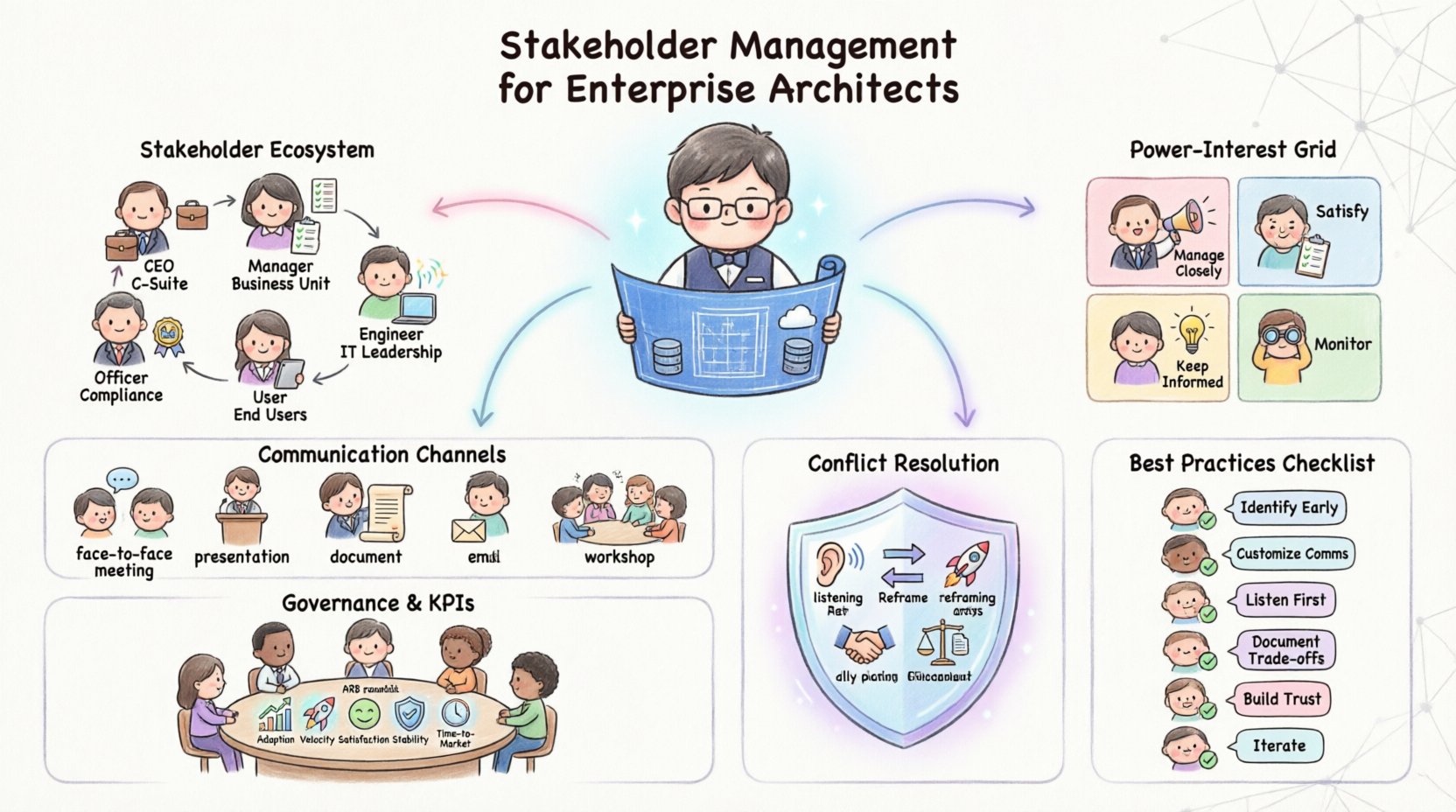
Understanding the Stakeholder Ecosystem 🌍
In the context of Enterprise Architecture, stakeholders extend beyond the IT department. They encompass the entire value chain of the organization. A clear understanding of who holds power and who holds influence is the first step toward effective governance.
Key Categories of Stakeholders
- C-Suite Executives: These individuals set the strategic direction. Their primary concern is return on investment, risk mitigation, and competitive advantage. For them, architecture must be framed in terms of business outcomes, not technical specifications.
- Business Unit Leaders: They manage specific operational areas. Their focus lies in agility, process efficiency, and customer experience. They often view architecture as a potential constraint unless it directly solves a pain point.
- IT Leadership & Engineering: This group includes CIOs, CTOs, and technical managers. They care about system stability, security, scalability, and maintainability. They are the primary implementers of architectural decisions.
- Regulatory & Compliance Officers: In highly regulated industries, these stakeholders ensure adherence to laws and standards. They often hold veto power over designs that do not meet compliance requirements.
- End Users: The employees who interact with the systems daily. Their feedback is crucial for adoption rates and usability.
The Cost of Misalignment
When architects fail to engage the right stakeholders, several negative outcomes emerge. Projects face delays due to late-stage objections. Budgets inflate as requirements change after development has begun. Systems become siloed because different departments pursue incompatible solutions. Ultimately, the organization loses confidence in the architecture function, viewing it as an administrative hurdle rather than a strategic asset.
Mapping Influence and Interest 📊
Not all stakeholders require the same level of attention. Attempting to engage everyone equally dilutes resources and creates communication fatigue. A structured approach to mapping stakeholders ensures that energy is directed where it matters most.
The Power-Interest Grid
This model categorizes stakeholders based on two dimensions: their power to influence the project and their interest in the outcome. This helps determine the appropriate engagement strategy for each group.
| Category | Characteristics | Engagement Strategy |
|---|---|---|
| High Power, High Interest | Key decision-makers who are deeply affected by the outcome. | Manage Closely: Regular updates, active participation in design reviews, and direct consultation. |
| High Power, Low Interest | Individuals who can block or approve but do not care about the details. | Satisfy: Keep them informed with high-level summaries. Ensure no surprises that could trigger a veto. |
| Low Power, High Interest | Subject matter experts or end-users who are enthusiastic but lack formal authority. | Keep Informed: Seek their input early. They often provide the practical insights needed for success. |
| Low Power, Low Interest | Groups that are minimally affected or have little influence. | Monitor: Minimal effort required. General announcements are sufficient. |
Dynamic Mapping
Stakeholder maps are not static documents. Influence and interest shift over time. A mid-level manager might gain power during a reorganization. A specific business unit might become more critical if a new product line is launched. Architects must review these maps periodically to ensure engagement strategies remain relevant.
Communication Protocols and Channels 🗣️
Effective communication is the bridge between architectural vision and stakeholder understanding. The message must be tailored to the audience. Technical jargon that resonates with engineers will confuse a marketing executive. Conversely, high-level business speak may frustrate a security engineer looking for specific controls.
Tailoring the Message
- For Executives: Focus on value, risk, and timing. Use visual summaries that highlight trade-offs. Avoid deep dives into code structure or database schemas.
- For Technical Teams: Provide detailed specifications, interface definitions, and integration patterns. Explain the “why” behind constraints to foster ownership.
- For Operations: Emphasize stability, supportability, and monitoring. Discuss deployment pipelines and rollback procedures.
- For Compliance: Map architecture decisions directly to regulatory requirements. Provide evidence of control implementation.
Choosing the Right Channel
The medium of communication affects the reception of the message. Different situations require different formats.
| Channel | Best Used For | Frequency |
|---|---|---|
| Face-to-Face Meetings | Complex negotiations, conflict resolution, strategic alignment. | As needed / Weekly |
| Formal Presentations | Architecture reviews, board updates, major announcements. | Monthly / Quarterly |
| Documentation | Standards, reference models, detailed design specs. | Updated per release |
| Email Updates | General status reports, meeting minutes, quick queries. | Weekly |
| Workshops | Collaborative design, requirement gathering, brainstorming. | Project Phase Dependent |
Navigating Conflict and Resistance 🛡️
Resistance is a natural part of change. When architecture proposes a new direction, it often implies that current practices will change or be retired. This threatens established routines and perceived security. Understanding the root cause of resistance allows architects to address it constructively.
Common Sources of Resistance
- Loss of Control: Teams may fear that centralization reduces their autonomy to build what they want.
- Resource Constraints: Stakeholders may believe the proposed architecture requires more time or money than available.
- Technical Debt: Proposals to refactor legacy systems often meet pushback because the immediate cost is high, while the benefit is long-term.
- Uncertainty: Fear of the unknown can cause stakeholders to cling to familiar, albeit inefficient, solutions.
Strategies for Resolution
When facing pushback, the approach should be collaborative rather than authoritative.
- Listen Actively: Allow stakeholders to voice concerns without interruption. Validate their points before responding.
- Reframe the Problem: Shift the conversation from “compliance” to “enablement.” Show how the architecture removes obstacles rather than creating them.
- Pilot Programs: Propose small-scale tests to demonstrate value before full rollout. This reduces the perceived risk.
- Find Allies: Identify champions within the resistant group who understand the benefits. Use them to influence their peers.
- Document Trade-offs: If a stakeholder insists on deviating from standards, document the risks and consequences formally. This ensures accountability.
Governance and Decision-Making Structures 🔄
Clear governance defines how decisions are made, who has the authority to approve them, and how exceptions are handled. Without this structure, architecture becomes a suggestion rather than a standard.
The Architecture Review Board (ARB)
An ARB is a formal body responsible for reviewing architectural artifacts. It ensures that proposed solutions align with enterprise standards and strategic goals.
- Membership: Should include representatives from IT, Business, Security, and Compliance. Cross-functional representation prevents bias.
- Process: Projects must submit design documents for review before significant spending occurs. The board provides feedback, requests changes, or grants approval.
- Authority: The ARB should have the power to halt projects that violate critical standards, but this power must be exercised judiciously to avoid bottlenecks.
Exception Management
Not every project fits the standard mold. Sometimes, business urgency or unique requirements necessitate a deviation. An exception process provides a formal way to manage these cases.
- Temporary vs. Permanent: Distinguish between short-term workarounds and permanent architectural drift.
- Remediation Plan: Exceptions should always include a timeline for returning to compliance or a plan to migrate away from the non-standard solution.
- Cost Implications: Exceptions often incur higher maintenance costs. Stakeholders must acknowledge these trade-offs.
Measuring Engagement and Success 📈
How do you know if stakeholder management is working? Qualitative feedback is useful, but quantitative metrics provide objective evidence of effectiveness.
Key Performance Indicators
- Adoption Rates: How many projects adhere to the defined architecture standards without requiring exceptions?
- Project Velocity: Does architecture involvement speed up delivery by reducing rework, or does it slow it down?
- Stakeholder Satisfaction: Regular surveys asking business leaders about the value of the EA function.
- System Stability: Reduction in outages or security incidents attributable to architectural flaws.
- Time-to-Market: The speed at which new capabilities can be delivered using the established architecture.
Feedback Loops
Success is not a destination but a continuous process. Establishing regular feedback loops ensures that the architecture function evolves with the organization.
- Post-Implementation Reviews: After a project goes live, gather feedback from the stakeholders involved. What went well? Where were the friction points?
- Quarterly Business Reviews: Present the EA roadmap and achievements to leadership. Align future priorities with current business needs.
- Open Forums: Create channels where developers and business users can ask questions or report issues related to architecture without fear of retribution.
Balancing Standardization and Agility ⚖️
One of the greatest challenges in Enterprise Architecture is finding the right balance between rigid standards and the need for speed. Too much standardization stifles innovation. Too little leads to chaos.
Architects must design platforms and patterns that are flexible enough to accommodate change. This involves defining core capabilities that must remain consistent, such as security protocols and data definitions, while allowing teams autonomy in implementation details, such as specific libraries or UI frameworks.
This approach, often called “constrained autonomy,” empowers teams to move fast within guardrails. It shifts the conversation from “What are you allowed to do?” to “Here is how you can succeed within our framework.” This mindset shift reduces resistance and fosters a culture of shared responsibility.
The Human Element in Technical Strategy
Technology is ultimately a tool used by people. The success of any architectural initiative depends on the people who build, maintain, and use it. Architects who prioritize relationships over diagrams build stronger organizations.
This requires empathy. It means understanding the pressures faced by a team trying to meet a deadline. It means recognizing that a legacy system might exist because it solved a critical problem in the past, even if it is inefficient today.
By treating stakeholders as partners rather than obstacles, Enterprise Architects can navigate complex environments with confidence. The result is an architecture that is not just technically sound, but also politically viable and business-aligned.
Summary of Best Practices
- Identify early: Map stakeholders at the start of any major initiative.
- Customize communication: Speak the language of the audience.
- Listen more than you speak: Understand concerns before proposing solutions.
- Document trade-offs: Make the cost of decisions transparent.
- Build trust: Deliver on promises and be honest about risks.
- Iterate: Refine governance and engagement strategies based on feedback.
Enterprise Architecture is a journey of alignment. It requires patience, clarity, and a deep commitment to the organization’s success. When stakeholders feel heard and understood, they become advocates for the architecture, driving the transformation forward with shared purpose.