

Enterprise Architecture (EA) often feels like navigating a complex maze without a map. Organizations strive for alignment between business strategy and IT capabilities, yet the path is rarely linear. To bring order to this complexity, professionals rely on frameworks. These structures provide the necessary scaffolding to analyze, design, plan, and implement enterprise architecture.
However, the landscape is crowded with methodologies. You may encounter references to TOGAF, Zachman, ArchiMate, and FEAF. Distinguishing between them is crucial for selecting the right approach. This guide provides a clear breakdown of the major frameworks, their specific components, and how they function within an organization.
🧩 What is an Enterprise Architecture Framework?
Before diving into specific models, it is essential to define what an Enterprise Architecture Framework actually is. It is not merely a software tool or a set of rules. Instead, it is a structured approach to defining the structure and processes of an organization.
A framework typically includes:
- Methodologies: Step-by-step processes for creating architecture.
- Content Models: A taxonomy for organizing architectural artifacts.
- Standards: Guidelines for consistency in documentation and design.
- Tools: (Optional) Mechanisms to support the process, though the framework exists independently of specific software.
The goal is to create a coherent view of the enterprise. This view ensures that technology investments support business goals. It reduces redundancy and improves agility. Without a framework, architecture efforts can become fragmented, leading to siloed systems and conflicting standards.
📋 The Zachman Framework: The Ontology of Architecture
Developed by John Zachman in 1987, the Zachman Framework is one of the oldest and most influential models in the field. It is best described as an ontology. This means it classifies the different types of information that exist within an enterprise. It does not prescribe a process for building the architecture; rather, it defines the content that must be understood.
🔳 The 6×6 Matrix
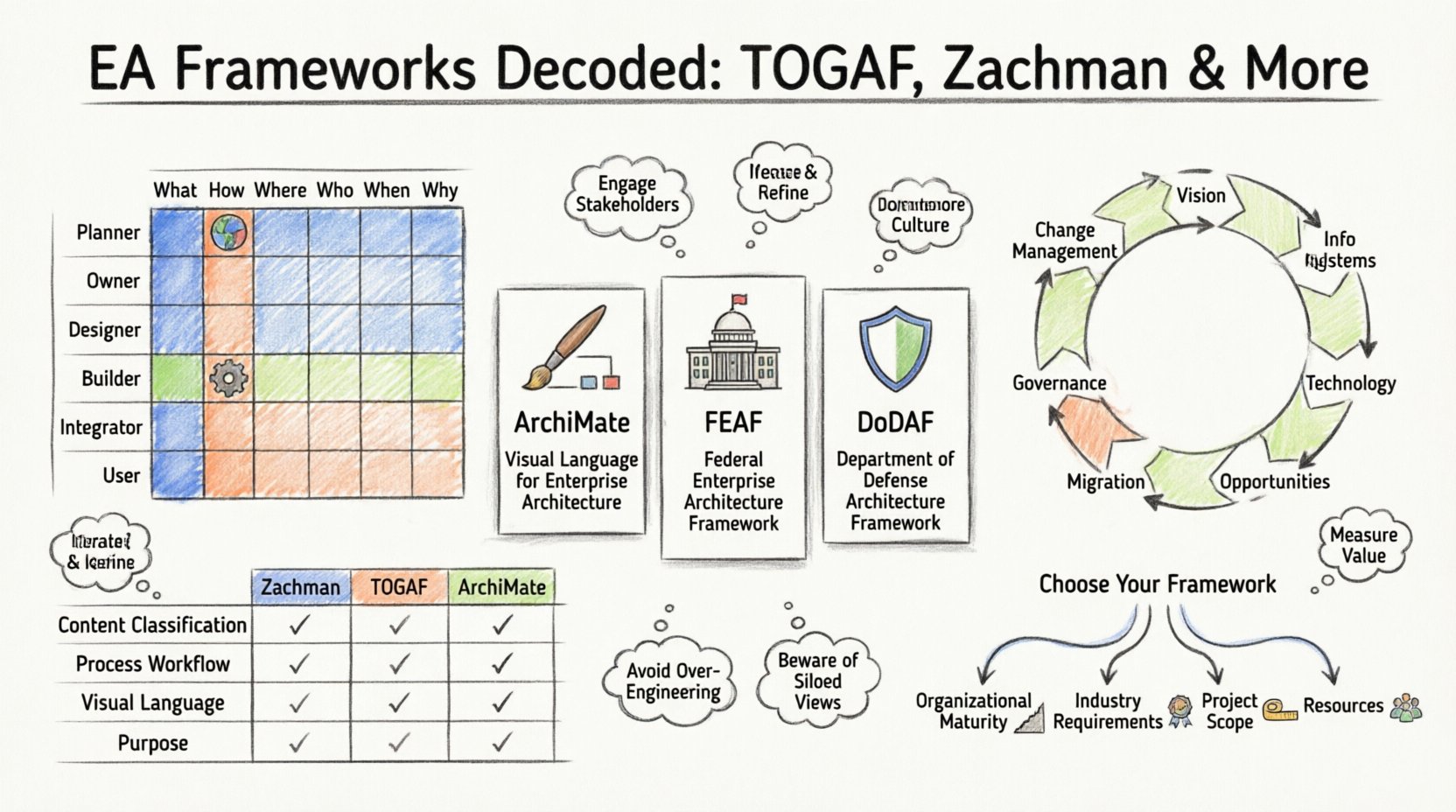
The core of the Zachman Framework is a matrix. It consists of six columns representing the fundamental questions of the enterprise. It also has six rows representing the perspectives of different stakeholders. This creates a grid of 36 cells, each representing a specific artifact or view.
The Columns (The Questions):
- What: Data or Information. What are the key business entities?
- How: Function or Process. How does the business operate?
- Where: Network or Location. Where are the systems and data located?
- Who: People or Organization. Who is involved in the execution?
- When: Time or Schedule. When do events occur?
- Why: Motivation or Strategy. Why does the business exist or do this?
The Rows (The Perspectives):
- Planner (Scope): High-level context and overview.
- Owner (Business Model): Detailed business logic and strategy.
- Designer (System Model): The technical design specifications.
- Builder (Technology Model): The actual implementation and code.
- Integrator (Functioning System): The deployed, operational system.
- User (Useful Function): How the end-user experiences the system.
For example, the intersection of What and Owner might be a data model of the business. The intersection of What and Builder might be a database schema. This comprehensive classification ensures that no critical aspect of the enterprise is overlooked during planning.
✅ Benefits of Zachman
- Comprehensive Coverage: It forces consideration of every angle of the enterprise.
- Vendor Agnostic: It does not rely on specific tools or technologies.
- Language Standardization: It provides a common vocabulary for stakeholders.
🔄 TOGAF: The Architecture Development Method
The Open Group Architecture Framework (TOGAF) is arguably the most widely used framework globally. Unlike Zachman, which focuses on content, TOGAF focuses heavily on the process. It provides a detailed method for developing and managing an enterprise architecture. This method is known as the Architecture Development Method (ADM).
🚀 The ADM Cycle
The ADM is a recursive cycle. It guides architects from the initial concept to the final implementation and maintenance. The cycle consists of several phases:
- Phase A: Architecture Vision. Define the scope, constraints, and stakeholders. Get approval for the project.
- Phase B: Business Architecture. Describe the business strategy, governance, and processes.
- Phase C: Information Systems Architectures. Design the data and application architectures.
- Phase D: Technology Architecture. Define the hardware, software, and network infrastructure.
- Phase E: Opportunities and Solutions. Identify major implementation projects and migration strategies.
- Phase F: Migration Planning. Create a detailed plan for transitioning from current to target state.
- Phase G: Implementation Governance. Ensure the architecture is implemented according to the plan.
- Phase H: Architecture Change Management. Manage changes to the architecture over time.
Between these phases lies the Architecture Repository. This is the central storehouse for all architecture artifacts. It ensures that decisions are documented and accessible throughout the lifecycle.
🛠️ Core Components of TOGAF
- The ADM: The workflow engine for architecture work.
- The Content Metamodel: A standard for organizing architecture information.
- The Capability Framework: A guide for assessing and improving the organization’s architecture maturity.
- The Standards, Information and Building Blocks: Guidelines for reusing components across the enterprise.
TOGAF is particularly strong for organizations that need a repeatable process. It helps manage large-scale transformations where multiple projects must align. It is less concerned with the static classification of data and more concerned with the journey of change.
🌐 Other Notable Frameworks
Beyond Zachman and TOGAF, several other frameworks address specific needs or industries. Understanding these options ensures you do not force a square peg into a round hole.
🎨 ArchiMate
ArchiMate is an open and independent modeling language. It is often used in conjunction with TOGAF. While TOGAF provides the process, ArchiMate provides the visual language. It allows architects to create clear diagrams that show relationships between business, application, and technology layers. This visual clarity is vital for communicating complex concepts to non-technical stakeholders.
🏛️ FEAF (Federal Enterprise Architecture Framework)
FEAF is used primarily by the US federal government. It was designed to promote information sharing and collaboration across different agencies. It focuses on cross-agency initiatives and shared services. If an organization operates within a highly regulated government environment, FEAF may be the mandated standard.
🛡️ DoDAF (Department of Defense Architecture Framework)
DoDAF is designed for the US Department of Defense. It emphasizes interoperability and systems engineering. It is highly detailed and focuses on the technical integration of complex systems. It is less business-focused and more capability-focused.
⚖️ Framework Comparison
Selecting the right framework requires understanding the differences in their focus and application. The table below summarizes the key distinctions.
| Feature | Zachman Framework | TOGAF | ArchiMate |
|---|---|---|---|
| Primary Focus | Content & Classification | Process & Workflow | Modeling Language |
| Structure | 6×6 Matrix | ADM Cycle | Visual Diagrams |
| Best Use Case | Comprehensive Inventory | Transformation Projects | Visual Communication |
| Process Definition | None | Extensive | None |
| Industry Adoption | Varied | Global / Corporate | Integration / EA |
It is common to combine these frameworks. For instance, an organization might use Zachman to ensure all data points are cataloged, use TOGAF to manage the transformation project, and use ArchiMate to document the final designs.
🧭 How to Choose the Right Framework
There is no single “best” framework. The choice depends on the specific context of the organization. Consider the following factors when making a decision.
1. Organizational Maturity
If the organization is just starting its architecture journey, a lightweight framework is often better. TOGAF can be heavy and may overwhelm teams that are new to the discipline. A simpler approach allows for quick wins and learning.
2. Industry Requirements
Regulated industries like finance or healthcare often have specific compliance needs. Some frameworks offer better support for governance and audit trails. Government sectors may mandate specific frameworks like FEAF or DoDAF.
3. Project Scope
Is the goal to document the current state or to drive a massive transformation? If the goal is transformation, TOGAF’s ADM is highly effective. If the goal is inventory and cataloging, Zachman provides a robust structure.
4. Resource Availability
Implementing a framework requires skilled personnel. TOGAF requires certified architects to manage the ADM cycle effectively. If resources are limited, a tailored subset of a framework is often more practical than the full standard.
🛠️ Implementation Best Practices
Once a framework is selected, the implementation phase begins. Success relies on discipline and alignment, not just documentation.
🤝 Engage Stakeholders Early
Architecture is not an IT-only function. It must reflect business needs. Engage business leaders, operations, and security teams from the start. Their input ensures the architecture supports real-world requirements.
📝 Define Standards and Patterns
Establish clear standards for how components are designed and documented. Use patterns to promote reuse. This reduces the cost of future changes and ensures consistency across the enterprise.
🔄 Iterate and Refine
Architecture is not a one-time event. It evolves as the business changes. Adopt an iterative approach. Review the architecture periodically. Update the models to reflect new realities.
📊 Measure Value
Define metrics to track the success of the architecture program. Look for reductions in project delivery time, decreases in technical debt, or improvements in system availability. These metrics demonstrate the value of the effort.
🚧 Common Pitfalls to Avoid
Even with a solid framework, teams can encounter obstacles. Awareness of common pitfalls helps mitigate risks.
1. Over-Engineering
Trying to model every single detail can lead to paralysis. Focus on the critical paths and high-value areas. Use abstraction for less critical components.
2. Ignoring Culture
A framework that conflicts with the organizational culture will fail. If the culture values speed over documentation, enforce a lighter process. Adapt the framework to fit the people, not the other way around.
3. Lack of Governance
Without governance, architecture guidelines are ignored. Establish an Architecture Review Board (ARB) to ensure compliance. This body should have the authority to approve or reject architectural decisions.
4. Siloed Efforts
Do not allow different departments to build their own architectures in isolation. Centralize the EA function or establish strong coordination mechanisms. Silos lead to redundancy and integration failures.
📈 The Future of Enterprise Architecture
The field is evolving. As organizations adopt cloud computing, microservices, and AI, the frameworks must adapt. The focus is shifting from static documentation to dynamic management. The concept of “Continuous Architecture” is gaining traction. This approach treats architecture as an ongoing activity rather than a project with a start and end date.
Automation is also playing a larger role. Tools are being used to scan systems and update architecture models automatically. This reduces the burden on architects and ensures the documentation remains accurate.
🔑 Key Takeaways
Understanding the landscape of enterprise architecture frameworks is vital for success. TOGAF offers a robust process for transformation. Zachman provides a comprehensive classification of information. ArchiMate enables clear visual communication. Each has strengths and weaknesses.
By selecting the right framework and implementing it with discipline, organizations can achieve better alignment. They can reduce costs and increase agility. The key is to remain flexible and adapt the framework to the unique needs of the business. Avoid rigid adherence to rules that do not serve the organization. Instead, focus on the outcome: a resilient, efficient, and strategic enterprise.
Start by assessing your current state. Identify the gaps between your business goals and your IT capabilities. Then, choose the framework that best bridges that gap. With the right tools and a clear plan, the complexity of enterprise architecture becomes manageable.