


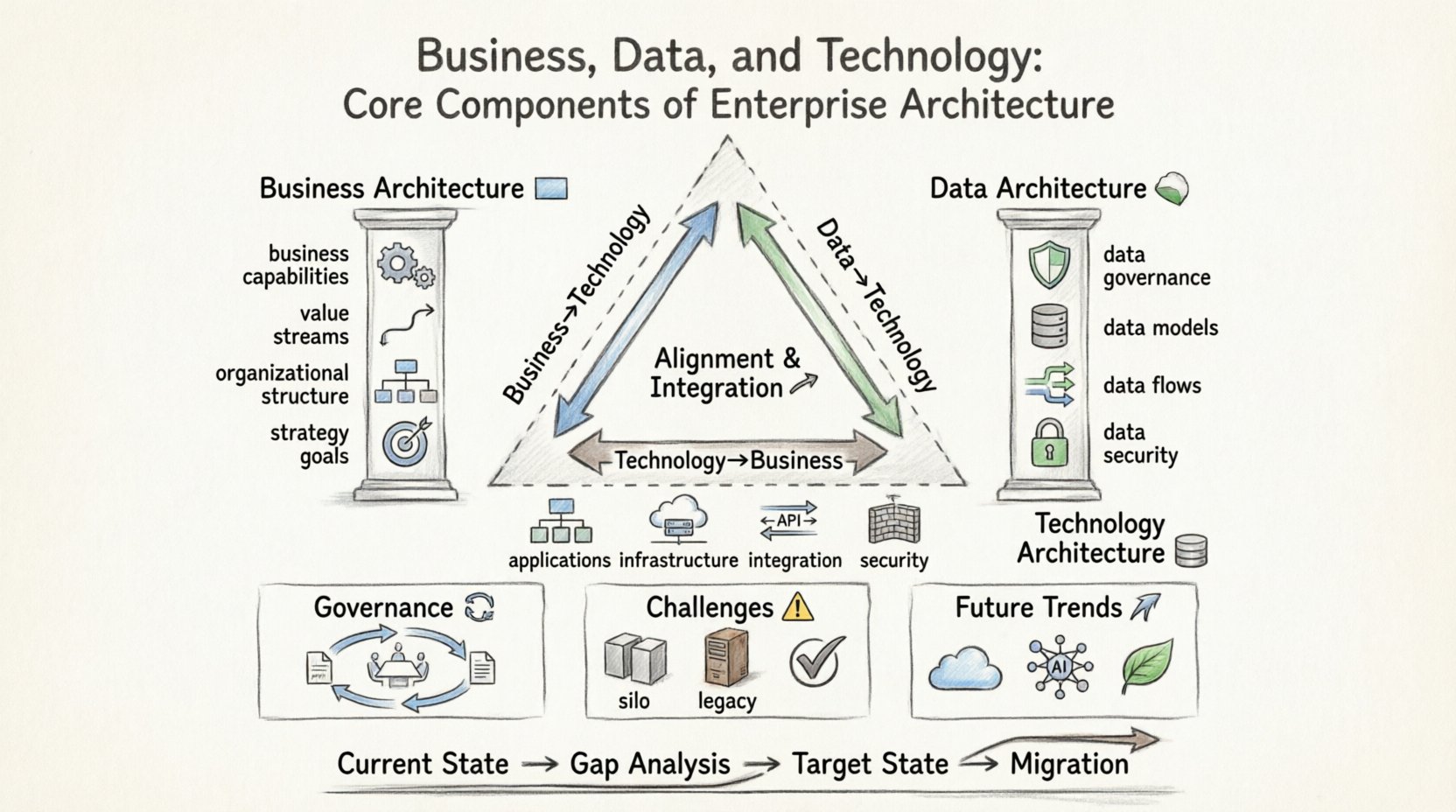
Enterprise Architecture (EA) serves as the strategic blueprint for an organization. It provides a holistic view of how business capabilities, information flows, and technical systems interact to support organizational goals. Without a structured approach, enterprises often face silos, redundant systems, and misaligned investments. This guide examines the three foundational pillars: Business, Data, and Technology.
Understanding these components is essential for leaders aiming to optimize operations, drive innovation, and maintain agility. This document details the structure, relationships, and governance required for a robust architecture.
1. The Business Architecture Layer 🏢
Business Architecture defines the structure of an organization and its core business processes. It acts as the bridge between high-level strategy and execution. This layer answers questions regarding what the organization does, how it delivers value, and how it is organized.
Key Elements of Business Architecture
- Business Capabilities: These represent the specific abilities an organization needs to execute its strategy. Examples include customer management, supply chain logistics, and financial reporting. Mapping capabilities helps identify strengths and gaps.
- Value Streams: A value stream describes the end-to-end sequence of activities that create value for a customer or stakeholder. It moves from a trigger (e.g., a customer order) to a result (e.g., delivered product).
- Organizational Structure: This defines the roles, departments, and governance bodies. It clarifies decision-making authority and accountability.
- Strategy & Goals: High-level objectives guide the architectural decisions. These include market expansion, cost reduction, or service enhancement.
Mapping Business Capabilities
Creating a capability map allows organizations to visualize their operational footprint. This visualization is critical for identifying redundancy or gaps.
- Identification: List all critical capabilities required to operate.
- Assessment: Evaluate current performance levels for each capability.
- Gap Analysis: Determine where current capabilities fall short of strategic needs.
- Investment Planning: Allocate resources to close identified gaps.
2. The Data Architecture Layer 📊
Data is the lifeblood of modern enterprises. The Data Architecture layer ensures that information is available, secure, and usable across the organization. It defines how data is collected, stored, managed, and utilized to support business processes.
Core Principles of Data Architecture
- Data Governance: Policies, procedures, and standards that ensure data quality and compliance. This includes ownership, stewardship, and access controls.
- Data Models: Logical and physical representations of data structures. They define relationships between entities, such as customers, orders, and products.
- Data Flows: The movement of data between systems. This includes ingestion, transformation, storage, and retrieval.
- Data Security: Mechanisms to protect sensitive information from unauthorized access or breaches.
Data Governance Framework
A robust framework is necessary to maintain data integrity over time. It ensures that data remains a trusted asset.
| Component | Function | Key Outcome |
|---|---|---|
| Policy Definition | Establishes rules for data handling | Consistency and Compliance |
| Stewardship | Assigns ownership to data domains | Accountability |
| Quality Monitoring | Tracks accuracy and completeness | Reliable Insights |
| Access Management | Controls who sees what data | Security & Privacy |
3. The Technology Architecture Layer 💻
The Technology Architecture layer encompasses the hardware, software, and network infrastructure required to support the business and data layers. It translates business requirements into technical specifications.
Technical Domains
- Application Architecture: Defines the structure of software systems. It includes microservices, monolithic applications, and integration patterns. The focus is on functionality and modularity.
- Infrastructure Architecture: Covers the physical and virtual resources. This includes servers, storage, networking, and cloud environments.
- Integration Architecture: Manages how different systems communicate. It involves APIs, middleware, and data exchange protocols.
- Security Architecture: Embeds security controls into the technical design. It protects against threats at the network, application, and data levels.
Technology Selection Criteria
Choosing the right technology stack requires careful evaluation. Decisions should align with long-term strategy rather than short-term trends.
- Scalability: Can the technology grow with demand?
- Interoperability: Does it integrate well with existing systems?
- Maintainability: Is it easy to update and support?
- Cost Efficiency: Does it offer value relative to the budget?
- Vendor Stability: Is the provider reliable and committed to the product?
4. Alignment and Integration 🔗
The true power of Enterprise Architecture lies in the alignment of these three components. A change in one layer impacts the others. Effective integration ensures that business goals are met through data and technology.
The Alignment Triangle
Consider the relationship between Business, Data, and Technology as a triangle where each side supports the other.
- Business to Technology: Business needs drive technology investments. A new customer service initiative requires specific tools and capabilities.
- Data to Technology: Data requirements dictate technical infrastructure. High-volume data processing needs robust storage and compute resources.
- Technology to Business: Technology enables new business models. Cloud computing allows for rapid scaling and remote work capabilities.
Gap Analysis and Roadmapping
To move from the current state to the target state, organizations perform gap analysis. This process identifies discrepancies between current capabilities and future requirements.
- Current State Assessment: Document existing systems, processes, and data flows.
- Target State Definition: Define the desired architecture based on strategic goals.
- Gap Identification: Highlight missing capabilities, data inconsistencies, or technical limitations.
- Migration Planning: Create a roadmap to transition from current to target state.
- Execution: Implement changes in phases to minimize risk.
5. Governance and Lifecycle Management 🔄
Architecture is not static. It evolves with the market, technology, and business needs. Governance ensures that changes are managed systematically and align with standards.
Architecture Governance Board
A governance board oversees architectural decisions. It ensures compliance with standards and strategic alignment.
- Review Committees: Regular meetings to assess proposed changes.
- Standards Enforcement: Ensuring all projects adhere to defined technical and data standards.
- Portfolio Management: Tracking the health and status of the overall IT portfolio.
Continuous Improvement
Regular reviews keep the architecture relevant. Feedback loops allow for adjustments based on real-world performance.
- Performance Metrics: Monitor system uptime, data latency, and process efficiency.
- Change Requests: Formalize how modifications are requested and approved.
- Knowledge Sharing: Document decisions and rationales for future reference.
- Training: Ensure staff understand architectural standards and tools.
6. Common Challenges and Solutions ⚠️
Implementing Enterprise Architecture is complex. Organizations often encounter obstacles that hinder progress. Recognizing these challenges early allows for proactive mitigation.
Challenge: Siloed Operations
Departments often operate independently, creating data and process silos. This leads to inefficiency and inconsistent information.
- Solution: Implement cross-functional teams and shared data platforms. Encourage collaboration through unified goals.
Challenge: Legacy Systems
Older systems may be difficult to integrate or maintain. They can slow down innovation and increase costs.
- Solution: Develop a migration strategy. Wrap legacy systems with modern APIs to enable connectivity without immediate replacement.
Challenge: Lack of Visibility
Leaders may not have a clear view of the IT landscape. This makes decision-making difficult.
- Solution: Create comprehensive architecture repositories. Use visualization tools to map dependencies and flows.
Challenge: Resistance to Change
Staff may resist new processes or technologies. Fear of the unknown can stall adoption.
- Solution: Involve stakeholders early in the design process. Provide training and support to build confidence.
7. Future Trends and Adaptation 🚀
The landscape of enterprise architecture is constantly shifting. Staying informed about emerging trends helps organizations remain competitive.
Cloud-Native Strategies
More organizations are moving to cloud-native designs. This approach emphasizes scalability, resilience, and rapid deployment.
- Microservices: Breaking applications into smaller, manageable services.
- Containerization: Packaging code and dependencies for consistent execution.
- Serverless Computing: Reducing infrastructure management overhead.
Data-Driven Decision Making
Analytics and artificial intelligence are becoming central to operations. Data architecture must support advanced processing and real-time insights.
- Real-Time Processing: Handling data streams for immediate action.
- Advanced Analytics: Leveraging machine learning for predictive insights.
- Data Lakes: Storing vast amounts of raw data for future exploration.
Sustainability and Green IT
Environmental impact is gaining importance. Architectural decisions now consider energy efficiency and carbon footprint.
- Energy-Efficient Code: Optimizing software to reduce computational load.
- Resource Optimization: Maximizing the utilization of hardware and cloud resources.
- E-Waste Reduction: Planning for hardware lifecycle and disposal.
8. Summary of Best Practices 📝
Success in Enterprise Architecture requires discipline, clarity, and continuous effort. The following practices help maintain a healthy architectural environment.
- Start with Business Value: Always link technical decisions to business outcomes.
- Document Everything: Maintain up-to-date documentation for knowledge transfer.
- Engage Stakeholders: Involve business and IT leaders in the planning process.
- Iterate Frequently: Adopt an agile approach to architecture design and implementation.
- Measure Success: Define KPIs to track the effectiveness of architectural initiatives.
By integrating Business, Data, and Technology, organizations build a foundation for resilience and growth. This structured approach reduces risk and enhances the ability to adapt to market changes. The journey requires commitment, but the long-term benefits are substantial.
Effective architecture is an ongoing practice. It demands attention to detail and a willingness to evolve. As the enterprise grows, so must its architectural framework. Keeping these core components in balance ensures sustained operational excellence.