

Preparing for a system analysis or business analyst interview requires a solid understanding of modeling techniques. Among the most common tools assessed is the Data Flow Diagram (DFD). This visual representation illustrates how data moves through a system. Candidates must demonstrate clarity on processes, data stores, external entities, and data flows. This guide covers essential questions, detailed answers, and structural advice to help you navigate your interview with confidence.
Understanding the Fundamentals of DFDs 🧠
Before diving into specific interview questions, it is crucial to grasp the core concept. A Data Flow Diagram maps the movement of data within a system. It does not show the control flow or the sequence of operations. Instead, it focuses on the transformation of data from input to output.
Why DFDs Matter in Interviews
- Communication: They bridge the gap between technical teams and stakeholders.
- Documentation: They serve as a blueprint for system development.
- Analysis: They help identify bottlenecks or missing data points.
DFD Symbols and Components 🛠️
Interviewers often ask about the standard notation used to create these diagrams. While different notations exist (like Gane & Sarson or Yourdon & Constantine), the core components remain consistent.
Key Components Explained
- External Entity: Represents a source or destination of data outside the system boundary.
- Process: A transformation or action that changes data.
- Data Store: Where data is saved for later use.
- Data Flow: The movement of data between components.
Comparison of Notations
| Feature | DeMarco (Yourdon) | Gane & Sarson |
|---|---|---|
| Process Shape | Circle or Rounded Rectangle | Rectangle with Rounded Corners |
| Data Store Shape | Open Rectangle | Rectangle with one side open |
| Data Flow Arrow | Simple Line | Arrow with a specific head |
Beginner Level Questions ❓
Entry-level interviews focus on definitions and basic identification. Expect questions that test your knowledge of the symbols and their purposes.
Q1: What is a Data Flow Diagram?
A: A Data Flow Diagram is a graphical representation of the flow of data through an information system. It models how data is input, processed, stored, and output. It helps visualize the logical system without worrying about physical implementation details.
Q2: List the four main components of a DFD.
A: The four primary components are:
- External Entities (Sources or Destinations)
- Processes (Actions or Transformations)
- Data Stores (Repositories)
- Data Flows (Movements)
Q3: What is an External Entity?
A: An External Entity is a person, organization, or system outside the boundary of the system being modeled. It interacts with the system by providing input data or receiving output data. It is not part of the system itself.
Intermediate Level Questions 🧐
Intermediate questions require you to apply your knowledge to scenarios. You may be asked to draw a diagram or explain the relationship between different levels of DFDs.
Q4: Explain the difference between a Context Diagram and a Level 0 DFD.
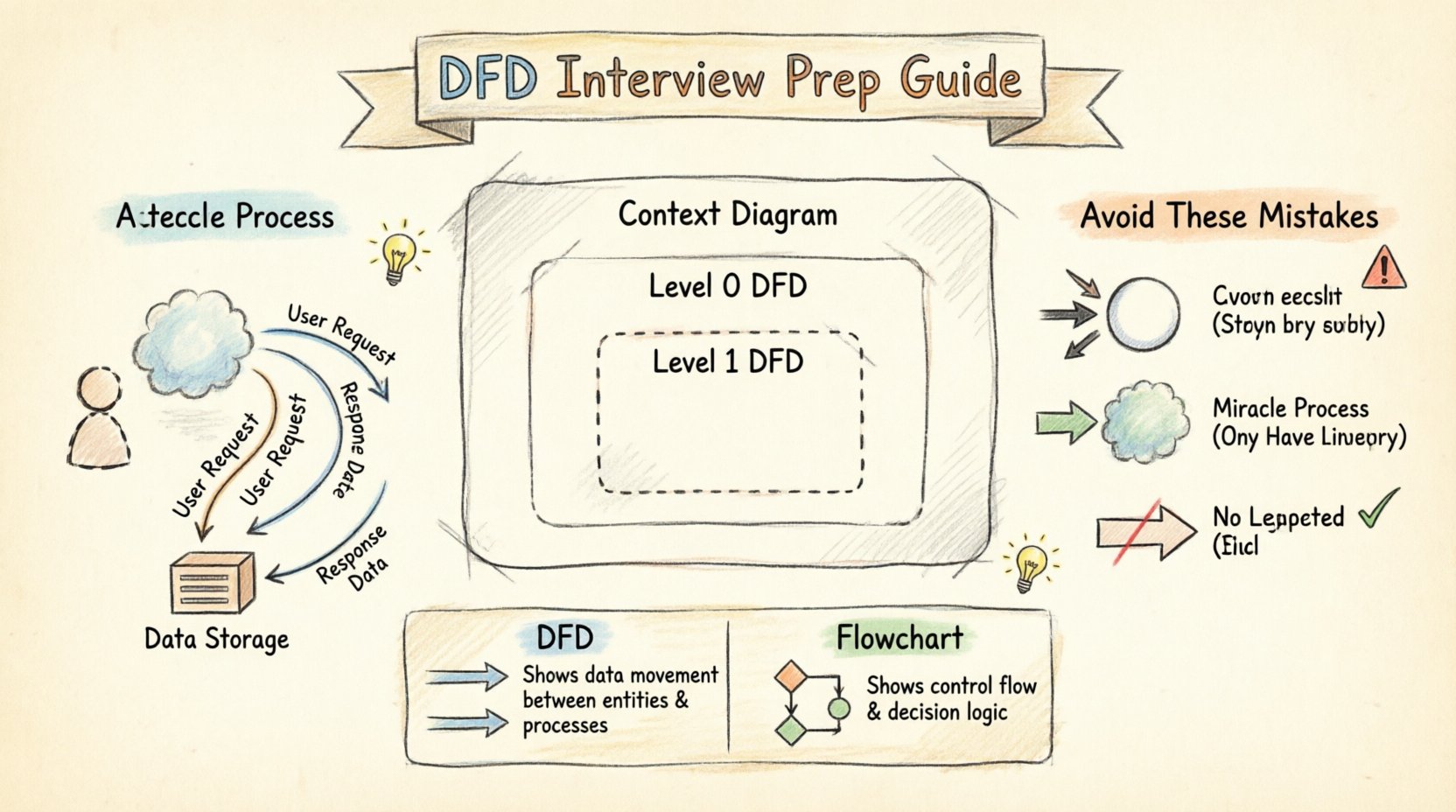
A: A Context Diagram is the highest-level DFD (Level 0). It shows the system as a single process and its interaction with external entities. A Level 0 DFD (often called a decomposed context) breaks the single process into major sub-processes. It provides more detail on how the system functions internally while maintaining the same external boundaries.
Q5: What is Data Balancing in DFDs?
A: Data balancing ensures that data flows entering and leaving a parent process match the flows in its child diagram. When a process is decomposed into sub-processes, the input and output data must remain consistent. This maintains the integrity of the data model across different levels of detail.
Q6: Can a Data Store connect directly to an External Entity?
A: No. Data cannot flow directly from a data store to an external entity without passing through a process. A process is required to transform or retrieve the data before it leaves the system. This rule ensures that data is always processed before exiting.
Advanced Level Questions 🚀
Senior roles often involve complex system analysis. Questions here focus on troubleshooting, optimization, and handling specific constraints.
Q7: How do you handle a situation where a data flow has no label?
A: Every data flow must be labeled. A label describes the type of data moving along the path. If a flow has no label, it is considered invalid. During a review, I would request clarification on what specific data is being transferred to ensure the diagram is accurate and actionable.
Q8: What is a Black Hole in a DFD?
A: A Black Hole occurs when a process has inputs but no outputs. The data enters the process and disappears without being transformed or stored. This is a logical error indicating that the process is not fulfilling its purpose or is missing necessary output flows.
Q9: What is a Miracle Process?
A: A Miracle Process is the opposite of a Black Hole. It occurs when a process has outputs but no inputs. This suggests data is appearing out of nowhere, which violates logical constraints. Every output must originate from an input or a data store.
Q10: How do you represent a loop in a DFD?
A: DFDs generally do not represent loops or control flow explicitly. If a loop exists in the logic, it is usually shown as a process that feeds back into a previous stage or data store. The diagram focuses on data movement, not the timing or repetition of actions. If specific iteration logic is needed, a flowchart is more appropriate.
Scenario-Based Questions 🌍
Interviewers love scenarios. They want to see how you apply theory to real-world problems. These questions often require you to think on your feet.
Scenario 1: The E-Commerce Order System
Question: We need to model an online store. A customer places an order. Inventory checks stock. If stock is available, payment is processed. If not, an out-of-stock notice is sent.
Analysis:
- External Entity: Customer, Supplier (for restocking).
- Process: Check Stock, Process Payment, Send Notification.
- Data Store: Order Database, Inventory Database.
- Flow: Order Request → Check Stock → Payment → Shipping.
Note: In this scenario, ensure the inventory check flow goes to the inventory store and the order flow goes to the order store.
Scenario 2: The Library System
Question: Describe the data flow for issuing a book to a member.
Analysis:
- Entity: Library Member.
- Process: Verify Membership, Check Availability, Update Record.
- Store: Member Database, Book Catalog, Loan Records.
Key Detail: The verification step must ensure the member is active before updating the loan records.
Common Mistakes to Avoid ⚠️
Even experienced analysts make mistakes. Mentioning these in an interview shows you understand the pitfalls.
1. Control Flow Confusion
DFDs show data movement, not decision logic. Do not use diamond shapes for decisions. Use processes to describe the action taken based on a condition.
2. Unlabeled Flows
Every line must have a name. “Data” is too vague. Use “Customer Details” or “Invoice Number” instead.
3. Direct Store-to-Store Connections
Data cannot move between two stores without a process in between. A process must define the logic for moving or copying that data.
4. Over-Detailed Diagrams
Level 1 diagrams should not contain every single step. Keep them high-level. Decompose into Level 2 for finer details.
DFD vs. Flowchart 🔄
This is a classic interview question. Candidates often confuse the two.
| Aspect | Data Flow Diagram | Flowchart |
|---|---|---|
| Focus | Data movement | Control flow and logic |
| Logic | No decision diamonds | Includes decision diamonds |
| Process | Transformation of data | Sequence of steps |
| Best Use | System Analysis | Algorithm Design |
Best Practices for Drawing DFDs 💡
To ensure your diagrams are professional and clear, follow these guidelines.
- Use Consistent Naming: Names should be consistent across all levels of the diagram.
- Limit Fan-Out: Avoid having too many processes connecting to a single data store.
- Color Coding: Use colors to distinguish between different types of entities (e.g., green for processes, blue for stores).
- Keep it Clean: Avoid crossing lines where possible. It improves readability significantly.
- Validate: Always check for Black Holes and Miracles before finalizing.
FAQ Section: Quick Interview Tips 🗣️
Q: How many levels should a DFD have?
A: There is no fixed number. It depends on the complexity of the system. Typically, 3 to 4 levels are sufficient. Context, Level 0, Level 1, and Level 2.
Q: Can a DFD show time sequences?
A: No. DFDs are static. They do not show the order of operations. For time-based logic, use a state diagram or flowchart.
Q: What if the system is too complex for one diagram?
A: Use context diagrams to summarize, and break down the system into subsystems. Each subsystem gets its own Level 0 diagram.
Q: How do you validate a DFD with stakeholders?
A: Walk through the diagram step-by-step. Ask them to trace a specific transaction from start to finish. If they can follow the data path, the diagram is clear.
Technical Writing for Interviews ✍️
When answering, structure your thoughts clearly. Use the STAR method (Situation, Task, Action, Result) for scenario-based questions.
- Situation: Describe the system context.
- Task: Explain what the diagram needed to achieve.
- Action: Detail the symbols and flows you chose.
- Result: Explain how the diagram helped the team understand the system.
Additionally, be prepared to discuss how you handle changes. Systems evolve. If a requirement changes, how do you update the DFD? The answer is to update the specific process or flow affected and check for balance in the parent and child diagrams.
Final Thoughts on Preparation 🎯
Success in DFD interviews comes from practice. Draw diagrams for various systems like banking, healthcare, or retail. Review standard notation guides. Understand the difference between physical and logical DFDs. A logical DFD shows what the system does. A physical DFD shows how it does it using specific hardware or software.
Remember, the goal is to communicate information clearly. If your diagram is confusing, it fails its purpose. Keep lines straight, labels precise, and logic sound. With these principles in mind, you are well-equipped to handle any question related to Data Flow Diagrams.
Good luck with your preparation. You have the knowledge to succeed.