

Enterprise architecture is often misunderstood as a solitary endeavor, where a few experts draw diagrams in isolation. However, the reality of modern organizational complexity demands a collaborative approach. When teams work in silos, the resulting architecture becomes fragmented, difficult to maintain, and disconnected from business reality. The solution lies in the strategic use of shared ArchiMate views. By aligning stakeholders around common visual models, organizations can bridge the gap between strategy and execution. This guide explores the mechanics, benefits, and best practices for implementing shared views within an enterprise architecture practice.
🔍 Understanding the Foundation: Views and Viewpoints
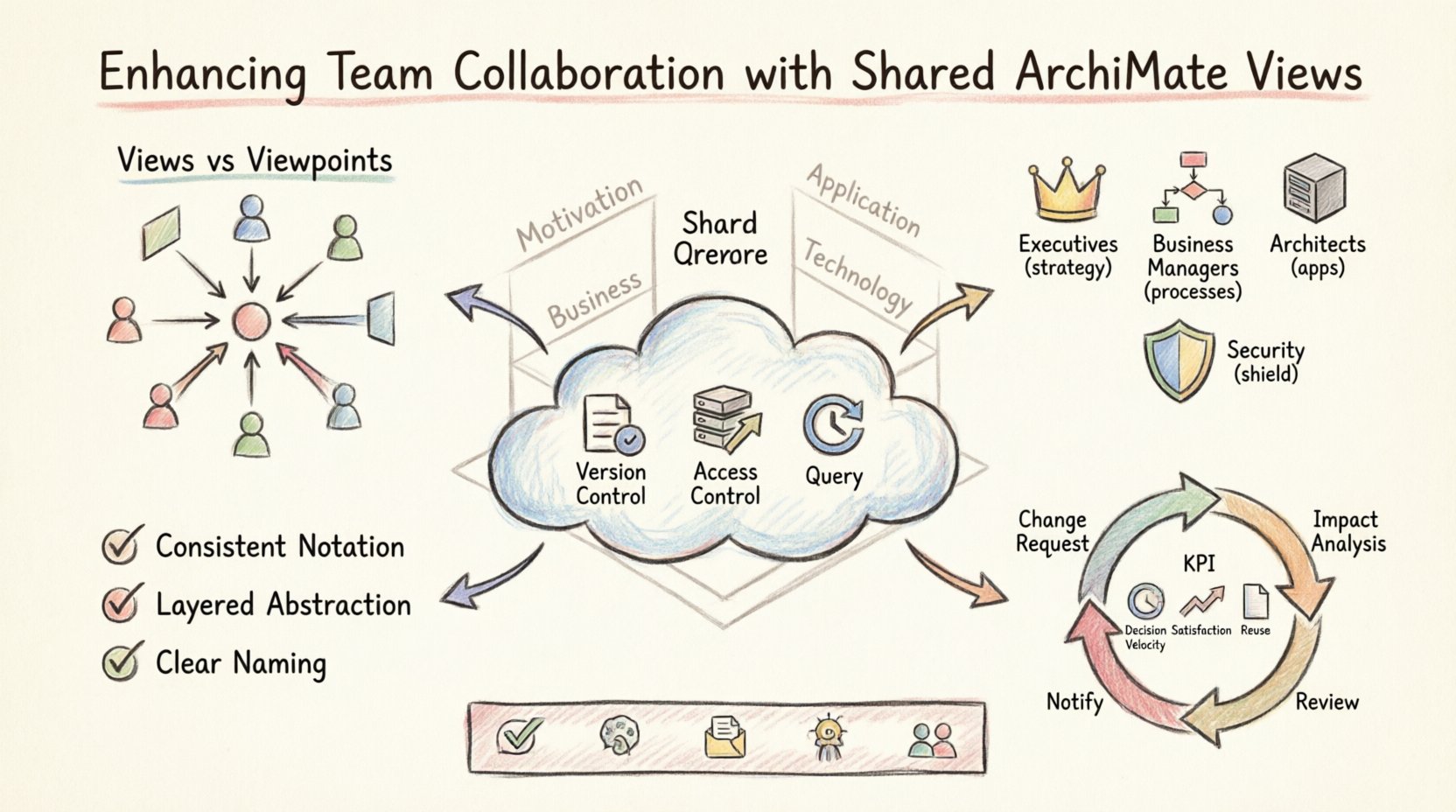
Before diving into collaboration, it is essential to define the core terminology. In the ArchiMate modeling language, a View is a representation of a system from the perspective of a specific stakeholder. A Viewpoint defines the conventions, languages, and notations used to create that view. Without shared standards, every architect creates their own dialect. Shared views ensure that a business manager and a technology lead interpret the same diagram with the same understanding.
- View: The actual model or diagram shown to a stakeholder.
- Viewpoint: The rules and templates that define what the view contains.
- Stakeholder: The individual or group with an interest in the architecture.
When these elements are shared across a team, they cease to be personal artifacts and become organizational assets. This shift requires discipline. It means agreeing on which elements to include, which to omit, and how to represent relationships. The goal is clarity, not completeness. A shared view should answer specific questions without overwhelming the audience with technical noise.
🤝 Why Collaboration Fails Without Shared Views
Architecture teams often face resistance from project managers and business leaders. This resistance usually stems from confusion. When different departments use different diagrams to describe the same system, trust erodes. Misalignment creates technical debt because solutions are built on assumptions that do not match the intended design.
Common symptoms of poor collaboration include:
- Contradictory Documentation: The business process map differs from the system architecture map.
- Reactive Modeling: Changes are made after implementation begins, rather than during planning.
- Information Silos: Knowledge resides in individual models rather than a central repository.
- Delayed Decisions: Stakeholders cannot agree on the impact of a change because they lack a shared reference.
Shared views address these issues by creating a single source of truth. When everyone accesses the same model, discussions move from “what does this diagram mean?” to “how do we solve this problem?” This shift accelerates decision-making and reduces the risk of costly rework.
📊 Aligning Stakeholders with the Right Views
Not every stakeholder needs to see the entire architecture. A developer needs to see application interfaces, while a CFO needs to see cost drivers and value streams. The key to collaboration is providing the right view to the right person. This requires a structured mapping of stakeholders to viewpoints.
| Stakeholder Group | Primary Focus | Recommended ArchiMate Layer | Key View Elements |
|---|---|---|---|
| Executive Leadership | Strategy & Value | Motivation, Business | Value Streams, Goals, Principles |
| Business Managers | Process & Roles | Business, Application | Process Flows, Roles, Business Services |
| Application Architects | Functionality & Interfaces | Application, Technology | Components, Interfaces, Data Objects |
| Infrastructure Teams | Hardware & Networks | Technology, Physical | Nodes, Devices, Communication Paths |
| Security Officers | Risk & Compliance | Motivation, Technology | Threats, Security Services, Compliance |
By adhering to this matrix, teams ensure that communication is targeted. A shared repository allows these views to be generated dynamically from the same underlying model data. This ensures consistency. If a business service changes, the application view updates automatically, and the business manager sees the change immediately without waiting for a new diagram to be drawn.
🛠️ Building the Shared Repository
The technical foundation for collaboration is the repository. This is the central storage where the architecture model lives. In a collaborative environment, the repository must support concurrent access. Multiple architects should be able to work on different parts of the model simultaneously without overwriting each other’s work.
Key requirements for the modeling environment include:
- Version Control: Every change must be tracked. This allows teams to revert mistakes and audit history.
- Access Control: Not everyone should be able to edit every view. Read-only access is often appropriate for stakeholders reviewing proposals.
- Query Capabilities: Users should be able to search the model to find specific components or relationships.
- Import/Export: The system must allow data to be moved in and out for reporting or integration with other tools.
When the environment supports these features, the architecture becomes a living system rather than a static document. It encourages experimentation. Teams can propose changes, simulate outcomes, and validate them against the shared model before committing resources to implementation.
📐 Design Principles for Effective Views
Creating a view is an act of abstraction. It involves simplifying reality to highlight specific aspects. To maintain collaboration, the abstraction must be consistent. If one view uses a specific color for “deprecated” elements and another uses a different color, confusion arises. Standardization is the bedrock of shared understanding.
Follow these design principles to ensure clarity:
- Consistent Notation: Adhere strictly to the ArchiMate standard. Avoid custom symbols that only the creator understands.
- Layered Abstraction: Start with high-level business views before drilling down into technology details. Do not overload a diagram with all layers at once.
- Contextual Relevance: Only include elements that are relevant to the current discussion. Remove clutter.
- Clear Naming: Use names that match the business glossary. Avoid technical jargon when presenting to non-technical stakeholders.
- Relationship Focus: Highlight the connections between elements, not just the elements themselves. Relationships show how value flows.
When these principles are applied, the effort required to interpret a view drops significantly. Stakeholders can focus on the content rather than decoding the visuals. This efficiency is critical for maintaining momentum in complex projects.
🔄 Managing Change and Governance
Architecture is not static. Business needs evolve, and technology landscapes shift. A shared view strategy must include a governance process for managing changes. Without governance, the model becomes outdated quickly, leading to a loss of trust. Stakeholders will stop looking at the views if they know the information is old.
A robust governance framework involves:
- Change Requests: A formal process for proposing modifications to the model.
- Impact Analysis: Before a change is accepted, its impact on other views must be assessed.
- Review Boards: A group of key stakeholders reviews significant changes to ensure alignment.
- Notification Systems: Stakeholders are alerted when views relevant to them are updated.
This process ensures that the shared views remain accurate and relevant. It turns the architecture practice into a service that supports the business, rather than a gatekeeper that blocks progress. By treating change as a managed workflow, the team maintains the integrity of the model over time.
💬 Communication Strategies for Architects
Even with perfect models, collaboration fails if the communication style is poor. Architects must translate model data into actionable insights. The view is a tool for conversation, not a replacement for it. Presenting a view should always be accompanied by a narrative that explains the context.
Effective communication tactics include:
- Walkthroughs: Lead stakeholders through the view step-by-step, explaining the flow of value.
- Scenario Analysis: Use the view to demonstrate “what if” scenarios. Show how a change impacts the system.
- Feedback Loops: Actively ask stakeholders if the view helped them make a decision. Adjust based on their input.
- Visual Hierarchy: Use size and color to guide the eye to the most important parts of the diagram.
When architects adopt these tactics, the view becomes a collaborative canvas. It invites questions and discussion. This engagement is vital for ensuring that the architecture reflects the actual needs of the organization.
⚠️ Common Challenges and Mitigation
Implementing shared views is not without obstacles. Resistance to transparency is common. Some teams prefer to keep their work private. Others fear that detailed models will be used to micromanage their projects. Addressing these concerns requires clear policies and a supportive culture.
Challenges often encountered:
- Over-Modeling: Creating too much detail too soon. Mitigation: Focus on high-level views first.
- Tool Complexity: Steep learning curves for the modeling environment. Mitigation: Provide training and simplified interfaces.
- Data Consistency: Discrepancies between the model and the live system. Mitigation: Regular audits and synchronization processes.
- Stakeholder Availability: Key decision-makers cannot attend review sessions. Mitigation: Asynchronous review tools and recorded walkthroughs.
Recognizing these challenges allows the team to prepare solutions in advance. Proactive management of friction points ensures that the collaboration effort yields results rather than frustration.
📈 Measuring Success and Impact
How do you know if shared views are working? Metrics are needed to validate the approach. Success is not just about having a model; it is about the model driving better outcomes. Look for indicators that show improved alignment and efficiency.
Key performance indicators include:
- Decision Velocity: How fast are decisions made after viewing the architecture?
- Change Request Volume: Are there fewer last-minute changes to projects?
- Stakeholder Satisfaction: Survey results regarding the clarity of architectural documentation.
- Reuse Rates: Are components being reused more often due to better visibility?
- Onboarding Time: How long does it take new team members to understand the system?
Tracking these metrics provides evidence of value. It justifies the investment in the architecture practice and encourages continued adoption. If the numbers show improvement, the team can refine the process further. If they do not, the approach needs adjustment.
🚀 Future Considerations for Architecture Teams
The landscape of enterprise architecture is evolving. Agile methods and DevOps practices are becoming standard. Shared views must adapt to support faster delivery cycles. The goal is to maintain architectural integrity without slowing down development.
Emerging trends to watch:
- Real-Time Visualization: Views that update automatically from deployment pipelines.
- Integration with Code: Linking architectural elements directly to code repositories.
- AI-Assisted Modeling: Using artificial intelligence to suggest improvements or identify inconsistencies.
- Cloud-Native Views: Adapting the model to represent dynamic, cloud-based infrastructure.
Staying aware of these trends ensures that the shared view strategy remains relevant. The core principle of collaboration remains constant, but the tools and methods evolve. Teams that embrace change will continue to deliver value through their architecture.
🔑 Summary of Best Practices
To summarize, enhancing collaboration with shared ArchiMate views requires a combination of technical discipline and social awareness. It is about building a common language that everyone in the organization understands. By standardizing views, managing the repository, and fostering open communication, teams can overcome silos and align on a shared vision.
Key takeaways for immediate action:
- Define clear viewpoints for different stakeholder groups.
- Establish a central repository for model storage and access.
- Implement governance processes for managing changes.
- Train teams on the modeling language and notation.
- Measure the impact of views on decision-making and project outcomes.
By following these steps, organizations can transform their architecture practice from a documentation exercise into a strategic asset. Shared views become the connective tissue that holds the enterprise together, ensuring that technology serves business goals effectively. The journey requires commitment, but the result is an organization that is more agile, aligned, and capable of navigating complexity.