

Enterprise Architecture frameworks provide the necessary structure to understand how organizations function. Among these, the ArchiMate specification stands out for its ability to model complex relationships across multiple layers. One of the most critical distinctions within this framework involves the Service concept. Specifically, understanding the difference between Business Services and Application Services is fundamental for accurate modeling.
When architects conflate these two types, the resulting model loses precision. Stakeholders may misinterpret the flow of value versus the delivery of technical capability. This guide explores the nuances of these services, their relationships, and the implications for architecture design.
🔍 The Concept of a Service in ArchiMate
Before dissecting the specific types, it is necessary to define what constitutes a Service in this context. In ArchiMate, a Service is not merely a software function. It is an abstract representation of what is provided to a specific receiver.
Provision: A Service is something that is provided by an active structure.
Consumption: A Service is something that is used by a passive structure.
Interface: The Service is realized by an Interface.
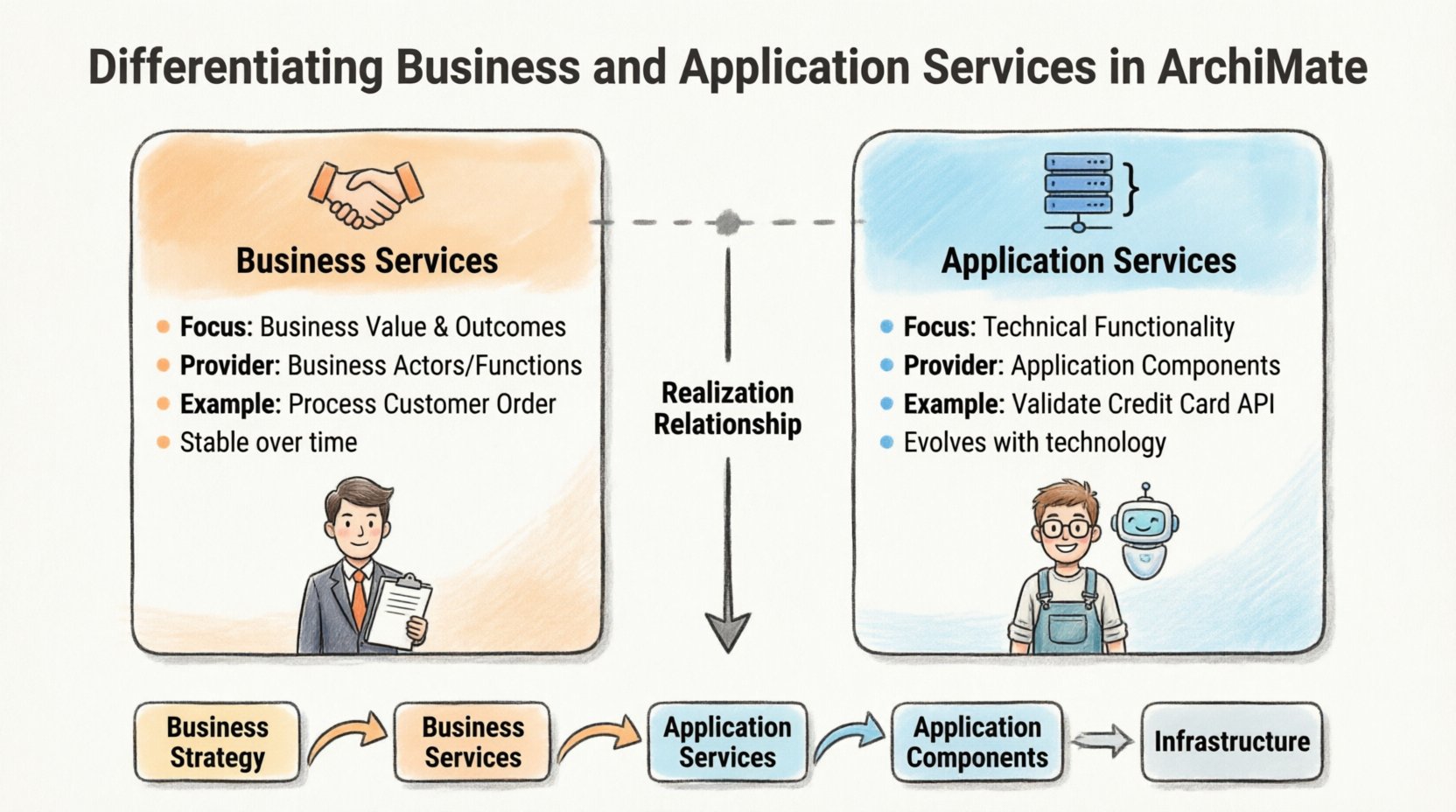
This definition applies universally across the layers. However, the nature of the provider and the receiver changes depending on the context. A Business Service is provided by a Business Actor or Business Function. An Application Service is provided by an Application Function or Application Component.
🏢 Business Services: The Value Proposition
Business Services represent the value that an organization delivers to its customers or internal stakeholders. They are the manifestation of business capabilities in action. When a customer interacts with an organization, they are consuming Business Services.
These services are external-facing or internal-facing but always relate to business outcomes. They are independent of the technical implementation. For example, the ability to process a payment is a Business Service. Whether that payment is processed by a mainframe, a cloud API, or a manual ledger is irrelevant to the definition of the service itself.
Characteristics of Business Services
Focus: Business outcomes and value creation.
Provider: Business Actors or Business Functions.
Receiver: Business Actors, Business Roles, or other Business Functions.
Granularity: Often coarse-grained, representing significant business processes.
Stability: Relatively stable over time, even as technology changes.
Consider a retail scenario. The service “Process Customer Order” is a Business Service. It encapsulates the logic of taking an order, verifying stock, and initiating fulfillment. The specific software used to record the order is an Application Service. The Business Service remains the same regardless of the tooling.
💻 Application Services: The Technical Enabler
Application Services reside in the Application Layer. They represent the functionality provided by the IT landscape. These services support the realization of Business Services. They are the technical mechanisms that enable business logic to execute.
If a Business Service is the “what,” the Application Service is the “how.” It describes the specific capability offered by the software environment. For instance, “Validate Credit Card” is an Application Service. It is a specific function within the payment software stack.
Characteristics of Application Services
Focus: Technical functionality and data processing.
Provider: Application Functions or Application Components.
Receiver: Other Application Functions, Business Functions, or Business Actors.
Granularity: Can range from coarse to fine-grained.
Stability: More volatile than Business Services due to technology evolution.
Application Services often expose themselves through Interfaces. They might be accessed by a Business Function that orchestrates a workflow, or by another Application Service that decomposes a complex task.
🆚 Key Differences: A Comparative Analysis
Understanding the distinction requires looking at how these services interact with the rest of the model. The following table outlines the primary differentiators.
Feature | Business Service | Application Service |
|---|---|---|
Layer | Business Layer | Application Layer |
Primary Purpose | Deliver Value | Enable Capability |
Realization | Realized by Business Process/Function | Realized by Application Function/Component |
Dependency | Depends on Application Services | Supports Business Services |
Example | Manage Customer Account | Update Account Database |
Consumer | Business Actor, Business Role | Application Function, Business Function |
Notice the dependency flow. A Business Service relies on Application Services to function. If the Application Service fails, the Business Service cannot be delivered. This dependency is modeled explicitly in ArchiMate to trace impact.
🔗 Relationships and Connections
The relationships between these services are critical for understanding the architecture. ArchiMate defines specific relationship types that clarify how services interact.
Realization
The Realization relationship is the most common link between the layers. It indicates that a higher-level concept is implemented by a lower-level concept.
Business Service Realization: A Business Service is realized by a Business Function or Business Process.
Application Service Realization: An Application Service is realized by an Application Component or Application Function.
Cross-Layer Realization: Crucially, a Business Service is realized by an Application Service.
This cross-layer realization defines the architecture’s core value chain. It shows exactly how the IT landscape enables the business value. For example, the Business Service “Ship Product” is realized by the Application Service “Generate Shipping Label”.
Access
The Access relationship defines how one structure uses the functionality of another. It is often used to show that a Business Function accesses an Application Service.
Business Function Accessing Application Service: This is common in human-driven processes where a user interacts with a system.
Application Function Accessing Application Service: This occurs in automated workflows where one software component calls another.
Communication
The Communication relationship describes the flow of information between structures. While less common for services directly, it is relevant when services exchange data.
Data Flow: A Business Service might communicate data to another Business Service.
System Interaction: An Application Service might communicate with a backend Application Service to retrieve data.
🧠 Modeling Best Practices
To maintain clarity and utility in your ArchiMate models, adhere to these best practices. Ambiguity in service modeling leads to confusion during implementation and maintenance.
1. Naming Conventions
Business Services: Use noun phrases that describe business value. Examples: “Manage Inventory,” “Process Claim,” “Provide Support.”
Application Services: Use verb-object phrases that describe technical actions. Examples: “Store Customer Data,” “Calculate Tax Rate,” “Render Dashboard.”
Consistent naming helps stakeholders quickly identify the layer. If you see “Calculate Tax Rate,” it implies an Application Service. If you see “Determine Tax Liability,” it implies a Business Service.
2. Avoid Layer Crossing
A common error is placing an Application Service in the Business Layer or vice versa. Ensure that every element is placed in its correct layer. If a service is technical in nature, it belongs in the Application Layer, even if it supports a business goal.
Check: Who provides the service?
Check: What is the primary outcome?
Check: Is the implementation dependent on software?
3. Granularity Consistency
Maintain consistent granularity within a layer. Do not mix high-level business strategies with low-level data operations in the same service list. Group related services into logical clusters.
Grouping: Group Application Services by domain (e.g., “Order Management Domain,” “Finance Domain”).
Grouping: Group Business Services by value chain (e.g., “Procurement,” “Sales,” “Fulfillment”).
🚧 Common Pitfalls and Misconceptions
Even experienced architects can stumble when differentiating these services. Recognizing these pitfalls helps in refining the model.
Pitfall 1: The “Black Box” Business Process
Often, architects model a Business Process without detailing the Application Services that support it. This creates a black box. The link between the “What” and the “How” is lost.
Solution: Always ensure that key Business Services are realized by specific Application Services. Trace the path from value to code.
Pitfall 2: Functional vs. Service Thinking
Architects sometimes model functions instead of services. A Function is an active structure that performs work. A Service is the output of that work provided to a receiver.
Distinction: A Business Function “Processes Orders” is an active structure. The Business Service “Order Processing” is the value provided. The Application Service “Order Validation” is the technical capability.
Impact: Confusing these leads to models that look like flowcharts rather than architecture maps.
Pitfall 3: Ignoring the Interface
Services are realized by Interfaces. Skipping the Interface layer makes it difficult to define contracts and protocols.
Requirement: Define the Interface for every Application Service.
Requirement: Define the Interface for Business Services if they interact with external actors.
📈 Impact on Strategy and Implementation
The distinction between Business and Application Services is not just theoretical. It has direct implications for strategic planning and technical implementation.
Strategic Alignment
When Business Services are clearly defined, strategy becomes measurable. You can map business goals directly to services. If a goal is to “Reduce Order Time,” you can trace this to the “Process Order” Business Service. Then, you can identify which Application Services are bottlenecks.
Investment: Helps prioritize IT investment based on business value.
Optimization: Allows for targeted optimization of specific Application Services without changing the Business Service.
Technical Implementation
For development teams, Application Services define the microservices or modules to be built. Clear definition ensures that the code aligns with the architectural intent.
Modularity: Application Services encourage modular design.
Integration: Interfaces defined on Application Services guide API contracts.
🔄 Evolution and Maintenance
Architecture is not static. Services evolve over time. Understanding the layers helps manage this evolution.
Technology Migration
When migrating from an on-premise system to the cloud, the Application Services may change. However, the Business Services should remain largely stable.
Stability: The Business Service “Manage Subscription” remains the same.
Change: The Application Service “Host Subscription Data” moves from a database server to a cloud storage service.
This separation ensures that business continuity is maintained even as the underlying technology shifts.
Service Decomposition
As organizations grow, coarse-grained services are often decomposed. A high-level Business Service might be split into multiple Application Services.
Example: “Manage User Identity” might split into “Authenticate User” and “Manage Profile” Application Services.
Result: The Business Service remains the same, but the technical implementation becomes more granular.
📊 Summary of Relationships
To visualize the flow, consider the following hierarchy:
Business Strategy: Defines the need for services.
Business Services: Deliver value to customers.
Application Services: Provide the technical capability.
Application Components: Implement the Application Services.
Infrastructure: Host the Application Components.
Each level supports the one above it. The Application Layer is the engine room, but the Business Layer is the destination.
🛠️ Practical Application in Modeling
When building a model, follow these steps to ensure correct differentiation.
Identify the Stakeholder: Who is consuming the service? If it is a customer or employee, it is likely a Business Service.
Identify the Provider: Who provides the service? If it is a software component, it is an Application Service.
Define the Interface: How is the service accessed? Define the protocol or interaction point.
Map the Realization: Link the Business Service to the Application Service using a realization arrow.
Validate the Flow: Ensure no cycles exist that violate the layering principles.
By following this disciplined approach, the model remains clear and actionable. It avoids the trap of technical jargon in the business layer and business jargon in the technical layer.
🌐 Broader Implications
The distinction supports other architectural frameworks. When integrating ArchiMate with TOGAF or Zachman, the Service layer acts as the bridge.
TOGAF: The Business Architecture defines the services; the Information Systems Architecture defines the applications.
ITIL: Service Management focuses on Business Services; IT Operations focuses on Application Services.
This interoperability allows organizations to use a single source of truth across different methodologies.
🔒 Security and Governance
Security controls are often applied at the Application Service level, but they protect the Business Service value.
Authentication: Applied to the Application Service Interface.
Auditing: Applied to the Business Service usage.
Compliance: Ensures the Application Service meets the requirements of the Business Service.
Understanding the layers helps in assigning security responsibilities correctly. Business owners own the value; IT owners own the capability.
📝 Final Thoughts on Service Modeling
The clarity provided by distinguishing Business and Application Services is indispensable for successful enterprise architecture. It creates a map that stakeholders can read and developers can follow. Without this distinction, models become abstract diagrams that fail to guide implementation.
Focus on the value delivered by Business Services and the capability provided by Application Services. Keep the layers distinct but connected. This discipline ensures that the architecture remains relevant as the organization evolves.
By adhering to these principles, architects build models that are not just documentation, but tools for transformation.