


Enterprise architecture serves as the blueprint for organizational change. It provides the structure needed to align business strategy with IT implementation. Within this discipline, the Business Layer of the ArchiMate framework offers a specific lens for understanding what an organization does, rather than how it does it. Cataloging business capabilities allows leaders to map potential to performance. This guide details the methodical approach to defining, structuring, and maintaining these capabilities using ArchiMate core concepts.
📐 Understanding the Business Layer
The Business Layer represents the most abstract view of the enterprise. It focuses on the business structure, behavior, and resources. Unlike the Application or Technology layers, which deal with software and infrastructure, the Business Layer deals with human activities, organizational units, and roles. To catalog capabilities effectively, one must first understand the elements that populate this layer.
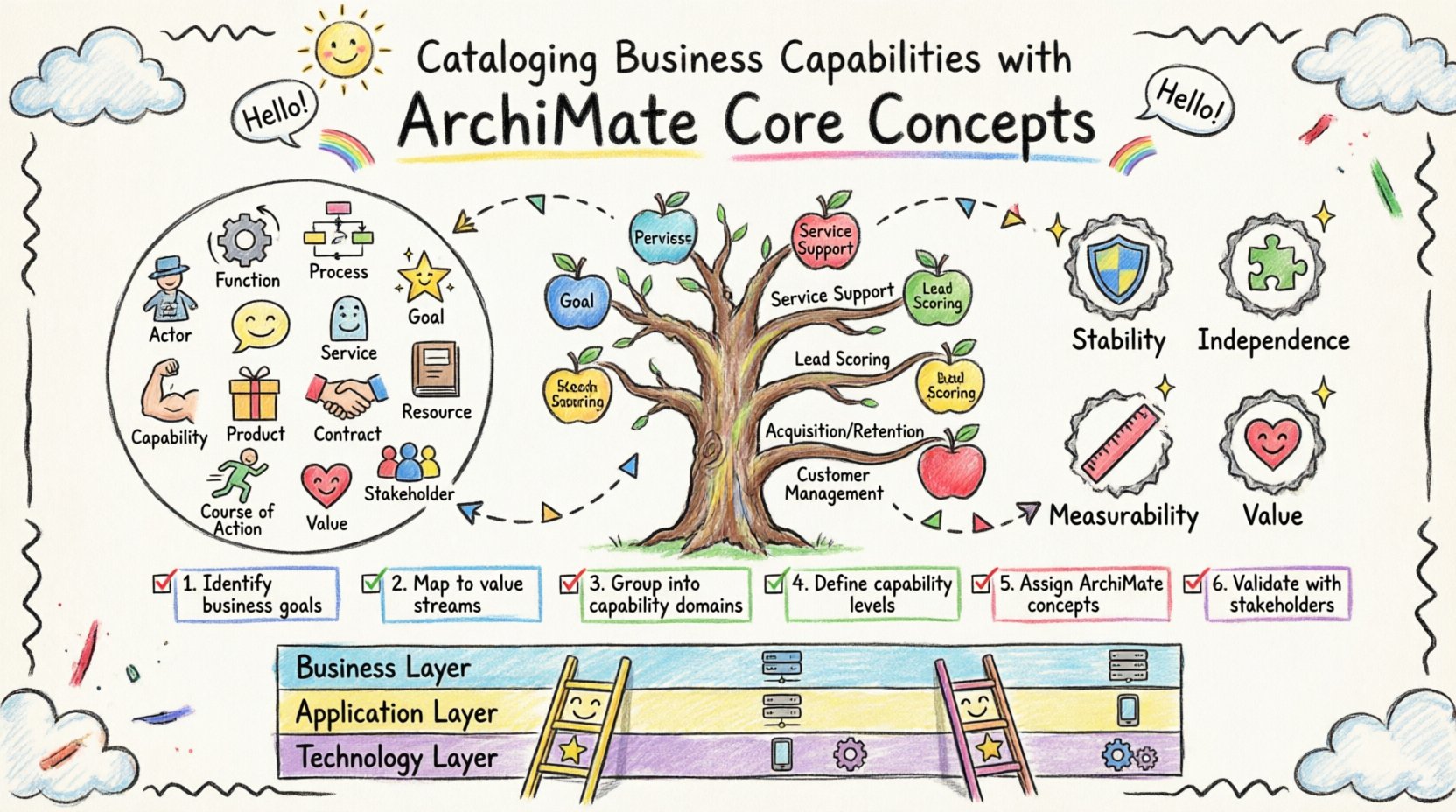
ArchiMate defines 12 core concepts for the Business Layer. These are divided into three categories:
- Business Object: Information used by a business actor or role. Examples include a Customer, a Product, or an Order.
- Business Actor: A human or system that plays a role in a business process. Examples include a Sales Representative or a Customer Service Agent.
- Business Role: A group of people or systems that act as a Business Actor.
- Business Function: A set of activities with a specific purpose. This is often synonymous with a department or a unit.
- Business Process: A sequence of activities performed to achieve a specific goal.
- Business Event: Something that happens at a specific point in time and triggers a process.
- Business Service: A collection of functionality offered by a Business Function.
- Business Interface: A point of interaction between an actor and a service.
- Business Collaboration: A group of actors working together.
- Business Goal: The desired end result of a business activity.
- Business Principle: A rule or guideline for business behavior.
- Business Driver: An internal or external factor that influences business activities.
While all these concepts are vital, the Business Capability is the cornerstone for strategic planning and investment prioritization. It provides a stable foundation that remains relatively consistent even when processes or organizational structures change.
🎯 Defining Business Capabilities
A business capability is the ability of an organization to perform a specific activity. It is a potential, not an action. This distinction is critical for accurate modeling. A process is an action taken; a capability is the capacity to take that action.
Key Characteristics
- Stability: Capabilities change less frequently than processes. A capability like “Manage Customer Relationships” remains valid even if the specific software or workflow changes.
- Independence: A capability exists independently of the organizational structure. It can be performed by different departments over time.
- Measurability: Capabilities can be assessed for maturity, performance, and cost.
- Value: Each capability contributes directly to the delivery of value to the customer or stakeholder.
When cataloging, avoid describing capabilities as verbs. Instead of “Handling Complaints,” use “Complaint Handling.” This keeps the focus on the ability rather than the task.
🗂️ Structuring the Capability Catalog
A capability catalog is a structured list of capabilities. It serves as a reference point for stakeholders to understand the scope of the enterprise. Without structure, the catalog becomes an unmanageable list. Hierarchy and grouping are essential for navigation.
Top-Down Approach
Start with the highest-level capabilities that define the business. Drill down into sub-capabilities to increase granularity. This creates a tree structure that mirrors the organizational logic.
- Level 1: Core Business Functions (e.g., Manage Operations).
- Level 2: Major Capabilities (e.g., Supply Chain Management).
- Level 3: Specific Capabilities (e.g., Inventory Control).
- Level 4: Granular Activities (e.g., Stock Replenishment).
Grouping Strategies
Grouping capabilities helps in analyzing overlaps and gaps. Common grouping methods include:
- Value Chain: Grouping by the flow of value from input to output.
- Strategic Pillar: Grouping by the strategic goals they support.
- Domain: Grouping by functional area (e.g., HR, Finance, Sales).
Example Hierarchy Table
| Level | Capability Name | Description |
|---|---|---|
| 1 | Customer Management | Managing all interactions with the customer lifecycle. |
| 2 | Acquisition | Attracting and converting new customers. |
| 2 | Retention | Maintaining existing customer relationships. |
| 3 | Lead Scoring | Evaluating potential customer interest levels. |
| 3 | Service Support | Providing assistance to current customers. |
🔗 Relationships and Dependencies
A capability does not exist in a vacuum. It relies on other capabilities, processes, and resources. Modeling these relationships reveals the complexity of the enterprise architecture.
Capability Realization
This relationship shows what realizes a capability. A capability can be realized by:
- Business Process: The specific steps taken to execute the capability.
- Business Object: The data or information required to support the capability.
- Business Function: The organizational unit responsible for the capability.
Capability Assignment
This defines who is responsible for the capability. It links a Business Capability to a Business Actor or Business Role. This is crucial for accountability.
- Actor to Capability: Who performs the work?
- Role to Capability: What function owns the work?
Capability Flow
Capabilities often flow into one another. The output of one capability becomes the input for another. This is common in value chains where one stage of production feeds the next.
Capability Usage
A capability may use another capability as a dependency. For example, “Order Fulfillment” uses the capability “Inventory Management” to check stock levels before shipping.
🛠️ Implementation Methodology
Building a catalog requires a systematic process. It is not a one-time task but an ongoing discipline. The following steps outline the workflow for establishing a robust capability model.
1. Define Scope and Boundaries
Identify the scope of the architecture work. Is this for the entire enterprise or a specific division? Defining boundaries prevents scope creep and ensures the model remains manageable.
2. Identify Stakeholders
Engage with subject matter experts (SMEs) from various departments. They possess the tacit knowledge required to define capabilities accurately. Their input ensures the catalog reflects reality.
3. Draft Initial Capability List
Create a working draft using the hierarchical approach. Do not aim for perfection initially. Focus on getting the major capabilities down on paper.
4. Validate and Refine
Review the draft with stakeholders. Check for overlaps, gaps, and ambiguities. Ensure the naming conventions are consistent. A capability should not be named “Sales” in one section and “Revenue Generation” in another.
5. Link to Strategy
Connect capabilities to business goals and drivers. This provides context for why the capability exists. It helps prioritize investment and improvement efforts.
6. Establish Governance
Define who owns the capability catalog. Who approves changes? Who is responsible for maintenance? Without governance, the model will become outdated quickly.
📊 Integration with Other Layers
The Business Layer is interconnected with the Application and Technology Layers. While the Business Capability is stable, the means to deliver it often change. ArchiMate allows for seamless traceability across these layers.
Application Capability Mapping
Every business capability should ideally be supported by at least one application capability. This mapping highlights software gaps and redundancies. If a critical capability has no supporting application, it poses a risk.
Technology Capability Mapping
Applications run on technology. Mapping capabilities down to the technology layer helps in infrastructure planning. It ensures that the underlying hardware and networks can support the required business functions.
Process to Capability Mapping
Processes are the dynamic execution of capabilities. By linking processes to capabilities, organizations can analyze efficiency. If a process is inefficient, the model shows which capability is suffering.
⚖️ Common Pitfalls and Best Practices
Even with a solid methodology, errors can occur during modeling. Recognizing common pitfalls helps in maintaining data integrity.
Confusing Process with Capability
This is the most frequent error. A process is a flow of activities; a capability is a state of being. Do not model “Processing Invoice” as a capability. Model “Invoice Processing” as the capability and “Payment Flow” as the process.
Over-Granularity
Creating too many levels of detail makes the model difficult to navigate. Aim for a level of detail that supports decision-making without overwhelming the viewer. If a capability is too specific, it may be a task, not a capability.
Lack of Ownership
Every capability should have an owner. Without ownership, there is no accountability for improvement or maintenance. This leads to stagnation in the model.
Inconsistent Naming
Use a consistent naming convention. Adhere to a standard format (e.g., Noun + Verb or Verb + Noun). Inconsistency confuses readers and makes searching difficult.
🔄 Maintenance and Evolution
The enterprise is dynamic. Capabilities evolve as the market changes. The capability catalog must evolve with it. Static models become liabilities.
Regular Reviews
Schedule periodic reviews of the catalog. Assess which capabilities are still relevant. Identify new capabilities required for new business models. Remove obsolete capabilities to reduce clutter.
Impact Analysis
When a change is proposed, use the model to assess impact. If a capability is modified, what other capabilities depend on it? This analysis prevents unintended consequences during change initiatives.
Version Control
Maintain versions of the model. This allows for historical tracking of changes. It helps in understanding the evolution of the business architecture over time.
📈 Measuring Maturity
Once the catalog is established, it can be used to measure the maturity of capabilities. This provides a baseline for improvement.
- Defined: The capability is documented and understood.
- Managed: The capability is measured and controlled.
- Defined: The capability is optimized and improved continuously.
Scoring capabilities allows for prioritization of investment. Resources should be directed toward capabilities that are critical to strategy but lack maturity.
🔍 Strategic Alignment
The primary value of a capability catalog is strategic alignment. It translates high-level strategy into actionable components. When planning a new initiative, leaders can look at the capability map to see where the initiative fits.
- Gap Analysis: Identify missing capabilities needed to support new strategies.
- Redundancy Check: Identify duplicate capabilities that can be consolidated.
- Resource Allocation: Direct funding to the capabilities that drive the most value.
This alignment ensures that IT investments support business goals directly. It moves the conversation from “What software do we need?” to “What business value do we need to deliver?”
🧭 Conclusion
Building a business capability catalog using ArchiMate core concepts is a foundational activity for enterprise architecture. It provides clarity, stability, and a common language for stakeholders. By focusing on what the organization can do, rather than how it does it, leaders gain a resilient view of the enterprise.
The process requires discipline, collaboration, and ongoing maintenance. Avoiding common pitfalls ensures the model remains accurate. Integrating the Business Layer with Application and Technology layers creates a holistic view. Ultimately, a well-structured capability model empowers organizations to navigate change with confidence and precision.