

Enterprise architecture is fundamentally about alignment. It connects the strategic intentions of leadership to the operational reality of execution. At the heart of this connection lies the concept of value streams. A value stream represents the series of activities that create value for a customer or stakeholder. To manage, analyze, and optimize these streams effectively, architects require a standardized language. ArchiMate provides this language through its Business Layer elements. This guide details the methodology for tracking value streams using specific ArchiMate business elements.
Tracking these flows is not merely a documentation exercise. It is a critical activity for identifying inefficiencies, ensuring regulatory compliance, and facilitating digital transformation. By leveraging the precise definitions within the ArchiMate framework, organizations can achieve transparency across their operational landscape. This article explores the specific business elements involved, how they interact, and the best practices for maintaining an accurate model.
🔍 The Core Components of Business Architecture
Before diving into the tracking mechanics, it is essential to understand the building blocks. ArchiMate defines a specific set of elements within the Business Layer. Each serves a distinct function in the value chain. Misunderstanding these definitions leads to cluttered models that fail to provide insight.
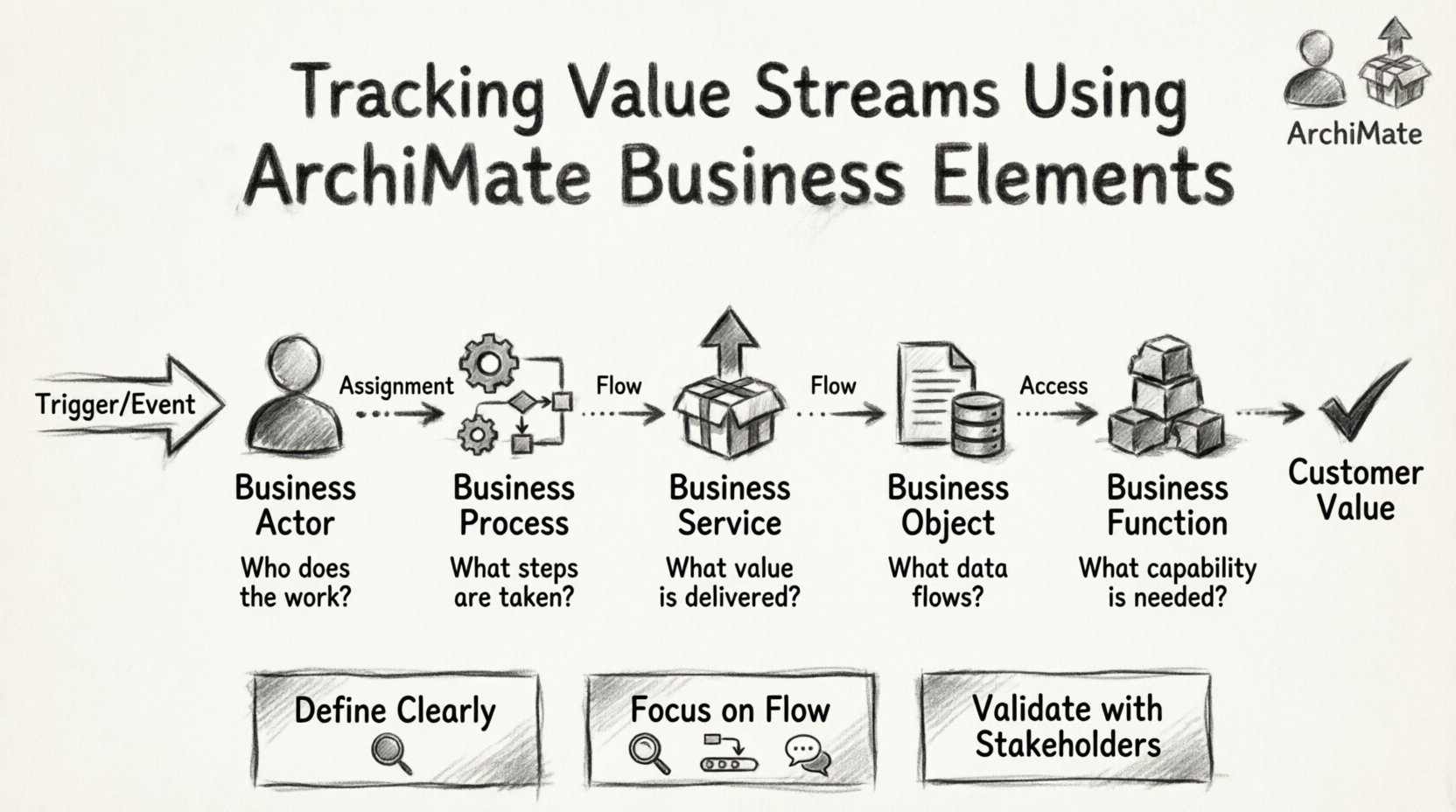
When mapping a value stream, you are essentially describing how work moves from initiation to delivery. This movement involves actors, processes, services, and objects. Below is a breakdown of the primary elements used in this context.
- Business Actor: Represents a person, organization, or system capable of performing work. In a value stream, actors are the initiators or receivers of value.
- Business Process: A collection of related and structured activities. These are the steps that transform inputs into outputs.
- Business Service: A collection of capabilities exposed to a stakeholder. Services define what is delivered, not how it is done.
- Business Object: A logical representation of information. These are the data entities that flow through the process.
- Business Function: A capability that is necessary to perform a business process. Functions are more abstract than processes.
Understanding the distinction between these elements is crucial. For instance, a Business Process describes the workflow, while a Business Service describes the outcome available to the customer. Confusing the two often results in models that are too detailed or too abstract to be useful.
🔗 Mapping the Value Stream Flow
Tracking a value stream requires establishing connections between the elements defined above. In ArchiMate, these connections are defined as relationships. The most critical relationship for value stream tracking is the flow relationship. This relationship indicates the flow of objects or information between elements.
When constructing a diagram, the flow should generally move from left to right, mirroring the passage of time. This visual convention aids stakeholders in understanding the sequence of events without requiring complex legends.
Consider the following workflow for mapping:
- Identify the Trigger: Every value stream begins with an event. This is often initiated by a Business Actor or an external Business Process.
- Define the Steps: Break down the stream into logical Business Processes. Each step should have a clear start and end point.
- Assign Responsibility: Link each process step to the Business Actor responsible for executing it. This clarifies accountability.
- Track the Data: Identify the Business Objects that are created, modified, or consumed at each stage. This ensures data integrity is maintained.
- Verify the Outcome: Ensure the final output aligns with the Business Service defined for the stream.
By following this sequence, you create a coherent narrative. The diagram becomes a story of how value is generated, rather than a static list of components.
📊 Element Roles in Value Streams
To ensure clarity, it is helpful to categorize how each element contributes to the value stream. The table below outlines the specific role each business element plays during the tracking process.
| Element Type | Role in Value Stream | Key Question Answered |
|---|---|---|
| Business Actor | Performs or Initiates | Who is doing the work? |
| Business Process | Executes Steps | What steps are taken? |
| Business Service | Delivers Value | What is provided to the customer? |
| Business Object | Carries Information | What data is moving? |
| Business Function | Provides Capability | What capability is required? |
This categorization prevents redundancy. For example, you do not need to model every single decision point as a separate process if it can be captured within a single process flow. Similarly, Business Functions should be used to group related processes, providing a higher level of abstraction when necessary.
🔗 Relationships and Connections
The power of ArchiMate lies in the relationships. Simply placing elements on a canvas is insufficient. You must define how they interact. For value stream tracking, specific relationships are required to ensure the model is semantically correct.
The Assignment relationship is vital here. It links an Actor to a Process, indicating who performs the work. Without this link, the model lacks accountability. It answers the question: “Who is responsible for this step?”
The Flow relationship connects processes to objects. It shows how data moves. For example, a “Create Order” process flows a “Purchase Order” object to a “Fulfillment” process. This traceability allows architects to analyze data lineage and identify where information might be lost or corrupted.
The Access relationship is used when one process needs to read or update an object. While similar to Flow, Access implies a dependency on the state of the object. Distinguishing between these two helps in understanding whether data is being passed along or if it is being actively managed.
🧩 Layered Context and Traceability
Business value streams do not exist in isolation. They rely on applications, technology, and strategy. While the focus here is on the Business Layer, effective tracking requires awareness of the broader context.
When a Business Process is mapped, it often realizes a Business Service. This realization relationship is important for cost analysis. If a service is not being utilized, the processes realizing it may be candidates for optimization.
Furthermore, tracking value streams often reveals gaps in the application landscape. If a process requires data that no system currently provides, the gap is visible. This insight drives investment decisions. Architects can prioritize application development based on the criticality of the value stream steps they support.
Traceability is maintained through the use of unique identifiers. Each element should have a stable ID. This allows cross-referencing between diagrams. A Business Process in a high-level diagram should link to the detailed subprocesses in a lower-level diagram. This drill-down capability ensures that strategic goals align with operational execution.
🛠️ Common Challenges in Tracking
Despite the structured nature of ArchiMate, practitioners often encounter difficulties. Recognizing these challenges early can prevent model degradation over time.
- Excessive Granularity: Trying to model every single click or decision makes the diagram unreadable. Focus on the value-added steps. Ignore administrative overhead unless it is a bottleneck.
- Role Confusion: Mixing up Business Actors and Business Functions. Actors are agents; Functions are capabilities. An Actor has a Function.
- Static vs. Dynamic: Value streams are dynamic. They happen over time. Static models often fail to capture the flow. Use sequence diagrams or flow relationships to emphasize movement.
- Outdated Models: Business processes change frequently. If the architecture is not updated, it becomes a historical record rather than a planning tool. Establish a review cadence.
- Tooling Limitations: Some modeling tools struggle with large diagrams. Use grouping and sub-diagrams to manage complexity. Do not force a single view to contain everything.
Avoiding these pitfalls requires discipline. It is better to have a simple, accurate model than a complex, confusing one. The goal is insight, not volume.
📈 Analyzing Performance and Gaps
Once the value stream is modeled, the next step is analysis. The model serves as a baseline for improvement. Several metrics can be derived from the structure.
Efficiency: By mapping processes, you can identify redundant steps. If two processes achieve the same outcome, one might be eliminated. This reduces operational cost.
Compliance: Regulatory requirements often dictate specific controls within a process. The model can highlight where these controls are applied. If a process lacks a control point, a gap is identified immediately.
Responsiveness: Long chains of processes indicate latency. Shortening the value stream improves speed to market. This is particularly relevant in digital transformation initiatives.
When analyzing the model, look for bottlenecks. A bottleneck is often where multiple flows converge. If a single Business Process handles inputs from ten different sources, it is a potential choke point. Resources should be allocated here to prevent delays.
🤝 Collaboration and Stakeholder Engagement
Architecture is a collaborative effort. The value stream model must be understandable to business stakeholders, not just architects. Using standard ArchiMate elements helps achieve this shared understanding.
- Use Standard Terminology: Ensure the names of processes match the terminology used in the business. If the business calls it “Order Management,” do not model it as “Procurement Workflow”.
- Visual Clarity: Use colors sparingly. Group related processes. Avoid crossing lines where possible.
- Iterative Refinement: Present the model to stakeholders early. Feedback loops are essential. The first draft is rarely the final version.
- Contextual Notes: Add annotations to explain complex flows. A diagram cannot tell every story. Text supplements visuals.
Engaging stakeholders ensures the model reflects reality. If the business process described in the model differs from what is actually done on the ground, the model will be rejected. Validation is a critical step in the tracking process.
🔄 Continuous Improvement and Lifecycle
Value streams are not static artifacts. They evolve as the business evolves. A robust tracking system includes a lifecycle management strategy.
When a new product is launched, a new value stream may be created. When a service is retired, the associated processes should be archived. Version control is essential. Changes to the architecture should be logged, noting the reason for the change and the impact on downstream systems.
Integration with other architectural domains is key. As the business layer changes, the Information Layer must adapt. As processes change, the Application Layer must be updated to support them. The value stream model acts as the bridge between these domains.
Regular audits of the model ensure it remains relevant. A common practice is to review the architecture quarterly. This keeps the organization agile and responsive to market changes. The architecture becomes a living document, not a shelf-ware artifact.
🎯 Strategic Alignment
The ultimate goal of tracking value streams is strategic alignment. The business strategy defines the direction. The value streams define the path. By mapping the path, you can verify if the organization is moving in the right direction.
If a strategic goal is “Customer Centricity,” the value streams should reflect this. Do the processes prioritize customer needs? Is the data flow designed to support a personalized experience? If the model shows a focus on internal efficiency at the expense of customer experience, there is a misalignment.
Architects can use the model to simulate scenarios. “What happens if we remove this step?” “What happens if we add this actor?” These simulations help leadership understand the impact of decisions before they are implemented. This reduces risk and increases the likelihood of success.
📝 Summary of Best Practices
To conclude this overview, here are the key takeaways for effective value stream tracking using ArchiMate business elements.
- Define Elements Clearly: Distinguish between Actors, Processes, Services, and Objects.
- Focus on Flow: Use relationships to show movement and dependency.
- Maintain Traceability: Link high-level streams to detailed processes.
- Validate with Stakeholders: Ensure the model matches reality.
- Manage Lifecycle: Update the model as the business changes.
- Avoid Over-Modeling: Keep diagrams readable and focused on value.
By adhering to these principles, organizations can leverage their enterprise architecture to drive meaningful change. The value stream becomes a tool for decision-making, not just a record of the past. It enables the organization to see the path from strategy to execution with clarity and confidence.
The integration of ArchiMate business elements into value stream tracking provides a structured approach to complexity. It brings order to chaos. It turns vague concepts into actionable insights. For any organization serious about operational excellence, mastering this methodology is a necessary step.
Start by mapping one critical stream. Validate it. Refine it. Then expand. This incremental approach builds momentum and trust in the architecture function. Over time, the value stream model becomes the backbone of the organization’s operational intelligence.
Remember, the tool is only as good as the model it supports. Invest time in the quality of the elements and relationships. The return on investment will be visible in the efficiency of the business operations and the clarity of the strategic decisions.