

Enterprise Architecture (EA) relies on structured methods to guide organizational transformation. Two of the most prominent standards in this domain are the TOGAF Architecture Development Method (ADM) and the ArchiMate modeling language. When used effectively, these frameworks complement each other to provide a robust structure for designing, planning, and governing enterprise change. However, integrating the granular detail of ArchiMate models with the procedural phases of TOGAF ADM requires deliberate alignment. This guide explores how to map ArchiMate concepts to specific ADM phases, ensuring consistency and clarity throughout the architecture lifecycle.
Many organizations struggle with disjointed architecture artifacts. Without a clear mapping strategy, models may remain static or fail to reflect the evolving business needs defined during the ADM cycle. Proper alignment ensures that every phase of the ADM has corresponding architectural outputs that are standardized, reusable, and understandable. This process bridges the gap between high-level strategy and detailed implementation specifications.
Understanding the Frameworks 🔍
Before diving into the mapping, it is essential to understand the distinct roles of each framework. TOGAF ADM is a cyclical process consisting of multiple phases. It provides the workflow, the steps, and the governance mechanisms for developing an enterprise architecture. It answers the question of how to build the architecture.
Conversely, ArchiMate is a modeling language. It provides the notation, the vocabulary, and the structure to represent the architecture itself. It answers the question of what is being built. ArchiMate uses a layered approach, separating Business, Application, and Technology domains, while also including a Strategy and Implementation layer. This separation allows architects to visualize dependencies and impacts across different levels of the organization.
Aligning these two means taking the procedural steps of the ADM and populating them with specific ArchiMate views and viewpoints. This ensures that the documentation produced in each phase is not just a report, but a structured model that can be analyzed, queried, and traced.
The ADM Cycle Overview 🔄
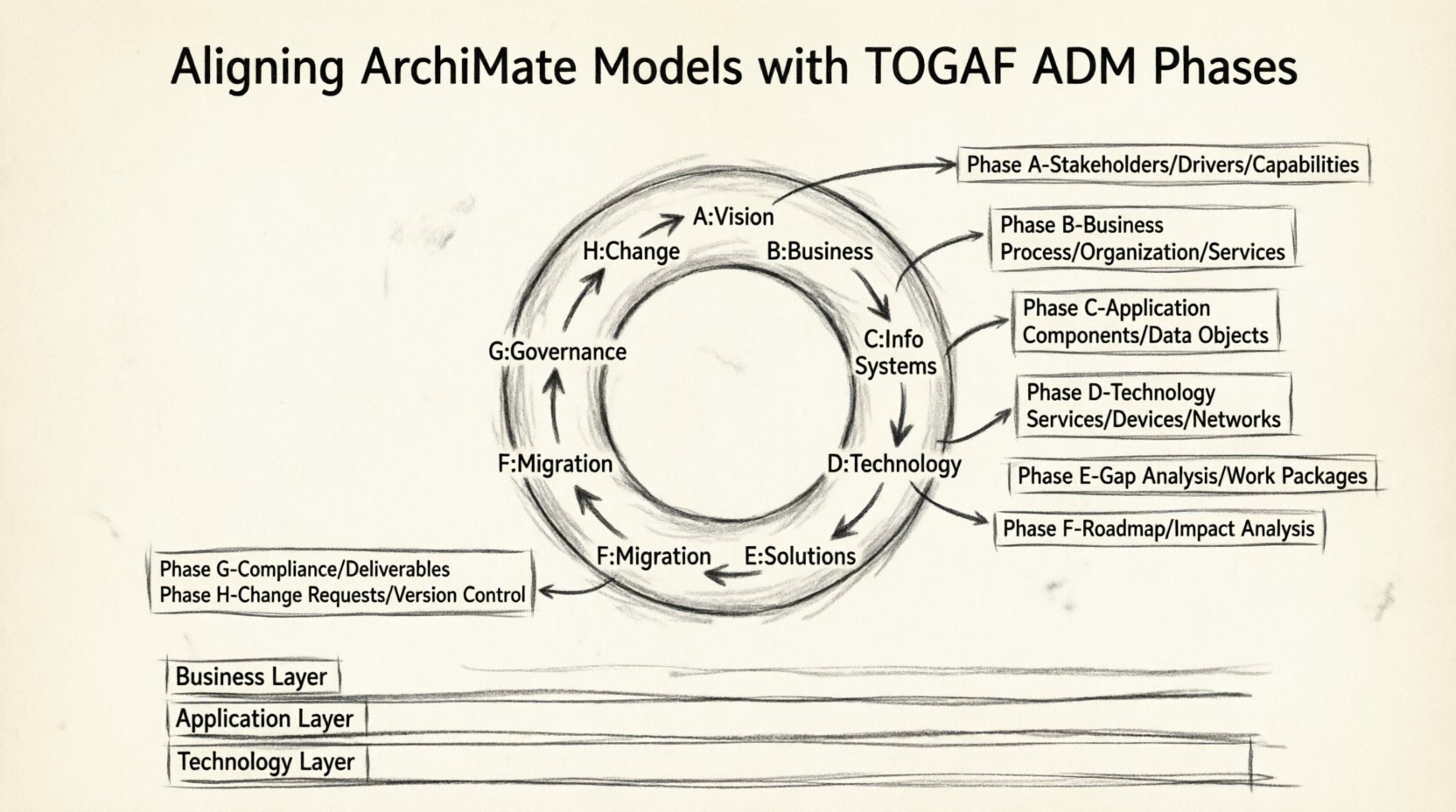
The TOGAF ADM consists of eight phases, often referred to as the core cycle. There is also a Preliminary Phase and a Requirements Management phase that runs parallel to the cycle. For the purpose of this alignment, we will focus on the core phases A through H, as these represent the primary architecture development work.
- Phase A: Architecture Vision
- Phase B: Business Architecture
- Phase C: Information Systems Architectures (Data and Application)
- Phase D: Technology Architecture
- Phase E: Opportunities and Solutions
- Phase F: Migration Planning
- Phase G: Implementation Governance
- Phase H: Architecture Change Management
Each phase produces specific deliverables. By mapping ArchiMate concepts to these deliverables, architects can create a cohesive repository. The following sections detail the specific ArchiMate modeling activities for each phase.
Phase A: Architecture Vision 👁️
Phase A focuses on defining the scope, constraints, and stakeholders for the architecture project. The primary output is the Architecture Vision document. In this phase, ArchiMate modeling is limited but critical. The goal is to establish the context.
Modeling Activities
- Stakeholder Modeling: Identify key stakeholders using the ArchiMate Stakeholder and Actor concepts. This clarifies who is affected by the change.
- Business Capability Overview: Create a high-level view of current capabilities versus future capabilities. This highlights gaps that the architecture must address.
- Value Stream: Define the high-level value streams that the architecture will support. This ensures the business context is present from the start.
- Driver Mapping: Use ArchiMate Drivers to represent the business drivers and risks identified during the visioning process.
It is important to keep the models in Phase A high-level. Detailed process flows or application interfaces are not yet required. The focus is on alignment with business strategy and the definition of the architecture scope.
Phase B: Business Architecture 🏢
Phase B is often the most intensive phase regarding ArchiMate usage. It defines the business strategy, governance, organization, and key business processes. This is where the core Business Architecture layer of ArchiMate comes into play.
Key Model Components
- Business Process Model: Detailed mapping of activities, functions, and business processes. This should include the flow of information and control.
- Organization Structure: Represent business roles, positions, and organizational units. This clarifies responsibility and accountability.
- Business Interaction: Define the interaction between business actors and the processes they perform.
- Business Service: Identify the services delivered to customers or other business units. This connects internal processes to external value delivery.
- Value Stream: Elaborate on the end-to-end value creation processes identified in Phase A.
During this phase, architects should create both current state (As-Is) and target state (To-Be) models. The gap analysis between these two states drives the requirements for the subsequent information systems and technology architectures.
Phase C: Information Systems Architectures 🗃️
Phase C splits into two sub-phases: Data Architecture and Application Architecture. This phase translates the business requirements into information and software support.
Data Architecture
- Business Object: Define the data entities relevant to the business processes (e.g., Customer, Order, Product).
- Data Object: Model the logical and physical data structures required to store these business objects.
- Relationships: Map the associations between data objects to ensure data integrity and flow.
Application Architecture
- Application Component: Identify the software applications that support the business services and business processes.
- Application Service: Define the services provided by the applications to the business layer.
- Application Interaction: Map the interfaces and data flows between applications.
- Usage Relationships: Specify which applications use data objects or other application services.
The alignment here ensures that every business process has a corresponding application support, and every business object has a corresponding data storage mechanism. This prevents the creation of orphaned systems that do not serve a clear business purpose.
Phase D: Technology Architecture 💻
Phase D focuses on the infrastructure and technology platforms required to support the application architecture. This includes hardware, networks, and cloud services.
Modeling Elements
- Technology Service: Define the services provided by the technology layer (e.g., Database Service, Compute Service).
- Technology Component: Model the physical or logical technology nodes (e.g., Server, Router, Cloud Instance).
- Device: Represent end-user devices or IoT devices interacting with the architecture.
- Network: Map the communication paths and protocols between technology components.
- Infrastructure: Define the environmental constraints and physical locations.
It is crucial to link the Technology Architecture back to the Application Architecture. Each application component must be deployed to at least one technology component. This ensures that the technical feasibility of the solution is validated before moving to implementation.
Phase E: Opportunities and Solutions 🚀
Phase E involves identifying the major work packages and projects required to move from the current state to the target state. This is where the architecture moves from design to planning.
Alignment Activities
- Gap Analysis: Use ArchiMate to explicitly visualize the differences between the As-Is and To-Be models across all layers.
- Work Packages: Group related architecture changes into logical work packages. These can be represented as specific projects or initiatives.
- Solution Definition: Define the specific solutions (software, services, or processes) that will be delivered to close the gaps.
- Dependency Mapping: Establish the dependencies between work packages to ensure a logical sequencing of implementation.
This phase is critical for budgeting and resource allocation. By using structured models, organizations can estimate the effort required for each work package more accurately. It also helps in identifying risks associated with specific technology transitions or business process changes.
Phase F: Migration Planning 📅
Phase F creates a detailed implementation and migration plan. It breaks down the work packages identified in Phase E into a roadmap.
Planning with Models
- Migration Roadmap: Visualize the timeline of architectural changes. This can be represented using a combination of ArchiMate diagrams and project schedules.
- Impact Analysis: Assess the impact of each migration step on the existing architecture. This helps in minimizing disruption during the transition.
- Resource Allocation: Link architectural components to the resources required to implement them. This ensures that the plan is realistic.
- Prerequisites: Define the architectural prerequisites that must be met before specific work packages can begin.
The migration plan should be iterative. As the architecture evolves during the implementation, the plan must be updated. ArchiMate models allow for versioning, which supports this iterative approach.
Phase G: Implementation Governance ⚖️
Phase G ensures that the implementation projects align with the defined architecture. It involves oversight and control mechanisms.
Governance Modeling
- Compliance Checking: Use ArchiMate to define compliance rules. For example, ensuring that all customer data is stored within specific technology nodes.
- Architecture Compliance: Compare the implemented solution against the target architecture. Deviations should be documented and analyzed.
- Change Requests: If a project requires a change to the architecture, it must be recorded as a modification to the model. This maintains the integrity of the architecture.
- Deliverable Verification: Ensure that all required architectural deliverables are produced and reviewed during the project lifecycle.
This phase is often where architecture governance fails. Without clear models, it is difficult to verify compliance. By using ArchiMate as the source of truth, architects can automatically check for deviations in the deployed systems.
Phase H: Architecture Change Management 🔄
Phase H deals with managing changes to the architecture after implementation. Enterprise environments are dynamic, and the architecture must evolve to support new business needs.
Change Management
- Change Requests: Capture new requirements or changes that impact the architecture. These are modeled as Drivers or Requirements.
- Impact Assessment: Analyze the ripple effects of proposed changes across the Business, Application, and Technology layers.
- Version Control: Maintain version history of the ArchiMate models. This allows architects to trace the evolution of the architecture over time.
- Feedback Loop: Feed information from operations and maintenance back into the architecture repository. This informs future iterations of the ADM cycle.
Architecture Change Management ensures that the architecture does not become obsolete. It creates a feedback loop that allows the TOGAF ADM cycle to repeat with updated information.
Mapping Table Summary 📊
The following table summarizes the key ArchiMate elements associated with each TOGAF ADM phase for quick reference.
| ADM Phase | Primary Focus | Key ArchiMate Elements |
|---|---|---|
| Phase A | Vision & Scope | Stakeholders, Drivers, Business Capabilities, Value Streams |
| Phase B | Business | Business Process, Organization, Business Service, Business Role |
| Phase C | Data & Application | Business Object, Application Component, Application Service, Data Object |
| Phase D | Technology | Technology Service, Technology Component, Device, Network |
| Phase E | Solutions | Gap Analysis, Work Packages, Implementation Event |
| Phase F | Migration | Migration Roadmap, Prerequisite, Impact Analysis |
| Phase G | Governance | Compliance, Implementation Event, Deliverable |
| Phase H | Change | Change Request, Requirement, Version Control |
Best Practices for Alignment 🛠️
Successful alignment requires more than just mapping elements. It requires a disciplined approach to modeling and governance. The following best practices help maintain consistency.
- Consistent Naming Conventions: Ensure that all architects use the same terminology for concepts, processes, and services. This avoids ambiguity in the models.
- Layer Separation: Keep Business, Application, and Technology layers distinct. Do not mix concepts across layers unless there is a clear interface defined.
- Viewpoint Definition: Define specific viewpoints for different stakeholders. Executives may need high-level capability maps, while developers need detailed interface specifications.
- Repository Management: Maintain a central architecture repository. All models should be stored in a single location to ensure version control and access.
- Traceability: Maintain traceability links between requirements, business capabilities, and technical components. This ensures that every line of code or process change has a business justification.
Common Challenges and Pitfalls ⚠️
Despite the clear benefits, aligning these frameworks presents challenges. Awareness of these pitfalls helps in avoiding common mistakes.
1. Over-Modeling
One common issue is creating models that are too detailed too early. In Phase A and B, focus on high-level concepts. Detailed process modeling can be done later. Over-detailing slows down the initial design and creates maintenance burdens.
2. Lack of Stakeholder Engagement
Models are useless if the stakeholders do not understand them. Ensure that diagrams are clear and that the terminology is accessible to business users, not just technical architects.
3. Ignoring the Iterative Nature
Architecture is not a one-time event. The ADM cycle is iterative. Models must be updated regularly to reflect changes in the business environment. Treating the architecture as a static document leads to obsolescence.
4. Siloed Models
Business architects often work separately from application architects. This leads to misalignment where the business needs do not match the technical capabilities. Regular cross-functional reviews are necessary to ensure integration.
The Value of Integration 📈
When ArchiMate and TOGAF ADM are aligned, the organization gains several strategic advantages.
- Improved Communication: Standardized models provide a common language for business and IT stakeholders.
- Better Decision Making: Clear visibility into impacts and dependencies allows for informed investment decisions.
- Reduced Risk: Governance and compliance checks reduce the risk of implementation failure.
- Agility: A well-maintained architecture repository allows for faster response to market changes.
- Cost Efficiency: Eliminating redundant systems and processes saves money in the long run.
Final Thoughts on Alignment 💡
Aligning ArchiMate models with TOGAF ADM phases is a foundational activity for mature enterprise architecture practices. It transforms abstract strategy into concrete, actionable plans. By following the structured approach outlined in this guide, organizations can ensure that their architecture is not just a collection of diagrams, but a living asset that drives business value.
The key is consistency. Whether it is the naming of business capabilities or the versioning of technology components, discipline is required. However, the payoff is an architecture that is understandable, maintainable, and aligned with the strategic goals of the enterprise. As technology evolves, the frameworks remain relevant because they focus on the underlying structure of the organization rather than specific tools or products.
Start with a clear scope. Define the value streams. Map the capabilities. Build the layers. Govern the implementation. And manage the changes. This cycle ensures that the enterprise architecture remains a strategic asset rather than a documentation burden.