

Enterprise architecture serves as the blueprint for organizational transformation. It bridges the gap between strategy and execution. To navigate this complexity, architects require a robust modeling language. ArchiMate provides that foundation. It offers a standardized way to visualize, analyze, and describe enterprise architecture. However, syntax alone does not guarantee success. The underlying principles guide how the language is applied. Understanding these principles ensures that the architecture remains relevant, actionable, and aligned with business goals.
This guide explores the core principles that drive effective ArchiMate modeling. We will examine the structural layers, the specific domains, and the modeling discipline required for high-quality outcomes. The focus remains on practical application and logical consistency. There is no magic involved, only disciplined application of established concepts.
The Foundation: Why Principles Matter 📐
Before diving into specific elements, it is necessary to understand the role of principles. A principle is a fundamental truth that serves as the foundation for a system of belief or behavior. In the context of enterprise architecture, principles dictate how we model reality.
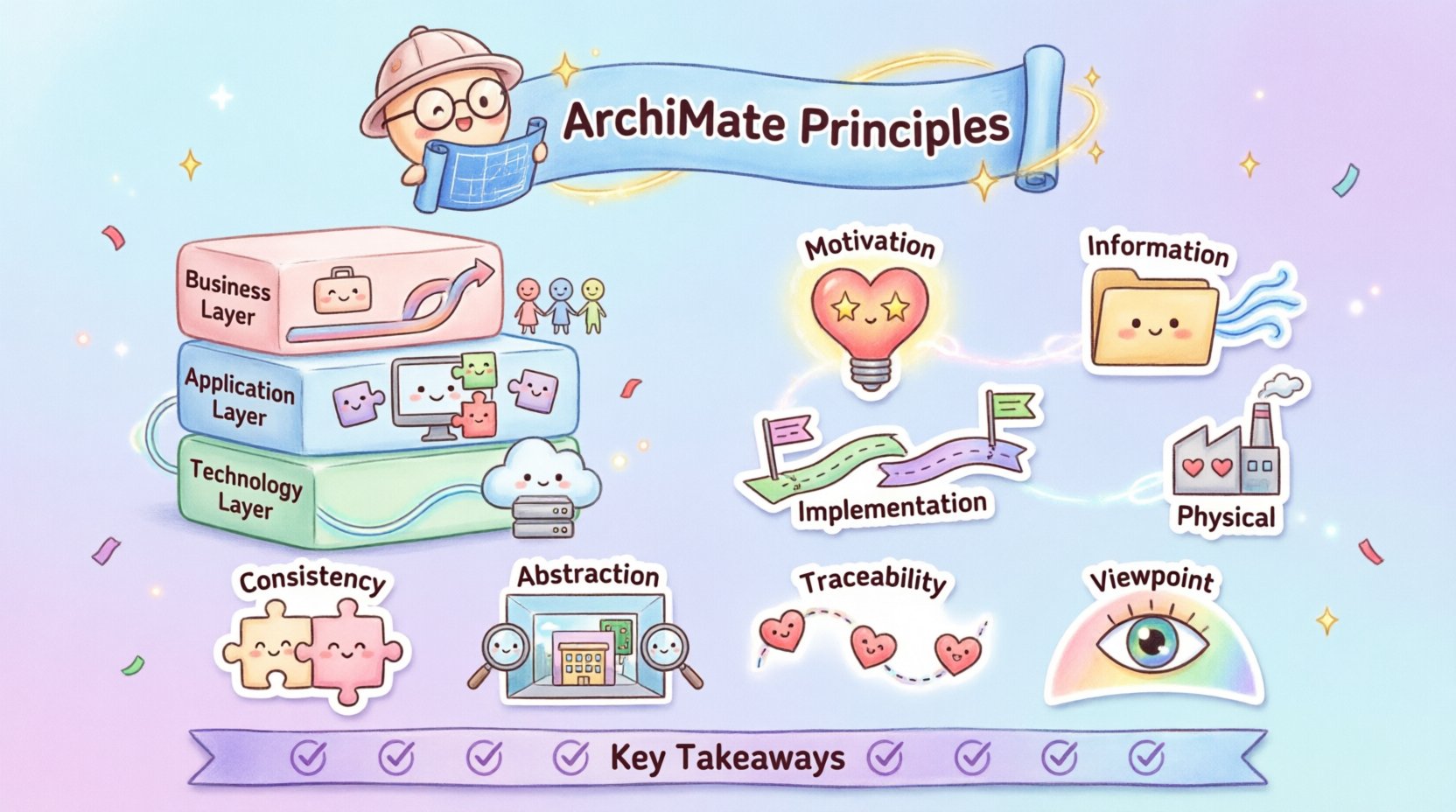
- Consistency: Models must remain consistent across different views and stakeholders.
- Abstraction: Complexity must be managed through appropriate levels of detail.
- Traceability: Decisions must be linked to their origins and impacts.
- Standardization: Terminology and notation must remain uniform.
Without these guiding pillars, an architecture repository becomes a collection of disconnected diagrams. It loses its value as a communication tool. The goal is clarity. The model should illuminate the structure, not obscure it.
Structural Layers: Business, Application, and Technology 🏗️
One of the most recognizable features of ArchiMate is its layered structure. This separation of concerns allows architects to focus on specific domains without getting lost in unrelated details. The three primary layers provide a clear vertical split of the enterprise landscape.
1. The Business Layer 💼
The Business Layer represents the visible activities of the enterprise. It is where value is created for customers. This layer includes:
- Business Processes: The steps taken to achieve a business goal.
- Business Roles: The people or groups performing activities.
- Business Objects: The information or physical items processed.
- Collaborations: The interactions between different roles.
When modeling this layer, the focus is on the what and who. It describes the value chain. It does not concern itself with the software or hardware that supports the process.
2. The Application Layer 🖥️
The Application Layer describes the software systems that support the business processes. It sits between the business needs and the technology infrastructure. Key elements include:
- Application Functions: The capabilities provided by the software.
- Application Components: The modular parts of a system.
- Application Services: The interfaces exposed to other systems.
This layer answers the question of how the business process is supported. It links business data to the logic that manipulates it.
3. The Technology Layer ⚙️
The Technology Layer describes the physical hardware and network infrastructure. It is the foundation upon which applications run. Elements here include:
- Devices: Computers, servers, and mobile devices.
- Networks: Communication paths and protocols.
- System Software: Operating systems and databases.
This layer addresses the where and with what of the infrastructure. It ensures that the technical capabilities align with the application requirements.
Layer Relationships
The connection between layers is critical. A change in the Business Layer should trigger a review of the Application Layer. A change in the Application Layer may require an update to the Technology Layer. This flow is known as the realization relationship.
| Layer | Focus | Key Question |
|---|---|---|
| Business | Value Creation | What needs to be done? |
| Application | Support Logic | How is it automated? |
| Technology | Infrastructure | Where does it run? |
Domain Specifics: Motivation, Strategy, and Information 🎯
While the three layers form the backbone, ArchiMate extends into other domains to cover the full spectrum of enterprise concerns. These domains add depth to the modeling effort.
The Motivation Domain 🧠
Why is a change happening? The Motivation Domain captures the drivers behind architectural decisions. It connects the structure to the intent. Key elements include:
- Goals: What the organization wants to achieve.
- Principles: Rules that guide decision-making.
- Requirements: Conditions that must be met.
- Drivers: External or internal forces causing change.
Linking requirements to goals ensures that every technical feature serves a strategic purpose. It prevents feature creep and keeps the architecture focused.
The Information Domain 📂
Information is the lifeblood of modern enterprises. The Information Domain models data structures independently of the software that processes them. This allows for a clearer understanding of data governance and flow. It focuses on:
- Information Entities: The core data concepts.
- Information Flows: The movement of data between entities.
By separating information from application logic, architects can redesign processes without being constrained by legacy database schemas.
The Implementation and Migration Domain 🔄
Architects do not just design the target state; they also plan the journey. This domain models the projects and work packages required to move from the current state to the target state. It includes:
- Work Packages: Groups of projects.
- Deliverables: The outputs of the projects.
- Assessment: The evaluation of the current state.
This ensures that the transition is manageable. It breaks down large initiatives into actionable steps.
The Physical Domain 🌍
For organizations with physical locations, the Physical Domain models the actual sites and equipment. This is crucial for industries like manufacturing, logistics, or healthcare where physical presence matters. It covers:
- Sites: Locations of business activities.
- Equipment: Physical assets used.
Modeling Principles for Success 🛠️
Using the language correctly is just as important as knowing the language itself. The following principles should guide every modeling session.
1. Consistency of Notation 📝
Every symbol and line type has a specific meaning. A solid arrow indicates a flow, while a dashed arrow indicates a dependency. Mixing these up creates ambiguity. Adhering to the notation standard ensures that anyone reading the diagram understands it in the same way.
2. Appropriate Abstraction Level 🎚️
Not every detail needs to be modeled. Modeling every single database table for a high-level strategy map is counterproductive. The level of detail should match the audience and the purpose of the view.
- Strategic View: High-level goals and business capabilities.
- Architectural View: Systems, components, and processes.
- Technical View: Servers, networks, and code structures.
3. Traceability 🔗
Every element in the model should be traceable to a requirement or a goal. If a process exists, there must be a reason for it. If a system exists, it must support a business function. Traceability links the abstract strategy to the concrete implementation.
4. Viewpoint Definition 👁️
A single diagram cannot show everything. Different stakeholders need different views. An executive needs a high-level overview. An engineer needs a technical deep dive. Defining viewpoints ensures that the right information is presented to the right person.
Governance and Maintenance 🛡️
An architecture model is not a one-time project. It is a living asset. It requires governance to maintain its accuracy and relevance.
Change Management
When a business requirement changes, the model must be updated. This requires a process for tracking changes. It ensures that the documentation reflects reality. Without this, the model becomes a historical artifact rather than a planning tool.
Quality Assurance
Regular reviews are necessary. Architects should check models for:
- Completeness: Are all necessary elements present?
- Correctness: Do the relationships make sense?
- Clarity: Is the diagram easy to read?
This process prevents technical debt from accumulating in the architecture documentation.
Common Pitfalls to Avoid ⚠️
Even experienced architects can stumble. Recognizing common mistakes helps in avoiding them.
1. Over-Modeling
Creating a model for every minor detail slows down the process. It creates a maintenance burden. Focus on the elements that drive decision-making. Ignore the noise.
2. Ignoring the Motivation Domain
Building a map without knowing why you are building it leads to misalignment. Always start with the goals and drivers. Let them dictate the structure.
3. Mixing Layers Indiscriminately
Placing technology details inside a business process diagram confuses the reader. Keep layers distinct unless you are explicitly showing a realization relationship.
4. Lack of Context
A diagram without a title or legend is useless. Ensure every view has a clear context. State what is included and what is excluded.
Conclusion and Next Steps 🚀
Mastering ArchiMate requires more than learning the icons. It requires a disciplined approach to modeling. By adhering to the core principles of consistency, abstraction, and traceability, architects can build models that truly serve the enterprise.
The journey involves continuous learning. The landscape changes. New technologies emerge. Business goals shift. The model must adapt. This flexibility is the hallmark of a successful enterprise architecture practice.
Start with the layers. Define the domains. Apply the principles. Review the work. This cycle ensures that the architecture remains a valuable asset for the organization. Success comes from clarity, not complexity.
Key Takeaways 📌
- Layers separate concerns: Business, Application, and Technology.
- Domains add context: Motivation, Information, and Implementation.
- Principles guide quality: Consistency, Abstraction, and Traceability.
- Governance maintains value: Regular reviews and change management.
Apply these concepts to your work. Focus on the principles. Let the language serve the strategy. The result will be an architecture that drives value and supports long-term success.