


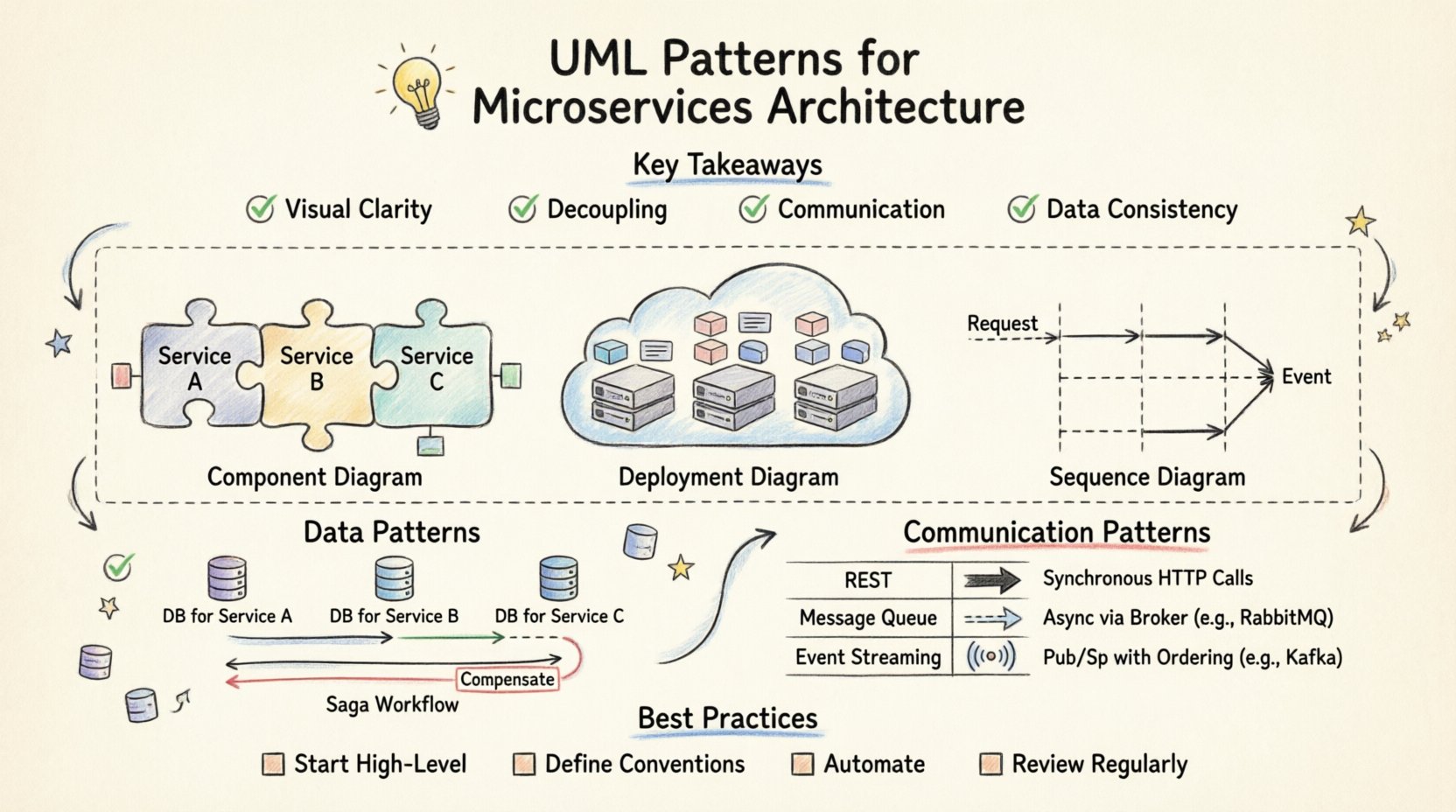
💡 Key Takeaways
Visual Clarity: UML diagrams provide a shared language for distributed teams, reducing ambiguity in complex service interactions.
Decoupling: Component and Deployment diagrams help enforce boundaries between microservices to maintain loose coupling.
Communication: Sequence diagrams are critical for mapping asynchronous and synchronous data flows across service boundaries.
Data Consistency: Class and Activity diagrams assist in defining data ownership and transactional boundaries in distributed systems.
Designing a microservices architecture requires a shift from monolithic thinking to distributed system patterns. While code defines functionality, visual models define structure and behavior. Unified Modeling Language (UML) remains a robust standard for documenting these complex interactions. This guide explores how specific UML patterns apply to microservices, ensuring clarity without reliance on proprietary tools. 📝
Why UML Matters in Distributed Systems 🌐
In a monolithic application, the boundaries are clear. In a microservices environment, services are distributed, potentially running on different nodes, languages, or protocols. This complexity introduces a communication overhead that can become unmanageable without documentation. UML serves as a neutral ground for architects, developers, and stakeholders to align on system topology.
Using standard diagrams allows teams to:
Identify bottlenecks before implementation begins.
Define clear contracts between services.
Visualize data flow and ownership.
Reduce cognitive load when onboarded to new projects.
Essential Diagram Types for Microservices 📊
Not all UML diagrams hold equal weight in this context. Certain types are better suited for modeling the distributed nature of microservices. Below is a breakdown of the most effective patterns.
1. Component Diagrams 🧩
Component diagrams are perhaps the most critical for high-level architecture. They represent the system as a collection of modular components. In microservices, each component typically represents an independent service.
When modeling a component diagram:
Interfaces: Define how services expose functionality (APIs). Use «interface» stereotypes to denote contracts.
Dependencies: Show how components rely on one another. Minimize these to maintain loose coupling.
Ports: Specify provided and required interfaces to clarify interaction points.
By visualizing services as black-box components, teams can focus on the logic within rather than the implementation details. This separation of concerns is vital for scalability.
2. Deployment Diagrams 🖥️
Microservices often span multiple environments, such as development, staging, and production. Deployment diagrams map the physical or virtual hardware nodes where software components reside.
Key elements to include:
Nodes: Represent servers, containers, or virtual machines.
Artifacts: Show the executable files or containers deployed to the nodes.
Connections: Illustrate network paths between nodes.
This diagram type helps in understanding infrastructure costs and potential points of failure. It ensures that the physical topology supports the logical architecture.
3. Sequence Diagrams 💬
Interaction flows are complex in distributed systems. A user request might trigger a chain of events across five different services. Sequence diagrams capture this temporal ordering of messages.
Best practices for sequence modeling:
Asynchronous Messages: Use dashed lines for asynchronous calls, common in event-driven architectures.
Return Messages: Clearly mark responses to ensure bidirectional understanding.
Activation Bars: Show when an object is performing an action, helping to identify performance bottlenecks.
Data Management Patterns 🗄️
Data consistency is one of the hardest challenges in microservices. Unlike a monolith, you do not have a single database transaction. UML Class and Activity diagrams help map out data ownership.
Database per Service
This pattern dictates that each service owns its data. Class diagrams should reflect that data entities are encapsulated within their respective service components. External access to this data must occur through the service interface, not direct database queries.
Saga Pattern Modeling
For distributed transactions, the Saga pattern coordinates a sequence of local transactions. An Activity diagram is ideal here. It shows the steps of a business process and how compensation actions are triggered if a step fails. This visualizes the rollback logic that is often difficult to trace in code alone.
Communication Patterns 🔄
Services must talk to each other. The mode of communication affects the system’s resilience and latency. UML can distinguish between synchronous and asynchronous interactions.
Pattern | UML Representation | Use Case |
|---|---|---|
REST / HTTP | Sequence Diagram (Synchronous) | Real-time data retrieval |
Message Queue | Sequence Diagram (Asynchronous) | Background processing |
Event Streaming | Component Diagram (Publish/Subscribe) | System-wide notifications |
Using these visual cues helps developers choose the right tool for the job. For example, if a diagram shows high-frequency polling, it may indicate a need for an event-driven approach instead.
Challenges in Modeling Microservices ⚠️
While UML is powerful, it is not without challenges in this context. The dynamic nature of microservices can make static diagrams obsolete quickly.
Versioning: Services evolve. Diagrams must be updated alongside code to remain accurate.
Complexity: A system with hundreds of services can result in diagrams that are too large to read.
Abstraction: Over-modeling can slow down development. Focus on the architecture that matters most.
To mitigate these issues, focus on context. Do not model every detail. Model the boundaries and the critical paths. Use stereotypes to indicate service types, such as «API Gateway» or «Worker».
Best Practices for Implementation ✅
To get the most out of UML in a microservices environment, adhere to these guidelines:
Start High-Level: Begin with Component and Deployment diagrams. Drill down to Sequence diagrams only for critical flows.
Define Conventions: Agree on notation standards within the team. Consistency is more important than aesthetics.
Automate Where Possible: If your tools support it, generate diagrams from code annotations. This keeps documentation in sync with implementation.
Review Regularly: Treat diagrams as living documents. Review them during architecture decision records (ADR) sessions.
Conclusion 🏁
Adopting UML patterns for microservices architecture brings structure to complexity. It allows teams to visualize the invisible connections between services. By focusing on Component, Sequence, and Deployment diagrams, organizations can build resilient, scalable systems. The goal is not to create extensive documentation for its own sake, but to use these models as a communication tool that reduces risk and clarifies intent.
Remember, the value lies in the understanding gained, not the diagram itself. Use these patterns to guide design decisions and foster a shared vision across your technical teams. 🚀