

💡 Key Takeaways
- Unified Standard: UML consolidated three competing object-oriented modeling methods into a single standard.
- OMG Leadership: The Object Management Group manages the standard, ensuring continuous evolution and versioning.
- Visual Communication: It provides a common language for developers to visualize, specify, and document systems.
- Version Maturity: From version 1.0 to 2.5, UML has expanded from static diagrams to complex behavioral modeling.
The landscape of software engineering has shifted dramatically over the past few decades. One of the most significant shifts has been the move toward standardization in system design. At the heart of this movement lies the Unified Modeling Language, a visual modeling language that has become the de facto standard for specifying, visualizing, constructing, and documenting software-intensive systems. Understanding its history provides context for why modern architectural diagrams look the way they do.
The Pre-UML Landscape 🕰️
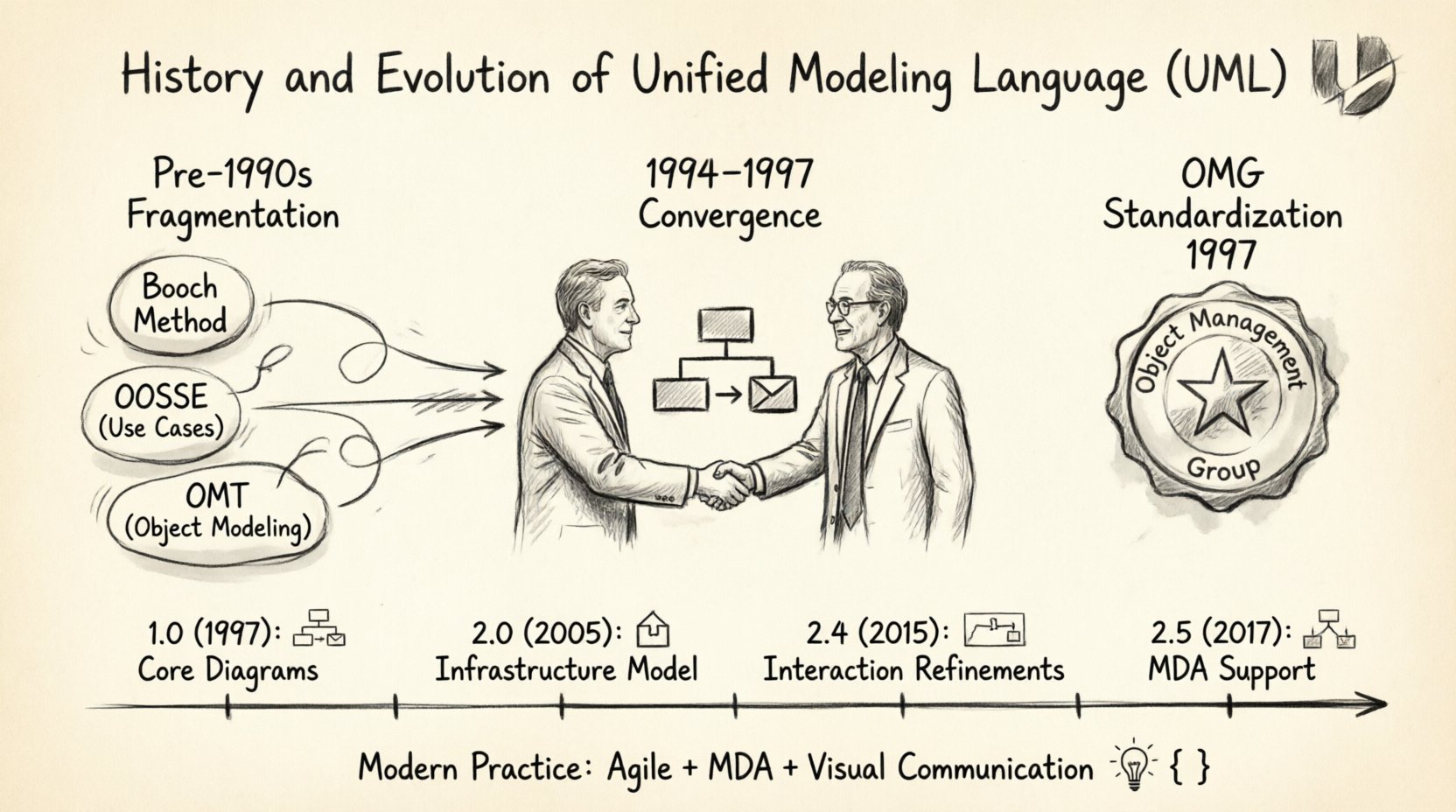
Before the mid-1990s, the field of object-oriented software development was fragmented. Multiple methodologies existed, each with its own notation, vocabulary, and philosophy. This lack of standardization created barriers to communication. Teams using different methods often struggled to understand each other’s designs. Three primary methods dominated the market, often referred to as the Big Three.
The Booch Method, developed by Grady Booch, was one of the earliest and most influential. It focused heavily on object-oriented analysis and design, emphasizing the decomposition of complex systems into manageable parts. It introduced concepts that are still prevalent today, such as classes and objects, but its notation was unique to the method.
Parallel to this was the Object-Oriented Software Engineering (OOSE) method. This approach, championed by Ivar Jacobson, placed a strong emphasis on use cases. It shifted the focus from purely structural elements to user interactions and functional requirements. This perspective was crucial for ensuring that the system met actual business needs rather than just technical specifications.
The third pillar was the Object Modeling Technique (OMT), created by James Rumbaugh. OMT was known for its rigorous approach to system modeling. It introduced a clear separation between object, dynamic, and functional models. This separation helped in organizing complex information but contributed to the fragmentation of the field.
The Convergence of Methods 🤝
By the early 1990s, it became evident that maintaining three separate methods was inefficient. The industry needed a unified approach. The three authors—Booch, Rumbaugh, and Jacobson—collaborated to merge their methods into a single, cohesive language. This collaboration was not merely about combining notations; it was about reconciling differences in philosophy and approach.
The process began in 1994. The team worked to integrate the strengths of each method. The Booch Method contributed to the class diagram and analysis. OOSE brought the use case concept. OMT provided a structured approach to dynamic modeling. The goal was to create a language that could handle the entire software development lifecycle, from requirements to implementation.
This unified effort resulted in the first version of the Unified Modeling Language. It was a significant milestone. It allowed teams to speak a common language. Architects could design systems that were understood by developers regardless of their background. The notation became standardized, reducing ambiguity in project documentation.
Standardization and the OMG 📜
The collaboration between the three authors led to the formation of the Object Management Group (OMG). The OMG is a consortium that develops and maintains consensus-based standards for enterprise integration. They adopted the Unified Modeling Language as a standard in 1997. This adoption formalized the language, making it an open specification rather than a proprietary method.
Standardization was critical for the longevity of the language. It allowed tool vendors to build software that supported the standard. This meant that models created with one tool could often be imported into another. It facilitated interoperability in an ecosystem that was previously siloed. The OMG established a process for versioning and updates, ensuring the language could evolve with industry needs.
Version Milestones 🚀
Since its adoption as a standard, UML has undergone several major revisions. Each version has addressed limitations in previous iterations and incorporated feedback from the community. The evolution reflects the changing nature of software development.
Version 1.0 (1997) established the core structure. It introduced the basic diagram types: Use Case, Class, Sequence, and State Diagrams. This version laid the foundation for object-oriented design.
Version 1.1 (1998) and 1.2 (1999) refined the notation. They fixed ambiguities and added clarity to specific diagram elements. These updates were essential for tooling support and widespread adoption.
Version 1.3 (2001) and 1.5 (2003) focused on extending the language. Version 1.5 introduced the notion of packages and improved the handling of complex relationships. It also added more details to state machines and interaction diagrams.
Version 2.0 (2005) was a major release. It introduced the UML Infrastructure model, which provided a formal foundation for the language. It added new diagram types, such as the Component Diagram and Deployment Diagram, to better represent modern distributed systems. It also standardized the metamodel, making the language more robust.
Version 2.1 through 2.5 (2017) represented incremental improvements. These versions refined existing diagrams and added support for new development practices. Version 2.4 introduced more flexibility in sequence diagrams. Version 2.5 focused on compliance and minor corrections. The table below summarizes the major version shifts.
| Version | Release Year | Key Contribution |
|---|---|---|
| 1.0 | 1997 | First OMG Standard |
| 2.0 | 2005 | Infrastructure Model & New Diagrams |
| 2.4.1 | 2015 | Interaction Refinements |
| 2.5.1 | 2017 | Model Driven Architecture Support |
UML in Modern Practice 🛠️
Today, the language remains a staple in software engineering. It is used to create blueprints for systems before code is written. This practice helps identify design flaws early, saving time and resources. The visual nature of the language makes it accessible to stakeholders who may not be programmers.
Agile methodologies have adapted UML to fit iterative processes. Instead of creating massive documentation upfront, teams create diagrams incrementally. These diagrams serve as living documentation that evolves alongside the software. This approach balances the need for structure with the flexibility required in modern development.
The language also supports Model Driven Architecture (MDA). This concept uses models as the primary input for code generation. While code generation is not always perfect, the models provide a high-level view of the system that ensures consistency. This reduces the gap between design and implementation.
Looking Forward 🔭
The future of the language depends on its ability to adapt. As software systems become more complex and distributed, the need for clear communication increases. The language continues to evolve to support these changes. New standards are being explored to integrate with cloud-native architectures and microservices.
There is a growing emphasis on interoperability between different modeling tools. Efforts are underway to ensure that models can be exchanged seamlessly across platforms. This ensures that the language remains relevant in a multi-tool environment.
The core principles remain unchanged: clarity, precision, and standardization. As long as these principles guide its evolution, the language will continue to serve as a vital tool for architects and developers. It bridges the gap between abstract requirements and concrete implementation, making it an enduring part of the engineering toolkit.