
Welcome to the world of Enterprise Architecture. If you have heard the term thrown around in meetings, read it in a job description, or seen it in a strategic document, you might be wondering what it actually entails. Often shrouded in jargon and complex diagrams, Enterprise Architecture (EA) is simply the practice of aligning an organization’s business strategy with its technology capabilities. It is the blueprint for how an organization operates, grows, and adapts to change.
This guide strips away the acronyms and abstract concepts to explain what EA really is, why it matters, and how it functions within a modern organization. Whether you are a business leader, an IT professional, or simply curious about how large organizations function, this breakdown provides a clear path forward.
🧩 Defining the Core Concept
To understand Enterprise Architecture, we must break the term into its two components:
- Enterprise: This refers to the entire organization, including its people, processes, data, and culture. It is not limited to the IT department.
- Architecture: This refers to the structural design and the relationships between the different parts of the system. It is the plan that ensures everything fits together correctly.
When combined, Enterprise Architecture is the discipline of defining how a business works today and how it should work tomorrow. It acts as a bridge between high-level strategy and day-to-day execution. Without this bridge, strategy often remains theoretical, and technology investments frequently fail to deliver value.
Think of it like building a house. You do not just start laying bricks. You need a floor plan, an electrical layout, and a plumbing design. EA is that master plan for the organization. It ensures that the plumbing (data flow) connects to the kitchen (business processes) and that the electrical wiring (technology infrastructure) supports the lighting needs (user experience).
🔑 Why Does Enterprise Architecture Matter?
Many organizations struggle with siloed information, redundant systems, and IT projects that do not support business goals. Enterprise Architecture addresses these issues directly. It provides a holistic view of the organization, allowing leaders to make informed decisions.
Key Benefits
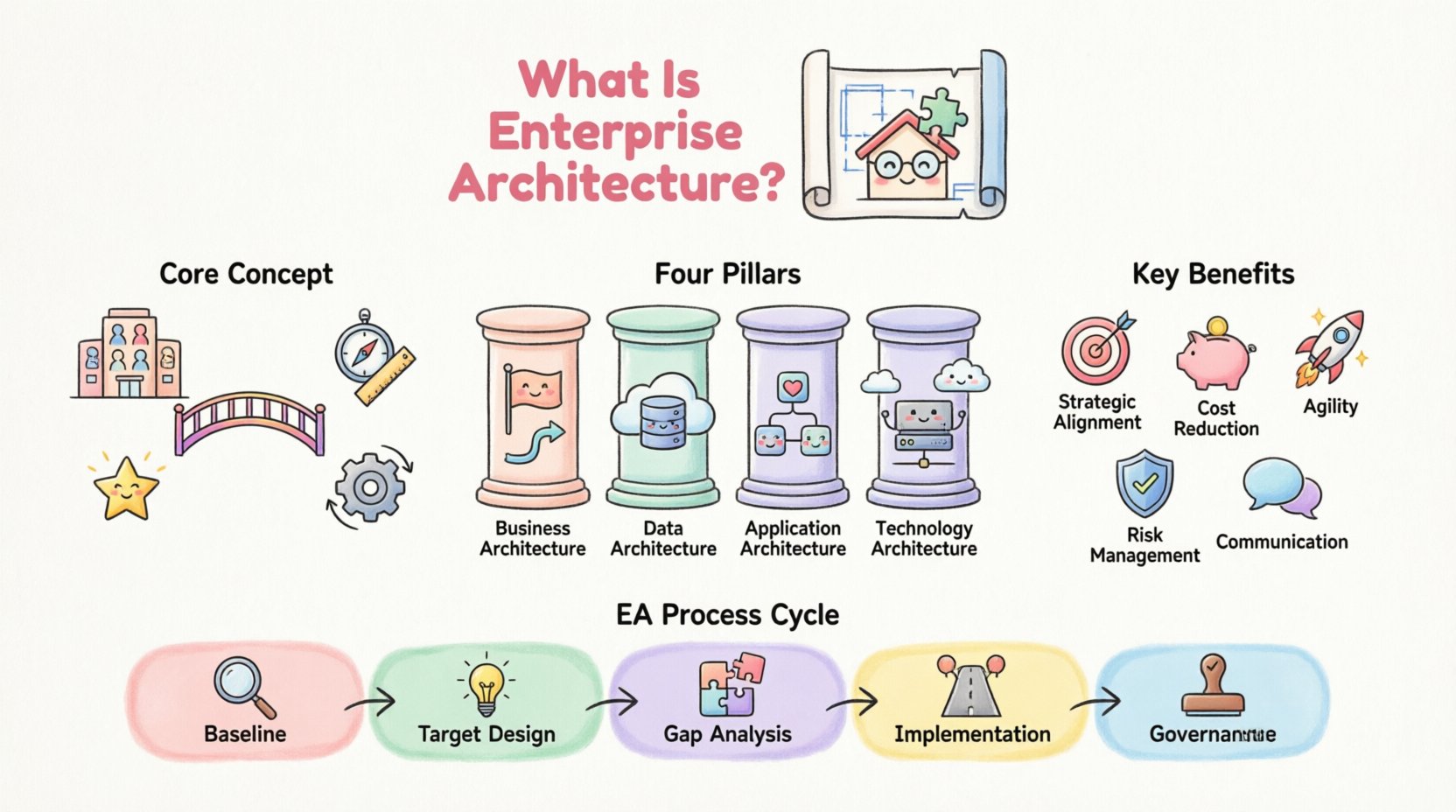
- Strategic Alignment: Ensures that technology investments directly support business objectives. If the goal is to expand into new markets, the architecture must support the necessary connectivity and data handling.
- Cost Reduction: By identifying duplicate systems and processes, organizations can eliminate waste. Instead of paying for three different software licenses for similar functions, EA suggests consolidating to one.
- Agility and Speed: A well-architected environment is easier to modify. When a new regulation is introduced or a market shift occurs, the organization can adapt its systems quickly rather than rebuilding from scratch.
- Risk Management: It helps identify security vulnerabilities and compliance gaps across the entire infrastructure before they become critical issues.
- Improved Communication: It creates a common language between business stakeholders and technical teams, reducing misunderstandings.
🏛️ The Four Pillars of Enterprise Architecture
While frameworks vary, most Enterprise Architecture models rely on four core domains. These domains ensure that every aspect of the organization is considered when planning changes.
| Domain | Focus Area | Key Questions |
|---|---|---|
| Business Architecture | Strategy, Governance, Organization, and Business Processes | What are our business goals? How do we deliver value to customers? |
| Data Architecture | Logical and physical data assets and data management | Where does our data live? Is it accurate and secure? |
| Application Architecture | Blueprint for individual applications and their interactions | Which systems do we use? Do they talk to each other? |
| Technology Architecture | Hardware, software, and network infrastructure | What servers or cloud environments do we need? Is the network fast enough? |
These pillars are not isolated. A change in the Business Architecture often triggers a review in the Application Architecture. For instance, if a business decides to offer 24/7 customer support (Business), the IT team might need to implement a new ticketing system (Application) hosted on a scalable cloud platform (Technology) that stores all customer interactions in a central database (Data).
📚 Common Frameworks and Approaches
To manage this complexity, practitioners use frameworks. These are not software products but rather sets of guidelines, standards, and best practices. They provide a structure for organizing information without dictating specific tools.
1. The Zachman Framework
One of the oldest and most foundational frameworks. It organizes architectural artifacts into a matrix based on perspectives (Who, What, Where, When, Why, How) and stakeholders (Planner, Owner, Designer, Builder, Subcontractor, User). It is less about process and more about ensuring all questions are answered for every part of the enterprise.
2. TOGAF (The Open Group Architecture Framework)
TOGAF is widely used because it provides a detailed method for creating an architecture. It focuses on the Architecture Development Method (ADM), which is a cycle of planning, designing, and implementing. It is known for its comprehensive documentation requirements and strong governance structure.
3. The Federal Enterprise Architecture (FEAF)
Originally designed for government use, this framework emphasizes cross-agency collaboration and standardization. It is useful for large organizations with multiple departments that need to share resources and data efficiently.
Choosing the Right Approach
There is no single “best” framework. The choice depends on the organization’s size, industry, and maturity level. Some organizations create their own internal standards based on these models. The key is to adopt a methodology that fits the culture and operational needs of the business.
👥 Roles and Responsibilities
Enterprise Architecture is a team effort. While the Chief Enterprise Architect often leads the charge, success requires collaboration across various roles.
- Chief Enterprise Architect (CEA): Responsible for the overall vision and strategy. They ensure the architecture supports long-term goals.
- Business Architects: Translate business strategy into architectural requirements. They understand the workflows and value chains.
- Solution Architects: Design specific solutions to meet immediate business needs. They work within the boundaries set by the enterprise architecture.
- Data Architects: Focus on the structure of data, ensuring it is accessible, secure, and usable.
- Technology Architects: Manage the infrastructure, ensuring hardware and networks support the applications.
- Stakeholders: Department heads and executives who define the business requirements and approve the architectural decisions.
It is important to note that these roles do not always exist as separate titles in every company. In smaller organizations, one person might wear multiple hats. In larger ones, the roles are highly specialized.
🔄 The Architecture Process
Enterprise Architecture is not a one-time project. It is a continuous cycle. The process generally follows these stages:
1. Baseline Assessment
Before planning for the future, you must understand the current state. This involves mapping existing processes, systems, and data flows. It often reveals inefficiencies and technical debt that need addressing.
2. Target Architecture Design
Based on the business strategy, the team designs the ideal future state. This includes defining new processes, selecting high-level technology standards, and outlining data governance rules.
3. Gap Analysis
This step compares the baseline (current state) with the target (future state). It identifies the differences that must be bridged. This analysis determines the scope of work required.
4. Implementation Planning
Creating a roadmap for migration. This involves prioritizing projects, allocating resources, and setting timelines. It ensures that changes happen in a logical order, minimizing disruption.
5. Governance and Compliance
Once the architecture is implemented, it must be maintained. Governance ensures that new projects adhere to the established standards. It prevents “shadow IT” where departments build systems that violate security or integration policies.
⚠️ Common Misconceptions
Because the field is complex, there are several myths that can hinder progress. Understanding these helps in setting realistic expectations.
- Misconception 1: It is just IT Work. False. While technology is a major component, EA is primarily about business strategy. Without business involvement, the architecture fails.
- Misconception 2: It Creates Bureaucracy. While governance is necessary, good EA reduces bureaucracy by clarifying standards. It prevents departments from reinventing the wheel.
- Misconception 3: It is a One-Time Project. False. The business environment changes constantly. EA must evolve alongside the organization.
- Misconception 4: You Need Complex Tools. False. While tools can help manage data, the core of EA is thinking and strategy. You can start with spreadsheets and diagrams.
- Misconception 5: It Stops Innovation. On the contrary, EA enables innovation by providing a stable foundation. It allows teams to experiment safely without breaking existing systems.
🚀 The Future of Enterprise Architecture
The landscape of Enterprise Architecture is shifting. As organizations become more digital, the role of the architect is evolving.
1. Increased Focus on Data
Data is now the most valuable asset for many organizations. Data architecture is becoming a central pillar, with a heavy emphasis on data quality, privacy, and real-time accessibility.
2. Cloud-Native Design
As organizations move away from on-premise servers to cloud environments, architecture must account for scalability, elasticity, and distributed systems. The focus is shifting from hardware procurement to service consumption.
3. Agile Architecture
Traditional architecture was often slow and document-heavy. Modern approaches integrate with Agile methodologies, allowing for iterative design and faster delivery of value.
4. Ecosystem Thinking
Organizations are no longer isolated. They integrate with partners, suppliers, and customers. Enterprise Architecture now considers the entire ecosystem, ensuring seamless interactions across organizational boundaries.
❓ Frequently Asked Questions
Q: Is Enterprise Architecture the same as IT Architecture?
A: No. IT Architecture is a subset of Enterprise Architecture. EA covers the whole business, while IT Architecture focuses specifically on the technology layer.
Q: How long does it take to implement EA?
A: It depends on the organization. Small initiatives can take months, while a full enterprise transformation can take years. It is a marathon, not a sprint.
Q: Do we need a dedicated team?
A: Not necessarily for small companies. Often, existing senior architects or managers can take on these responsibilities. As the complexity grows, a dedicated team becomes more necessary.
Q: How do we measure success?
A: Success is measured by reduced costs, faster time to market, improved system reliability, and higher alignment between IT projects and business goals.
Q: Can we start small?
A: Yes. Many organizations start with a specific domain, such as Data Architecture or Application Rationalization, before expanding to a full enterprise view.
🔍 Moving Forward
Enterprise Architecture is the backbone of organizational stability and growth. It provides the clarity needed to navigate complex changes and the discipline required to manage resources effectively. By understanding the pillars, frameworks, and processes outlined in this guide, you are better equipped to engage with architectural initiatives.
The goal is not perfection but alignment. An effective architecture allows an organization to move forward with confidence, knowing that the foundation supports the vision. Whether you are leading the effort or participating in it, the principles of EA offer a roadmap to a more efficient and resilient organization.