
In modern distributed architectures, data integrity is the backbone of reliability. When backend systems operate at high concurrency, the static nature of an Entity Relationship Diagram (ERD) often clashes with the dynamic reality of runtime operations. This guide explores the technical nuances of identifying and resolving conflicts that arise when schema definitions struggle to keep pace with simultaneous data interactions. We will examine the mechanisms behind these discrepancies and outline a structured approach to maintaining consistency without sacrificing performance.
Developers and architects frequently encounter situations where the documented relationships between data entities do not reflect the actual state of the database during peak load. These conflicts can manifest as race conditions, orphaned records, or constraint violations that disrupt service availability. Understanding the root causes is the first step toward building resilient systems capable of handling complex data flows.
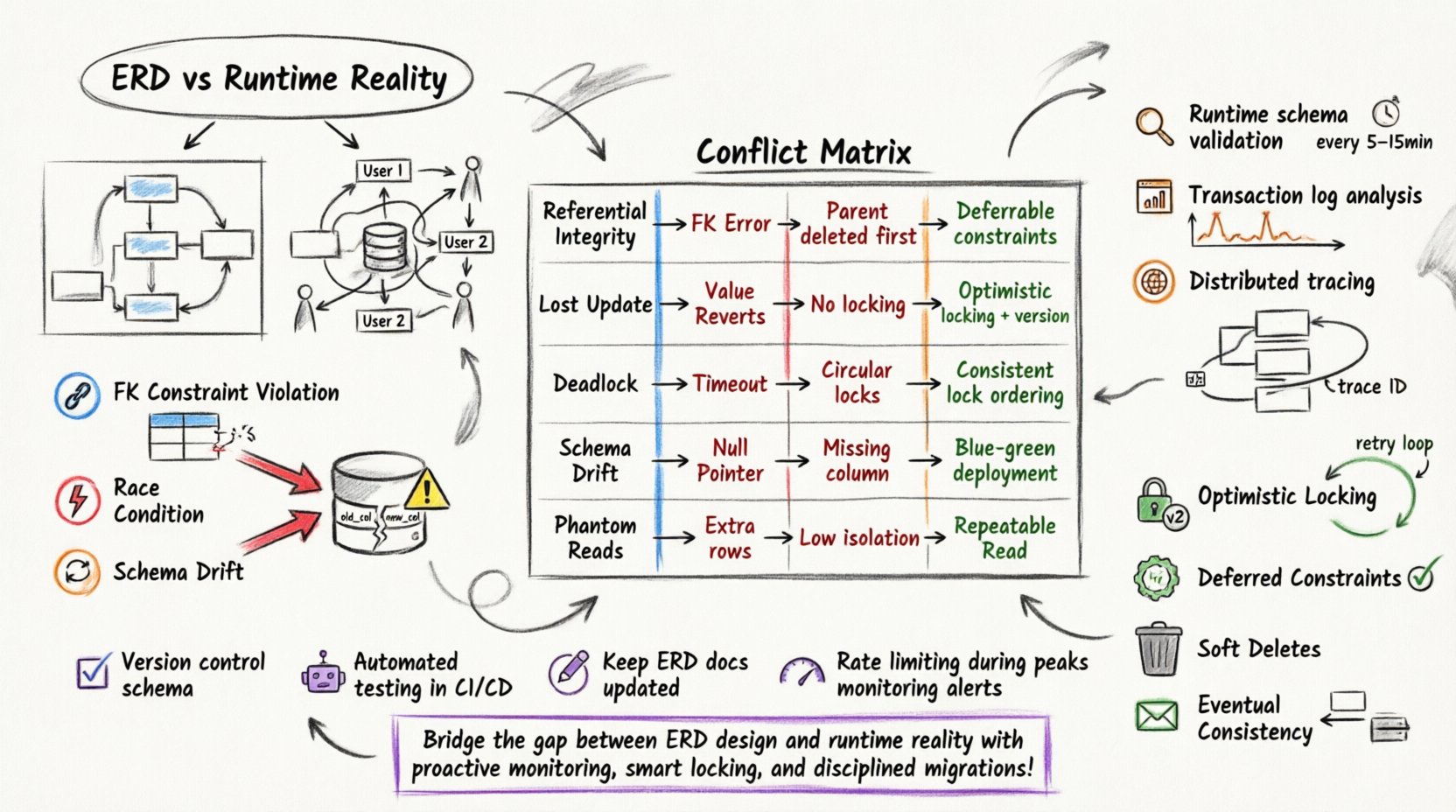
🧩 Understanding the Disconnect: Design vs. Runtime
An Entity Relationship Diagram serves as a blueprint for database structure. It defines tables, columns, keys, and relationships in a static format. However, a backend system in production is a living organism. Thousands of requests may hit the system simultaneously, executing transactions that modify the state defined in the diagram. When concurrency levels rise, the timing of these modifications becomes critical.
- Static Definitions: The ERD represents the ideal state where relationships are enforced strictly.
- Dynamic Execution: Concurrent requests execute independently, often bypassing intended sequencing.
- State Drift: Over time, schema changes or race conditions cause the actual data to diverge from the diagram.
This divergence creates friction. When a service expects a specific foreign key relationship to exist, but a concurrent deletion removes that reference, the system may fail. Troubleshooting these issues requires a deep dive into transaction isolation and locking mechanisms.
🛑 Common Conflict Patterns in High Concurrency
Identifying the specific type of conflict is essential for effective resolution. Below are the most prevalent patterns observed when entity relationships struggle under load.
1. Foreign Key Constraint Violations
When two services attempt to read and write related data simultaneously, referential integrity can be compromised. One process might delete a parent record while another is in the middle of inserting a child record referencing it. Without proper locking, the database rejects the child insertion, causing transaction rollbacks.
- Symptom: Unexpected foreign key errors in logs.
- Impact: Transaction failure and potential data loss.
- Frequency: High during batch updates or flash sales.
2. Race Conditions on Shared Entities
Multiple threads accessing the same entity instance can lead to lost updates. If the ERD implies a one-to-one relationship but the application logic allows concurrent modification, the final state may not match the diagram’s constraints.
- Symptom: Data overwrites previous changes silently.
- Impact: Inaccurate reporting and business logic errors.
- Frequency: Consistent during high read/write workloads.
3. Schema Migration Drift
Deploying schema changes in a live environment without downtime can introduce temporary conflicts. If the application code expects a column that is being added or removed, the system enters an inconsistent state. This is particularly dangerous in systems requiring zero downtime.
- Symptom: Application crashes during deployment windows.
- Impact: Service interruption and rollback complexity.
- Frequency: Dependent on release cadence.
📊 Conflict Matrix: Symptoms and Solutions
To streamline troubleshooting, use the following matrix to correlate observed symptoms with potential causes and remediation strategies.
| Conflict Type | Observable Symptom | Primary Cause | Recommended Mitigation |
|---|---|---|---|
| Referential Integrity | FK Constraint Error | Parent deleted before child update | Deferrable constraints or application-level checks |
| Lost Update | Value Reverts | Concurrent writes without locking | Optimistic locking with version columns |
| Deadlock | Transaction Timeout | Circular dependency in locks | Consistent lock ordering and timeouts |
| Schema Drift | Null Pointer Exception | Code expects missing column | Blue-green deployment with schema versioning |
| Phantom Reads | Query Returns Extra Rows | Isolation level too low | Read Committed or Repeatable Read isolation |
🔍 Detection Strategies: Monitoring and Validation
Before fixing a conflict, you must detect it. Relying solely on error logs is insufficient for high-concurrency systems where failures might be intermittent. Implementing proactive monitoring is crucial.
1. Schema Validation at Runtime
Integrate schema validation steps into your health checks. Periodically query the database metadata to verify that the actual structure matches the expected ERD. If a column is missing or a constraint is altered, alert the operations team immediately.
- Frequency: Run checks every 5 to 15 minutes.
- Scope: Focus on critical entities involved in core transactions.
- Automation: Trigger alerts via the notification pipeline.
2. Transaction Log Analysis
Examine transaction logs for patterns indicating constraint violations. Look for spikes in rollback rates or foreign key errors. This data helps pinpoint which entities are under the most stress.
- Key Metrics: Rollback rate, lock wait time, deadlock count.
- Tools: Built-in database auditing features.
- Frequency: Real-time streaming analysis.
3. Distributed Tracing
Trace requests across services to see where data integrity breaks down. If a transaction spans multiple services, tracing reveals which service modifies the data in a way that conflicts with the downstream expectation.
- Benefit: Identifies cross-service dependency issues.
- Implementation: Inject trace IDs into database queries.
- Visualization: Map the flow of data modifications.
🛠️ Resolution Techniques and Architectural Adjustments
Once a conflict is identified, the resolution often requires architectural changes rather than simple code patches. The following techniques address common concurrency issues related to entity relationships.
1. Optimistic Locking
Instead of blocking access to a record, use a version number. When a record is read, the current version is noted. On update, the database checks if the version matches. If another process modified the record, the update fails, and the application retries.
- Pros: Reduces lock contention; improves throughput.
- Cons: Increased complexity in retry logic.
- Use Case: High-read, low-write scenarios.
2. Deferred Constraints
Some databases allow constraints to be deferred until the end of a transaction. This permits temporary violations during the transaction, provided they are resolved before commit. This is useful for batch operations where intermediate states do not need to be valid.
- Pros: Flexibility in complex updates.
- Cons: Risk of commit failure if validation fails at the end.
- Use Case: Bulk data imports or complex migrations.
3. Soft Deletes and Archiving
Hard deletes can cause immediate orphaned records if not handled carefully. Soft deletes mark a record as inactive rather than removing it. This preserves the relationship in the ERD while logically separating the data.
- Pros: Maintains referential integrity.
- Cons: Data growth over time; requires cleanup jobs.
- Use Case: Audit trails and historical data retention.
4. Eventual Consistency Patterns
In distributed systems, strong consistency is not always required. Using event sourcing or message queues allows services to react to changes asynchronously. The ERD represents the logical model, while the physical state converges over time.
- Pros: High availability and scalability.
- Cons: Temporary data inconsistency.
- Use Case: Analytics, notifications, non-critical updates.
🔄 Schema Migration Strategies for Concurrency
Changing the structure of a database in a live system is risky. Standard migrations often require downtime or locking the table, which kills concurrency. To mitigate ERD conflicts during changes, adopt specific migration patterns.
1. Expand and Contract
This two-step process ensures backward compatibility.
- Expand: Add the new column or table without removing the old one. Deploy code that writes to both.
- Migrate: Run a background job to populate the new structure using historical data.
- Contract: Once data is migrated, remove the old column and update code to use the new structure.
2. Read-Write Splitting
During a migration, route write traffic to the old schema and read traffic to the new schema (or vice versa). This allows for a gradual transition without breaking active sessions.
- Requirement: Load balancer configuration flexibility.
- Benefit: Zero downtime for users.
- Complexity: Requires careful routing logic.
⚙️ Transaction Isolation and Data Consistency
The level of isolation defined in the database system dictates how concurrent transactions interact. Misconfiguration here is a leading cause of ERD conflicts.
- Read Uncommitted: Allows dirty reads. Avoid for critical data integrity.
- Read Committed: Standard for most systems. Prevents dirty reads but allows non-repeatable reads.
- Repeatable Read: Ensures the same query returns the same results. Prevents non-repeatable reads but allows phantom reads.
- Serializable: Highest isolation. Prevents all anomalies but significantly reduces performance.
Selecting the right isolation level is a trade-off between consistency and performance. For entity relationships that must remain strict, higher isolation is necessary, but it increases the likelihood of deadlocks.
🧩 Best Practices for Maintaining Schema Integrity
To minimize future conflicts, adopt a disciplined approach to database design and management.
- Version Control Schema: Treat database migrations as code. Store them in the same repository as application logic.
- Automated Testing: Include schema validation in the CI/CD pipeline. Ensure the ERD matches the deployed state before release.
- Documentation: Keep ERD diagrams updated. An outdated diagram is as dangerous as no diagram at all.
- Rate Limiting: Throttle write operations during peak times to reduce lock contention.
- Deadlock Monitoring: Set up alerts for deadlock events. Investigate them immediately to prevent recurring patterns.
🧪 Real-World Scenario: Order Processing
Consider an order processing system where an Order entity has many OrderItem entities. In a flash sale, thousands of orders are placed simultaneously.
- Problem: Inventory stock is reduced before the Order is committed. If the Order fails, the Inventory remains reduced, causing a conflict with the ERD’s stock constraints.
- Resolution: Implement a reservation system. Reserve stock at the start of the transaction and only deduct it upon successful Order commit. If the Order fails, release the reservation.
- Outcome: Inventory counts remain accurate, and the ERD constraints are respected even under extreme load.
📝 Final Thoughts on System Resilience
Maintaining the integrity of entity relationships in a highly concurrent environment is an ongoing challenge. It requires vigilance, robust tooling, and a clear understanding of how data flows through the system. By anticipating conflicts and implementing the strategies outlined above, teams can ensure that their backend systems remain stable and reliable.
Focus on building defenses at the code, database, and architecture levels. Regular audits of the schema against the live data will prevent drift. Embrace patterns that prioritize data consistency without crippling performance. With a disciplined approach, the gap between the Entity Relationship Diagram and runtime reality can be bridged effectively.
Key Takeaways
- Monitor schema drift continuously using automated health checks.
- Use optimistic locking to handle concurrent updates efficiently.
- Plan migrations using expand and contract patterns to avoid downtime.
- Choose isolation levels that balance consistency with throughput.
- Keep documentation synchronized with the deployed database state.