
Enterprise Architecture (EA) is often misunderstood in the business world. It is frequently viewed as an abstract, theoretical exercise that sits far away from daily operations. However, for organizations aiming to scale efficiently, EA provides the structural foundation required to align technology with business goals. Whether you are a developer, a business analyst, or a stakeholder, understanding the reality of EA is crucial for navigating modern digital landscapes.
In this guide, we will strip away the jargon and address the most persistent myths surrounding this discipline. We will explore why EA is not just about documentation, how it impacts agility, and who can actually benefit from it. By the end, you will have a clear, practical understanding of how enterprise architecture functions in real-world scenarios.
What Exactly Is Enterprise Architecture? 🤔
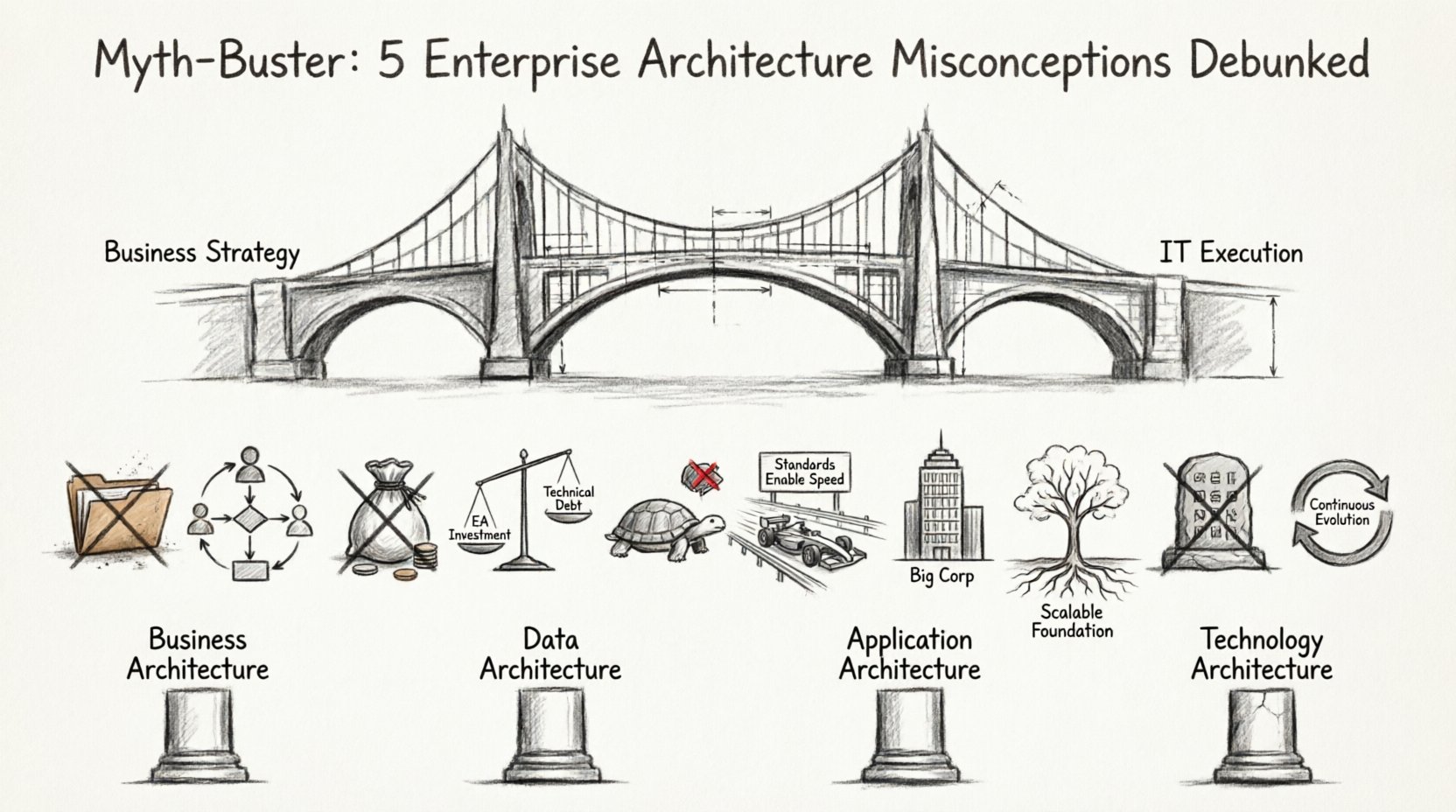
Before diving into the myths, it is helpful to define the core concept. Enterprise Architecture is a comprehensive framework used to manage an organization’s information assets and technology infrastructure. It acts as a bridge between the business strategy and the IT execution.
Think of it as the blueprint for a building. Just as an architect ensures that the plumbing, electrical wiring, and structural beams work together before construction begins, EA ensures that software, data, and hardware work together before deployment. It covers four main domains:
- Business Architecture: Defines the business strategy, governance, functions, and processes.
- Data Architecture: Describes the structure of an organization’s logical and physical data assets.
- Application Architecture: Provides a blueprint for individual applications, their interactions, and their relationships to business processes.
- Technology Architecture: Describes the hardware and software infrastructure needed to support the applications.
This holistic view ensures that when a business decision is made, the technical implications are understood immediately.
Myth 1: Enterprise Architecture Is Just IT Documentation 📄
The most common misconception is that EA is simply about creating diagrams and writing documents that nobody reads. Critics argue that it is a bureaucratic exercise that results in static files gathering dust on a server.
The Reality: EA is a dynamic management practice, not a filing system.
While documentation is part of the process, the value lies in the alignment and decision-making that the architecture supports. When implemented correctly, EA artifacts serve as living references that guide developers and stakeholders in making better choices. It is about creating a shared language between the business and technology teams.
Consider the impact of poor documentation. Without a clear map of how systems interact, new employees struggle to understand the landscape, and changes are made in isolation. This leads to “spaghetti code” and fragmented systems. EA provides the governance to prevent this chaos.
Key Takeaways:
- EA documentation is a tool for communication, not an end goal.
- Architecture diagrams are used to visualize dependencies and risks.
- The focus is on enabling decisions, not just recording them.
Myth 2: Enterprise Architecture Is Too Expensive 💰
Many organizations hesitate to invest in EA because they perceive it as a luxury item. The argument is often that small teams or startups cannot afford the overhead of hiring architects or maintaining an architecture practice.
The Reality: The cost of not having an architecture is often significantly higher.
Without architectural guidance, organizations tend to accumulate technical debt. This occurs when quick fixes are applied to solve immediate problems without considering long-term impacts. Over time, this debt accumulates interest in the form of maintenance costs, security vulnerabilities, and inability to integrate new tools.
Furthermore, shadow IT often arises in the absence of EA. This is when departments purchase their own software without coordination with the broader IT strategy. This leads to data silos, redundant licenses, and security gaps. EA helps centralize these decisions to reduce waste.
Cost Comparison:
| Scenario | With EA | Without EA |
|---|---|---|
| System Integration | Planned and standardized | Ad-hoc and fragile |
| Tooling Costs | Consolidated and optimized | Redundant and bloated |
| Security | Proactive and unified | Reactive and patchy |
| Change Management | Controlled and predictable | Chaotic and risky |
Investing in EA is an investment in risk reduction and efficiency.
Myth 3: Enterprise Architecture Slows Down Agility 🐢
In an era where speed is often equated with success, EA is frequently blamed for slowing down development. The perception is that architects create red tape, requiring endless approvals before code can be written or deployed.
The Reality: Good architecture enables agility by reducing friction.
When systems are poorly designed, teams spend more time fixing integration issues than building new features. This is the opposite of agility. EA establishes guardrails and standards that allow teams to move faster within a safe environment. It is similar to traffic laws; they restrict individual driving speed, but they allow the entire highway to flow smoothly without collisions.
Modern EA practices embrace iterative development. Instead of a massive upfront design phase, architects work alongside development teams to shape the architecture as the product evolves. This approach ensures that the architecture remains relevant and supportive of rapid delivery.
How EA Supports Speed:
- Reusability: Standardized components can be reused across projects, saving development time.
- Clear Standards: Teams do not waste time debating which tools to use; they follow established guidelines.
- Risk Management: Potential failures are identified early, preventing costly delays later.
Myth 4: Enterprise Architecture Is Only for Large Corporations 🏢
It is often assumed that EA is reserved for massive enterprises with thousands of employees and complex legacy systems. Startups and small businesses are thought to be too nimble to need this kind of formal structure.
The Reality: Complexity scales with growth, regardless of size.
Even small organizations face challenges related to scalability and integration. As a company grows, the number of applications and data points increases exponentially. Without a coherent strategy, a small company can quickly become as tangled as a large one.
Early adoption of EA principles helps startups build a foundation that can support future growth. It prevents the need for a complete overhaul later when the company outgrows its initial setup. This “shift left” approach saves significant time and resources in the long run.
Why Small Teams Need EA:
- It ensures that initial technical choices do not block future product features.
- It helps in making strategic vendor decisions early.
- It prepares the organization for funding rounds where technical health is scrutinized.
- It reduces the risk of key-person dependency by documenting systems.
Myth 5: Enterprise Architecture Is a Static Blueprint 🗺️
Many believe that once an architecture is designed, it is set in stone. This view treats the architecture as a finished product rather than a continuous process. It implies that the business environment remains constant, which is rarely the case.
The Reality: Enterprise Architecture is a living, evolving discipline.
The business landscape changes constantly. Market demands shift, regulations update, and new technologies emerge. A static blueprint would become obsolete quickly. Effective EA is iterative. It involves continuous monitoring, assessment, and adjustment.
Architects must be responsive to change. They need to understand the impact of a new regulation on data storage or how a new cloud service can reduce latency. This requires a mindset of continuous improvement rather than one-time design.
Characteristics of Dynamic EA:
- Feedback Loops: Data from operations informs architectural decisions.
- Adaptability: Structures are designed to be modular and changeable.
- Review Cycles: Regular audits ensure the architecture matches current business needs.
Comparing Misconception vs. Reality 🔄
To summarize the key points discussed above, here is a quick reference guide contrasting the common myths with the actual practices of effective Enterprise Architecture.
| Misconception | Reality |
|---|---|
| It is just documentation. | It is a management practice for alignment. |
| It is too expensive. | It reduces technical debt and waste. |
| It slows down agility. | It enables speed through standards. |
| It is only for big companies. | It is vital for scalable growth. |
| It is static. | It is continuous and adaptive. |
How to Start Your EA Journey 🚀
If you are convinced that EA is valuable, the next step is implementation. You do not need to overhaul everything overnight. A phased approach is recommended.
1. Assess the Current State
Understand what you have. Inventory your applications, data sources, and infrastructure. Identify where the pain points are. Are there duplicate systems? Is data security a concern? This assessment forms the baseline for all future work.
2. Define the Target State
Where do you want to be? This should be driven by business goals. If the goal is faster time-to-market, the architecture must support rapid deployment. If the goal is data privacy, the architecture must prioritize security controls.
3. Identify Gaps
Compare the current state with the target state. What is missing? Is it a lack of integration? Is it outdated hardware? This gap analysis creates the roadmap.
4. Engage Stakeholders
EA cannot happen in a vacuum. You need buy-in from business leaders and IT staff. Communicate the value clearly. Show how this work supports their specific goals, whether it is cost reduction or innovation.
5. Iterate and Improve
Do not wait for perfection. Start with small wins. Implement a standard for one area, measure the results, and then expand. This builds momentum and trust in the architecture function.
Key Roles in Enterprise Architecture 👥
Understanding the roles helps clarify how the work gets done. While titles vary, the core functions remain similar.
- Enterprise Architect: Oversees the overall structure and alignment of IT with business strategy.
- Solutions Architect: Designs specific solutions to meet defined business requirements.
- Technical Architect: Focuses on the technology stack and infrastructure details.
- Data Architect: Manages the flow and structure of data across the organization.
- Business Architect: Aligns business processes and capabilities with IT systems.
Collaboration between these roles is essential. A solution architect cannot design a robust system without understanding the data architecture constraints. Similarly, a business architect cannot design a process without knowing the technical capabilities.
The Value of Effective Enterprise Architecture 📈
When implemented correctly, Enterprise Architecture delivers tangible benefits. It is not an abstract concept; it drives measurable outcomes.
Improved Decision Making
Leaders have access to accurate information about how their technology supports business goals. This allows for data-driven decisions rather than guesses.
Reduced Complexity
By identifying and removing redundant systems, the organization becomes leaner and more efficient. Maintenance costs drop, and system reliability increases.
Better Risk Management
Security and compliance are built into the design, not added as an afterthought. This reduces the likelihood of breaches and regulatory fines.
Enhanced Innovation
With a stable foundation, teams can focus on creating new value rather than maintaining old systems. Innovation becomes sustainable.
Cost Optimization
By standardizing tools and platforms, organizations can negotiate better licenses and reduce redundant spending.
Conclusion: A Strategic Necessity
Enterprise Architecture is often shrouded in mystery, but its purpose is clear: to ensure that technology serves the business effectively. By debunking the myths surrounding this discipline, organizations can move forward with confidence.
It is not about bureaucracy or slowing down progress. It is about building a resilient foundation that allows for sustainable growth. Whether you are a small startup or a large corporation, the principles of EA apply. The key is to adapt the practice to your specific context.
Start by understanding the core domains. Recognize the value of alignment. Embrace the iterative nature of architecture. And remember that the goal is not perfection, but continuous improvement. With the right approach, Enterprise Architecture becomes a powerful enabler of success.
Take the next step in your learning journey. Explore the resources available, engage with the community, and begin applying these principles to your work. The path to a mature architecture practice is long, but the destination is worth the effort.