
Enterprise architecture provides the blueprint for organizational structure, but regulatory compliance adds a layer of mandatory constraints that must be woven into every decision. When architects model systems without explicit compliance traceability, audits become reactive nightmares. By leveraging ArchiMate relationships, organizations can create a living map where regulatory requirements are not merely documents sitting in a repository but active elements connected to capabilities, processes, and services.
This guide explores how to model and monitor regulatory compliance using the relationship types defined in the ArchiMate 3 specification. The focus remains on the methodology and structural integrity of the model rather than specific tooling implementations.
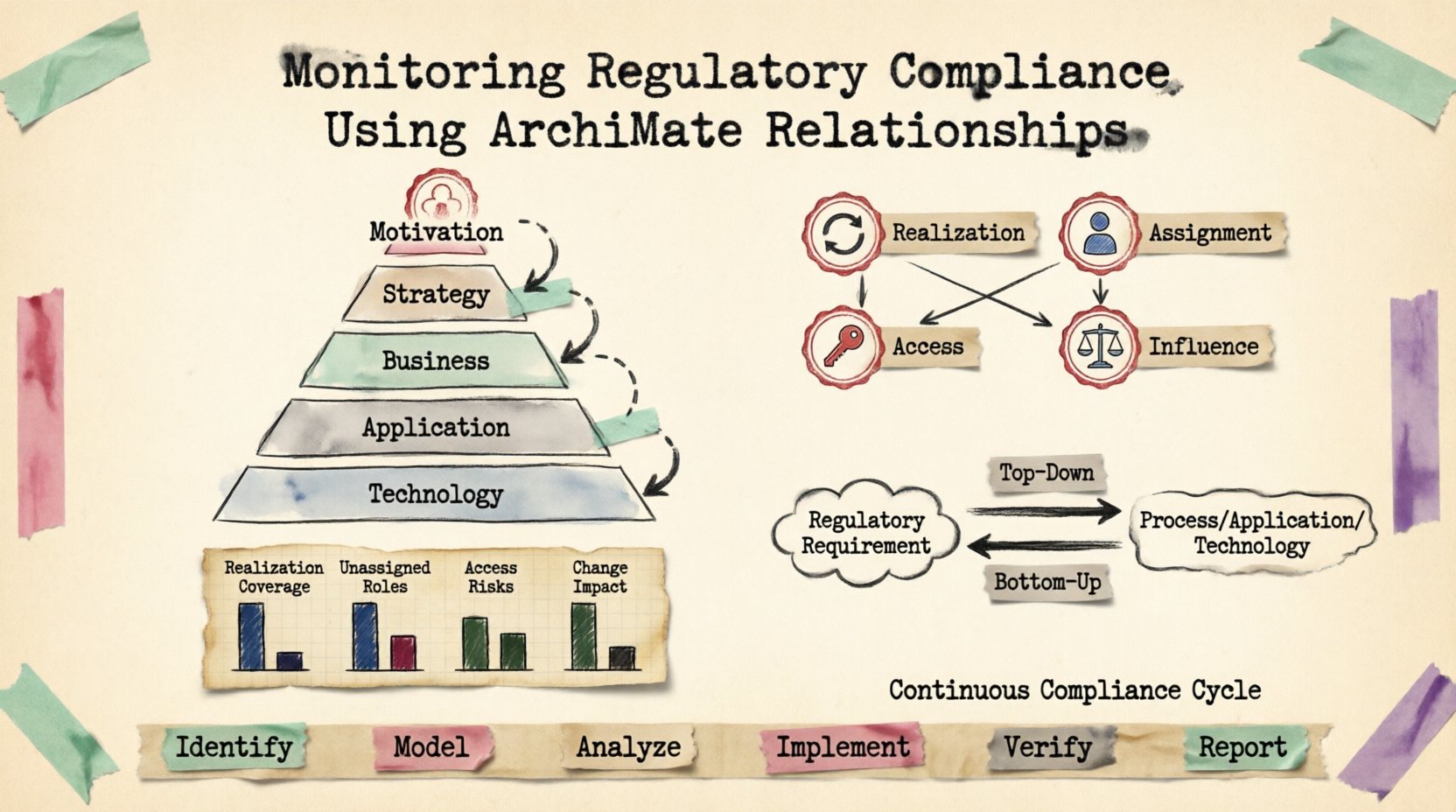
🔍 The Challenge of Compliance in Enterprise Architecture
Regulatory frameworks such as GDPR, SOX, HIPAA, or PCI-DSS impose strict rules on data handling, process execution, and security controls. Traditionally, compliance is treated as a separate activity, often audited annually. However, embedding these requirements into the enterprise architecture ensures they are considered during design and change management.
Without a structured approach, compliance requirements become:
- 📄 Static documents disconnected from operational reality
- 🔗 Untraceable from the processes that execute them
- ⚠️ Difficult to assess during impact analysis
- 🧩 Siloed from the technology that supports them
ArchiMate solves this through its relationship model. Relationships define how elements interact, allowing architects to trace a regulation from the Motivation Layer down to the Implementation Layer.
🧱 ArchiMate Layers and Compliance Modeling
To effectively monitor compliance, one must understand which layers of the ArchiMate framework hold compliance artifacts. Each layer offers specific perspectives on how regulations impact the organization.
| Layer | Compliance Focus | Example Element |
|---|---|---|
| Motivation | Goals, Drivers, Requirements | Regulatory Requirement, Compliance Goal |
| Business | Processes, Roles, Functions | Service, Process, Business Actor |
| Application | Data, Functions, Interfaces | Application Function, Data Object |
| Technology | Infrastructure, Security | Node, Device, System Software |
| Strategy | Value, Capability, Principle | Capability, Principle, Value |
By placing compliance requirements in the Motivation Layer and connecting them downward, architects create a chain of evidence. If a process changes, the impact on the requirement can be immediately assessed.
🔗 Key Relationship Types for Compliance
The power of ArchiMate lies in its relationships. Not all connections are equal when auditing. Certain relationship types provide stronger evidence of compliance than others. Below is a breakdown of the most critical relationships for compliance monitoring.
1. Realization Relationships 🔄
The Realization relationship indicates that one element implements or realizes another. In compliance modeling, this is the most critical link.
- Requirement Realization: A process realizes a compliance requirement. This proves the requirement is active.
- Capability Realization: A capability realizes a strategic goal. This proves the organization has the capacity to meet the goal.
- Service Realization: An application service realizes a business service. This ensures the business service is supported technically.
Example: A “Data Retention Policy” (Requirement) is realized by a “Document Archiving Process” (Business Process). If the process is removed, the requirement is no longer realized, triggering an immediate compliance flag.
2. Assignment Relationships 👤
The Assignment relationship links an actor to a business object, process, or function. Compliance often dictates who is responsible for what.
- Actor to Process: Defines who executes the control.
- Actor to Requirement: Defines who is accountable for the compliance obligation.
This relationship is vital for audit trails. Auditors need to know exactly which role is responsible for a specific control. If an actor is changed, the assignment relationship must be updated to reflect the new accountability.
3. Access Relationships 🔑
The Access relationship describes how an application function accesses data, or how a business object is accessed by a process. Data privacy regulations rely heavily on this.
- Data Access: Which processes access sensitive data objects?
- System Access: Which users access specific application functions?
By modeling access, you can answer the question: “Who can see this data?” This is essential for GDPR “Right to Access” or HIPAA privacy rules.
4. Influence Relationships ⚖️
The Influence relationship shows how one element affects another without direct implementation. This is often used for constraints or risks.
- Requirement to Process: A requirement influences a process, meaning the process must adhere to it but does not necessarily implement it directly.
- Principle to Capability: A principle influences how a capability is developed.
Use this for softer constraints, such as “Best Practices” or “Guidelines” that should guide behavior but are not hard-coded requirements.
5. Aggregation and Specialization 🧩
While not direct compliance links, these structural relationships help organize compliance artifacts.
- Aggregation: Grouping related compliance controls into a “Control Framework”.
- Specialization: Creating sub-requirements (e.g., “Financial Reporting” is a specialization of “General Accounting”) to manage granularity.
📈 Monitoring Compliance Through Traceability
Once the model is built, monitoring becomes a matter of querying relationships. A static model is useless for ongoing compliance. The model must be dynamic, updated as the organization changes.
Traceability Matrix
A traceability matrix is a standard compliance artifact. In ArchiMate, this matrix is generated automatically by the relationships defined in the model.
- Top-Down Traceability: Start with a Motivation Layer Requirement. Follow Realization links to find the supporting Processes, Applications, and Technology.
- Bottom-Up Traceability: Start with a Technology Change. Follow the Reverse Realization links to find which Business Services and Requirements are affected.
This bidirectional traceability is the core of continuous compliance monitoring. It allows for impact analysis before changes are deployed.
🛡️ Common Compliance Scenarios and Modeling Patterns
Different regulations require different modeling patterns. Below are three common scenarios and how to represent them using ArchiMate relationships.
Scenario 1: Data Privacy (GDPR/CCPA)
Focus: Data flows and user consent.
- Element: Data Object (Personal Data).
- Relationship: Access (Process accesses Data).
- Constraint: Add a “Principle” element stating “Consent Required”.
- Link: Use Influence (Process influenced by Principle).
- Monitoring: Check if any “Access” relationship exists without a corresponding “Consent” realization.
Scenario 2: Financial Controls (SOX)
Focus: Segregation of duties and audit trails.
- Element: Business Role (CFO, Auditor).
- Relationship: Assignment (Role assigned to Process).
- Constraint: Define “Segregation of Duties” as a Principle.
- Link: Use Influence (Principle influences Role assignment).
- Monitoring: Query for Roles that are assigned to conflicting processes (e.g., creating and approving invoices).
Scenario 3: Security Standards (ISO 27001)
Focus: Infrastructure and access control.
- Element: Technology Node / Device.
- Relationship: Realization (Security Control realizes Requirement).
- Constraint: Define “Encryption at Rest” as a Requirement.
- Link: Use Realization (Technology Node realizes Requirement).
- Monitoring: Identify nodes that do not realize the encryption requirement.
📋 Best Practices for Compliance Modeling
To ensure the model remains a useful asset for compliance rather than a maintenance burden, follow these guidelines.
- 🎯 Granularity: Do not model every single regulation as a single element. Group them into categories (e.g., “Data Privacy”, “Financial Integrity”).
- 🔄 Versioning: Requirements change. Ensure your modeling platform supports versioning of requirements and relationships.
- 🔗 Minimal Links: Only create relationships that have evidence. Do not guess. An unfounded link reduces trust in the model.
- 👥 Role Clarity: Ensure actors are defined clearly. A “User” is too vague. Use “Data Analyst” or “Compliance Officer”.
- 📉 Deprecation: When a regulation is repealed, do not delete the element. Mark it as “Deprecated” or “Historical” to maintain audit history.
- 🤖 Automation: Where possible, use scripts or queries to validate the model. Manually checking relationships for hundreds of controls is inefficient.
⚠️ Common Pitfalls to Avoid
Even experienced architects can stumble when integrating compliance. Be wary of these common mistakes.
1. The “Checkbox” Syndrome
Creating a requirement element and linking it to a process just to say “it is there”. This creates noise. The relationship must represent a real dependency. If the process changes and the requirement no longer holds, the relationship should break.
2. Ignoring the Motivation Layer
Starting the model in the Business Layer and working down. Always start with the Motivation Layer (Requirements, Goals). Without this anchor, the model lacks context for why a control exists.
3. Over-Engineering Relationships
Using complex relationship chains (A influences B, which realizes C, which is accessed by D) for simple controls. Keep the chain as short as possible to maintain clarity.
4. Static Compliance
Building the model once and never updating it. Compliance is dynamic. Laws change, and processes change. The model must reflect the current state of the organization.
📉 Assessing Compliance Health
Once the model is established, how do you measure the health of your compliance posture? Use the relationships to generate metrics.
| Metric | Definition | Benefit |
|---|---|---|
| Realization Coverage | % of Requirements with at least one Realization link. | Shows if requirements are actually being met. |
| Unassigned Roles | % of Processes without an assigned Actor. | Highlights accountability gaps. |
| Access Risks | % of Sensitive Data Objects with no Access control defined. | Identifies data exposure risks. |
| Change Impact | Number of Requirements affected by a proposed change. | Quantifies risk before implementation. |
These metrics provide objective data for management and auditors. They move the conversation from “we think we are compliant” to “the model shows 95% coverage of Requirement X”.
🔄 Continuous Improvement Cycle
Compliance is not a destination; it is a cycle. The ArchiMate model supports this cycle through its change management capabilities.
- Identify: New regulation or change in existing law.
- Model: Update the Motivation Layer with new Requirements.
- Analyze: Use relationships to identify affected Business and Technology layers.
- Implement: Modify processes or technology to satisfy new links.
- Verify: Check the Realization relationships to confirm the new links exist.
- Report: Generate metrics on compliance coverage.
By embedding this cycle into the architecture workflow, compliance becomes a natural outcome of good design rather than a separate burden.
🛠️ Implementation Considerations
While the methodology is tool-agnostic, practical implementation requires a repository that supports deep querying of relationships. The modeler must ensure that:
- Relationships are labeled clearly (e.g., “Realizes”, “Assigned To”).
- Metadata is attached to elements (e.g., Regulation ID, Version, Expiry Date).
- Permissions are managed so only authorized personnel can modify compliance links.
- Change logs are maintained to track who modified a relationship and when.
This audit trail is crucial. If a compliance relationship is deleted, the system must record who did it and why. This prevents accidental removal of critical controls.
🌐 Integration with Other Frameworks
ArchiMate does not exist in a vacuum. It often integrates with other standards.
- TOGAF: Use ArchiMate for the architecture description and TOGAF for the methodology.
- COBIT: Map ArchiMate processes to COBIT control objectives.
- ITIL: Link ArchiMate services to ITIL service catalogs.
When integrating, ensure the relationship types remain consistent. A “Realization” in ArchiMate should map clearly to the implementation concept in the other framework. This cross-referencing strengthens the compliance argument.
🔮 Future-Proofing Compliance
Regulations are becoming more complex and dynamic. The ArchiMate model must be robust enough to handle future changes.
- Modularity: Keep compliance requirements modular so they can be moved between layers.
- Abstraction: Use Abstraction relationships to define high-level principles that apply to many specific requirements.
- Extensibility: Use extensions to add compliance-specific attributes if the standard metamodel is insufficient.
By building a flexible model, the organization can adapt to new laws without rebuilding the entire architecture.
📝 Final Considerations
Monitoring regulatory compliance using ArchiMate relationships transforms compliance from a bureaucratic exercise into a structural property of the enterprise. By defining clear relationships between requirements and capabilities, organizations gain visibility into their risk posture.
The key is not to build a perfect model, but a traceable one. Every relationship should represent a fact that can be verified. As the organization evolves, the model evolves. This ensures that compliance is always current, accurate, and aligned with business objectives.
Start by mapping your critical requirements. Define the relationships. Monitor the gaps. This approach provides the authority and confidence needed to navigate the complex landscape of modern regulation.