
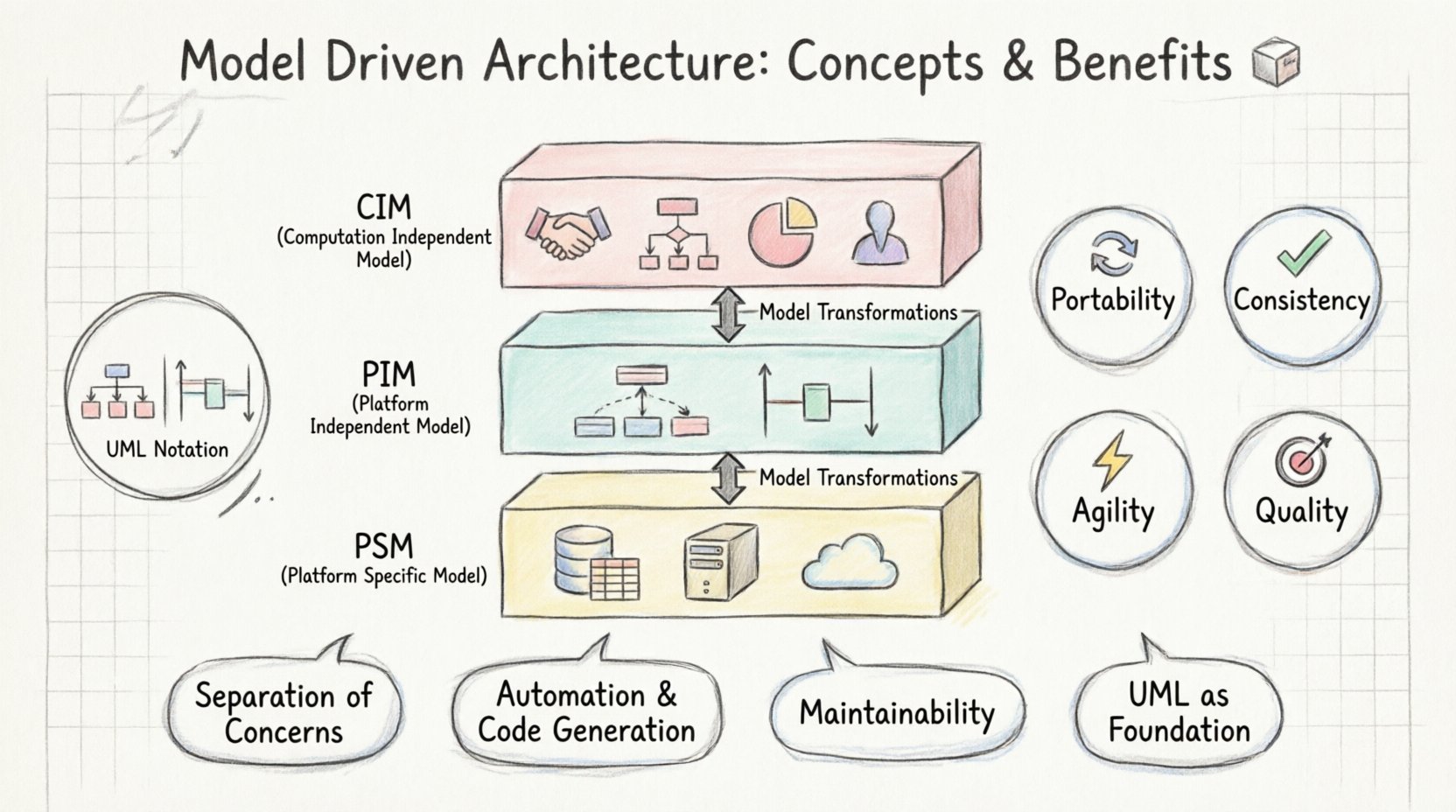
💡 Key Takeaways
- Separation of Concerns: MDA divides system design into platform-independent and platform-specific models.
- Automation: Code generation reduces manual coding errors and speeds up development cycles.
- Maintainability: Changes to business logic propagate automatically across different technical platforms.
- UML Integration: Unified Modeling Language serves as the foundational notation for defining these models.
Model Driven Architecture (MDA) represents a significant shift in software engineering methodologies. It prioritizes the creation of models as the primary artifacts of development rather than code. In this approach, the business logic is captured in a platform-independent manner, allowing the system to adapt to various technical environments without rewriting the core logic. This process relies heavily on the Unified Modeling Language (UML) to standardize how these models are visualized and understood by stakeholders.
Understanding the Core Concepts 🧠
At its heart, MDA is about abstraction. By moving away from writing code directly, engineers focus on describing what the system must do rather than how it does it technically. This separation allows for greater flexibility. When technology changes, the models can be reinterpreted to generate new code for the new environment, preserving the original business intent.
The architecture is built upon three distinct levels of abstraction:
- Computation Independent Model (CIM): This is the highest level of abstraction. It describes the system in terms of the business domain without concern for how it will be processed. It focuses on the requirements and the rules of the business environment.
- Platform Independent Model (PIM): This model describes the system design in a way that is independent of any specific software or hardware platform. It captures the structure, behavior, and constraints of the system without detailing the implementation specifics.
- Platform Specific Model (PSM): This level adds the details required for a specific technology. It incorporates the constraints and capabilities of the target platform, such as a specific database or operating system.
Transformations occur between these levels. A model at the PIM level can be transformed into multiple PSMs. This is where the automation aspect becomes critical. Tools process the PIM and apply transformation rules to produce the code for the PSM.
The Role of UML in MDA 📐
Unified Modeling Language is the standard notation used to express these models. Without a standardized language, the PIM and PSM would be ambiguous. UML provides the diagrams and syntax necessary to define classes, interactions, states, and components.
In an MDA workflow, UML is not just for documentation; it is the executable specification. Diagrams such as Class Diagrams define the static structure, while Sequence Diagrams define the dynamic behavior. This precision ensures that when the transformation tools run, they have unambiguous instructions on what code to generate.
Using UML allows for a common understanding among business analysts, architects, and developers. The visual nature of the diagrams bridges the gap between technical implementation and business requirements. This alignment reduces the risk of misinterpretation, which is often a source of defects in traditional coding-first approaches.
Benefits of the Approach 🚀
Adopting a model-driven approach offers several tangible advantages over traditional development cycles. The primary benefit is the reduction of repetitive tasks. Once the transformation rules are established, generating code for different platforms becomes a matter of configuration rather than recreation.
Here is a breakdown of the key advantages:
| Benefit | Description |
|---|---|
| Portability | Systems can be deployed across different platforms by regenerating code from the same PIM. |
| Consistency | Code generated from models follows the same patterns, reducing inconsistency across the codebase. |
| Agility | Changes in requirements can be modeled and propagated quickly without manual code rewriting. |
| Quality | Automated generation reduces human error and enforces architectural standards. |
Implementation Lifecycle ⚙️
Implementing MDA requires a structured lifecycle. It begins with the analysis phase, where the domain is understood and modeled in the CIM. This is followed by the design phase, where the PIM is created. Engineers must define the rules for transformation to the PSMs at this stage.
The generation phase follows, where the actual code is produced. However, MDA does not eliminate the need for manual intervention entirely. Developers still need to write the transformation logic and may need to hand-code specific complex components that do not fit the general model patterns. This hybrid approach ensures that the system remains performant and tailored to specific needs.
Maintenance is significantly altered in this model. Instead of patching code directly, engineers update the model. The transformation tools then regenerate the affected parts of the system. This ensures that the deployed code remains in sync with the design intent.
Challenges and Considerations ⚖️
While the benefits are substantial, there are challenges to consider. The learning curve can be steep. Engineers must understand both the domain logic and the transformation tools. There is also a dependency on the tooling ecosystem. If the tools are not robust, the automation may introduce new errors.
Additionally, performance tuning can be difficult. Generated code is often generic. In high-performance scenarios, hand-optimized code might be necessary. This requires a balance between automation and manual optimization. Organizations must weigh the cost of tool acquisition and training against the long-term savings in maintenance and development time.
Another consideration is the version control of models. Just as code requires versioning, models must be tracked rigorously. Merging changes in models can be more complex than merging code, as the structural changes impact the entire transformation pipeline.
Future Outlook 🔮
The industry continues to evolve towards more automated development processes. MDA laid the groundwork for modern low-code and no-code platforms. These platforms are essentially a simplified form of MDA, where the abstraction levels are managed by the platform vendor rather than the development team.
As systems become more complex and distributed, the ability to manage complexity through abstraction becomes increasingly valuable. The principles of MDA ensure that the focus remains on the business value rather than the technical implementation details.
By adhering to these structured methodologies, organizations can build systems that are resilient to change. The separation of business logic from technical infrastructure allows for a future-proof architecture. This adaptability is crucial in a landscape where technology stacks evolve rapidly.
Summary of Strategic Value 📊
Model Driven Architecture provides a robust framework for managing software complexity. By leveraging UML and transformation rules, teams can achieve higher quality and faster delivery. The initial investment in modeling pays off through reduced maintenance costs and improved portability. While it requires discipline and specific tooling, the long-term benefits for system evolution are clear.
Organizations seeking to improve their development efficiency should consider how MDA principles can be integrated into their workflows. The focus on models rather than code creates a single source of truth that guides the entire lifecycle of the software.