
Enterprise Architecture often operates in a vacuum of abstraction. While diagrams and models provide clarity on structure and relationships, the financial reality frequently remains disconnected. Integrating cost analysis with ArchiMate technology resources bridges this gap. It transforms static models into dynamic financial instruments. This process ensures that architectural decisions reflect economic constraints and value generation. When technology resources are mapped directly to financial data, organizations gain visibility into where capital is consumed. This alignment supports strategic planning and resource allocation.
Many organizations struggle to connect the dots between an application component and its budget line item. Without this connection, architecture becomes an academic exercise rather than a management tool. The goal is to embed financial metrics into the architecture framework. This approach requires a disciplined method of data collection and mapping. It involves understanding the specific elements of the ArchiMate language and assigning appropriate cost attributes. This guide details the methodology for achieving this integration effectively.
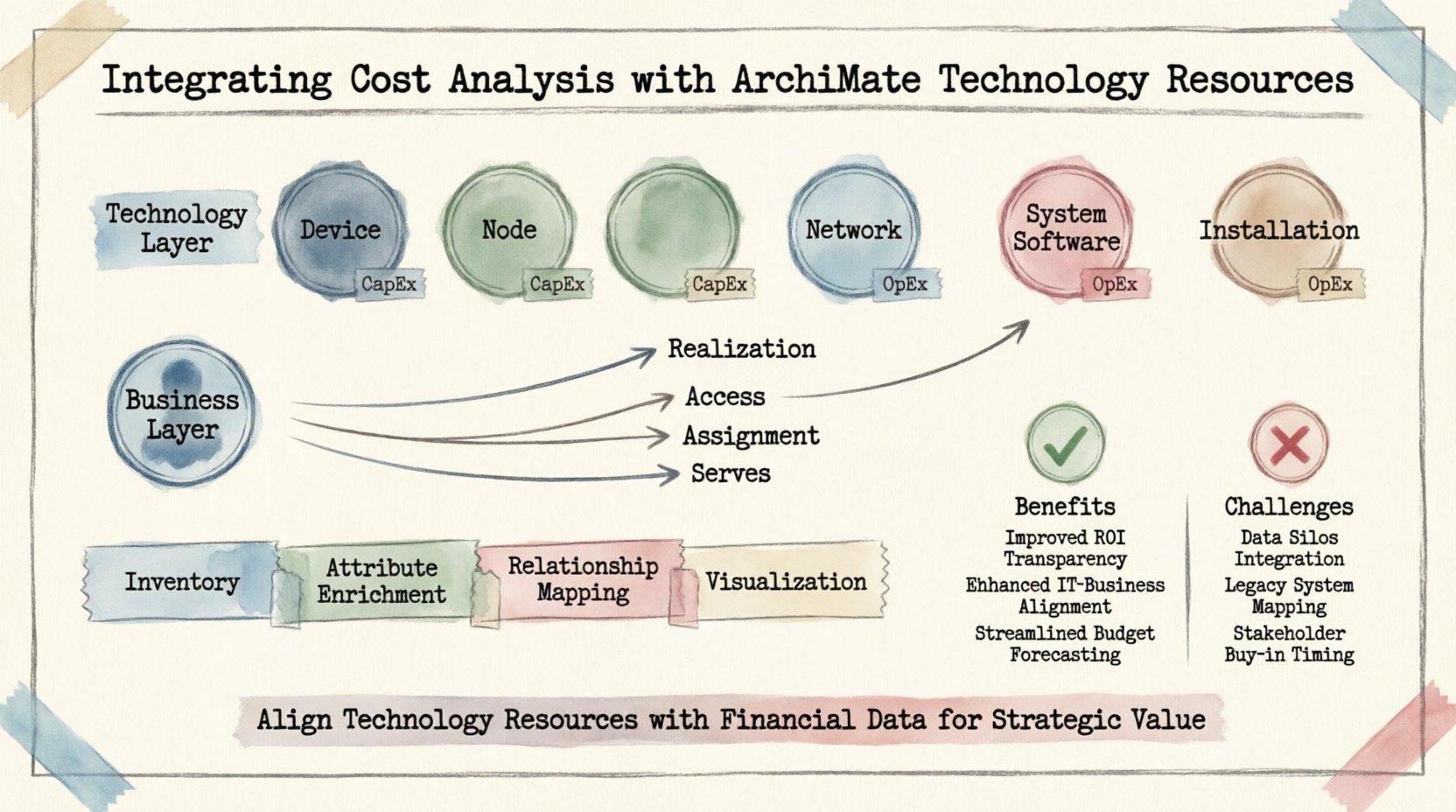
📊 Understanding the Technology Layer in ArchiMate
The Technology Layer is the foundation of the ArchiMate architecture. It describes the physical and logical hardware and software infrastructure. Understanding this layer is the first step toward cost integration. The layer consists of specific elements that represent physical resources. These elements are the targets for cost analysis.
Core Elements of the Technology Layer
To analyze costs, one must identify the objects that incur expenses. The following elements are critical for this mapping:
- Device: Physical hardware such as servers, routers, or workstations. These often involve CapEx (Capital Expenditure) for purchase and OpEx (Operational Expenditure) for maintenance.
- Node: Logical processing nodes within a device. Costs here may relate to licensing or processing power allocation.
- Network: The communication infrastructure. Costs include bandwidth, connectivity fees, and security protocols.
- System Software: Operating systems and middleware. Licensing models vary significantly here.
- Installation: The physical placement of software on hardware. This can involve labor costs during deployment.
Each of these elements represents a potential cost center. By cataloging them, architects create a bill of materials for the IT landscape. This catalog serves as the baseline for financial modeling. Without a clear inventory of these resources, cost analysis remains speculative.
The Role of Relationships
Costs do not exist in isolation. They flow through relationships. An application runs on a node, which sits on a device. A device consumes electricity, which is billed to a specific department. Understanding these relationships is vital. It allows for the allocation of shared costs. For example, a server hosting multiple applications should have its cost split based on resource utilization.
ArchiMate defines specific relationship types that support this analysis:
- Realization: Shows how a technology component realizes a function or service.
- Access: Indicates how a component accesses another.
- Assignment: Links a technology resource to an organizational unit.
- Serves: Demonstrates how a technology component supports a business process.
These relationships enable the tracing of costs from a business requirement down to a physical server. This traceability is essential for accurate budgeting.
💰 The Need for Cost Analysis in Architecture
Why integrate financial data into an architectural model? The primary reason is accountability. Architecture drives investment. Every new application or infrastructure change requires funding. When the cost is visible within the model, decision-makers can evaluate trade-offs. They can see the financial impact of technical debt or modernization efforts.
Strategic Alignment
Business strategy dictates where money should go. Architecture dictates how money is spent. Integrating cost analysis ensures these two forces are synchronized. If a business strategy focuses on innovation, the architecture model should reflect higher investment in research and development infrastructure. If the focus is on efficiency, the model should highlight consolidation and optimization opportunities.
This alignment prevents a scenario where architecture builds a system that the business cannot afford to run. It ensures that technical capabilities are sustainable over the long term. Financial constraints become design parameters rather than afterthoughts.
Vendor Management and Licensing
Software licensing is a major cost driver. Many organizations overspend on licenses due to a lack of visibility. An integrated model tracks which software is installed on which hardware. It highlights underutilized assets. This data supports negotiations with vendors. It also aids in compliance audits. Knowing exactly where software resides helps avoid penalties associated with unauthorized use.
Decision Support
Architecture decisions often involve choosing between options. Option A might be cheaper upfront but cost more to maintain. Option B might require higher initial investment but offer lower operational costs. A model with embedded cost data allows for Total Cost of Ownership (TCO) calculations. This supports data-driven decision-making. Stakeholders can compare options based on financial metrics rather than technical preference alone.
🔗 Mapping Costs to ArchiMate Objects
The technical challenge lies in mapping financial data to architectural objects. This requires a structured approach. It is not enough to simply list prices. The data must be linked to the specific elements in the model. This linkage enables aggregation and reporting.
Attribute Definition
Each ArchiMate element must support cost attributes. Standard elements may need extension to hold financial data. The following attributes are commonly required:
- Acquisition Cost: The initial cost to purchase or build the resource.
- Maintenance Cost: Recurring costs for support, updates, and repairs.
- Energy Cost: Power consumption estimates for physical devices.
- Licencing Cost: Annual fees for software usage rights.
- Personnel Cost: Labor required to manage the resource.
These attributes should be defined consistently across the model. Inconsistencies lead to inaccurate reports. For example, one element might track annual costs while another tracks monthly costs. Standardization is key to reliable analysis.
Granularity Levels
Cost data varies in granularity. Some costs apply to a single device. Others apply to an entire data center. The model must support different levels of aggregation. This allows for high-level budgeting as well as detailed expense tracking.
| Level | Example Object | Cost Type | Frequency |
|---|---|---|---|
| Device | Server Rack A | Hardware Purchase | One-time |
| Software | Database License | Subscription Fee | Annual |
| Service | Cloud Hosting | Usage Based | Monthly |
| Infrastructure | Data Center Floor | Facility Rent | Quarterly |
This table illustrates how costs map to different layers of the architecture. A comprehensive model captures all these levels. It ensures that no hidden costs are overlooked during planning.
Data Integration Patterns
Where does the cost data come from? It typically resides in financial systems or asset management databases. Integrating these sources requires a mapping strategy. There are two common approaches:
- Direct Linking: Cost objects are stored within the architecture repository. This provides immediate access but may duplicate data.
- External Reference: The model links to external databases via identifiers. This keeps data in the source of truth but requires integration queries.
Direct linking is often easier for reporting. External referencing is better for data integrity. The choice depends on the organization’s IT landscape. In either case, unique identifiers are essential. Every technology resource must have a unique key to link it to its cost record.
🛠️ Implementation Steps for Integration
Implementing this integration requires a phased approach. Rushing the process often leads to data errors. A structured plan ensures accuracy and adoption. The following steps outline a robust implementation strategy.
Phase 1: Inventory and Discovery
The first step is to identify all technology resources. This involves auditing the current environment. Every server, application, and network link must be accounted for. This creates the baseline model. Without a complete inventory, cost analysis will be incomplete. The inventory should include asset tags, serial numbers, and location data.
Phase 2: Attribute Enrichment
Once the inventory is established, financial attributes are added. This may involve querying financial systems. It may also involve manual entry for legacy assets. During this phase, data quality checks are critical. Verify that costs are current and valid. Remove obsolete assets from the cost model to avoid skewing results.
Phase 3: Relationship Mapping
Costs must be allocated based on usage. This requires mapping relationships. For example, if a database server supports three applications, how is its cost split? Define rules for allocation. Percentage-based splits are common. Usage-based splits are more accurate. Document these rules clearly. This ensures consistency in future reporting.
Phase 4: Visualization and Reporting
Data is useless if it is not visible. Create dashboards and reports that display costs alongside architecture views. Stakeholders need to see the financial impact of architectural changes. Use heatmaps to highlight high-cost areas. Use trend lines to show cost growth over time. Visualization makes the data actionable.
📉 Benefits and Challenges
Integrating cost analysis brings significant value. However, it also introduces complexity. Understanding both sides allows for better risk management.
Key Benefits
- Improved Budget Accuracy: Forecasts are based on actual asset data rather than estimates.
- Better Resource Allocation: Funds can be directed to high-priority areas with clear justification.
- Reduced Waste: Unused or underutilized assets become visible and can be retired.
- Enhanced Communication: Architects can speak the language of finance, bridging the gap between departments.
- Compliance: Easier tracking of licensing and regulatory costs.
Common Challenges
- Data Freshness: Costs change frequently. Keeping the model up to date requires ongoing maintenance.
- Ownership: Who is responsible for updating cost data? This must be clearly defined.
- Complexity: Mapping costs to complex architectures can become overwhelming without automation.
- Resistance: Finance teams may be hesitant to share data with architecture teams due to privacy concerns.
Addressing these challenges requires clear governance. A dedicated team should oversee the data integrity of the model. Regular audits should be scheduled to ensure accuracy.
🔄 Managing the Data Lifecycle
Cost data is dynamic. Assets are replaced, retired, or upgraded. The architecture model must reflect these changes. This requires a lifecycle management process.
Change Management
Any change to the architecture should trigger a cost review. If a new server is added, its cost must be entered. If a server is decommissioned, its cost must be removed. This ensures the model always reflects the current state. Change management processes should include a checklist for cost updates.
Data Governance
Governance policies define how data is handled. This includes access rights, retention periods, and update frequencies. Who can modify cost data? Who can view it? These questions must be answered. Strict governance prevents unauthorized changes that could lead to financial discrepancies.
Continuous Improvement
As the organization evolves, so do the cost models. New cost drivers may emerge, such as carbon footprint fees or cloud-specific pricing models. The architecture framework must be flexible enough to accommodate these changes. Regular reviews of the cost model help identify areas for improvement. Feedback from stakeholders should be incorporated into the design.
🎯 Strategic Outcomes
When executed well, this integration transforms the role of the architect. They become stewards of value, not just builders of systems. The model becomes a source of truth for investment planning. It supports long-term sustainability and efficiency.
Organizations that master this integration gain a competitive advantage. They can respond faster to market changes. They can optimize their IT spend without sacrificing performance. They can demonstrate the value of architecture to the board. This visibility builds trust and secures funding for future initiatives.
The journey is not short. It requires commitment and discipline. However, the return on investment justifies the effort. By aligning technology resources with cost analysis, organizations build a resilient and financially sound architecture. This foundation supports innovation and growth in a complex digital landscape.
Final Thoughts on Implementation
Start small. Select a pilot area, such as a specific business unit or application portfolio. Apply the cost analysis framework there. Learn from the results. Refine the process. Then expand to the broader enterprise. This incremental approach reduces risk and builds confidence. It allows the organization to adapt the framework to its specific needs.
The integration of cost analysis with ArchiMate technology resources is not merely a technical task. It is a strategic imperative. It ensures that the digital foundation of the enterprise is built on solid financial ground. By following the methodologies outlined here, organizations can achieve clarity, control, and confidence in their architectural investments.