
Enterprise Architecture (EA) has traditionally been associated with stability, long-term planning, and comprehensive documentation. ArchiMate, a widely adopted modeling language, provides a structured approach to visualizing, analyzing, and designing enterprise architectures. However, the modern business landscape demands speed, adaptability, and continuous delivery. This creates a tension between the rigorous structure of ArchiMate and the fluid nature of Agile methodologies. Integrating these two paradigms requires a deliberate shift in mindset and process. This guide explores how to embed Agile practices within the ArchiMate framework to support dynamic business transformation without sacrificing architectural integrity.
When organizations attempt to merge these methodologies, they often face resistance. Architects worry about losing control, while Agile teams feel bogged down by documentation. The solution lies not in choosing one over the other, but in harmonizing them. By treating architecture as a living service rather than a static artifact, teams can deliver value faster while maintaining alignment with strategic goals. The following sections detail the principles, strategies, and practical steps for this integration.
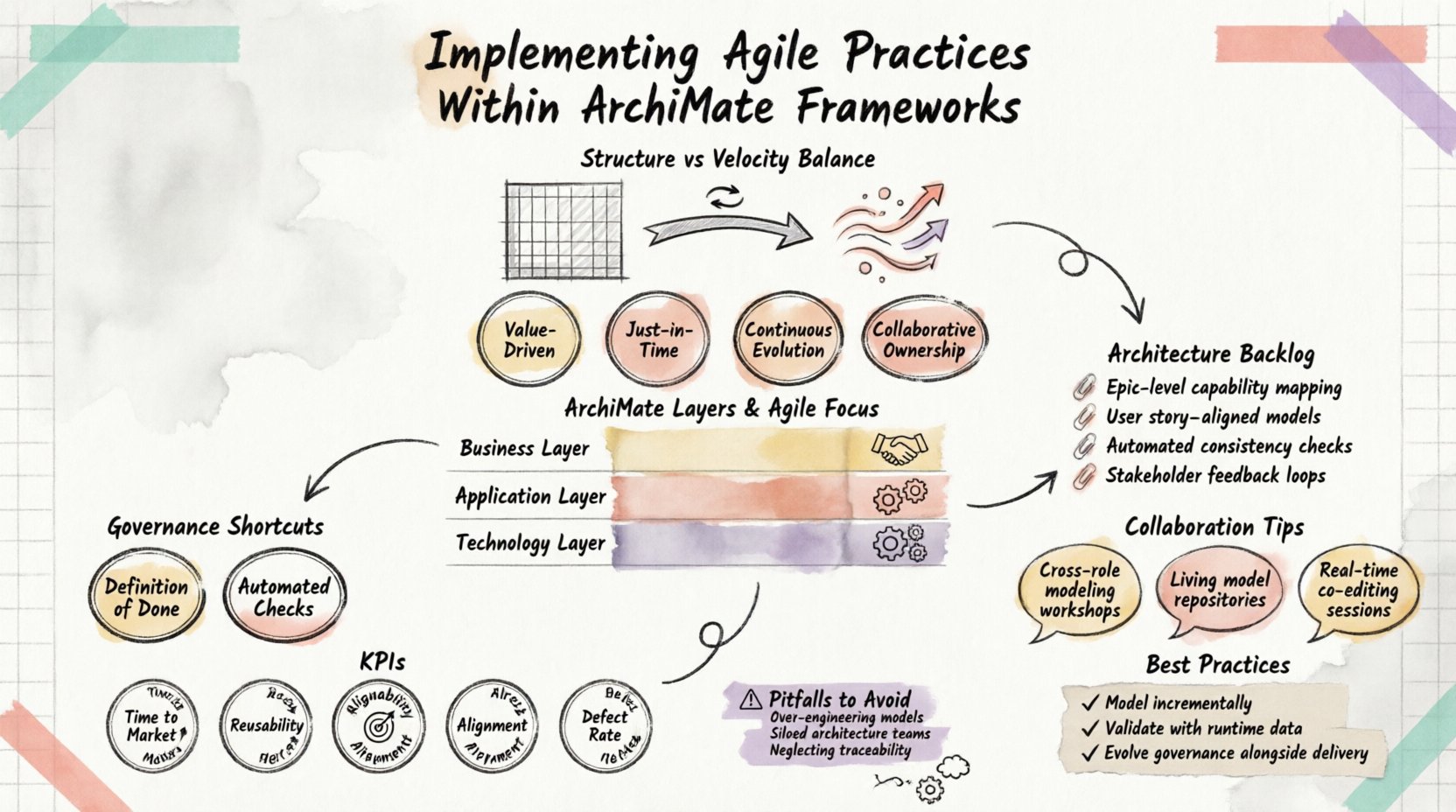
Understanding the Challenge: Structure vs. Velocity 🔄
ArchiMate organizes enterprise architecture into layers such as Business, Application, Technology, and Strategy. It relies on relationships and viewpoints to ensure consistency. Agile, conversely, prioritizes individuals and interactions over processes and tools, and working software over comprehensive documentation. The perceived conflict is often about timing and granularity.
- Traditional EA: Focuses on big designs upfront, comprehensive models, and governance gates.
- Agile Delivery: Focuses on incremental value, just-in-time planning, and adaptive responses.
When these approaches clash, the result is often a bottleneck. The architecture team waits for requirements to be fully defined before modeling, while the delivery team needs guidance to start coding. To resolve this, the architecture function must shift from being a gatekeeper to a facilitator. This does not mean abandoning ArchiMate; it means using it to support Agile flows rather than hinder them.
Core Principles for Agile Enterprise Architecture 🧠
Successful integration requires adopting specific principles that respect both the rigor of modeling and the speed of delivery. These principles guide how models are created, maintained, and consumed.
- Value-Driven Modeling: Every model element must contribute to a business value stream. If a layer does not support a current initiative, it can be deferred.
- Just-in-Time Detail: Models should be detailed only when necessary for decision-making. High-level views suffice for strategic alignment, while detailed views are built for specific implementation sprints.
- Continuous Evolution: Architecture is not a one-time state. It evolves alongside the business capabilities and technology stack.
- Collaborative Ownership: Architects and developers should co-own the architectural artifacts. This ensures the models reflect reality and are used actively.
Mapping ArchiMate Layers to Agile Iterations 📅
To make ArchiMate work in an Agile context, we must map the modeling effort to the sprint cycle. This ensures that architecture delivers value at the same cadence as the product delivery.
| ArchiMate Layer | Agile Focus | Modeling Granularity |
|---|---|---|
| Business Layer | Value Streams, Capabilities | Strategic Epics & Themes |
| Application Layer | Systems, Services | Sprint Backlog Items |
| Technology Layer | Infrastructure, Nodes | Technical Spikes & Refinement |
By aligning the layers with the iteration types, teams can visualize where architecture fits into the delivery pipeline. For example, the Business Layer might be modeled during the planning phase of a release train, while the Application Layer is refined during specific sprint planning sessions.
Constructing the Architecture Backlog 📋
In Scrum, there is a Product Backlog for features. In Agile Enterprise Architecture, there should be an Architecture Backlog. This backlog contains tasks related to architectural design, refactoring, and governance that are necessary to support the product backlog.
The Architecture Backlog should include items such as:
- Capability Mapping: Defining which business capabilities are supported by which applications.
- Interface Definitions: Specifying how systems interact before integration begins.
- Standards Compliance: Ensuring new components meet the agreed-upon technical standards.
- Refactoring Tasks: Addressing technical debt identified during previous sprints.
These items are prioritized alongside feature work. If an architectural constraint blocks a feature, the architecture task takes precedence. This ensures that technical debt does not accumulate to a point where velocity slows down significantly.
Governance Without Bottlenecks 🛡️
Governance is often the biggest hurdle in Agile environments. Heavy approval processes slow down delivery. The goal is to implement lightweight governance that ensures compliance without creating delays.
- Definition of Done: Include architectural checks in the Definition of Done for user stories. A story is not complete if it violates a critical architectural principle.
- Automated Checks: Where possible, automate compliance checks using tools that validate the models against standards.
- Community of Practice: Establish a group of architects who review designs asynchronously. This allows for feedback without a formal gate meeting.
- Architecture Runway: Build enough architectural foundation to support multiple sprints of development without needing constant redesign.
This approach shifts governance from a post-hoc audit to an integrated part of the development process. It ensures that architecture is a supportive layer rather than a policing function.
Collaboration and Communication 🤝
Effective communication is essential when bridging the gap between architects and developers. ArchiMate models can be dense and abstract. To make them useful in Agile teams, they must be simplified and contextualized.
- Visual Communication: Use ArchiMate viewpoints to create diagrams that answer specific questions. A full enterprise model is too large; a focused view is actionable.
- Living Documents: Treat models as documentation that is updated regularly. Outdated models create confusion and should be avoided.
- Workshops: Conduct modeling workshops with stakeholders. This ensures that the architecture reflects the actual needs of the business and the technical constraints of the team.
- Feedback Loops: Establish channels for developers to report issues with the architecture. If the model does not match reality, it must be updated.
Measuring Value and Maturity 📊
How do we know if this integration is working? Traditional metrics like model completeness are not sufficient. We need metrics that reflect business value and delivery speed.
Key performance indicators include:
- Time to Market: Does the architecture enable faster delivery of features?
- Reusability: Are components being reused across different initiatives?
- Alignment Score: How well do the implemented solutions match the strategic capabilities?
- Defect Rate: Are architectural violations leading to production issues?
Tracking these metrics helps stakeholders understand the return on investment for architectural activities. It justifies the time spent on modeling by showing how it contributes to business outcomes.
Common Pitfalls and How to Avoid Them ⚠️
Even with a solid plan, organizations often stumble when trying to implement Agile EA. Recognizing these pitfalls early can save significant time and resources.
- Over-Modeling: Creating detailed models for every feature. Fix: Focus on high-level patterns and only detail what is needed for immediate implementation.
- Ignoring the Business Layer: Focusing too much on technology. Fix: Ensure the Business Layer is always visible and connected to the capabilities being delivered.
- Static Governance: Reviewing architecture once a year. Fix: Integrate reviews into the sprint cycle.
- Lack of Tools: Relying on manual updates. Fix: Use repositories that support versioning and collaboration, ensuring models are always up to date.
The Future of Adaptive Modeling 🔮
As enterprises continue to evolve, the role of architecture will become even more dynamic. The future lies in adaptive modeling where the architecture updates itself based on telemetry and business changes. ArchiMate provides the vocabulary for this future state. By starting with the practices outlined in this guide, organizations can build a foundation that supports continuous innovation.
Implementing Agile practices within ArchiMate frameworks is not about diluting the rigor of enterprise architecture. It is about making that rigor accessible, timely, and relevant to the teams building the products. When done correctly, it creates a symbiotic relationship where architecture enables speed, and speed informs architecture.
Summary of Best Practices ✅
To recap the key takeaways for successful integration:
- Start Small: Begin with one value stream or capability area.
- Focus on Value: Ensure every model element supports a business outcome.
- Iterate: Treat architecture as a series of sprints, not a waterfall project.
- Collaborate: Involve developers and business stakeholders in the modeling process.
- Measure: Track metrics that matter to the business, not just the architecture team.
By adhering to these principles, organizations can achieve a balance between stability and agility. The result is an enterprise architecture that is robust, relevant, and ready for the demands of the modern digital economy.