
💡 Key Takeaways
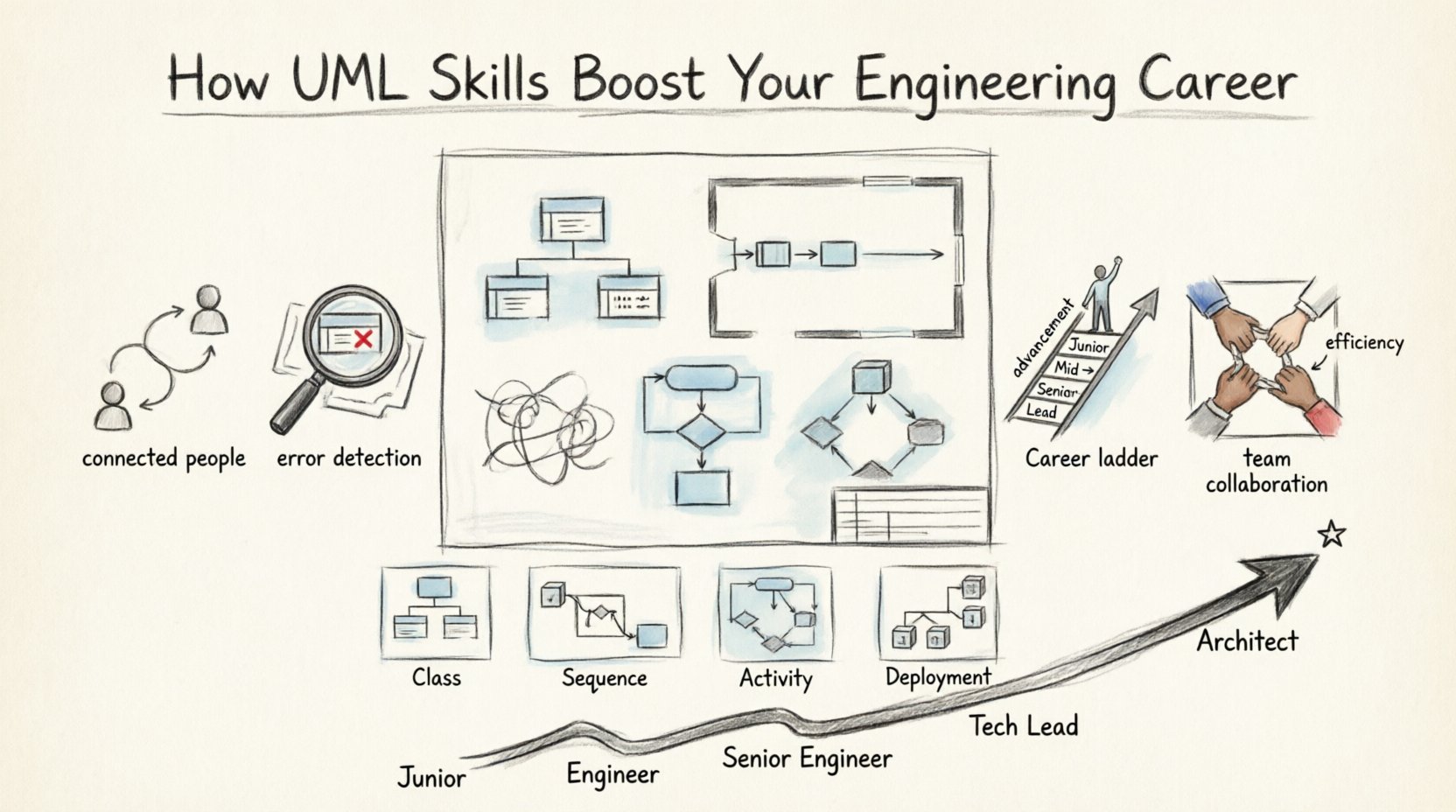
- Standardized Communication: UML provides a universal language that bridges gaps between developers, stakeholders, and designers.
- Early Error Detection: Visualizing architecture before coding reduces costly refactoring and logic errors.
- Career Advancement: Proficiency in modeling is often a prerequisite for senior architect and lead roles.
- Team Efficiency: Clear diagrams accelerate onboarding and reduce misunderstandings during collaborative projects.
Engineering is fundamentally about solving complex problems. While code is the tool of execution, the blueprint is the tool of thought. Unified Modeling Language (UML) serves as that blueprint. It is not merely a set of drawing conventions; it is a method of thinking that structures abstract ideas into tangible systems. For engineers aiming to progress beyond writing isolated functions, mastering the principles of UML offers a distinct advantage in career trajectory and professional effectiveness.
The Value of Visualizing Architecture 🏗️
Software systems often become complex quickly. As features accumulate, the logical connections between components can become opaque. Relying solely on code to understand system behavior is inefficient. Code describes the implementation, but UML describes the intent. By creating diagrams that map out interactions, you create a shared mental model for the entire team.
Consider a scenario where a new feature requires integration with an external service. Without a clear view of the data flow, developers may guess at the interface. A sequence diagram clarifies the exact order of messages, the actors involved, and the expected responses. This clarity prevents the common pitfall of building features that do not align with the broader system design.
The ability to visualize architecture allows you to spot potential bottlenecks or single points of failure early in the lifecycle. This foresight is highly valued in engineering leadership. It demonstrates a capacity to think holistically rather than locally.
Communication Across Disciplines 🤝
Engineering does not happen in a vacuum. You will work with product managers, business analysts, and QA testers. These roles often lack the technical depth to read source code, yet they understand the business logic. UML acts as a translation layer.
A Use Case diagram, for instance, provides a high-level view of user interactions without getting bogged down in technical syntax. It answers the question: “What does the system do for the user?” This is a question stakeholders ask frequently. Being able to present your technical solution in a format they understand builds trust and reduces friction during requirement gathering.
Furthermore, technical documentation often suffers from being outdated. Code changes, but documentation lags. While UML diagrams are not a replacement for code, they serve as a stable reference point for the system’s intended structure. When a developer joins a new team, a set of well-maintained diagrams reduces the time required to understand the codebase.
Understanding Core Diagram Types
Different problems require different views. UML provides a suite of diagram types, each serving a specific purpose. Knowing when to use which diagram is a skill in itself.
| Diagram Type | Primary Purpose | Career Benefit |
|---|---|---|
| Class Diagram | Structure and relationships between objects | Essential for backend architecture roles |
| Sequence Diagram | Time-ordered interactions between objects | Clarifies API contracts and flow logic |
| Activity Diagram | Workflow and algorithmic logic | Helps optimize complex business processes |
| Deployment Diagram | Hardware topology and software distribution | Critical for DevOps and infrastructure roles |
Understanding these distinctions allows you to choose the right tool for the right job. It signals to your peers that you understand the nuances of system design.
Reducing Technical Debt 📉
One of the most significant challenges in software development is technical debt. This accumulates when shortcuts are taken during the design phase to meet immediate deadlines. A lack of modeling often leads to these shortcuts.
When you take the time to model the system, you are forced to think through edge cases and dependencies before writing a single line of code. This upfront investment pays dividends later. It reduces the likelihood of needing to refactor the entire database schema after deployment. It also minimizes the risk of breaking existing functionality when adding new features.
Engineers who prioritize design documentation are often tasked with leading refactoring efforts. They understand the dependencies well enough to change them safely. This reputation for stability and foresight is a key driver for promotions to senior or principal engineer levels.
Collaboration and Team Dynamics 👥
Modern engineering is a team sport. Code reviews are essential, but they are often focused on syntax and immediate logic. Design reviews, facilitated by UML, focus on architecture and long-term maintainability.
During a design review, diagrams serve as the focal point of the discussion. Instead of debating abstract concepts verbally, the team can point to a specific box or arrow on a diagram. This objectivity reduces conflict and keeps the conversation focused on the system rather than personal preferences.
Additionally, diagrams help in knowledge transfer. If a key team member leaves, the diagrams provide a roadmap for their replacement. This continuity is vital for organizational stability. Engineers who maintain high-quality diagrams are seen as custodians of the project’s health.
Building a Robust Portfolio 📂
When applying for higher-level roles, demonstrating your design capabilities is just as important as showing your coding skills. A portfolio that includes architectural diagrams for past projects stands out.
It shows that you approach problems systematically. Recruiters and hiring managers look for evidence of strategic thinking. Including a case study where you used modeling to resolve a complex integration issue can be more compelling than a list of technologies used.
It is important to note that the quality of the diagram matters more than the quantity. A single, well-annotated sequence diagram that solves a real problem is more valuable than ten generic class diagrams. Focus on clarity and accuracy.
Continuous Learning and Adaptation 🔄
The field of software engineering evolves rapidly. New patterns emerge, and technologies shift. However, the principles of modeling remain constant. The ability to abstract a problem and represent it visually is a transferable skill.
Whether you move to microservices, serverless architectures, or distributed systems, the need to understand how components interact remains. UML provides a stable foundation upon which you can build your expertise in these new areas.
Investing time in learning UML is an investment in your cognitive toolkit. It trains you to break down complexity. This skill is applicable not just in coding, but in project management, system analysis, and technical leadership.
Conclusion
UML is not a silver bullet, nor is it a requirement for every line of code. However, as you progress in your engineering career, the scope of your responsibility expands. You move from writing code to designing systems. In this realm, the ability to communicate complex structures clearly becomes paramount.
Proficiency in UML equips you with a professional language that transcends technical boundaries. It fosters better collaboration, reduces errors, and establishes you as a thoughtful architect. By integrating these skills into your workflow, you position yourself for opportunities that require both technical depth and strategic vision.