
Designing a robust database schema is foundational to the reliability of any software system. An Entity Relationship Diagram (ERD) serves as the blueprint for this architecture, translating abstract business requirements into concrete data structures. However, a diagram on paper—or in a modeling tool—does not guarantee a functional database. The gap between design and implementation often leads to performance bottlenecks, data inconsistencies, and costly refactoring efforts later in the lifecycle.
For Database Administrators (DBAs) and Data Architects, the validation phase is where theoretical models meet practical constraints. This guide provides a comprehensive, technical checklist for ensuring Entity Relationship Diagram integrity. We will move beyond basic syntax to examine logical consistency, normalization standards, constraint enforcement, and documentation practices. By adhering to these principles, you establish a solid foundation that supports scalability and maintainability without relying on specific software vendors or proprietary tools.
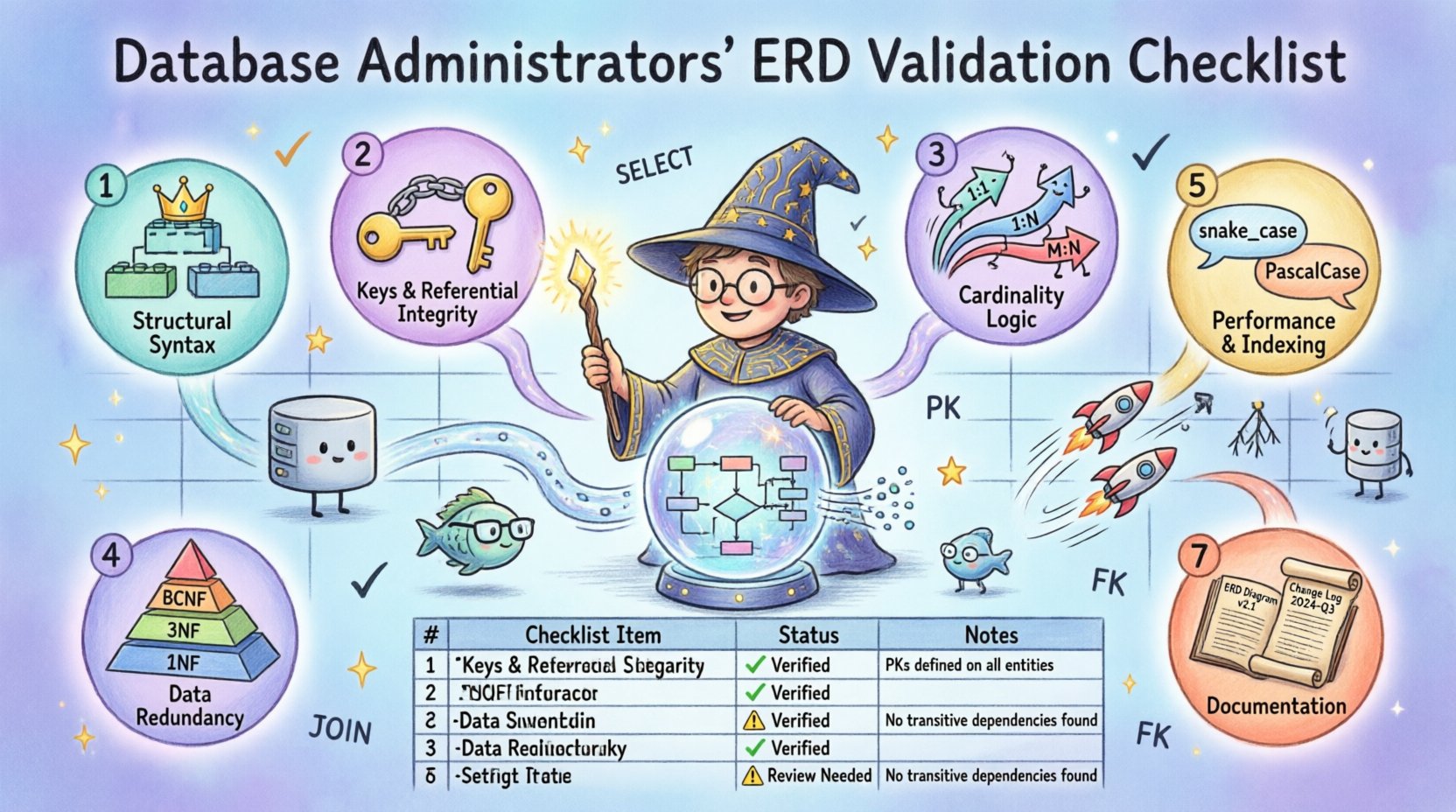
1. Structural Syntax and Schema Definition 🏗️
The first layer of validation involves the fundamental building blocks of the diagram. Every entity and relationship must adhere to strict structural rules. If the syntax is flawed, the resulting SQL DDL (Data Definition Language) will fail or produce unexpected results.
- Entity Naming Conventions: Ensure all entity names follow a consistent naming standard. Singular nouns are generally preferred for entities (e.g.,
Customerrather thanCustomers) to align with object-oriented modeling patterns. Avoid special characters, spaces, or reserved keywords. - Table Naming Consistency: Map entities directly to table names. Verify that the mapping is one-to-one unless a specific normalization strategy dictates otherwise. Check for naming collisions where different entities might map to the same table name.
- Primary Key Identification: Every table must have a defined Primary Key (PK). Without a unique identifier, rows cannot be distinguished, leading to data integrity violations. Ensure the PK is not nullable.
- Attribute Completeness: Verify that every entity has attributes defined. Empty entities often indicate a misunderstanding of the business domain or an incomplete data model.
- Data Type Precision: Check that data types are specific. Avoid generic types like
TEXTorINTwhere precision matters. UseVARCHAR(n)with defined lengths andDECIMAL(p, s)for financial data.
2. Keys, Constraints, and Referential Integrity 🔑
Keys are the mechanisms that hold the database together. Foreign Keys (FK) create the links between tables, enforcing relationships. Validating these constraints is critical for maintaining data accuracy.
- Foreign Key Existence: Confirm that every relationship line in the ERD corresponds to a Foreign Key constraint in the schema. Missing FKs break referential integrity, allowing orphaned records.
- On Delete/Update Actions: Define the behavior of the database when a parent record is deleted or updated. Common actions include
CASCADE,SET NULL, orRESTRICT. The ERD should explicitly document these behaviors. - Composite Keys: If a Primary Key consists of multiple columns, verify that all components are necessary. Avoid redundancy. Check that Foreign Keys referencing composite keys include all columns of the parent key.
- Unique Constraints: Identify fields that must be unique across the table but are not the Primary Key. For example, an email address or a national ID number. Ensure these are marked as
UNIQUEin the design. - Check Constraints: Validate any business rules that cannot be enforced by data types alone. Examples include age ranges, status codes, or percentage limits.
3. Cardinality and Relationship Logic 🔄
Relationships define how entities interact. Cardinality specifies the minimum and maximum number of instances of one entity that can be associated with instances of another. Misinterpreting cardinality is a common source of data loss or redundancy.
- One-to-One (1:1): Used when a record in one table corresponds to exactly one record in another. Validate that this is truly necessary and not a case for merging tables.
- One-to-Many (1:N): The most common relationship. Verify that the foreign key resides in the “many” side table. Ensure the FK is nullable if the relationship is optional.
- Many-to-Many (M:N): Direct M:N relationships are not physically possible in relational databases. They must be resolved into an associative entity (junction table) containing two foreign keys.
- Optional vs. Mandatory: Distinguish clearly between optional relationships (FK can be null) and mandatory relationships (FK cannot be null). This impacts data entry requirements.
- Recursive Relationships: For entities that relate to themselves (e.g., Employees managing Employees), ensure the Foreign Key points back to the same table’s Primary Key.
4. Normalization and Data Redundancy 📉
Normalization reduces data redundancy and improves integrity. While performance tuning sometimes requires denormalization, the baseline design should be normalized.
- First Normal Form (1NF): Ensure atomicity. No repeating groups or arrays within a single cell. Every column should hold a single value.
- Second Normal Form (2NF): All non-key attributes must depend on the entire Primary Key. In composite keys, check for partial dependencies.
- Third Normal Form (3NF): Non-key attributes must depend only on the Primary Key. Remove transitive dependencies where an attribute depends on another non-key attribute.
- Boyce-Codd Normal Form (BCNF): A stricter version of 3NF. Ensure every determinant is a candidate key. This is crucial for complex schemas.
- Denormalization Review: If the design includes denormalized tables, validate that the redundancy is intentional and documented. Plan for triggers or application logic to keep redundant data synchronized.
5. Naming Standards and Readability 📝
Consistency in naming prevents confusion among developers and administrators. A chaotic naming convention leads to errors during development and maintenance.
- Snake Case vs. Camel Case: Adopt a standard (e.g.,
snake_casefor tables,PascalCasefor entities). Document this rule in the data dictionary. - Prefixes and Suffixes: Use standard prefixes for specific table types, such as
tbl_for tables orv_for views. Avoid proprietary prefixes that tie the schema to a specific database engine. - Abbreviation Control: Limit abbreviations to well-known industry standards. Define all abbreviations in the documentation. Avoid internal jargon.
- Consistent Attribute Names: Ensure that attributes with the same meaning across tables have consistent names (e.g.,
created_atvs.creation_date). Standardize on one format.
6. Performance and Indexing Considerations 🚀
While the ERD is primarily logical, it must account for physical performance. A beautiful design that cannot handle load is a failed design.
- Foreign Key Indexing: Foreign Keys should almost always be indexed. This speeds up joins and enforcement of referential integrity. Check if the ERD indicates indexes on FK columns.
- Search Columns: Identify columns frequently used in
WHEREclauses orJOINconditions. Ensure they are indexed in the design plan. - Partitioning Strategy: For large tables, consider partitioning keys. The ERD should highlight which columns determine data distribution.
- Avoid Over-Indexing: More indexes mean slower writes. Validate that indexes are necessary and not redundant.
7. Documentation and Version Control 📂
A model without documentation is a liability. The ERD must be treated as living documentation that evolves with the system.
- Data Dictionary: Maintain a detailed description for every table and column. Include business definitions, data types, and constraints.
- Change History: Record every change to the schema. Note the date, author, and reason for the change. This is vital for debugging and auditing.
- Visual Clarity: Ensure the diagram is readable. Avoid crossing lines where possible. Use grouping to separate logical domains.
- Version Tags: Assign version numbers to the ERD itself. Do not overwrite the previous version without archiving it.
Validation Checklist Summary 📋
Use this table to track your validation progress before deploying a schema to production.
| Category | Check Item | Status | Notes |
|---|---|---|---|
| Structure | All tables have Primary Keys | ☐ | |
| Structure | Primary Keys are NOT NULL | ☐ | |
| Keys | Foreign Keys match Parent Primary Keys | ☐ | |
| Keys | Referential Actions Defined | ☐ | |
| Relationships | M:N resolved to Junction Tables | ☐ | |
| Relationships | Cardinality (Min/Max) Defined | ☐ | |
| Normalization | No Transitive Dependencies | ☐ | |
| Normalization | Atomic Values (1NF) | ☐ | |
| Performance | FK Columns Indexed | ☐ | |
| Documentation | Column Descriptions Present | ☐ |
Common Pitfalls and Errors ⚠️
Avoid these common mistakes that compromise diagram integrity.
| Error Type | Description | Impact |
|---|---|---|
| Missing FK | Relationship exists visually but no constraint in DB | Orphaned records, data corruption |
| Redundant PKs | Multiple candidate keys without clear selection | Confusion, performance issues |
| Circular Dependencies | Table A references B, B references A, A references B | Deployment failures, deadlock risks |
| Implicit Relationships | Logic implied but not explicitly modeled | Application errors, ambiguous data |
| Over-Cardinality | Relationships marked 1:1 when they are 1:N | Data loss, inability to store multiple values |
Implementation and Testing Strategies 🧪
Validation does not end with the diagram. It continues through the implementation phase.
- Schema Generation: Use the ERD to generate DDL scripts. Review the generated SQL manually. Automated tools can introduce errors or assumptions.
- Data Migration Testing: Test the schema with a sample dataset. Ensure that data loads correctly and relationships hold.
- Constraint Enforcement: Write scripts to intentionally violate constraints. Ensure the database rejects the data as expected.
- Join Testing: Perform complex joins to verify that the relationships return the correct result sets. Check for Cartesian products caused by missing constraints.
- Performance Profiling: Run queries against the schema to identify missing indexes or inefficient join paths before production deployment.
Continuous Maintenance 🔄
A validated ERD is not a one-time achievement. It requires ongoing attention as business needs evolve.
- Review Cycles: Schedule regular reviews of the schema with stakeholders. Business rules change, and the data model must adapt.
- Deprecation: Mark unused tables or columns for deprecation before removal. This prevents breaking changes for dependent applications.
- Feedback Loop: Gather feedback from developers who use the API or application layer. They often identify logical gaps not visible in the diagram.
- Audit Logs: Enable auditing on sensitive tables. Track who modifies the data and when.
Technical Standards and Compliance 🛡️
Depending on your industry, specific compliance standards may dictate how the ERD is structured.
- Data Privacy: Ensure Personally Identifiable Information (PII) is handled correctly. Use encryption or tokenization strategies where required.
- Retention Policies: Design tables to support data retention and archival. Include columns for retention dates.
- Audit Trails: Ensure every transactional table has a mechanism to track changes (e.g.,
updated_by,updated_at). - Backup Strategies: The schema design should support point-in-time recovery. Avoid designs that make snapshots impossible.
Final Thoughts on Integrity 🎯
Validating an Entity Relationship Diagram is a discipline that blends technical precision with business understanding. It requires patience, thoroughness, and a willingness to question assumptions. By following this checklist, Database Administrators ensure that the underlying data infrastructure is sound, reliable, and ready for the demands of modern applications.
The integrity of the data model dictates the integrity of the data itself. When the blueprint is flawed, the building is unsafe. Take the time to validate every relationship, every key, and every constraint. This upfront investment prevents significant technical debt and operational headaches down the road. A well-validated ERD is the first step toward a resilient data ecosystem.
Remember that tools can assist, but human judgment is irreplaceable. Always apply critical thinking to the model. Verify that the logic holds under edge cases. Ensure that the design supports future growth without requiring a complete rebuild. This approach ensures longevity and stability for your database systems.