
In the complex ecosystem of modern enterprise architecture (EA), few concepts carry as much weight as the value stream. While strategy defines where an organization wants to go, value streams define how work actually flows to get there. Understanding these flows is not merely an exercise in documentation; it is the foundation for building adaptable, efficient, and resilient systems. This guide explores the mechanics of value streams within the architecture discipline, moving from definition to practical alignment.
Defining the Value Stream in an EA Context 📊
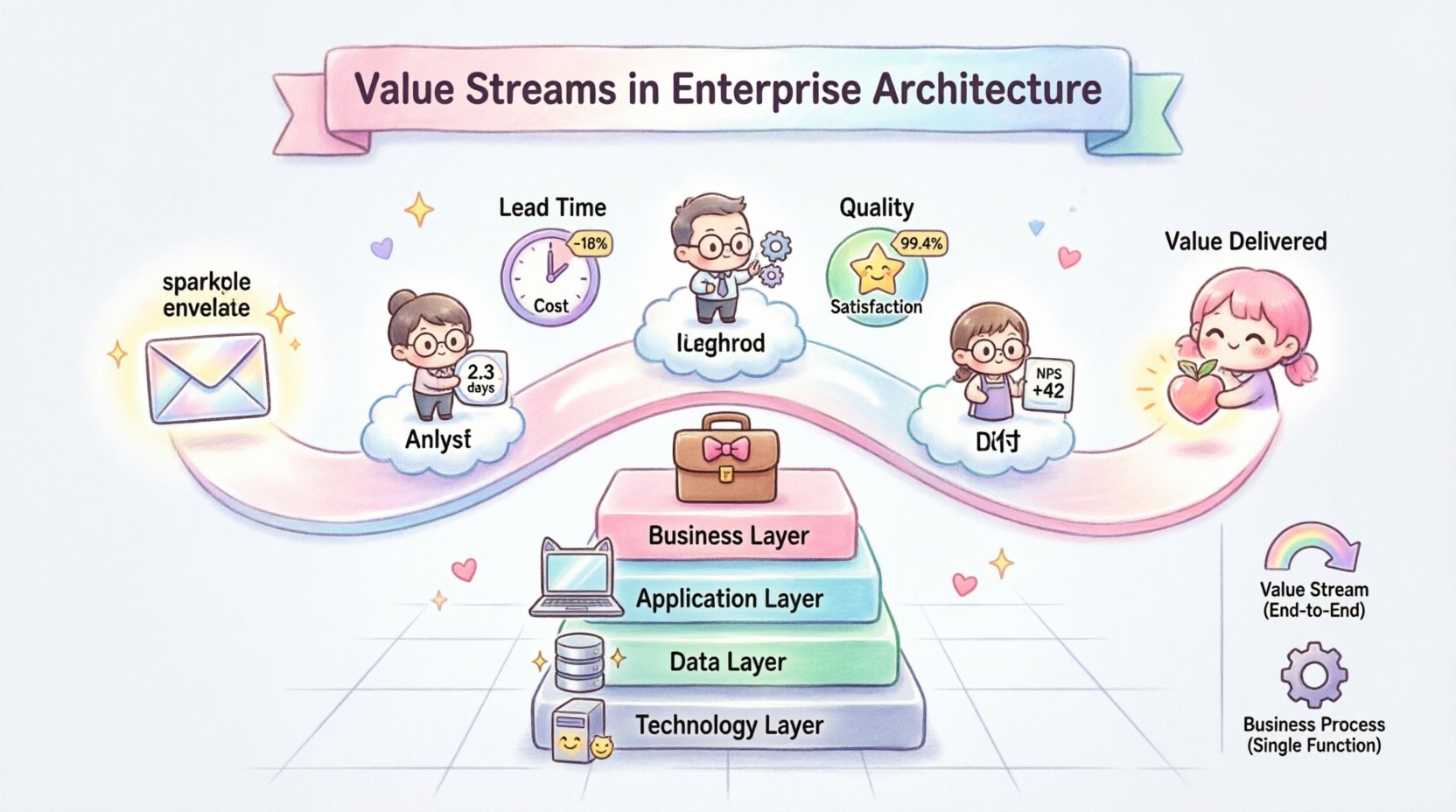
A value stream is a series of steps an organization takes to deliver value to a customer. It is end-to-end, spanning from the initial trigger to the final outcome. Unlike a process, which might focus on a specific task or departmental function, a value stream connects disparate activities across the entire organization.
In enterprise architecture, identifying and modeling value streams allows leaders to see the business through the lens of delivery rather than hierarchy. This perspective shifts the focus from “who does what” to “what creates value”.
- Trigger: The event that initiates the stream (e.g., a customer order, a regulatory requirement).
- Steps: The activities performed to transform the trigger into a result.
- Outcome: The tangible or intangible value delivered to the stakeholder.
- Metrics: Indicators used to measure performance (e.g., lead time, cost per unit).
When architects map these streams, they reveal dependencies that often remain hidden in traditional organizational charts. A siloed view of IT and Business often obscures these connections. A value stream approach exposes where friction occurs.
Value Streams vs. Business Processes 🔄
Confusion often arises between value streams and processes. While related, they serve different purposes within the architectural framework. Processes are often granular and operational. Value streams are strategic and holistic.
| Feature | Value Stream | Business Process |
|---|---|---|
| Scope | End-to-end, cross-functional | Specific task or departmental function |
| Focus | Customer value delivery | Operational efficiency |
| Time Horizon | Long-term strategic flow | Short-term execution |
| Ownership | Process Owner / Value Stream Owner | Department Manager |
Recognizing this distinction is critical. An architecture team might optimize a process for speed, but if that process does not align with the value stream, it creates local efficiency at the expense of global effectiveness.
Strategic Alignment Through Value Streams 🎯
The primary function of enterprise architecture is to align business strategy with technology execution. Value streams act as the connective tissue between these two domains. By mapping architecture components to specific value streams, organizations ensure that every investment contributes directly to value creation.
1. Business Capability Mapping
Business capabilities represent the “what” an organization can do. Value streams represent the “how” value is delivered. Mapping capabilities to value streams reveals gaps. For example, if a value stream requires “Real-time Inventory Tracking” but the capability map shows no active capability for this, a gap exists. This drives targeted investment rather than blanket technology spending.
2. Application Portfolio Rationalization
Applications should be evaluated based on their support for value streams. If an application supports multiple streams, its value is higher. If it supports a stream that is being phased out, it becomes a candidate for retirement. This data-driven approach reduces technical debt.
3. Data Governance
Data flows along value streams. By understanding the path of information from trigger to outcome, architects can identify where data quality matters most. Critical decision points within a value stream require high-fidelity data, whereas administrative steps may tolerate lower standards.
Methodology for Mapping Value Streams 📝
Creating accurate value stream maps requires a structured approach. It is not enough to draw a diagram; the map must reflect reality and be maintained over time.
- Identify the Stream: Select a specific stream to focus on (e.g., Order-to-Cash, Hire-to-Retire). Avoid trying to map the entire enterprise at once.
- Define Boundaries: Clearly state where the stream begins and ends. A common error is including upstream or downstream activities that do not directly impact the specific value delivered.
- Engage Stakeholders: Interview the people who actually perform the work. Process owners often describe the “ideal” state, while practitioners describe the “as-is” reality.
- Visualize the Flow: Use flow diagrams to depict the sequence of steps. Include handoffs between departments.
- Analyze the Waste: Look for delays, rework, and unnecessary approvals. These are indicators of architectural friction.
Connecting Architecture Layers to Value Streams 🏗️
Enterprise architecture is often described in layers: Business, Application, Data, and Technology. Value streams provide the context to link these layers together.
The Business Layer
This is the home of the value stream itself. It defines the steps, the actors, and the capabilities required. This layer answers the question: What is the business trying to achieve?
The Application Layer
Applications are the tools that execute the steps defined in the business layer. When mapping, architects should associate specific applications with specific steps in the value stream. This creates a traceability matrix. If a step fails, the responsible application is immediately identifiable.
The Data Layer
Data entities are consumed and created at various points in the value stream. For instance, a “Customer Order” entity is created at the start of the Order-to-Cash stream. Data architecture must ensure these entities are accessible and consistent across the applications that touch them.
The Technology Layer
Infrastructure supports the applications. While value streams rarely map directly to servers or networks, the performance of the technology layer directly impacts the speed of the value stream. Latency in the technology layer becomes lead time in the value stream.
Measuring Success and Performance 📈
Once value streams are mapped and aligned, they must be measured. Without metrics, optimization is impossible. Metrics should be chosen based on the value proposition of the stream.
- Lead Time: How long does it take from trigger to outcome? Reducing this often indicates improved agility.
- Cost to Serve: What is the financial cost associated with executing the stream? This includes technology costs and labor.
- Quality Rate: How often is the outcome delivered correctly the first time? Rework consumes capacity.
- Customer Satisfaction: The ultimate indicator of value. Does the outcome meet the customer’s expectation?
Tracking these metrics over time allows architects to validate their design decisions. If a new application is introduced to a stream, the lead time should decrease or the quality rate should improve. If metrics do not change, the architectural change may be superficial.
Common Challenges in Value Stream Implementation 🚫
Despite the clear benefits, implementing value stream thinking in enterprise architecture faces significant hurdles. Awareness of these pitfalls helps architects navigate them.
1. Static Mapping
Value streams are dynamic. Business environments change, competitors shift, and customer needs evolve. A map created today may be obsolete in six months. Architecture teams must treat value stream models as living documents that require regular review and updates.
2. Over-Engineering
There is a temptation to create highly detailed models with excessive granularity. While detail is good, too much detail creates maintenance overhead and discourages stakeholder engagement. Start high-level and drill down only where necessary for decision-making.
3. Siloed Ownership
Value streams often cross departmental boundaries. If the “Order-to-Cash” stream is owned by Sales, but the “Fulfillment” part is owned by Operations, neither party may feel responsible for the whole. A dedicated Value Stream Owner is often needed to bridge this gap.
4. Technology First Bias
IT teams sometimes start with technology choices before understanding the business flow. This leads to systems that force the business to adapt to the software, rather than software adapting to the business. Always start with the value stream, not the technology stack.
Future Proofing the Architecture 🚀
As organizations look toward the future, value streams become even more critical. Digital transformation, automation, and AI all operate within the context of value streams. To prepare for these changes, the architecture must be modular.
Modularity allows specific steps within a value stream to be upgraded without disrupting the entire flow. For example, replacing a manual approval step with an automated AI decision engine should not require rewriting the entire Order-to-Cash process.
- Decouple Capabilities: Ensure business capabilities are defined independently of the specific value streams they support.
- Standardize Interfaces: When applications interact across value streams, use standardized data interfaces to reduce friction.
- Focus on Outcomes: Continuously validate that the architecture supports the desired business outcomes, not just the technical requirements.
Integrating Value Streams into Governance 🛡️
Governance ensures that architectural decisions adhere to standards and strategies. Value streams should be a central part of the governance model.
- Architecture Review Boards: When proposing new initiatives, require an impact analysis on the relevant value streams. How does this change the flow? Does it introduce new risks?
- Investment Prioritization: Use value stream health to prioritize projects. Streams that are critical to revenue but performing poorly should receive priority funding.
- Risk Management: Map risks to specific steps in the value stream. Identify where a failure would cause the most damage to the customer experience.
Building the Business Case 📉
Enterprise architecture teams often struggle to demonstrate their ROI. Value streams provide a tangible way to communicate value. By linking architectural improvements to stream performance, the business case becomes clear.
For example, an architecture project to modernize a legacy data system might be framed as: “This change will reduce the Order-to-Cash lead time by 20%, increasing cash flow and customer satisfaction.” This language resonates with executive stakeholders far more than technical jargon.
Conclusion on Value Stream Architecture 🏁
Enterprise architecture is not about drawing diagrams for the sake of it. It is about creating a blueprint for organizational success. Value streams provide the most reliable blueprint available because they focus on the delivery of value.
By adopting a value stream-centric approach, organizations can break down silos, align technology with strategy, and measure their true performance. It requires discipline and continuous maintenance, but the payoff is an architecture that supports, rather than hinders, business growth.
Start by selecting one critical value stream. Map it. Measure it. Optimize it. Repeat. This iterative process builds the foundation for a resilient enterprise capable of adapting to whatever comes next.