
In the complex landscape of Enterprise Architecture, clarity is the most valuable asset. Organizations often struggle to distinguish between the strategic vision of the business and the tactical execution of specific projects. Two pivotal roles frequently appear in this discussion: Domain Architecture and Solution Architecture. While both serve to align technology with business goals, their scope, responsibilities, and timelines differ significantly.
Understanding the nuance between these two disciplines is critical for building scalable systems, avoiding technical debt, and ensuring that IT investments deliver actual business value. This guide provides a deep dive into the definitions, responsibilities, artifacts, and interactions of Domain and Solution Architecture.
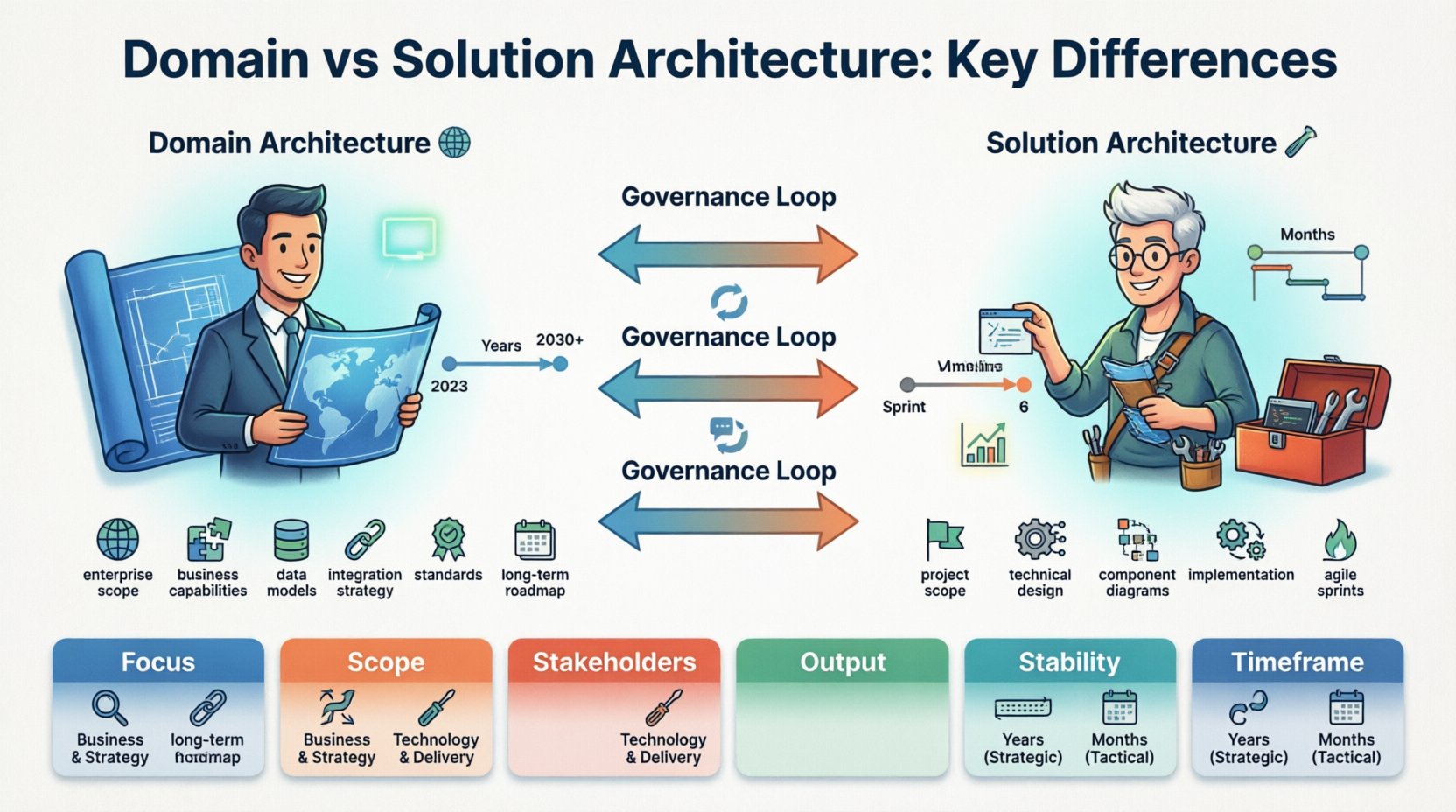
Understanding Domain Architecture 🌐
Domain Architecture operates at a high level of abstraction. It focuses on the structure of the business domain itself, independent of specific technology choices. It defines the boundaries, capabilities, and relationships within the enterprise.
The primary objective is to create a blueprint that ensures consistency across the organization. It acts as a governance layer, ensuring that different parts of the business do not duplicate efforts or create incompatible systems.
Core Responsibilities
- Business Capability Modeling: Defining what the business does, not just how it does it.
- Data Domains: Establishing the master data entities and their lifecycle.
- Integration Strategy: Defining how systems communicate (e.g., APIs, messaging).
- Standards and Principles: Setting the rules for technology selection and design.
- Long-term Roadmap: Planning the evolution of the IT landscape over years.
Key Artifacts
- Business Capability Maps
- Enterprise Data Models
- Application Portfolios
- Integration Blueprints
- Technology Standards Documentation
Time Horizon
Domain Architecture looks at the long term. It is concerned with stability and reusability. Changes here are infrequent but have massive impact. If a Domain Architect changes a core data model, every solution relying on that model must adapt.
Understanding Solution Architecture 🔧
Solution Architecture operates at the project level. It focuses on designing a specific solution to solve a defined business problem. It translates the high-level requirements into a detailed technical design.
The Solution Architect bridges the gap between the business requirements and the technical implementation. They ensure that the specific solution fits within the broader Enterprise Architecture constraints.
Core Responsibilities
- Requirement Analysis: Breaking down user stories and functional needs.
- Technical Design: Selecting specific components, frameworks, and platforms.
- Implementation Planning: Defining the build, test, and deploy strategy.
- Stakeholder Management: Working directly with development teams and project managers.
- Cost and Risk Assessment: Estimating effort and identifying technical risks.
Key Artifacts
- System Design Documents (SDD)
- Component Diagrams
- Interface Control Documents
- Deployment Diagrams
- Proof of Concept (PoC) Specifications
Time Horizon
Solution Architecture is short to mid-term. It is tied to the lifecycle of a specific project or product. Once the solution is delivered and operational, the architecture documentation evolves into maintenance mode.
Key Differences at a Glance 📊
To clarify the distinctions, we can compare the two architectures across several dimensions.
| Dimension | Domain Architecture | Solution Architecture |
|---|---|---|
| Focus | Business Capabilities & Standards | Specific Problem & Implementation |
| Scope | Enterprise-wide | Project or Product-specific |
| Stakeholders | CIO, Business Leaders, Enterprise Architects | Project Managers, Developers, Business Owners |
| Output | Standards, Patterns, Roadmaps | Design Specs, Code Decisions |
| Stability | High (Changes slowly) | Variable (Changes with requirements) |
| Timeframe | Years | Months to Quarters |
How They Interact 🤝
These two disciplines are not silos; they are interdependent. A Solution Architecture cannot function effectively without the guardrails provided by Domain Architecture. Conversely, Domain Architecture remains theoretical without the feedback loop from Solution Architecture.
The Governance Loop
Domain Architecture defines the “Rules of the Road.” Solution Architecture drives the “Car.” If the Solution Architect ignores the rules, the vehicle may break down or crash into other lanes. If the Domain Architect sets rules that are impossible to drive on, the project fails before it starts.
- Upward Feedback: Solution Architects report implementation challenges back to Domain Architects. This helps refine standards.
- Downward Guidance: Domain Architects publish patterns and anti-patterns that Solution Architects must adhere to.
- Consistency Checks: Before a solution is approved, it is often reviewed against Domain standards to ensure compliance.
Collaboration Scenarios
Consider a scenario where a business unit wants to launch a new customer portal.
- Domain Architect: Defines how customer data is structured globally. Ensures the portal complies with data privacy standards. Identifies that a new customer service capability is needed in the portfolio.
- Solution Architect: Designs the portal interface. Selects the web framework. Decides how to connect to the customer database defined by the Domain Architect. Manages the specific security implementation for this project.
When to Use Each 📅
Determining the right architectural focus depends on the nature of the initiative. Using the wrong focus can lead to either rigid bureaucracy or technical chaos.
When to Prioritize Domain Architecture
- Mergers and Acquisitions: When integrating two companies, you need to align their data and application landscapes.
- Regulatory Compliance: When new laws affect data handling across the entire organization.
- Technology Refresh: When migrating the entire infrastructure stack (e.g., moving to cloud-native patterns).
- Standardization: When you have too many different tools solving the same problem.
- Strategic Planning: When defining the IT roadmap for the next 3-5 years.
When to Prioritize Solution Architecture
- New Product Launch: Building a specific application from scratch.
- Feature Development: Adding significant functionality to an existing system.
- Integration Projects: Connecting two specific systems (e.g., CRM to ERP).
- Performance Optimization: Tuning a specific application for speed or scale.
- Agile Sprints: Where quick decisions are needed to keep development moving.
Skills and Competencies 🎓
While there is overlap in skills, the depth and breadth required differ for each role.
Domain Architect Skills
- Business Acumen: Deep understanding of business processes and value streams.
- Strategic Thinking: Ability to see the big picture and predict future trends.
- Communication: Translating technical concepts for executive leadership.
- Modeling: Proficiency in enterprise modeling languages (e.g., ArchiMate).
- Governance: Experience with change management and policy enforcement.
Solution Architect Skills
- Technical Depth: Strong coding knowledge and understanding of specific stacks.
- System Design: Knowledge of patterns, microservices, and distributed systems.
- Project Management: Understanding of Agile, Waterfall, and resource allocation.
- Problem Solving: Ability to troubleshoot complex technical issues quickly.
- Vendor Evaluation: Assessing third-party tools and services.
Common Pitfalls and Misconceptions ⚠️
Organizations often stumble when implementing these roles. Here are common issues to avoid.
1. Role Confusion
Expecting a Solution Architect to define enterprise standards often leads to micromanagement. Expecting a Domain Architect to design a specific UI leads to delays. Clear boundaries must be established.
2. The “Ivory Tower” Problem
Domain Architecture can become disconnected from reality if it does not consult with Solution Architects. This results in standards that are too rigid or impossible to implement.
3. Ignoring the Solution Context
Applying enterprise-wide standards to a small, internal tool can waste resources. Solution Architects need the authority to deviate from standards when justified.
4. Lack of Feedback
If Domain Architecture does not hear about implementation failures, the standards will not improve. A feedback loop is essential for evolution.
The Evolution of Architecture 🚀
The field of architecture is changing. As organizations move towards cloud-native environments and microservices, the lines between these roles can blur.
Cloud Influence
Cloud providers offer pre-built services that reduce the need for custom infrastructure design. This shifts Solution Architecture focus towards data integration and API management, which are often Domain concerns.
Platform Engineering
There is a growing trend towards creating internal platforms. This combines the strategic vision of Domain Architecture with the implementation focus of Solution Architecture to provide self-service capabilities for developers.
Data-Centric Design
With the rise of AI and analytics, data architecture has become central. Both Domain and Solution Architects must prioritize data quality, lineage, and governance more than ever before.
Decision Framework for Leaders 👥
How should leaders decide where to invest their architectural resources?
- Assess Complexity: High complexity requires strong Domain Architecture to prevent fragmentation.
- Assess Velocity: High velocity requires strong Solution Architecture to enable rapid iteration.
- Assess Risk: High risk (e.g., financial data) requires stricter Domain Governance.
- Assess Maturity: Immature organizations need more Domain guidance. Mature organizations need more Solution flexibility.
Best Practices for Alignment 🤝
To ensure success, follow these practices.
- Regular Syncs: Hold bi-weekly meetings between Domain and Solution teams.
- Shared Repositories: Maintain a single source of truth for architecture diagrams and standards.
- Joint Reviews: Involve Domain Architects in Solution Design Reviews.
- Clear Definitions: Document what constitutes a “Standard” versus a “Pattern” versus a “Guideline”.
- Continuous Learning: Encourage architects to rotate roles to understand the challenges of the other side.
Final Thoughts on Architectural Balance ⚖️
Successful Enterprise Architecture is not about choosing one over the other. It is about balancing the stability of the Domain with the agility of the Solution. Domain Architecture provides the foundation, ensuring the house stands firm. Solution Architecture provides the rooms, ensuring the house is livable.
By understanding the distinct roles, responsibilities, and interactions of these two disciplines, organizations can build technology landscapes that are both robust and responsive. The goal is not rigid control, but empowered alignment. When these two forces work in harmony, the organization achieves sustainable growth and technological resilience.
Remember that architecture is a discipline of trade-offs. There is no perfect design, only the best design for the current context. Continuous evaluation and adaptation remain the core of effective architectural practice.