
Enterprise architecture relies on clear visibility into how systems interact. At the heart of this visibility lies the documentation of Application Components and the APIs they expose. When modeling within the ArchiMate framework, precision in defining these interfaces ensures that stakeholders understand service delivery and dependency structures. This guide provides a structured approach to documenting API interfaces, focusing on clarity, traceability, and alignment with business goals.
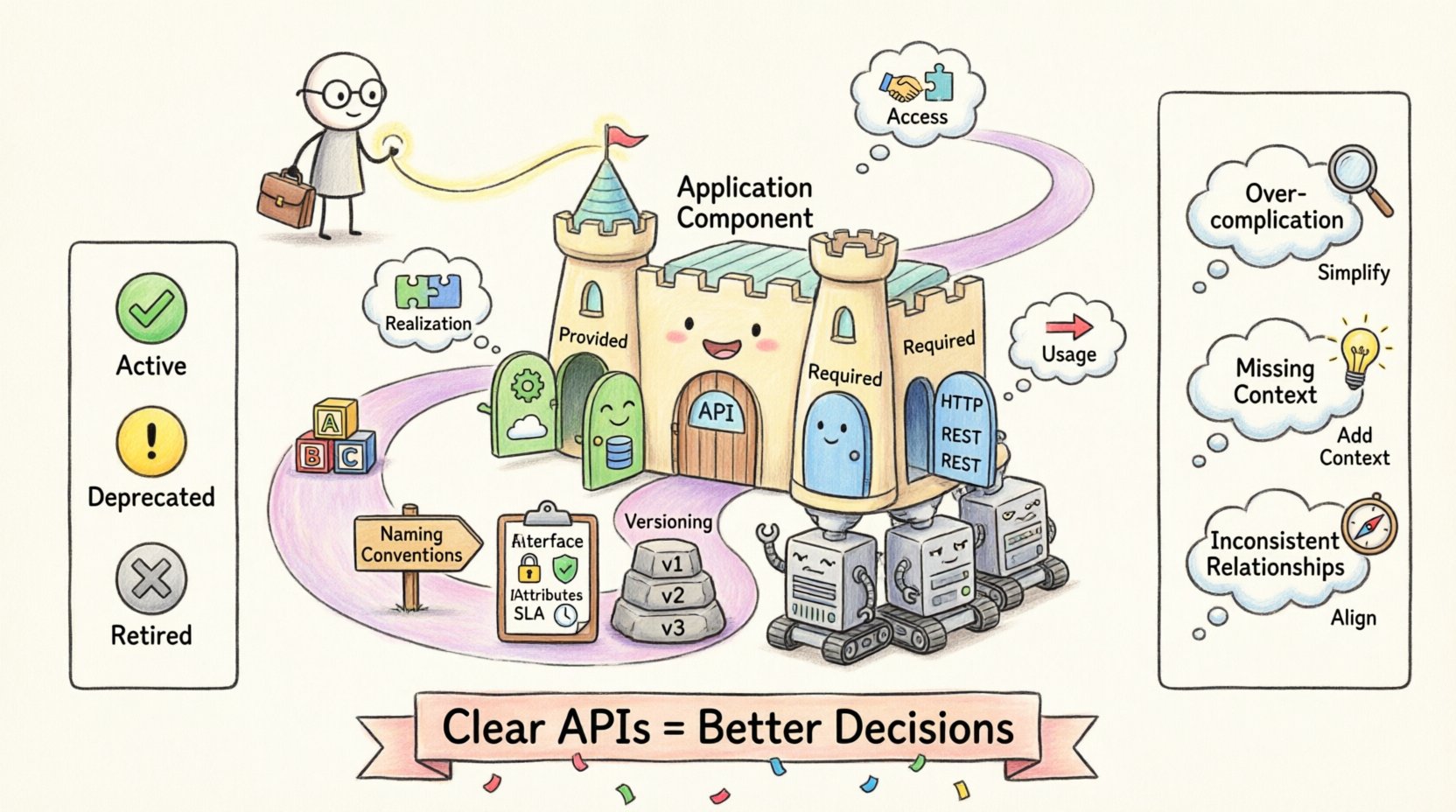
🏗️ 1. Foundations of Application Component Modeling
Before diving into specific interface attributes, it is essential to establish the fundamental building blocks. The Application Layer acts as the bridge between the business requirements and the underlying technology infrastructure. Accurate modeling here prevents ambiguity during implementation and integration phases.
1.1 Defining the Application Component
An Application Component represents a modular part of the application landscape. It encapsulates functionality and exposes specific capabilities to other components. When documenting these components, focus on their distinct responsibilities rather than implementation details.
- Logical Boundaries: Define clear limits of responsibility for each component.
- Functional Grouping: Group related functions to reduce coupling.
- Identification: Assign unique identifiers to ensure traceability across the model.
1.2 The Role of Interfaces
Interfaces serve as the contract between components. They define what a component offers and what it needs to function. In the context of APIs, these interfaces represent the programmable entry points for data exchange and service invocation.
- Abstraction: Interfaces hide internal logic, exposing only necessary operations.
- Interaction: They facilitate communication between independent components.
- Standardization: Using standardized interface definitions promotes interoperability.
🔗 2. Interface Semantics and Relationships
ArchiMate defines specific semantics for how interfaces interact with components. Understanding these relationships is critical for creating a valid and meaningful model. The distinction between Provided and Required interfaces is fundamental.
2.1 Provided and Required Interfaces
A component can provide services to others or require services from others. Documenting both sides of this equation creates a complete picture of the ecosystem.
- Provided Interface: This represents the services a component offers. It is the API endpoint that external callers utilize.
- Required Interface: This represents the services a component needs to operate. It is the dependency on an external API.
2.2 Relationship Types: Access, Realization, Usage
Different relationship types denote different levels of dependency and implementation linkage. Selecting the correct relationship affects how the architecture is interpreted.
| Relationship Type | Description | Use Case |
|---|---|---|
| Access | Indicates that a component uses an interface provided by another. | Application A calls the API of Application B. |
| Realization | Indicates that a component implements an interface. | Code implements the defined API contract. |
| Usage | Indicates that a component makes use of a service. | General dependency without strict implementation binding. |
Using the correct relationship ensures that the model accurately reflects the runtime behavior and design intent.
📝 3. Structuring API Documentation Standards
Consistency in documentation is key to maintaining a usable architecture repository. When documenting API interfaces, treat them as first-class citizens with their own set of attributes and metadata.
3.1 Naming Conventions
Names should be descriptive and consistent. Avoid abbreviations that might be ambiguous to different teams. A standardized naming convention aids in automated tooling and reporting.
- Prefixes: Use prefixes like API- or SVC- to distinguish interfaces from components.
- Verb-Noun Structure: Use Get-Resource or Update-Record to describe functionality.
- Versioning: Include version numbers in the name if the interface evolves frequently (e.g., API-V2).
3.2 Interface Attributes
Beyond the name, specific attributes provide necessary context for developers and architects. This information reduces the need for external documentation lookups.
| Attribute | Purpose | Example |
|---|---|---|
| Protocol | Defines the communication standard. | HTTP, REST, SOAP, gRPC |
| Security Level | Indicates authentication requirements. | OAuth2, API Key, Mutual TLS |
| Latency SLA | Defines performance expectations. | < 200ms |
| Rate Limit | Defines usage constraints. | 1000 req/min |
3.3 Versioning and Lifecycle
APIs evolve. Documentation must reflect the lifecycle stage of the interface to prevent the use of deprecated endpoints.
- Active: The interface is fully supported and recommended for use.
- Deprecated: The interface is functional but discouraged; migration paths exist.
- Retired: The interface is no longer supported and should not be used.
🌐 4. Layering and Connectivity
Architectural models are not isolated. Application components must be connected to the Business Layer and the Technology Layer. This connectivity demonstrates value and implementation feasibility.
4.1 Business Service Alignment
Every API should ultimately support a business capability. Mapping APIs to Business Services ensures that technical changes align with business outcomes.
- Traceability: Link the API to the Business Process it supports.
- Value Delivery: Document how the API enables a specific business outcome.
- Stakeholder Mapping: Identify which business units consume the API.
4.2 Technology Layer Integration
The Application Layer sits on top of the Technology Layer. The API implementation relies on specific technology stacks. Documenting this relationship clarifies infrastructure dependencies.
- Implementation Nodes: Link the Application Component to the specific Server or Cloud Node.
- Communication Pathways: Specify the network protocols and security zones involved.
- Data Storage: Indicate if the API interacts with specific databases or data stores.
🔄 5. Managing API Lifecycle in the Model
A static model is a poor reflection of a dynamic environment. Change management processes must be integrated into the architecture repository to keep documentation current.
5.1 Change Request Integration
When a business requirement changes, the API model must be updated. This ensures that the architecture remains an accurate source of truth.
- Impact Analysis: Use the model to identify dependent components before making changes.
- Approval Workflows: Define who must approve changes to critical interfaces.
- Version Control: Maintain a history of interface definitions within the model.
5.2 Impact Assessment
Understanding the ripple effect of API changes is vital. The model allows for visualization of downstream impacts.
- Upstream: Which business processes rely on this API?
- Downstream: Which applications will break if this API changes?
- Cross-Layer: How does this affect the technology infrastructure?
🚧 6. Common Modeling Challenges
Even with best practices, architects face specific hurdles when documenting interfaces. Recognizing these pitfalls helps in avoiding them.
6.1 Over-Complication
Modeling every single method of an API can lead to an overly complex diagram. Focus on the contract rather than the implementation details.
- Grouping: Aggregate related endpoints under a single interface definition.
- Abstraction: Use higher-level interface names where specific endpoints are less critical.
6.2 Missing Context
Interfaces defined without context are difficult to understand. Ensure that the purpose and constraints are documented.
- Comments: Add descriptive notes to interface nodes.
- Diagrams: Use sequence diagrams or flow diagrams to supplement static models.
6.3 Inconsistent Relationships
Using the wrong relationship type (e.g., Usage instead of Access) can confuse the model’s logic. Stick to the semantic definitions strictly.
- Review: Regularly audit relationships for correctness.
- Guidelines: Maintain a style guide for relationship usage.
📊 7. Reporting and Stakeholder Communication
The value of the model is realized through communication. Reports generated from the architecture repository should highlight API health, dependencies, and gaps.
7.1 Dependency Analysis
Stakeholders need to know which components rely on which APIs. Dependency reports help in risk management and planning.
- Critical Path Identification: Highlight APIs that, if failed, stop critical processes.
- Single Points of Failure: Identify components with no redundancy.
7.2 Gap Analysis
Compare the current state with the target state to identify missing interfaces or undocumented dependencies.
- Service Gaps: Identify business services without corresponding APIs.
- Redundancy: Identify multiple APIs performing the same function.
🔍 8. Final Considerations
Maintaining high-quality documentation for API interfaces within ArchiMate requires discipline and adherence to standards. By focusing on clear semantics, consistent naming, and strong layer connections, architects can create a model that serves as a reliable blueprint for the organization.
The process is iterative. As the landscape changes, the model must evolve. Regular reviews ensure that the documentation remains relevant. Prioritize clarity over completeness in the initial phases, then expand as the model matures. This approach ensures that the architecture repository remains a practical tool rather than an administrative burden.
Ultimately, the goal is to facilitate better decision-making. When interfaces are well-documented, integration becomes smoother, and risks are reduced. This foundation supports agility and innovation in the long term.
By following these guidelines, teams can ensure that their application landscape is documented with precision, enabling effective management of complex API ecosystems.