
Enterprise architecture serves as the blueprint for organizational change. It bridges the gap between business strategy and IT execution. A core concept in the ArchiMate methodology is the architectural plateau. Plateaus represent distinct states of the enterprise architecture at specific points in time. Understanding how to define baseline and target architectures using these plateaus is essential for effective transition planning. This guide explores the mechanics of plateaus, the modeling of current and future states, and the practical steps for managing architectural evolution.
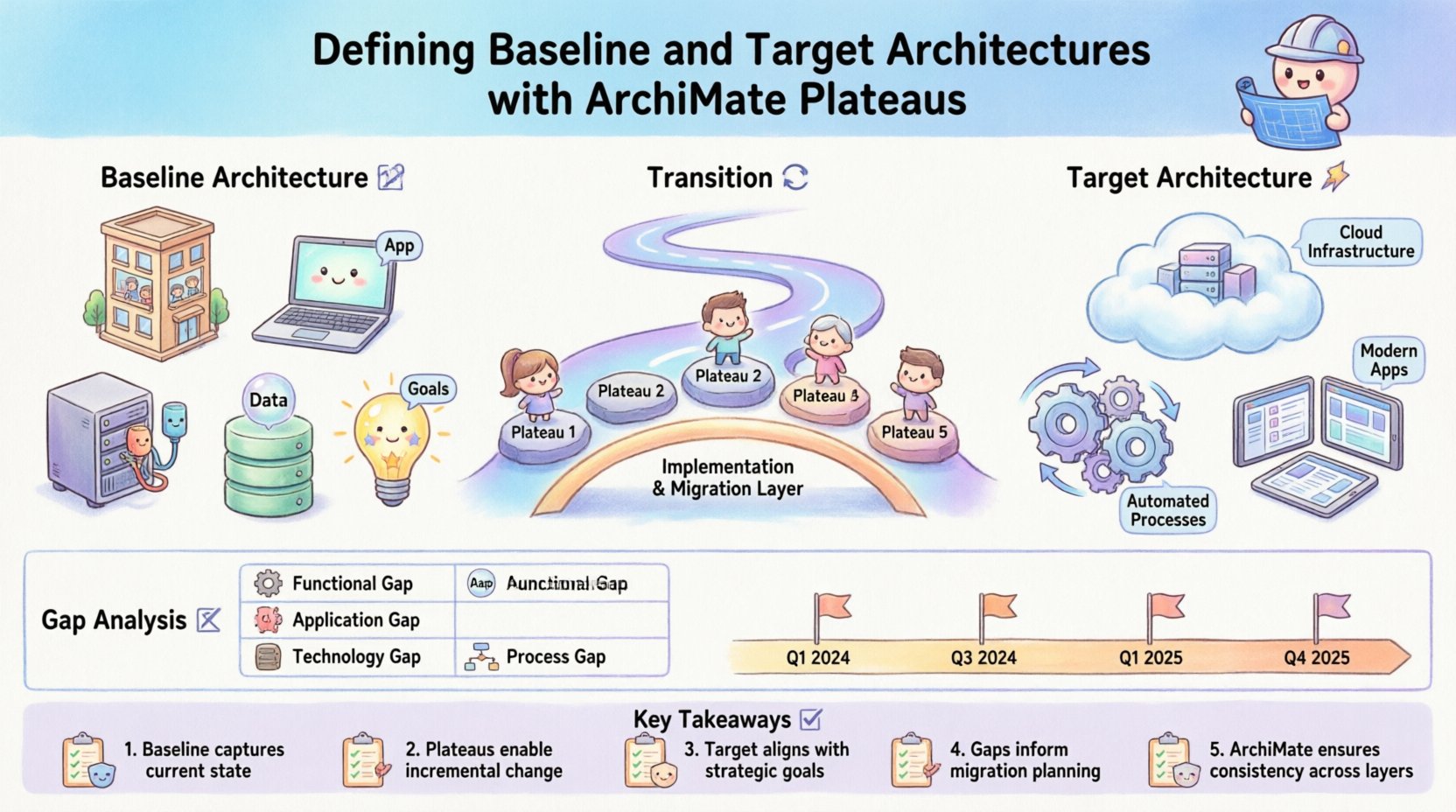
Understanding Architectural Plateaus 🏛️
An architectural plateau is a snapshot of the enterprise architecture at a stable moment. It is not merely a static image but a comprehensive description of the business, data, application, and technology layers. Plateaus allow architects to compare the current state against a desired future state. This comparison forms the foundation for gap analysis and roadmap development.
Why Plateaus Matter
Without defined plateaus, change initiatives lack context. Stakeholders need to know where they are starting and where they intend to arrive. Plateaus provide this clarity. They help in:
- Contextualizing Change: Showing how specific projects fit into the broader architectural landscape.
- Managing Complexity: Breaking down massive transformations into manageable, stable states.
- Communication: Providing a visual and structured language for business and IT leaders to discuss strategy.
- Decision Support: Enabling informed decisions about resource allocation and investment.
Defining the Baseline Architecture 📊
The baseline architecture represents the current reality of the enterprise. It is the “as-is” state. Modeling this accurately is critical because any future state is built upon it. If the baseline is incorrect, the target architecture will be flawed, leading to implementation failures.
Key Components of Baseline Modeling
When constructing a baseline plateau, architects must capture the following elements across the ArchiMate layers:
- Business Layer: Identify active business processes, business functions, roles, and organizational structures. Document how value is currently delivered to customers.
- Application Layer: Map the software applications supporting the business. Note interfaces, services, and data objects managed by these applications.
- Technology Layer: Describe the infrastructure, hardware, networks, and middleware that host the applications.
- Data Layer: Define the logical data entities and physical data stores. Understand how information flows between business and technical components.
- Motivation Layer: Capture current drivers, principles, and goals that explain why the current architecture exists.
Best Practices for Baseline Accuracy
To ensure the baseline plateau is reliable, consider the following:
- Verification: Cross-reference models with system owners and process owners. Do not rely solely on documentation.
- Simplicity: Avoid over-detailing. Focus on the elements that influence the transition. Exclude minor legacy components that have no strategic impact.
- Consistency: Ensure relationships between layers are modeled correctly. For example, an application must be supported by a technology component.
- Versioning: Clearly label the plateau with a date or version number to track its age.
Defining the Target Architecture 🚀
The target architecture represents the desired “to-be” state. It is derived from business strategy and requirements. Unlike the baseline, which describes reality, the target describes aspiration. It must be achievable, aligned with business goals, and technically feasible.
Strategic Alignment
Before modeling the target plateau, architects must validate the strategic drivers. The target state should answer the following questions:
- What business capabilities need to be improved?
- How will digital transformation affect operational efficiency?
- What regulatory or compliance requirements must be met?
- How will cost structures change?
Modeling the Target State
Creating the target plateau involves designing new relationships and components. Key activities include:
- Capability Mapping: Define new business capabilities required to support the strategy.
- Application Rationalization: Identify which applications will be retired, replaced, or enhanced.
- Infrastructure Planning: Design the target technology landscape, including cloud adoption or on-premise retention.
- Process Redesign: Model optimized business processes that leverage new technology and capabilities.
- Principle Definition: Establish new architectural principles that guide the implementation of the target state.
Transitioning Between Plateaus 🔄
The movement from a baseline plateau to a target plateau is not instantaneous. It occurs through a series of transitions. Each transition represents a significant step toward the final goal. These transitions are often broken down into intermediate plateaus.
The Transition Concept
A transition is an action or set of actions that moves the enterprise from one stable state to another. In ArchiMate, transitions are modeled using the Implementation & Migration layer. This layer connects the motivation layer to the implementation layer.
Steps in Transition Planning
- Identify Gap: Analyze the differences between the baseline and target plateaus.
- Define Projects: Group the required changes into manageable projects or work packages.
- Sequence: Order the projects based on dependencies and business value.
- Resource Allocation: Determine the budget, skills, and time required for each transition.
- Validation: Review the transition plan with stakeholders to ensure feasibility.
Gap Analysis and Roadmapping 🗺️
Gap analysis is the systematic process of identifying the differences between the baseline and target architectures. It is the bridge between the two plateaus. The output of this analysis drives the architecture roadmap.
Types of Gaps
Gaps can exist in various areas. Understanding the type of gap helps in selecting the right solution.
| Gap Type | Description | Example |
|---|---|---|
| Functional Gap | The target requires a business function that does not exist in the baseline. | New customer self-service portal. |
| Application Gap | The current applications cannot support the required business functions. | Legacy CRM lacks API capabilities. |
| Technology Gap | The infrastructure cannot support the new applications or data volume. | Server hardware is at end-of-life. |
| Process Gap | Current processes are inefficient or do not align with the target model. | Manual approval workflow needs automation. |
Building the Roadmap
Once gaps are identified, they are translated into a timeline. The roadmap visualizes the journey. It should be high-level enough to be understood by executives but detailed enough to guide project managers.
- Phasing: Divide the roadmap into phases (e.g., Phase 1: Foundation, Phase 2: Optimization).
- Milestones: Define key achievements that signify the completion of a transition.
- Risk Management: Identify potential risks that could derail the transition and plan mitigation strategies.
Governance and Maintenance 🛡️
Architectural plateaus are not one-time deliverables. They require ongoing maintenance to remain relevant. As the enterprise evolves, plateaus must be updated to reflect the current reality.
Keeping Plateaus Current
To maintain the integrity of the architecture:
- Regular Reviews: Schedule periodic reviews of the baseline plateau to ensure it matches the actual environment.
- Change Control: Implement a process for updating the architecture when significant changes occur.
- Repository Management: Store models in a central repository to ensure version control and accessibility.
- Training: Ensure that architects and stakeholders understand how to use the models effectively.
Architectural Compliance
Governance also involves ensuring that new projects comply with the target architecture. This prevents “architectural drift,” where the implementation deviates from the design. Compliance checks should be integrated into the project lifecycle.
Common Challenges and Solutions ⚠️
Working with architectural plateaus presents specific challenges. Recognizing these early can prevent project delays.
- Challenge: Outdated Data. Baseline models often become outdated quickly.
- Solution: Automate data collection where possible and enforce regular update cycles.
- Challenge: Lack of Stakeholder Engagement. Business leaders may not see the value in modeling.
- Challenge: Scope Creep. The target architecture may become too ambitious.
- Challenge: Interdependency Complexity. Changes in one layer affect others significantly.
Integrating with Other Frameworks 🤝
ArchiMate is often used alongside other frameworks such as TOGAF. The plateau concept aligns well with the Architecture Development Method (ADM). In TOGAF, the baseline and target architectures are defined during Phases B, C, and D. ArchiMate provides the notation to model these phases precisely.
Alignment with Business Strategy
The motivation layer in ArchiMate connects the architecture to business strategy. By linking value streams and drivers to plateaus, architects ensure that technical changes support business outcomes. This alignment is crucial for securing funding and support for transition initiatives.
Conclusion 📝
Defining baseline and target architectures with ArchiMate plateaus is a fundamental discipline in enterprise architecture. It provides structure to complex change initiatives and ensures that technology investments align with business goals. By modeling stable states, identifying gaps, and planning transitions, organizations can navigate the path to digital transformation with confidence. The key lies in accuracy, consistency, and continuous governance. When executed well, plateaus become powerful tools for strategic alignment and operational excellence.
Key Takeaways ✅
- Plateaus are snapshots: They capture stable states of the enterprise at specific times.
- Baseline is reality: Ensure the “as-is” model is accurate before planning change.
- Target is aspiration: Align the “to-be” model with business strategy and drivers.
- Gaps drive action: Identify differences to create a roadmap for implementation.
- Governance is key: Maintain plateaus to ensure they remain relevant over time.