Now Reading: Comprehensive Guide to TOGAF ADM and ArchiMate with AI-Powered Enterprise Architecture in Visual Paradigm
-
01
Comprehensive Guide to TOGAF ADM and ArchiMate with AI-Powered Enterprise Architecture in Visual Paradigm


Comprehensive Guide to TOGAF ADM and ArchiMate with AI-Powered Enterprise Architecture in Visual Paradigm
Introduction
In today’s complex and rapidly evolving digital landscape, enterprise architecture (EA) plays a pivotal role in aligning business strategy with IT capabilities. Two foundational frameworks that empower organizations to design, implement, and govern enterprise architectures are TOGAF ADM (Architecture Development Method) and ArchiMate. When combined with modern AI-powered tools like Visual Paradigm, these frameworks become even more powerful—transforming the traditional, manual, and time-intensive EA process into a dynamic, intelligent, and accelerated workflow.

This comprehensive guide explores:
-
The core principles of TOGAF ADM and ArchiMate
-
How Visual Paradigm’s AI-powered EA features revolutionize the traditional “Guide-Through Process”
-
The tangible benefits of AI integration in enterprise architecture
-
Best practices for leveraging these tools effectively
1. What is TOGAF ADM?
Definition and Purpose
The TOGAF Architecture Development Method (ADM) is the cornerstone of the TOGAF (The Open Group Architecture Framework), providing a structured, iterative, and phase-based approach to developing, governing, and managing enterprise architecture. It ensures that an organization’s IT strategy is tightly aligned with its business goals, enabling strategic transformation, improved agility, and sustainable innovation.
Developed and maintained by The Open Group, TOGAF ADM is widely adopted across industries, from finance and healthcare to government and manufacturing.

Phases of TOGAF ADM
The ADM consists of nine phases, starting with a preliminary phase and followed by eight core phases (A–H), each with specific objectives and deliverables:

| Phase | Name | Key Objectives |
|---|---|---|
| P | Preliminary Phase | Establish the architecture framework, define governance, and set up the architecture team and tools. |
| A | Architecture Vision | Define the scope, vision, and high-level goals of the architecture initiative. |
| B | Business Architecture | Model business strategy, processes, functions, and organizational structure. |
| C | Information Systems Architecture (Data & Application) | Design data models, application components, and their interactions. |
| D | Technology Architecture | Define infrastructure, platforms, networks, and technology standards. |
| E | Opportunities & Solutions | Identify implementation options, assess feasibility, and define migration plans. |
| F | Migration Planning | Develop detailed roadmaps, timelines, budgets, and resource plans for transitioning from current to target states. |
| G | Implementation Governance | Monitor and control the execution of the architecture, ensuring compliance and alignment. |
| H | Architecture Change Management | Establish processes for managing ongoing changes, feedback loops, and continuous improvement. |
✅ Key Insight: The ADM is not a linear process—it is iterative. Architects often revisit earlier phases as new insights emerge during implementation.
2. What is ArchiMate?
Overview and Purpose
ArchiMate is an open-standard modeling language developed by The Open Group, designed to provide a unified, visual language for describing, analyzing, and communicating the relationships among:
-
Business processes
-
Applications
-
Data and information
-
Technology infrastructure
It enables architects to create clear, consistent, and interoperable architecture models across different domains—making it easier to collaborate, communicate, and make informed decisions.
ArchiMate Layers and Structure
ArchiMate is organized into three primary layers, each representing a different level of abstraction:
| Layer | Description |
|---|---|
| Strategy Layer | Focuses on strategic goals, capabilities, and resources. Includes elements like Goals, Capabilities, Resources, and Stakeholders. |
| Business, Application, and Technology Layers | The core of the model: • Business Layer: Processes, services, actors, and organizational units. • Application Layer: Application components, interfaces, and services. • Technology Layer: Hardware, software, networks, and platforms. |
| Implementation and Migration Layer | Supports transformation planning: • Tracks migration projects • Maps dependencies between current and target states • Includes Migration Activities, Work Packages, and Roadmaps |
📌 Best Practice: Use ArchiMate’s layered structure to ensure consistency and traceability across all architecture artifacts.
Why ArchiMate Matters
-
Standardization: Ensures uniformity across teams and organizations.
-
Interoperability: Facilitates integration with other tools and frameworks.
-
Clarity and Communication: Visual diagrams help stakeholders understand complex systems without technical jargon.
🔗 Learn more: What is ArchiMate? – Visual Paradigm
3. Visual Paradigm’s AI-Powered Enterprise Architecture (EA) Features
From Manual to Intelligent: The Evolution of EA Tools
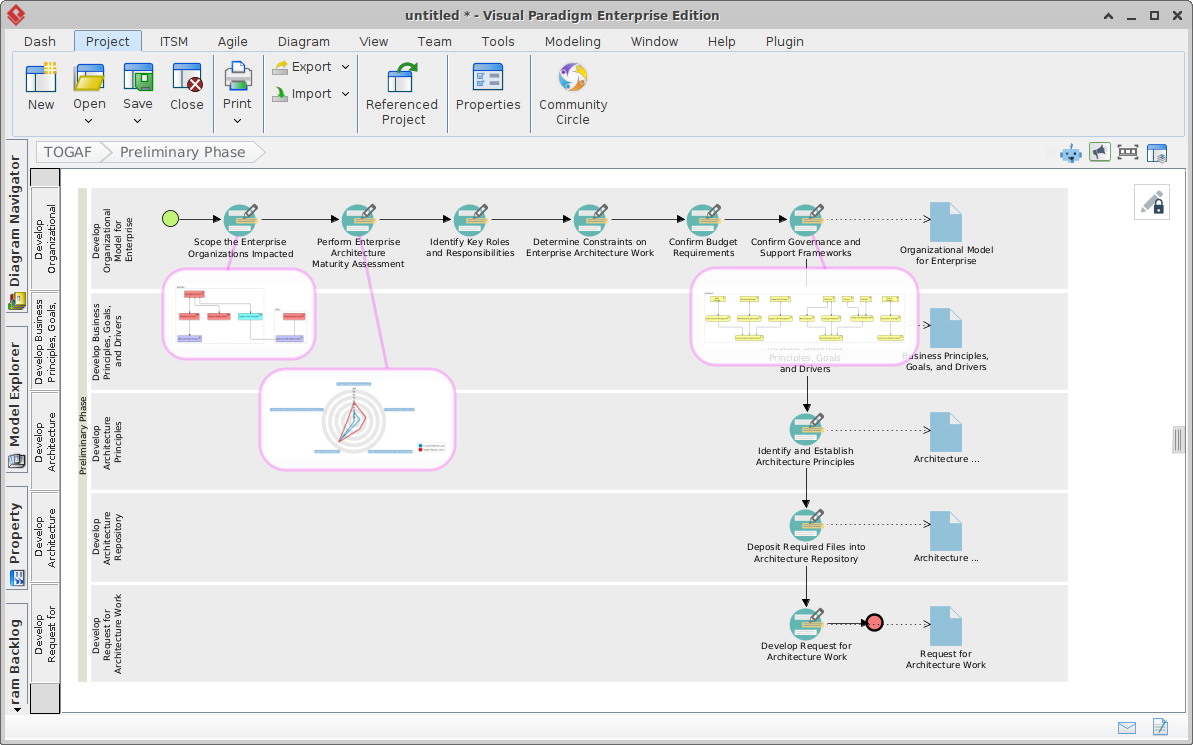
Traditional enterprise architecture tools often rely on a “Guide-Through Process”—a step-by-step navigator that walks users through each phase of TOGAF ADM, offering templates, checklists, and guidance. While effective, this approach can be slow and labor-intensive.
Enter Visual Paradigm’s AI-powered EA features, which transform the Guide-Through Process into an intelligent co-pilot that automates creation, analysis, and documentation—significantly accelerating the architecture lifecycle.
Key AI-Powered Capabilities in Visual Paradigm
✅ 1. Instant Diagram Generation from Natural Language
-
How it works: Users describe a business challenge in plain English (e.g., “Design a mobile app ordering system for a coffee shop with loyalty rewards and real-time inventory tracking”).
-
AI Output: Instantly generates a compliant ArchiMate diagram with:
-
Correctly mapped business processes
-
Application components (e.g., mobile app, backend service)
-
Data entities (e.g., customer profile, order history)
-
Technology infrastructure (e.g., cloud server, API gateway)
-
-
Benefit: Eliminates the need for manual drafting from scratch.
📌 Example: Describe “a customer service portal for handling insurance claims” → AI generates a full ArchiMate model with actors, processes, applications, and data.
🔗 See it in action: AI-Powered Togaf ADM Guide – Visual Paradigm
✅ 2. Reduced Manual Effort (Up to 70% Faster)
-
The AI automates repetitive tasks such as:
-
Creating initial architecture diagrams
-
Filling in standard templates
-
Mapping relationships between components
-
-
Result: Architects spend less time on boilerplate work and more time on strategic analysis and validation.
💡 Estimate: Up to 70% reduction in manual effort in early-stage architecture development.
✅ 3. Automated Impact and Gap Analysis
-
The AI analyzes existing architecture models to:
-
Identify gaps between current and target states
-
Detect missing components or incomplete relationships
-
Assess impact on organizational units, applications, or data
-
-
Output: Automated reports highlighting:
-
Required changes
-
Dependencies
-
Risk areas
-
-
Use Case: Before launching a digital transformation, the AI flags that the current CRM system lacks integration with the new e-commerce platform.
🔗 Learn more: AI-Powered Togaf ADM Tool – Visual Paradigm
✅ 4. Automated Document and Report Generation
-
Based on the context of the ArchiMate diagram, the AI generates:
-
Architecture vision statements
-
Business case summaries
-
Migration plans
-
Compliance reports
-
-
Format: Structured, professional text ready for stakeholder review or executive presentation.
-
Benefit: Eliminates the need to manually write deliverables from scratch.
✅ Ideal for compliance, governance, and audit readiness.
✅ 5. Intelligent Refinement and Suggestions
-
The AI doesn’t just generate diagrams—it improves them:
-
Detects missing connections (e.g., a business process not linked to an application)
-
Suggests missing elements (e.g., adding a data store for transaction history)
-
Recommends cleanup of redundant or irrelevant nodes
-
Offers best practice suggestions based on ArchiMate standards
-
-
Result: Higher-quality, more accurate, and more maintainable models.
🔗 Enhanced AI support: Enhanced AI Activity Diagram Support – Visual Paradigm
4. Guide-Through Process vs. AI-Powered EA: A Comparison
| Feature | Traditional Guide-Through Process | AI-Powered EA (Visual Paradigm) |
|---|---|---|
| Approach | Step-by-step guidance with templates | Intelligent co-pilot with instant generation |
| Speed | Moderate (requires manual input) | Fast (instant diagram and document generation) |
| Effort | High (manual drafting, research, formatting) | Low (automated creation and refinement) |
| Accuracy | Depends on user expertise | Enhanced by AI validation and standards compliance |
| Learning Curve | Steeper (requires understanding of ADM phases) | Easier (natural language input reduces complexity) |
| Best For | Teams needing structure and compliance | Teams seeking speed, innovation, and scalability |
✅ Summary:
The Guide-Through Process ensures compliance and structure.
The AI-Powered Feature delivers speed, efficiency, and intelligence, enabling teams to skip the blank canvas and move directly to validation and decision-making.
🔗 Reference: Step-by-Step TOGAF ADM Guide – Visual Paradigm
5. Best Practices for Using AI in Enterprise Architecture
While AI dramatically enhances productivity, it’s not infallible. Follow these best practices to maximize benefits while minimizing risks:
-
Use AI as a Co-Pilot, Not a Replacement
Always review and validate AI-generated outputs. AI may misinterpret context or miss subtle business nuances. -
Start with Clear, Specific Prompts
The better your natural language description, the more accurate the AI output. Be specific about:-
Business goals
-
Key actors and processes
-
Required integrations
-
-
Combine AI Output with Human Judgment
Use AI for rapid prototyping and initial modeling, then apply expert analysis for refinement and governance. -
Maintain Version Control and Audit Trails
Track changes made by AI and by human architects to ensure accountability and traceability. -
Integrate with Existing EA Governance
Ensure AI-generated artifacts comply with organizational standards, security policies, and regulatory requirements. -
Train Your Team on AI Capabilities
Provide workshops on how to use AI effectively—e.g., writing effective prompts, interpreting outputs, and validating results.
Conclusion
The integration of TOGAF ADM, ArchiMate, and AI-powered tools like Visual Paradigm represents the future of enterprise architecture. By combining the structured rigor of TOGAF ADM with the visual clarity of ArchiMate and the speed and intelligence of AI, organizations can:
-
Accelerate architecture development
-
Improve accuracy and consistency
-
Empower teams with self-service capabilities
-
Focus more on strategic innovation and less on manual tasks
🚀 Final Thought: The future of enterprise architecture isn’t just about better models—it’s about faster, smarter, and more collaborative architecture. With AI, you’re not just building systems—you’re building the future, faster.
References
TOGAF ADM and ArchiMate in Visual Paradigm’s Guide-Through Process Tool
Provides a detailed comparison of TOGAF ADM and ArchiMate within Visual Paradigm’s guided workflow.
Use Case Modeling Studio – Visual Paradigm
An in-depth look at Visual Paradigm’s Use Case Modeling Studio, highlighting its role in creating, managing, and generating use cases with AI assistance.
What is ArchiMate? – Visual Paradigm
Comprehensive overview of ArchiMate, its layers, and its application in enterprise architecture.
AI-Powered Togaf ADM Guide – Visual Paradigm
Explains how AI enhances the TOGAF ADM process in Visual Paradigm, including instant diagram generation and automated analysis.
AI-Powered Togaf ADM Tool – Visual Paradigm
Details the AI-driven features of Visual Paradigm’s EA tool, including document generation and gap analysis.
Step-by-Step TOGAF ADM Guide – Visual Paradigm
Walks users through each phase of TOGAF ADM using Visual Paradigm’s structured guidance.
Enhanced AI Activity Diagram Support – Visual Paradigm
Announcement of improved AI capabilities in generating and refining activity diagrams.
Comprehensive Review: Visual Paradigm’s AI Diagram Generation Features
Independent review highlighting strengths and use cases of Visual Paradigm’s AI-powered diagramming tools.
ArchiMate Tools – Visual Paradigm
Overview of ArchiMate support in Visual Paradigm, including modeling, analysis, and reporting features.
Visual Paradigm AI Guide Release Notes
Official release notes detailing new AI capabilities in the Togaf ADM Guide feature.