
Building software systems for enterprise environments requires more than just writing code; it demands a deep understanding of the business logic that drives those systems. At the heart of this understanding lies the domain model. For new architects stepping into this responsibility, the transition from theoretical design to practical implementation can be fraught with subtle but costly errors. A robust domain model acts as the single source of truth, bridging the gap between business requirements and technical execution. However, without careful attention, even well-intentioned designs can crumble under complexity.
This guide explores the most frequent mistakes made during the design phase of enterprise architecture. By identifying these traps early, architects can construct systems that are resilient, maintainable, and aligned with organizational goals. We will delve into specific patterns, common misconceptions, and practical strategies to ensure your models stand the test of time.
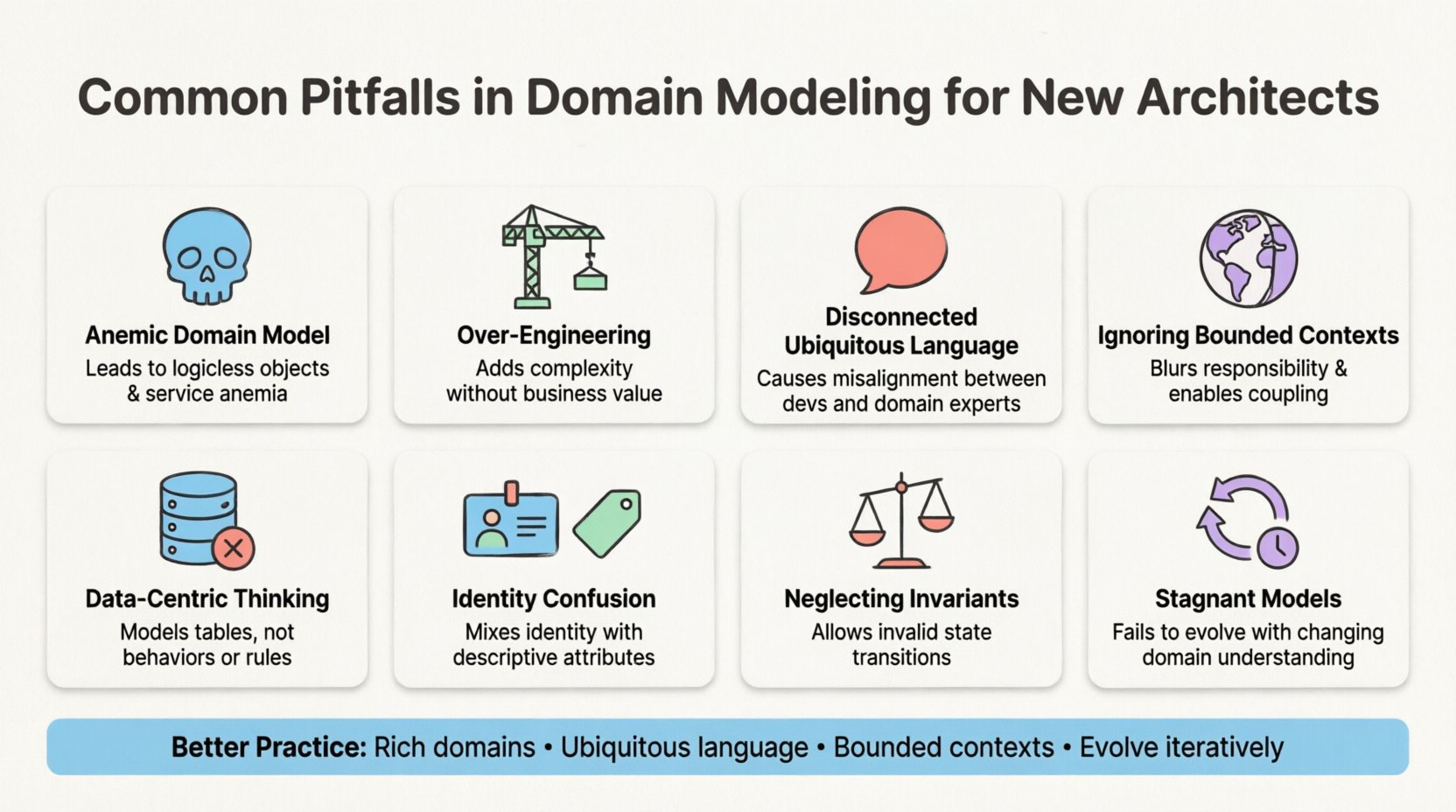
The Anemic Domain Model Trap 💀
One of the most pervasive issues in modern software development is the creation of an anemic domain model. This occurs when domain objects are reduced to mere data containers, possessing public properties and getters/setters but lacking behavior. In this scenario, business logic is pushed out of the domain layer and scattered across service classes or controllers.
- Why it happens: Developers often prioritize database mapping ease over object-oriented principles. They view objects primarily as rows in a table.
- The Consequence: The domain loses its meaning. Validation rules become scattered, and the lifecycle of an entity becomes hard to track because the object itself does not enforce its own integrity.
- The Impact: Maintenance costs skyrocket. Changing a business rule requires modifying multiple service layers instead of a single domain method.
To avoid this, ensure that your entities encapsulate their state and behavior. A Customer object should know how to place an order, not just hold the data required to create one. The logic regarding order limits, credit checks, or account status should reside within the Customer class itself.
Disconnected Ubiquitous Language 🗣️
Domain-Driven Design emphasizes the importance of a ubiquitous language—a shared vocabulary used by both business stakeholders and technical teams. A common pitfall for new architects is allowing this language to diverge between the business context and the code implementation.
If the business refers to a “Client,” but the code uses “UserAccount,” confusion inevitably arises. If stakeholders discuss “Order Fulfillment” but the system models “Shipping Status,” the model fails to reflect reality. This disconnect leads to:
- Miscommunication: Requirements are misunderstood during the translation phase.
- Refactoring Overhead: Constant changes to the codebase just to match a shifting business term.
- Loss of Trust: Developers stop listening to business input because their terminology is not respected in the system.
Strategy for Alignment:
- Hold workshops where terms are defined explicitly.
- Use code names that match the business glossary exactly.
- Document the glossary as a living document, updated alongside the code.
Over-Engineering Before Understanding 🏗️
There is a temptation for architects to design a perfect, flexible system that handles every conceivable future scenario. This is often called “YAGNI” (You Aren’t Gonna Need It) violation. New architects frequently create complex inheritance hierarchies or generic interfaces in anticipation of requirements that do not exist.
Risks of Over-Engineering:
- Increased Complexity: Simple use cases become difficult to implement because the structure is too rigid.
- Hidden Bugs: Complex logic paths introduce more opportunities for errors.
- Slower Delivery: Time spent designing the “perfect” solution delays the delivery of actual value.
Focus on Current Needs:
Design for the problem at hand. It is better to have a simple, working model that can be refactored later than a complex model that never gets built. Embrace the fact that models evolve. If a specific extension point is needed, add it only when the business case demands it.
Ignoring Bounded Contexts 🌍
In large enterprise systems, the domain is rarely a single, unified concept. It is composed of multiple subdomains. A new architect might try to model the entire enterprise as one massive object graph. This ignores the concept of Bounded Contexts, where the same term might have different meanings in different parts of the business.
For example, the term Product in the Sales context might include pricing and availability, while in the Inventory context, it might focus on SKU and warehouse location. Merging these into a single model creates a bloated entity with irrelevant data and confusing logic.
- Context Boundaries: Define clear lines where different models take ownership of specific data.
- Context Mapping: Establish how these models communicate. Use Anti-Corruption Layers to prevent one context from contaminating another with its specific implementation details.
- Shared Kernel: Where integration is necessary, agree on a shared subset of the model, but keep the rest isolated.
Data-Centric Thinking vs. Object-Centric Thinking 💾
It is common for architects to start with the database schema and build the domain model around it. This reverses the natural flow of Domain-Driven Design. The database is a persistence concern, while the domain model is a business concern.
When you model after the database:
- You introduce implementation details (foreign keys, null constraints) into your business logic.
- Refactoring the database schema becomes a breaking change for the business logic.
- You lose the ability to treat the domain as a pure object model.
Separation of Concerns:
Keep the domain model clean. Do not expose database columns as properties if they do not have business meaning. Use a mapping layer to translate between the object graph and the relational structure. This ensures that your business logic remains independent of storage technology.
Neglecting Invariants and Business Rules ⚖️
An invariant is a condition that must always be true. In a well-designed domain, invariants are enforced by the model itself. New architects often push validation logic into the UI or the service layer, leaving the domain object in an invalid state momentarily.
Examples of Neglected Invariants:
- A
BankAccountallowing a negative balance when overdraft protection is not active. - An
Orderbeing in aShippedstate without a validTrackingNumber. - A
Discountbeing applied to an order that is below the minimum threshold.
If these checks happen outside the object, the object can be corrupted. If a method is called directly (bypassing the service layer), the invariant might be violated. The model must protect its own integrity.
Identity and Value Object Confusion 🆔
Understanding the difference between Entities and Value Objects is crucial. Entities are defined by their identity (e.g., a specific Employee), whereas Value Objects are defined by their attributes (e.g., a Address or Currency).
Common Mistake:
Treating Value Objects as Entities. If you assign a unique ID to a StreetAddress, you create unnecessary complexity. If you treat an Employee as a Value Object, you lose the ability to track its history over time.
- Entities: Require an identity. Two employees with the same name are different people.
- Value Objects: No identity. Two addresses with the same street and city are the same value.
Mixing these up leads to performance issues (unnecessary lookups by ID) and logical errors (treating data that should be immutable as mutable).
Stagnant Models 🔄
A domain model is not a one-time deliverable. It is a living artifact that must evolve with the business. A common pitfall is treating the initial design as the final truth. When business requirements shift, the model should shift with them.
Signs of a Stagnant Model:
- Developers feel they cannot add new features without breaking existing ones.
- Code comments explain why certain workarounds are in place.
- The model contains logic for features that were deprecated years ago.
Continuous Refinement:
Encourage refactoring as a standard practice. Regularly review the domain model with business stakeholders. If a concept no longer exists in the business, remove it from the code. If a new concept emerges, model it immediately. A model that does not change is a model that is dying.
Common Pitfalls vs. Better Practices
The following table summarizes the key distinctions between common errors and recommended architectural approaches.
| Pitfall | Impact | Better Practice |
|---|---|---|
| Anemic Domain Objects | Logic scattered, hard to maintain | Rich Domain Objects with encapsulated behavior |
| Database-First Design | Tight coupling to storage | Domain-First, mapped to storage later |
| Single Monolithic Model | Complexity explosion, confusion | Bounded Contexts with clear boundaries |
| Validation in Service Layer | Invalid state possible | Validation within the Domain Entity |
| Over-Engineering | Slower delivery, hidden bugs | Simple designs, evolve as needed |
| Ignoring Ubiquitous Language | Miscommunication, rework | Shared vocabulary between business and tech |
Practical Steps for Improvement 🛠️
Avoiding these pitfalls requires a shift in mindset and process. Here are actionable steps to integrate into your architecture workflow.
1. Conduct Domain Storytelling Sessions
Instead of just gathering requirements, sit down with domain experts and walk through scenarios. Ask them to describe how a transaction flows. Map their narrative to your model. This ensures the model reflects the actual work, not just the theoretical ideal.
2. Enforce Code Ownership
Assign specific parts of the domain model to specific developers or teams. This creates accountability. If the Order model breaks, the team responsible for Order knows they need to fix it. This prevents the “everyone owns nothing” syndrome.
3. Implement Static Analysis
Use tools to enforce architectural rules. For example, prevent service classes from accessing database entities directly. Force them to go through the domain interface. This maintains the separation of concerns automatically.
4. Regular Model Reviews
Schedule periodic sessions where the team reviews the domain model. Look for smells like long methods, god classes, or inconsistent naming. Treat the model with the same scrutiny as production code.
5. Documentation as Code
Keep your documentation in the same repository as your code. If the code changes, the documentation must change. Use tools that generate diagrams from the code structure to ensure visual representations match the implementation.
The Human Element of Architecture 👥
Finally, remember that domain modeling is not just a technical exercise; it is a social one. The quality of the model depends heavily on the communication between architects, developers, and business stakeholders. A perfect model is useless if the business does not understand it, or if the developers cannot implement it efficiently.
Collaboration is key. Involve senior developers in the design phase. Their experience with implementation constraints can prevent theoretical designs that are impossible to build. Involve business analysts in the naming conventions. Their insight ensures the model remains relevant to the organization.
Summary of Architectural Health ✅
Building a high-quality domain model is a journey of continuous improvement. It requires vigilance against the temptation to cut corners for speed. It demands respect for the business rules and the people who execute them. By avoiding the pitfalls outlined in this guide—such as anemic models, disconnected language, and data-centric coupling—you lay a foundation for systems that are robust and adaptable.
Focus on clarity, encapsulation, and alignment. Let the model serve the business, not the other way around. When the domain model accurately reflects the reality of the enterprise, the code becomes easier to write, easier to test, and easier to understand. This is the true measure of architectural success.
Keep iterating. Keep listening. Keep refining. The best models are not built in a day; they are grown over time, nurtured by feedback, and strengthened by consistent practice.