
Enterprise Architecture (EA) is a discipline that bridges the gap between business strategy and technology execution. It involves defining an organization’s structure, processes, and information systems to ensure they work together efficiently. However, the path to becoming a proficient Enterprise Architect is fraught with challenges. Many individuals enter this role with strong technical skills but lack the strategic vision or political savvy required for success.
Whether you are transitioning from a technical lead or stepping into a leadership role, understanding the pitfalls is crucial. This guide outlines the most frequent errors made by newcomers and provides actionable strategies to navigate them effectively. We will explore the human, technical, and strategic dimensions of the role without relying on specific tools or hype.
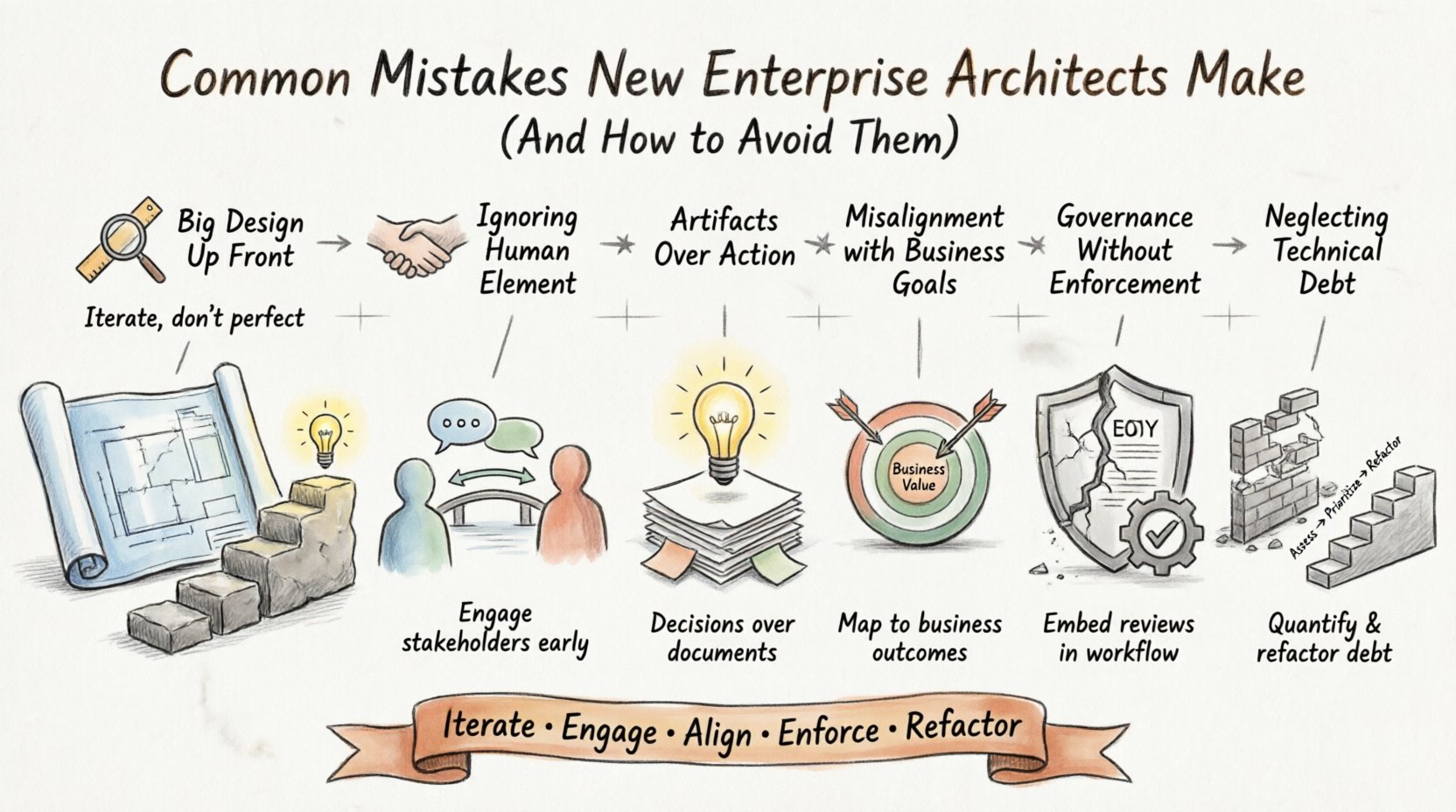
1. The “Big Design Up Front” Trap 📐
One of the most common initial missteps is attempting to design the entire future state of the enterprise before any implementation begins. New architects often feel pressure to create a perfect blueprint that covers every system and process. This approach assumes that requirements are static and that the future is predictable.
Why It Happens
- Desire for Control: Architects want to see the full picture to feel secure.
- Lack of Iteration: Belief that architecture must be finalized before development starts.
- Academic Influence: Over-reliance on theoretical models that demand completeness.
The Impact
When you spend months designing a solution that may not fit the current reality, you delay value delivery. Business needs change rapidly. By the time your “perfect” architecture is approved, the business context may have shifted. This leads to abandoned plans, wasted effort, and frustration among stakeholders who expected immediate progress.
The Fix
Adopt an iterative approach. Focus on the immediate problem space rather than the entire landscape. Deliver value in increments. Create a “target” view that is flexible, allowing for adjustments as you learn more about the business constraints. Treat architecture as a living document, not a stone tablet.
2. Ignoring the Human Element 🤝
Enterprise Architecture is not just about diagrams and data models; it is fundamentally about people. A new architect might focus entirely on the technical correctness of a solution while neglecting the organizational dynamics. This includes resistance to change, conflicting priorities, and communication gaps.
Why It Happens
- Technical Background: Many architects come from coding or engineering roles where logic prevails.
- Underestimation of Culture: Belief that facts alone will persuade decision-makers.
- Siloed Thinking: Focusing on one department without understanding cross-functional impacts.
The Impact
If stakeholders feel their concerns are ignored, they will resist the architecture. Projects stall. Adoption rates drop. You may have the perfect technical design, but if the business units refuse to adopt it, the architecture fails. This leads to shadow IT and fragmented systems that undermine the very governance you intended to enforce.
The Fix
Invest time in stakeholder management. Understand the political landscape. Listen to concerns before proposing solutions. Translate technical concepts into business value. Engage with leaders early to build alliances. Architecture is a social process as much as a technical one.
3. Artifacts Over Action 📄
There is a tendency to produce documentation for the sake of documentation. New architects often spend more time creating diagrams, standards documents, and reports than they do facilitating decisions or enabling development teams.
Why It Happens
- Measurability: It is easier to count pages than to measure influence.
- Perceived Value: Assuming that if it is not written down, it does not exist.
- Job Security: Creating a dependency on the architect for interpretation.
The Impact
When the primary output is a document, the architecture becomes a museum piece. Developers may not read it, or they may find it outdated immediately. This creates a disconnect between the “as-is” documentation and the “as-built” reality. The role becomes bureaucratic rather than enabling.
The Fix
Focus on decision records rather than comprehensive blueprints. Ensure every artifact serves a specific purpose for a specific audience. If a diagram does not help a developer make a decision, reconsider its necessity. Keep documentation lightweight and accessible. Prioritize working solutions over comprehensive papers.
4. Misalignment with Business Goals 🎯
A critical failure occurs when the architecture supports technology that does not drive business value. This often manifests as optimizing for technical elegance rather than business outcomes. The architect becomes a gatekeeper for technology choices without understanding the revenue or cost implications.
Why It Happens
- Tech-Centric Mindset: Passion for new technology overshadows business needs.
- Lack of Business Context: Not understanding the P&L or strategic objectives.
- Isolation: Working in a vacuum without regular business reviews.
The Impact
The organization invests in systems that do not solve customer problems. Resources are wasted on technical debt that does not impact the bottom line. The architecture becomes a cost center rather than an investment. This erodes trust in the EA function among executive leadership.
The Fix
Map every architectural initiative to a specific business capability or objective. Ask “Why are we doing this?” before asking “How will we build it?”. Ensure the roadmap reflects business priorities, not just technical refresh cycles. Speak the language of the business, focusing on agility, cost, and risk.
5. Governance Without Enforcement 🛡️
Establishing policies is easy; enforcing them is hard. New architects often create a set of standards and principles but lack the mechanism to ensure compliance. This leads to a situation where rules exist on paper but are ignored in practice.
Why It Happens
- Desire to Avoid Conflict: Reluctance to say “no” to project teams.
- Process Gaps: No clear integration of architecture review into the delivery lifecycle.
- Lack of Authority: Insufficient mandate to enforce standards.
The Impact
When standards are ignored, the architecture drifts. Systems become incompatible. Integration points fail. Security risks increase due to unvetted components. The organization loses the ability to reuse assets, leading to duplication and higher costs.
The Fix
Integrate architecture reviews into the project lifecycle at key milestones. Make compliance a criterion for funding or release. Use automated checks where possible to reduce manual friction. Build a culture where standards are seen as aids to success, not hurdles to overcome. Balance flexibility with necessary constraints.
6. Neglecting Technical Debt 🧱
Technical debt accumulates when quick fixes are taken over robust solutions. New architects often fail to quantify or manage this debt. They may focus on the new build while ignoring the cost of maintaining the legacy environment.
Why It Happens
- Focus on Innovation: Excitement about new features distracts from maintenance.
- Invisibility: Debt is often hidden in the background until it causes failure.
- Short-Term Pressure: Business demands speed over stability.
The Impact
Over time, the system becomes rigid and expensive to change. Velocity slows down. The organization spends more resources on maintenance than on innovation. Eventually, the cost of the system exceeds the value it provides, forcing a costly and risky migration.
The Fix
Treat technical debt as a financial liability. Quantify the cost of carrying debt in terms of time and money. Create a strategy for refactoring and modernization. Allocate a portion of every sprint to debt reduction. Make debt visible to leadership so they understand the trade-offs.
Summary of Key Pitfalls and Solutions 📊
The following table summarizes the common mistakes discussed above and provides a quick reference for corrective actions.
| Mistake | Root Cause | Impact | Solution |
|---|---|---|---|
| Big Design Up Front | Need for certainty | Delayed value, irrelevant plans | Iterative design, flexible targets |
| Ignoring Human Element | Technical focus | Resistance, shadow IT | Stakeholder engagement, communication |
| Artifacts Over Action | Measurability bias | Unused documentation | Decision records, lightweight docs |
| Misalignment with Goals | Tech-centric view | Wasted investment | Business mapping, value focus |
| Weak Governance | Avoiding conflict | Architecture drift | Lifecycle integration, automated checks |
| Neglecting Debt | Innovation bias | Slow velocity, high cost | Quantify debt, refactoring sprints |
Building a Sustainable Practice 🚀
Avoiding these mistakes is not a one-time fix; it requires a shift in mindset. Enterprise Architecture is a long-term discipline. It requires patience to build trust and persistence to maintain standards. You must remain adaptable as the technology landscape shifts.
Focus on outcomes rather than outputs. When you deliver a solution that actually helps the business achieve its goals, the architecture validates itself. Do not get bogged down in the theory of what architecture “should” be. Instead, focus on what works in your specific organizational context.
Continuous learning is essential. The tools and technologies change, but the principles of alignment, governance, and value delivery remain constant. By understanding these common pitfalls, you position yourself to navigate the complexities of the role with confidence. You become a partner to the business, not just a technical advisor.
Remember that the goal is not perfection. It is progress. Start small, demonstrate value, and expand your influence over time. This approach builds a foundation that can withstand the inevitable changes of the digital landscape.