
In the modern digital landscape, organizations face increasing pressure to adapt quickly to market shifts while maintaining operational stability. The complexity of IT infrastructure, combined with disparate business processes, often creates friction that slows growth. Enterprise Architecture (EA) serves as the strategic blueprint to align technology with business goals. This article explores a real-world scenario where a large organization successfully navigated this transformation.
The Organization and Context 🌍
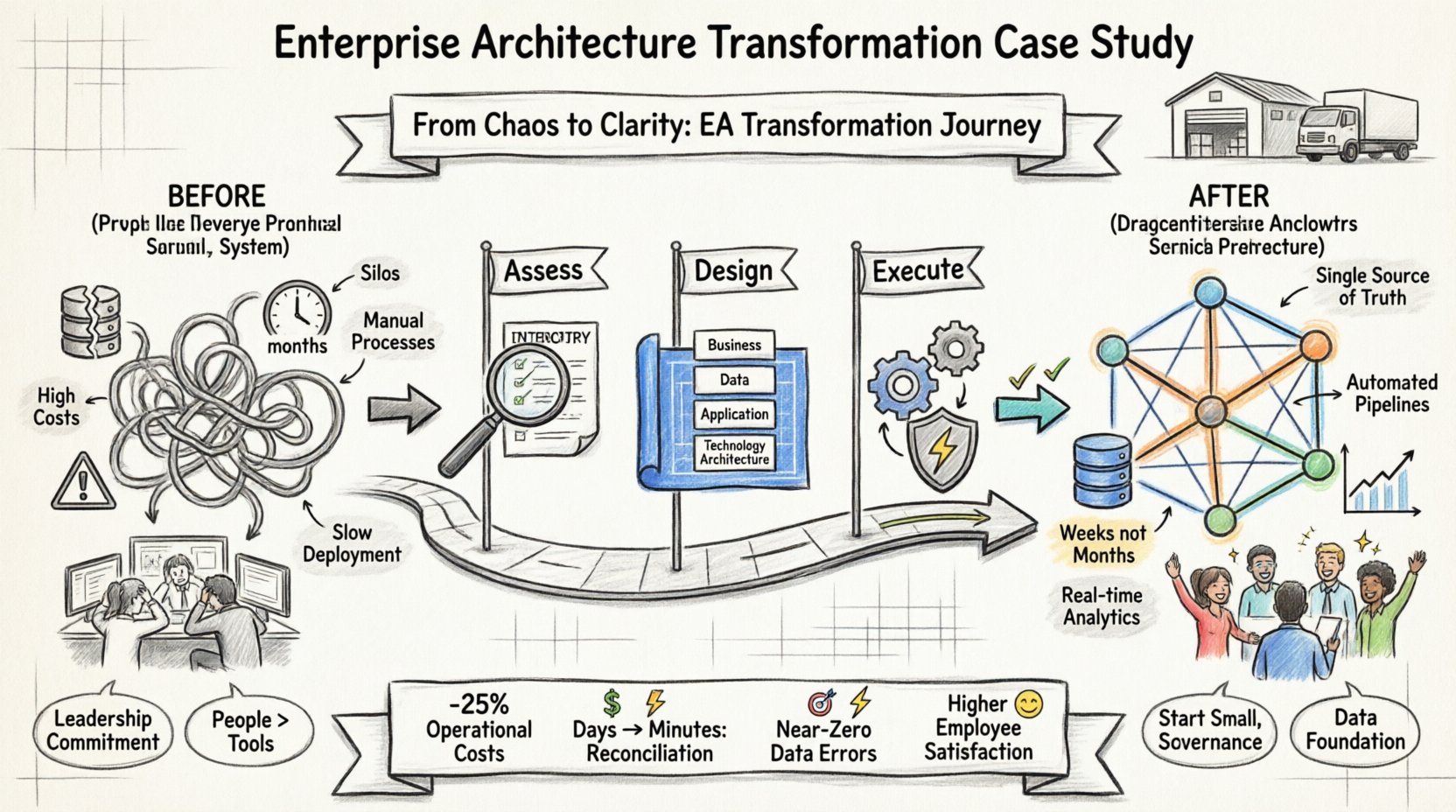
Consider a hypothetical entity referred to here as “Apex Logistics.” For over two decades, Apex Logistics operated a dominant position in regional supply chain management. However, as global trade expanded, their internal systems began to struggle. The company relied on a collection of legacy applications that were built independently over time. Each department maintained its own data repositories, leading to significant information silos.
Leadership recognized that the current state was unsustainable. Manual data reconciliation between departments consumed valuable hours. Decision-making was reactive rather than proactive due to fragmented reporting. The goal was clear: achieve a unified operational view without disrupting ongoing business activities.
Core Challenges Identified 🔍
Before any technical changes could be made, a thorough assessment was required. The organization identified several critical pain points that hindered progress. These issues were not merely technical; they were deeply rooted in organizational structure and process.
- Fragmented Data: Customer information existed in multiple formats. Sales data did not match shipping records, causing billing errors and customer dissatisfaction.
- High Maintenance Costs: Supporting hundreds of disconnected systems required a large team of specialized engineers. License fees and hardware costs were escalating annually.
- Slow Time-to-Market: Launching a new service took months because every new feature required manual integration work across different legacy platforms.
- Compliance Risks: Data privacy regulations were tightening. The lack of a centralized view made auditing and securing sensitive information nearly impossible.
- Inconsistent User Experience: Employees had to log into different systems to complete a single workflow, reducing productivity and increasing training overhead.
These challenges highlighted the need for a structured approach. Ad-hoc fixes had failed in the past. A holistic strategy was necessary to address the root causes.
Adopting Enterprise Architecture Principles 📐
The organization decided to implement Enterprise Architecture principles. This framework provided a methodical way to analyze the current state and design a target state. EA is not about buying new tools; it is about understanding the relationships between business capabilities and technology.
The approach followed four primary layers of architecture:
- Business Architecture: Defined the strategy, governance, organization, and key business processes.
- Data Architecture: Described the structure of an organization’s logical and physical data assets and data management resources.
- Application Architecture: Provided a blueprint for the individual application systems, their interactions, and relationships to the core business processes.
- Technology Architecture: Described the logical software and hardware capabilities required to support the deployment of business, data, and application services.
By mapping these layers, the team could see where redundancies existed and where gaps threatened performance. This visual mapping was crucial for gaining buy-in from stakeholders across the company.
The Transformation Roadmap 🛣️
Transitioning from the current state to the target state required a phased plan. Rushing the process would have introduced instability. The roadmap was divided into three distinct phases: Assessment, Design, and Execution.
Phase 1: Assessment and Baseline 📊
The first step involved cataloging every asset. This included inventorying servers, databases, applications, and the people who managed them. The team created an inventory of business capabilities to understand what the organization actually needed to deliver value.
- Gap Analysis: Comparing current capabilities against desired capabilities revealed significant gaps in data integration and real-time reporting.
- Stakeholder Interviews: Engaging with department heads ensured that the technical plan aligned with actual business needs.
- Risk Identification: The team identified critical dependencies. For example, the billing system relied on data from the logistics module, meaning a change in one could break the other.
Phase 2: Strategic Design 🎯
With a clear baseline, the design team began drafting the future state. The focus was on modularity and interoperability. Instead of building monolithic systems, the strategy favored services that could communicate easily.
Key design principles included:
- Standardization: Adopting common data definitions across all departments to ensure consistency.
- Decoupling: Separating the user interface from the backend logic to allow independent updates.
- Automation: Reducing manual intervention wherever possible to minimize human error.
- Scalability: Ensuring the infrastructure could handle spikes in demand without performance degradation.
Phase 3: Execution and Governance 🏛️
Implementation required strict governance. Without oversight, teams might revert to old habits. A governance board was established to review all new projects against the architectural standards.
The execution followed an iterative model. Small wins were prioritized to demonstrate value quickly. This helped maintain momentum and trust. Major infrastructure changes were scheduled during low-traffic periods to minimize disruption.
Structural Changes and Comparison 📉
To understand the magnitude of the shift, it helps to compare the organizational structure before and after the transformation. The following table outlines the key differences.
| Area | Before Transformation | After Transformation |
|---|---|---|
| Data Handling | Manual entry, spreadsheets, siloed databases | Automated pipelines, single source of truth |
| System Integration | Point-to-point connections (spaghetti architecture) | Service-oriented interactions (clean architecture) |
| Deployment Speed | Months for new features | Weeks for new features |
| IT Cost Structure | High maintenance, reactive spending | Optimized licensing, proactive planning |
| Decision Making | Based on outdated reports | Real-time dashboards and analytics |
This shift was not just about technology; it changed how the organization operated. Data became an asset rather than a byproduct of operations.
Measurable Outcomes and Benefits 📈
After twelve months of sustained effort, the organization began to see tangible results. The metrics tracked by the leadership team confirmed the success of the initiative.
- Cost Reduction: By retiring redundant systems and optimizing infrastructure, operational costs dropped by approximately 25% within the first year.
- Efficiency Gains: Automated data flows reduced the time spent on reconciliation tasks from days to minutes.
- Agility: The time required to onboard new partners decreased significantly due to standardized integration protocols.
- Accuracy: Data errors related to billing and shipping were reduced to near zero, improving customer trust.
- Employee Satisfaction: Staff reported less frustration with tools, allowing them to focus on higher-value tasks.
Perhaps the most significant benefit was cultural. Teams began to collaborate more effectively. The silos that once separated IT and Business were bridged by the shared language of Enterprise Architecture.
Key Lessons Learned 💡
While the transformation was successful, the journey provided several important lessons for other organizations considering similar paths.
1. Leadership Commitment is Essential 👔
Architecture initiatives often fail without top-down support. When leaders prioritize the strategy, resources are allocated accordingly. In this case, executive sponsorship ensured that architectural standards were not bypassed for short-term gains.
2. People Matter More Than Technology 🧑💻
Tools are only as good as the people who use them. Extensive training programs were necessary to ensure staff understood the new workflows. Change management was a critical component of the plan.
3. Start Small, Scale Fast 🚀
Attempting to overhaul the entire infrastructure at once is risky. The organization started with a pilot project in one department. Success there provided the confidence to expand to the rest of the company.
4. Governance Must Be Practical ⚖️
Rules that are too strict stifle innovation. The governance board focused on enforcing standards that protected the integrity of the system without slowing down delivery. Flexibility was allowed for experimental projects.
5. Data is the Foundation 🗄️
Application modernization is futile if data remains messy. The organization invested heavily in data quality initiatives. Clean data allowed for better analytics and decision-making across the board.
Sustaining the Architecture 🛡️
Transformation is not a one-time event. It requires continuous maintenance. The organization established a dedicated architecture team to oversee the long-term health of the ecosystem.
This team is responsible for:
- Reviewing New Requests: Ensuring any new software or process aligns with the overall strategy.
- Monitoring Technical Debt: Identifying areas where shortcuts were taken and planning remediation.
- Updating Standards: Keeping pace with industry trends and emerging technologies.
- Fostering Collaboration: Organizing forums where developers and business analysts can share insights.
This ongoing commitment ensures that the architecture remains relevant as the business evolves.
Impact on Business Strategy 📝
The technical improvements directly influenced business strategy. With better visibility into operations, leadership could explore new markets with greater confidence. The ability to scale quickly allowed the company to bid on larger contracts that were previously out of reach.
The reduction in operational friction meant that customer service could focus on relationship building rather than fixing data errors. This shift in focus improved net promoter scores and customer retention rates.
Furthermore, the standardized environment made it easier to acquire smaller competitors. Integration became a matter of days rather than months, facilitating a more aggressive growth strategy.
Conclusion on the Journey 🏁
The transformation of this organization demonstrates the power of structured thinking in complex environments. Enterprise Architecture provided the discipline needed to navigate change without losing control. By focusing on alignment, standardization, and governance, the company turned a chaotic IT landscape into a strategic asset.
Success in this area is not about finding a silver bullet. It is about consistent effort, clear communication, and a willingness to adapt. Organizations that invest in these principles position themselves for sustainable growth in an increasingly digital world.
The journey continues as new challenges arise. However, the foundation laid during this transformation ensures that the organization is prepared to face them with resilience and clarity.