
Enterprise transformation is rarely a single event. It is a journey of continuous change, often spanning years and involving complex interactions between business strategy, applications, and technology infrastructure. Navigating this complexity requires a structured approach. The ArchiMate modeling language offers a standardized way to visualize these changes. Specifically, the Implementation and Migration package provides the necessary constructs to plan these transitions effectively. This guide explores how to build robust migration roadmaps using ArchiMate Implementation Events. We will look at the mechanics of sequencing change, managing dependencies, and ensuring alignment across the enterprise.
When organizations plan significant shifts, they often face the challenge of communicating how one state evolves into another. A migration roadmap serves as the bridge between the current situation and the desired future state. By leveraging Implementation Events, architects can break down large transformations into manageable steps. This document provides a detailed framework for constructing these roadmaps without relying on specific software tools, focusing instead on the architectural principles and logical flow required for success.
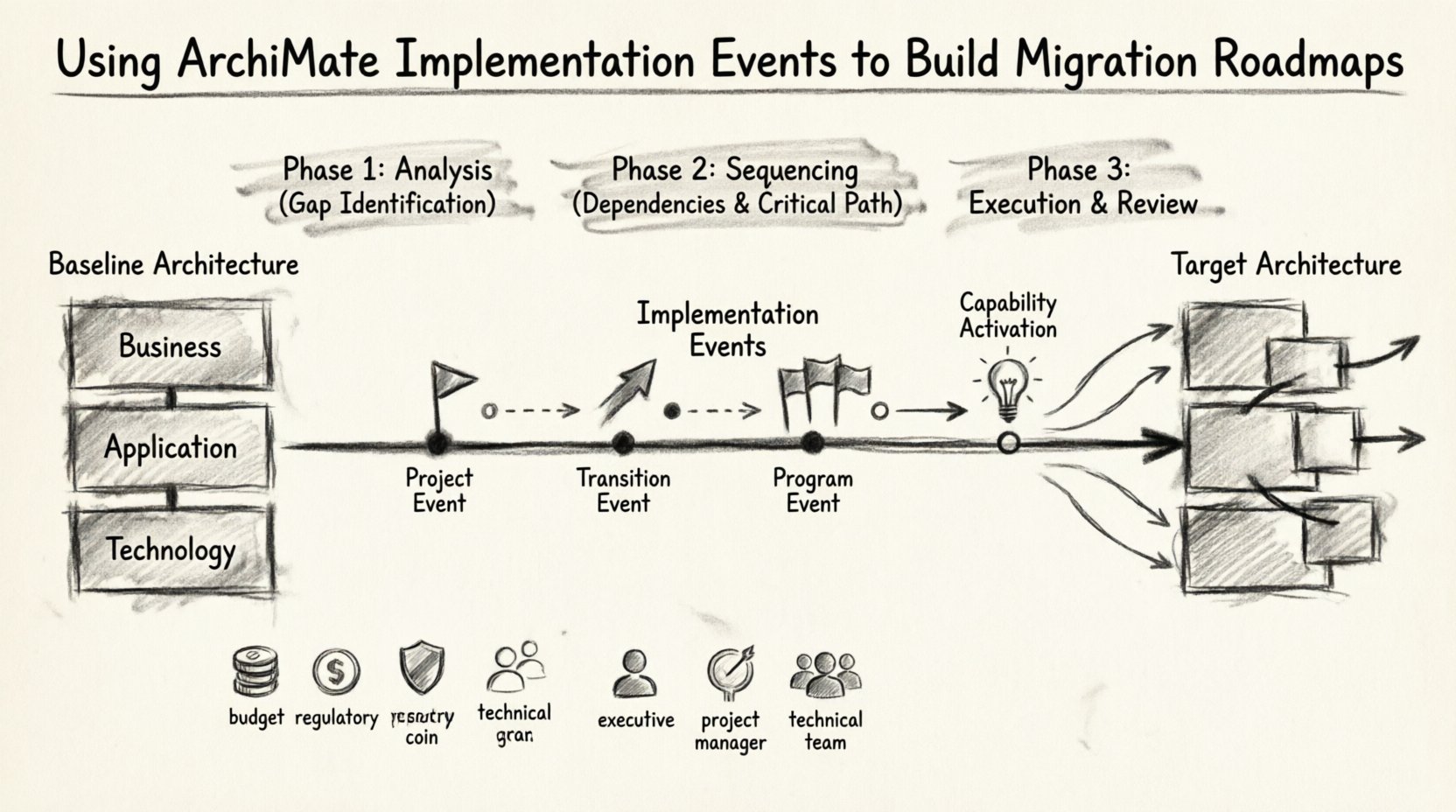
Understanding ArchiMate Implementation Events 🧩
Before constructing a roadmap, it is essential to understand the core building blocks. ArchiMate defines Implementation and Migration as a specific viewpoint focused on change over time. Within this package, the Implementation Event is the primary actor in the sequence of transformation.
- Definition: An Implementation Event represents a specific point in time when a change is executed. It is a milestone that marks the transition from one state to another.
- Role: It connects the Baseline Architecture (current state) to the Target Architecture (future state) through a series of steps.
- Relationship: Events are linked by Realization relationships to the changes they enable. They also have temporal relationships, indicating the order in which they occur.
Unlike a simple list of tasks, an Implementation Event in ArchiMate carries semantic meaning regarding the architecture. It implies that a specific capability or function is being turned on, turned off, or modified. This distinction is crucial for high-level planning.
Types of Implementation Events 📅
Not all events are created equal. Depending on the scope of the transformation, you may encounter different types of events. Understanding these distinctions helps in assigning the correct level of detail to the roadmap.
| Event Type | Description | Typical Scope |
|---|---|---|
| Project Event | Marking the completion of a defined project deliverable. | Department or Business Unit |
| Transition Event | A significant shift in the operational landscape. | Enterprise Level |
| Program Event | Indicating the completion of a program containing multiple projects. | Multi-year Initiative |
| Capability Activation | Specifically enabling a new business capability. | Business Layer |
The Role of Migration Roadmaps in Enterprise Architecture 🚦
A migration roadmap is more than a Gantt chart. In the context of ArchiMate, it is a dynamic model that explains why changes happen and how they fit together. It connects the strategic goals to the technical execution.
When you build a roadmap using Implementation Events, you achieve several critical objectives:
- Clarity on Sequencing: It prevents the logical fallacy of implementing a technology before the business process requires it.
- Risk Identification: By visualizing dependencies, you can spot bottlenecks before resources are committed.
- Stakeholder Communication: A visual model is often easier to digest than a spreadsheet for senior leadership.
- Resource Allocation: It helps in understanding the timeline for infrastructure, budget, and personnel.
Without a structured roadmap, organizations risk “Big Bang” migrations. These are high-risk approaches where everything changes at once. A phased approach, modeled through Implementation Events, allows for incremental value delivery and feedback loops.
Constructing the Roadmap: Phase 1 – Analysis 📊
The foundation of any roadmap lies in the analysis of the current and future states. This phase is about establishing the gap. You cannot plan a journey without knowing the departure point and the destination.
1. Define the Baseline Architecture
The Baseline Architecture represents the current state of the enterprise. It includes the Business, Application, and Technology layers. You must document what exists today.
- Business Layer: Identify active processes, organizational units, and roles. Which capabilities are currently enabled?
- Application Layer: List the software systems in use. Which applications support which business processes?
- Technology Layer: Map the infrastructure, networks, and hardware that host the applications.
2. Define the Target Architecture
The Target Architecture describes the desired state after the transformation. This is driven by strategic objectives.
- Business Capability: What new capabilities are needed? Which old ones should be retired?
- Application Portfolio: Which new applications are required? Which legacy systems need replacement?
- Technology Infrastructure: What infrastructure standards are needed to support the new applications (e.g., cloud, on-premise, hybrid)?
3. Identify the Gap
Comparing the Baseline and Target reveals the gap. This gap is filled by the Implementation Events. You must explicitly document what changes are required to bridge this distance. This is often called a Gap Analysis.
For each gap identified, you must determine if it requires a new capability, a modification of an existing one, or the retirement of an obsolete element. This decision dictates the nature of the Implementation Event.
Constructing the Roadmap: Phase 2 – Sequencing 🔄
Once the gap is identified, the next step is sequencing. This is where the Implementation Events are placed on a timeline. The goal is to determine the logical order of execution.
1. Establish Dependencies
Not all changes can happen simultaneously. Some changes rely on the completion of others. ArchiMate allows you to model these dependencies using Dependency relationships between Implementation Events.
- Hard Dependencies: Change B cannot start until Change A is complete. For example, you cannot migrate a database to a new cloud provider until the network connectivity is established.
- Soft Dependencies: Change B is better off if Change A is done, but can technically proceed. For example, training staff is optimal after the software is installed, but can happen beforehand.
2. Timebox the Events
Assigning timeframes to events is critical for resource planning. However, in early-stage roadmaps, these should be estimates rather than fixed dates.
- Phases: Group events into logical phases (e.g., Foundation, Core, Optimization).
- Duration: Estimate the duration for each phase based on complexity.
- Milestones: Set clear checkpoints where progress is reviewed.
3. The Critical Path
Identify the sequence of events that determines the total duration of the project. If any event on this path is delayed, the entire roadmap is delayed. Focus your risk management efforts on these specific events.
Modeling Dependencies and Constraints 🛑
Constraints are external factors that limit your options. Dependencies are internal relationships between the changes. Both must be modeled to create a realistic roadmap.
Common Constraints in Migration
| Constraint Type | Example | Impact on Roadmap |
|---|---|---|
| Financial | Budget approval cycles occur quarterly. | Events must align with fiscal periods. |
| Regulatory | Compliance audits must be passed before migration. | Events must precede compliance deadlines. |
| Resource | Limited availability of specialized architects. | Events cannot overlap if resources are scarce. |
| Technical | Legacy system must be decommissioned first. | Strict sequencing required. |
Modeling the Flow
When modeling the flow of events, use specific relationships to denote the nature of the connection.
- Trigger: One event initiates another.
- Access: One event requires access to a resource provided by another.
- Assignment: One event is assigned to a specific organizational unit.
By explicitly mapping these relationships, you create a dependency graph. This graph can be used to calculate the earliest start dates and latest finish dates for each event.
Managing Risks and Stakeholders 🤝
A roadmap is a living document. As the project progresses, risks will emerge, and stakeholder needs will shift. Managing these human and operational factors is just as important as the technical modeling.
Risk Mitigation Strategy
Every Implementation Event carries a level of risk. You should assess and document these risks before execution begins.
- Probability: How likely is the event to fail?
- Impact: If it fails, how much does it delay the roadmap?
- Mitigation: What steps will be taken to reduce the risk?
Stakeholder Communication
Different stakeholders need different views of the roadmap.
- Executives: Need high-level milestones and budget impacts. They care about the Target Architecture.
- Project Managers: Need detailed task dependencies and resource allocation. They care about the Implementation Events.
- Technical Teams: Need specific technical specifications and integration points. They care about the Application and Technology layers.
Using ArchiMate allows you to generate different views from the same model. You can slice the data to provide the relevant information for each group without losing the overall context.
Execution and Review 📊
Once the roadmap is approved, the execution phase begins. However, the work does not end there. Continuous review is necessary to ensure the roadmap remains valid.
Monitoring Progress
Track the status of each Implementation Event against the planned timeline. Use key performance indicators (KPIs) to measure success.
- On-Time Delivery: Percentage of events completed by the scheduled date.
- Budget Variance: Actual spend versus planned budget.
- Quality Metrics: Defect rates or performance issues post-implementation.
Updating the Model
If the roadmap deviates from the plan, the model must be updated. This might involve:
- Adding New Events: If scope creep occurs.
- Removing Events: If a capability is no longer needed.
- Re-sequencing: If dependencies change due to external factors.
This iterative process ensures that the roadmap remains an accurate representation of the plan. It prevents the document from becoming obsolete shortly after creation.
Best Practices for Architecture Modeling 🛠️
To ensure the roadmap is effective, adhere to these architectural principles during the modeling process.
- Keep it Hierarchical: Do not model every single task. Group tasks into phases, and phases into programs. This maintains readability.
- Focus on Value: Ensure every Implementation Event can be traced back to a business value or capability.
- Maintain Consistency: Use standard naming conventions for all elements. This reduces confusion.
- Document Assumptions: Clearly state the assumptions made during the planning phase. This helps in future audits.
Integrating Business and Technology Layers 🔗
One of the greatest strengths of ArchiMate is the ability to link layers. A migration roadmap should not just focus on technology. It must reflect the business impact.
When mapping an Implementation Event, ask the following questions:
- Which Business Process is affected? Does the change improve efficiency or customer experience?
- Which Application supports this? Is the application being replaced, upgraded, or retired?
- Which Technology is required? Is new hardware or network capacity needed?
This cross-layer mapping ensures that the technology investment directly supports the business goal. It prevents the common pitfall of buying technology that does not solve a business problem.
Handling Legacy Systems in Migration 🧱
Legacy systems are often the biggest hurdle in migration. They may be stable but difficult to integrate with modern solutions. The roadmap must account for the specific challenges of legacy environments.
- Decommissioning Strategy: Plan for the eventual retirement of the legacy system. Do not leave it running indefinitely.
- Data Migration: Ensure data integrity during the transition. This often requires a specific Implementation Event for data cleansing.
- Parallel Running: Sometimes, the legacy system must run alongside the new system for a period. This adds complexity to the timeline.
Summary of Key Takeaways 📝
Building a migration roadmap using ArchiMate Implementation Events is a strategic exercise. It requires a deep understanding of the enterprise architecture and the ability to sequence change logically. By following the steps outlined in this guide, organizations can create roadmaps that are clear, actionable, and aligned with business goals.
Remember that a roadmap is a tool for communication and planning, not just a document. It should be used to facilitate dialogue between stakeholders. Regular reviews and updates keep the plan relevant. With careful modeling of dependencies and constraints, the path from the current state to the target state becomes manageable.
Success in enterprise architecture comes from discipline. Stick to the framework. Respect the relationships between elements. Focus on the value delivered by each step. This approach ensures that transformation is not just a technical exercise, but a driver of business success.