Mastering Unified Modeling Language: Building a Hotel Management System with VPasCode
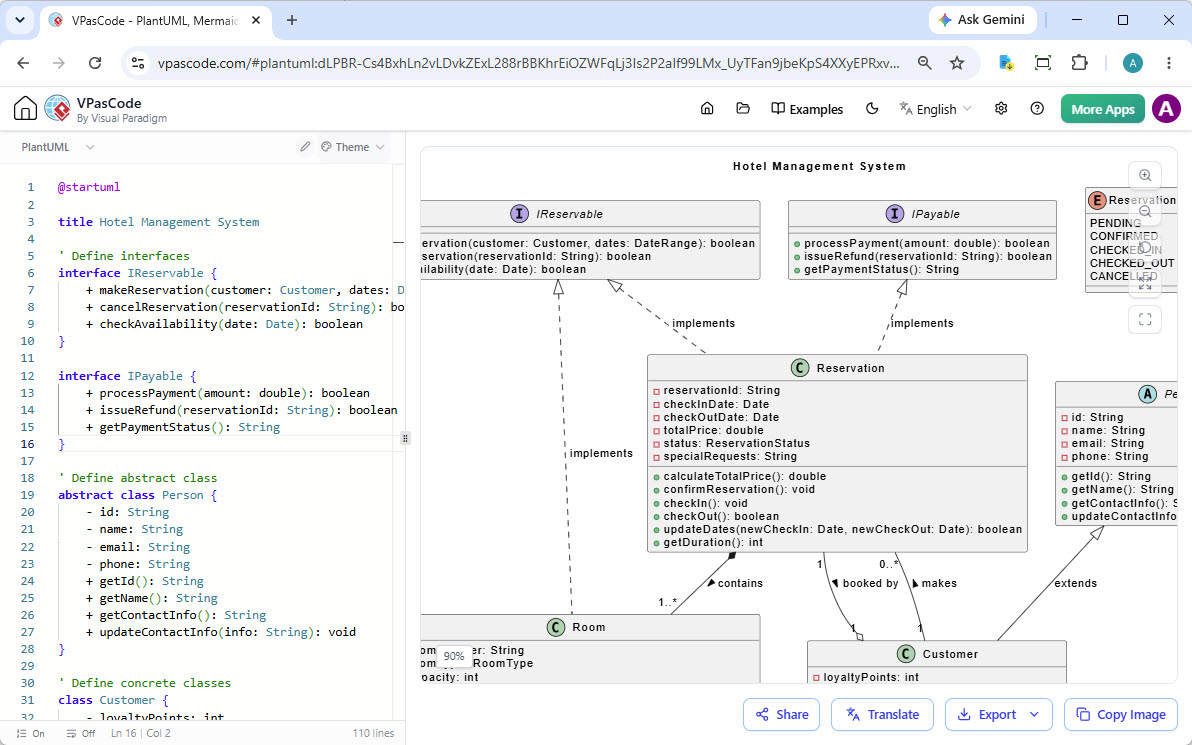
In the modern landscape of software architecture, maintaining visual clarity while managing complex class hierarchies is a significant challenge. VPasCode, the unified “diagram as code” tool from Visual Paradigm, bridges the gap between text-based efficiency and graphical precision. The screenshot provided illustrates a robust PlantUML Class Diagram representing a Hotel Management System.
This tutorial deconstructs the architecture shown in the interface, guiding you through the specific modeling elements, from defining abstract parent classes to implementing complex interface contracts.
1. The Architecture: Interfaces and Contracts
Before defining specific entities like a “Customer” or a “Room,” a well-structured system defines the behavior expected of its components. In the code snippet provided, we see two critical interfaces: IReservable and IPayable.
These interfaces act as blueprints. The IReservable interface ensures that any class implementing it possesses the capability to handle reservation logic (making, canceling, and checking availability). Similarly, IPayable enforces financial standards like processing payments and issuing refunds.
@startuml
title Hotel Management System

' Define interfaces
interface IReservable {
    + makeReservation(customer: Customer, dates: DateRange): boolean
    + cancelReservation(reservationId: String): boolean
    + checkAvailability(date: Date): boolean
}

interface IPayable {
    + processPayment(amount: double): boolean
    + issueRefund(reservationId: String): boolean
    + getPaymentStatus(): String
}
2. The Power of Abstraction: The Person Class
One of the most common pitfalls in object-oriented design is creating redundant code for shared attributes. The diagram utilizes an abstract class named Person. This is a crucial modeling decision.
In the visual output, Person is marked with an “A” (for Abstract), indicating it cannot be instantiated directly. Instead, it serves as a parent class. Any specific type of person—such as a Customer or a Staff member—will “extend” this class, automatically inheriting common properties like id, name, email, and phone.
' Define abstract class
abstract class Person {
    - id: String
    - name: String
    - email: String
    - phone: String
    + getId(): String
    + getName(): String
    + getContactInfo(): String
    + updateContactInfo(info: String): void
}
3. Concrete Entities and Relationships
The core of the system lies in the concrete classes. The diagram prominently features Reservation, Room, and Customer.
- Reservation: This class is the central hub. It contains attributes for
reservationId,checkInDate, andstatus. Notice the methodscheckIn()andcheckOut(), which likely transition thestatusattribute. - Room: A simple entity representing the physical asset, containing attributes like
roomNumber,roomType, andcapacity. - Customer: The concrete implementation of the
Personabstract class, adding specific attributes likeloyaltyPoints.
4. Visualizing Relationships: Implementation and Association
The true power of this diagram lies in the arrows connecting these boxes. VPasCode renders these relationships clearly:
Interface Implementation (The “Dashed” Arrow)
Observe the dashed arrows pointing from the Reservation class to IReservable and IPayable. In UML, this signifies an implementation relationship. The Reservation class must provide the code logic for every method defined in these interfaces.
Association and Composition
The solid lines represent relationships between concrete objects:
- Contains: The relationship between
ReservationandRoomsuggests that a reservation is tied to a specific room. - Booked By: The relationship between
ReservationandCustomerindicates ownership. The “1” and “0..*” cardinality markers (visible near the lines) define the multiplicity: one reservation is made by one customer (or potentially zero), while a customer can make many reservations.
' Relationship Example
Reservation "1" -- "0..*" Customer : makes
Reservation "1" -- "1" Room : contains
5. Dynamic Status States
The screenshot also reveals a pop-up menu on the right side labeled E Reservation, showing statuses like PENDING, CONFIRMED, CHECKEDIN, CHECKEDOUT, and CANCELLED.
While the static class diagram defines the structure, this pop-up hints at a state machine concept. In a full system design, you might define a ReservationStatus enumeration or a State Diagram to manage how a reservation transitions from Pending to Confirmed once payment is processed.
Conclusion
The Hotel Management System diagram in VPasCode demonstrates how “diagram as code” tools allow developers to model complex inheritance hierarchies and interface contracts with precision. By defining the abstract Person class and enforcing the IReservable and IPayable contracts, the system ensures a high degree of modularity and maintainability.