


Designing a database is akin to architecting a building. If the foundation is weak, the structure cannot support the weight of the applications built upon it. At the heart of this foundation lies the Entity Relationship Diagram (ERD). This visual blueprint defines how data connects, interacts, and remains consistent throughout its lifecycle. A well-constructed ERD prevents data redundancy, ensures integrity, and clarifies complex business logic for developers and stakeholders alike.
This guide delves deep into the anatomy of a robust ERD. We will move beyond basic shapes and lines to explore the specific components that create a reliable schema. From the precise definition of an entity to the nuanced rules of cardinality, every element plays a critical role. By understanding these mechanics, you can create data models that scale and adapt without collapsing under pressure.
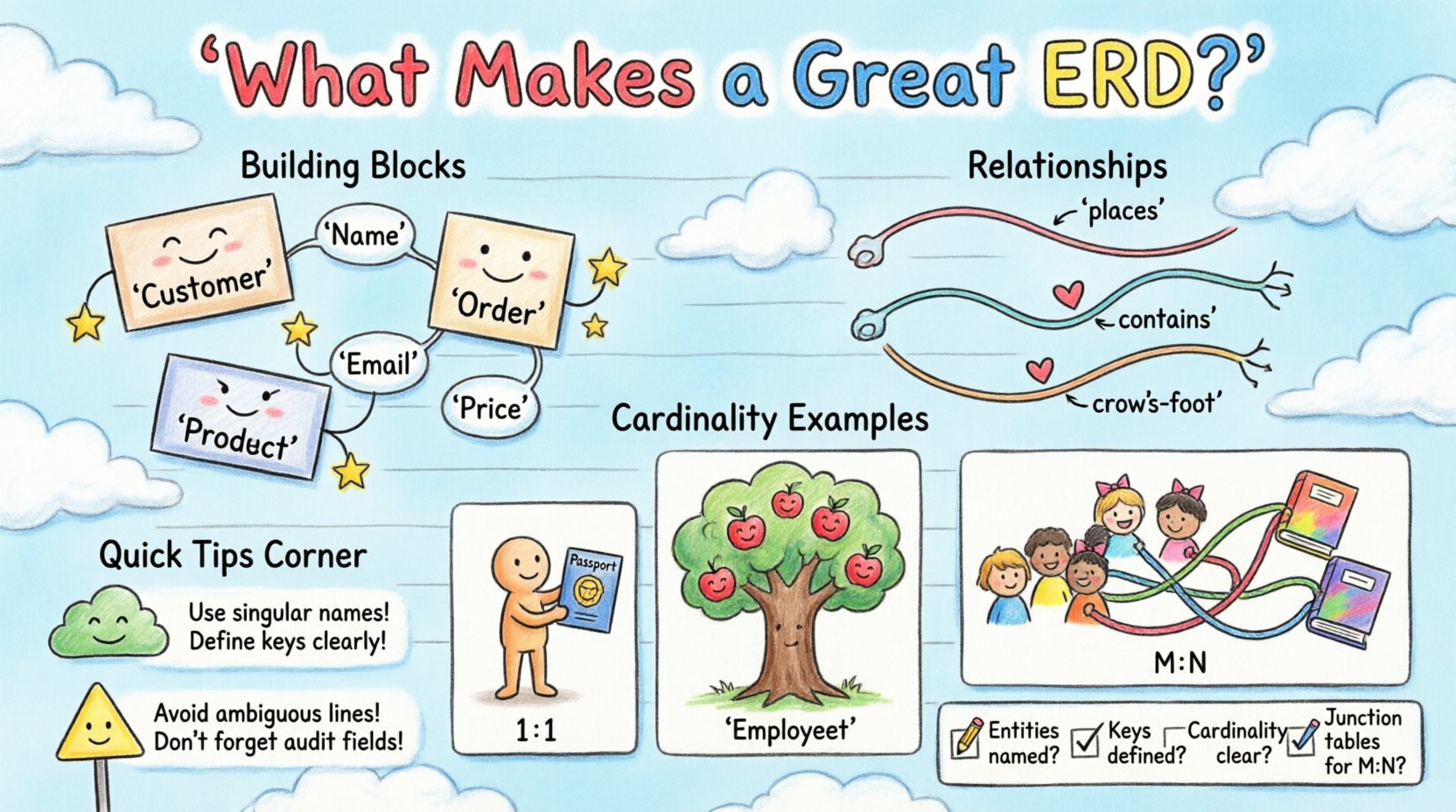
Understanding the Core Components 🧱
An Entity Relationship Diagram is not merely a drawing; it is a logical representation of data structures. To build one effectively, you must identify and define its fundamental building blocks. Each component serves a specific function within the broader schema.
- Entities: These represent real-world objects or concepts about which data is stored. In a retail context, examples include Customers, Orders, and Products. Entities are typically depicted as rectangles.
- Attributes: These are the specific properties or characteristics of an entity. For a Customer entity, attributes might include Name, Email, and Phone Number. Attributes are usually shown as ovals or listed within the entity box.
- Relationships: These define how entities interact with one another. A Customer places an Order. This interaction is a relationship. Relationships are represented by lines or diamonds connecting entities.
- Keys: Unique identifiers that distinguish records. Primary keys ensure uniqueness, while foreign keys establish links between tables.
When these components are aligned correctly, the resulting diagram provides a clear map of the information architecture. Ambiguity in any of these areas can lead to significant issues during implementation.
Defining Entities with Precision 🔍
Entities are the nouns of your database language. However, not every noun deserves to be an entity. A robust design requires rigorous scrutiny of what constitutes an entity versus an attribute.
Identifying the Right Scope
Deciding whether something is an entity often depends on the business rules and data needs. If an object requires its own set of attributes and relationships distinct from another, it should likely stand as a separate entity. Consider the following criteria:
- Independence: Does the object exist without the context of another object?
- Attributes: Does it have multiple properties that need to be stored?
- Relationships: Does it relate to other objects in a way that needs tracking?
For instance, in a library system, a Book is an entity. It has a title, ISBN, and author. An ISBN is an attribute. However, if the library tracks the history of editions separately, an Edition might become its own entity to manage specific metadata like publication year and binding type.
Naming Conventions
Consistency in naming is vital for long-term maintenance. Use singular nouns for entities to avoid confusion. For example, use Customer rather than Customers. This aligns with the logical expectation that a table holds many records of a single type, not multiple types.
- Clarity: Names should be self-explanatory.
- Consistency: Avoid mixing singular and plural forms.
- Uniqueness: Ensure no two entities share the same name.
Attributes and Data Integrity 📝
Attributes define the content within the entities. They determine the granularity of the data and influence query performance. A robust ERD distinguishes between different types of attributes to ensure the schema supports various data operations.
Primary Keys
The primary key is the unique identifier for a record. It must be unique and not null. Choosing the right primary key is a strategic decision.
- Surrogate Keys: System-generated values (like integers) that have no business meaning. They are stable and efficient for joining tables.
- Natural Keys: Real-world identifiers (like a Social Security Number or Email). These are meaningful but can change or be complex.
Foreign Keys
Foreign keys create the links between entities. They reference the primary key of another table. This mechanism enforces referential integrity, ensuring that a relationship cannot exist if the referenced record does not exist.
- Cascading Rules: Define what happens when a parent record is deleted. Should related records be deleted, updated, or nullified?
- Nullability: Determine if a relationship is mandatory. If an Order must have a Customer, the foreign key cannot be null.
Derived Attributes
Sometimes, data can be calculated from other attributes. For example, Age can be derived from Date of Birth. Storing derived attributes can save computation time but risks data inconsistency if the source changes. Careful consideration is required when deciding to store these values.
Relationships and Cardinality 🔗
Relationships are the connective tissue of the diagram. They describe the business logic that binds entities together. The most critical aspect of relationships is cardinality, which defines the quantity of instances involved in a relationship.
Cardinality determines the constraints on the data. Incorrect cardinality can lead to orphaned records or impossible data structures. There are three primary types of cardinality to understand.
| Cardinality Type | Description | Example |
|---|---|---|
| One-to-One (1:1) | A single instance of Entity A relates to a single instance of Entity B. | A Person and a Passport. |
| One-to-Many (1:M) | A single instance of Entity A relates to multiple instances of Entity B. | A Department and Employees. |
| Many-to-Many (M:N) | Multiple instances of Entity A relate to multiple instances of Entity B. | Students and Courses. |
Implementing Many-to-Many
In relational database theory, a Many-to-Many relationship is implemented via an associative entity (often called a junction or bridge table). This intermediate table breaks the direct relationship into two One-to-Many relationships.
- Structure: The junction table contains the primary keys of both related entities as foreign keys.
- Attributes: This table can also store specific attributes about the relationship itself, such as the date a student enrolled in a course.
Notation Styles and Visual Standards 📐
While the logic remains the same, the visual representation varies. Different notations are used across the industry to convey the same structural information. Understanding these styles ensures that diagrams are readable by all team members.
Crow’s Foot Notation
This style uses symbols at the ends of lines to denote cardinality. A single line represents one, while a crow’s foot (three branching lines) represents many. It is widely adopted due to its clarity.
Chen Notation
This older style uses diamonds to represent relationships and ovals for attributes. While visually distinct, it is less common in modern physical modeling but still useful for conceptual diagrams.
UML Class Diagrams
Unified Modeling Language diagrams offer a more generalized approach. They include visibility modifiers and method signatures, which are useful for object-oriented design but can add complexity to pure data modeling.
Choosing a Standard
Consistency is more important than the specific choice. Select a notation that your team understands and stick to it. Mixing styles within a single diagram can cause confusion and errors during implementation.
Normalization and Data Integrity 🛡️
A robust ERD supports normalization. This process organizes data to reduce redundancy and improve integrity. While the ERD is a logical model, it should be designed with normalization rules in mind.
- First Normal Form (1NF): Ensure atomic values. Each column should contain a single value, not a list.
- Second Normal Form (2NF): Remove partial dependencies. All non-key attributes must depend on the entire primary key.
- Third Normal Form (3NF): Remove transitive dependencies. Non-key attributes should not depend on other non-key attributes.
Violating these principles in the design phase often leads to anomalies during data updates. For example, if an address is stored in a customer table and the customer moves, updating that address in one place might leave stale data elsewhere if not properly normalized.
Common Pitfalls to Avoid ⚠️
Even experienced designers can make mistakes. Recognizing common errors helps in refining the model before it becomes code.
Over-Engineering
Designing for every possible future scenario can make the schema overly complex. Focus on current requirements while leaving room for expansion. Adding tables for hypothetical features adds maintenance overhead without immediate value.
Ambiguous Relationships
Ensure that every line in the diagram has a clear meaning. A line between two entities must have a defined direction and type. If a relationship can be interpreted in multiple ways, the logic is flawed.
Ignoring Constraints
Constraints like unique values or not-null requirements must be explicitly defined. If these are only enforced at the application level, data integrity is at risk. The database should enforce these rules.
Missing Attributes
It is easy to forget less obvious attributes. Consider audit fields like Created At, Updated At, and Deleted At. These are essential for tracking changes and managing soft deletes.
Maintenance and Version Control 🔄
An ERD is not a one-time task. As business requirements evolve, the data model must adapt. A robust diagram includes mechanisms for tracking changes.
- Versioning: Maintain a history of diagram revisions. This helps in understanding why certain decisions were made.
- Documentation: Add comments or metadata to explain complex relationships or business rules that are not obvious from the visual structure.
- Review Cycles: Schedule regular reviews of the schema with stakeholders to ensure it still aligns with business goals.
Checklist for a Robust ERD ✅
Before finalizing your design, run through this checklist to ensure completeness and accuracy.
| Checklist Item | Status |
|---|---|
| Are all entities named consistently (singular)? | ☐ |
| Are primary keys clearly defined for every entity? | ☐ |
| Are all foreign keys referencing valid parent entities? | ☐ |
| Is cardinality explicitly defined for all relationships? | ☐ |
| Are there any many-to-many relationships converted to junction tables? | ☐ |
| Have audit fields been added where necessary? | ☐ |
| Is the diagram free of circular dependencies? | ☐ |
| Are naming conventions consistent across all attributes? | ☐ |
Final Thoughts on Data Architecture 🏁
Building a robust Entity Relationship Diagram requires attention to detail and a deep understanding of data relationships. It is a balance between theoretical purity and practical application. By focusing on clear entities, precise attributes, and well-defined relationships, you create a foundation that supports growth and stability.
Remember that the goal is not just to draw lines and boxes, but to model reality accurately. A good diagram communicates complex logic simply. It serves as the single source of truth for the database team, application developers, and business analysts.
Invest time in the design phase. The effort spent refining the ERD now saves countless hours of debugging and refactoring later. Data modeling is a skill that improves with practice and rigorous review.